These photos of 90s Japan follow the decade street by street, from gyaru and Gothic Lolita looks on Takeshita Street to tuned Skylines at night car meets. The Nikkei peaked on 29 December 1989 and the bubble economy unwound through the early 1990s, yet Tokyo’s youth culture grew louder as the money ran out.
Each image below comes with the story behind it, including the two events of 1995 that changed the country: the Kobe earthquake and the Tokyo subway sarin attack.
90s Japan in Photos, Section by Section
JDM culture in Japan

In the 90s, Japanese Domestic Market (JDM) culture became an exciting movement focused on the appreciation and modification of Japanese cars. “JDM Cars” specifically refers to vehicles and products made for sale within Japan, manufactured to meet unique regulations and consumer preferences distinct to the Japanese market. Japanese streets and car meets became a hub for enthusiasts.
Brands like Nissan, Honda, Toyota, and Mazda released vehicles that not only appealed to local consumers but also captured the attention of car enthusiasts around the world.
One of the key aspects of JDM culture in the 90s was the rise of street racing and car modification. Enthusiasts would customise their cars with performance upgrades, flashy body kits, and unique paint jobs. Car meets and events were set up so that drivers could flaunt their modified vehicles and compete in races. The Nissan Skyline GT-R, Honda Civic Type R, and Mazda RX-7 became symbols of this era, renowned for their performance and tuning potential.
Tuned Japanese cars also starred in The Fast and the Furious (2001), and The Fast and the Furious: Tokyo Drift (2006), set on the streets of Tokyo, brought JDM culture into the world spotlight, showcasing the thrilling world of Japanese cars and street racing to a global audience.


Throwback to Gyaru Style Unleashed

Bold and audacious, the Gyaru style shook the 90s fashion world with its eye-catching outfits, statement nails, and iconic makeup. Gyaru wasn’t just a look; it was an attitude, a rebellious and vibrant approach to femininity that challenged traditional Japanese ideals.
With their daring colourful gyaru outfits and accessories, Gyaru girls pushed the boundaries of fashion norms. They adorned themselves with unique gyaru makeup, featuring dramatic eye makeup, tanned skin, and colourful lips, celebrating individuality. Gyaru hairstyles, like big, voluminous curls and bold colours, added to their distinctive presence. Every street in Japan became a runway.
The gyaru nails were also a key feature, with elaborate designs that showcased creativity and flair, often featuring charms, colours, and intricate art. As Gyaru girls painted the town with fearless hues of self-expression, they created a movement that resonated with many and influenced the landscape of 90s Japanese youth culture.
Gothic Lolita’s Mysterious Charm

In the heart of 90s Japan, Gothic Lolita fashion introduced a world where elegance met dark fantasy. Cloaked in lace, ruffles, and intricate designs, lolita enthusiasts embraced a style that blended Victorian charm with a Japanese twist.
With parasols, elaborate dresses, and a touch of mystery, this look transcended fashion to become a lifestyle. Each Lolita outfit was a story, meticulously styled to capture the wearer’s individuality. Gothic Lolita became a unique blend of beauty and boldness that left an unforgettable mark on the fashion scene.
Kawaii: The Heart of Japanese Cute Culture

Kawaii, meaning “cute,” became a defining aesthetic in 90s Japan, influencing everything from fashion to lifestyle.
The Kawaii movement was popularised by the rise of characters like Hello Kitty, which captured the hearts of both children and adults with its adorable design. By the 1980s and 90s, these characters became symbols of cuteness and innocence, influencing fashion and lifestyle choices. Fashion magazines like Fruits, celebrated kawaii’s playfulness, photographing fashionistas on the streets of Harajuku with pastel colours, oversized accessories, and a touch of innocence.
Unsurprisingly, the kawaii movement extended beyond fashion to influence various aspects of pop culture, including music, art, and even lifestyle choices. As it gained popularity, kawaii became a form of resistance against the more serious and conformist aspects of Japanese society.


The Streetwear of Harajuku

In the 90s, Japanese streetwear, particularly in the Harajuku district of Tokyo, flourished as a vibrant expression of youth culture and individuality. Harajuku became known as a fashion hub, where diverse styles mixed and mingled, reflecting both traditional Japanese aesthetics and Western influences.
Streetwear in Harajuku was marked by its bold colours, eclectic patterns, and a mix of high fashion and everyday wear. Brands like A Bathing Ape (BAPE) and Comme des Garçons became popular and influenced global fashion trends. Other brands like Hysteric Glamour and Tsumori Chisato also shaped the streetwear aesthetic.
Yoyogi Park and Takeshita Street were filled with colour and creativity. Young people experimented with bold patterns, oversized accessories, and unique hairstyles, capturing the 90s spirit.
Kobe Earthquake of 1995

In January 1995, the Hanshin-Awaji earthquake struck, forever changing the lives of those in Kobe. With a magnitude of 7.3, it not only devastated Kobe but also surrounding areas in Hyogo Prefecture, leading to 6,434 deaths.
More than 100,000 buildings were destroyed and 300,000 people were displaced from their homes, the disaster shook Japan to its core. The disaster led to a reevaluation of Japan’s infrastructure and emergency response systems, prompting the government to enhance disaster preparedness and response strategies.
In the aftermath, people showed remarkable resilience. Relief efforts poured in from across the country and internationally, showcasing a spirit of solidarity.
Memorials, like the Port of Kobe Earthquake Memorial Park, serve as powerful reminders of both the tragedy and the strength that followed, cementing the earthquake’s place in Japan’s collective memory.
Takeshita Street in Harajuku

A stroll down Takeshita Street in the 90s was a sensory overload of colour, style, and creativity. This iconic Harajuku location drew people from around the world, eager to experience its thrift shops, quirky boutiques, and cutting-edge fashion. Takeshita was a crossroads for fashion and culture, with every corner offering something new to explore. The vibe was electric, and anyone who visited knew they were part of a moment. Harajuku’s Takeshita Street defined fashion for a generation and inspired countless trends beyond Japan.
Bosozoku: The Rebellious Biker Spirit

Bosozoku, which means “violent running,” refers to a subculture of motorcycle gangs that emerged in Japan in the 1950s. Membership peaked in 1982 at more than 42,000, so by the 1990s the scene was already past its height.
Bosozoku, Japan’s notorious biker gang culture, combined fierce, unique bikes with unique fashion statements. They influenced fashion, music, and even the way young people customised their vehicles. Members often donned a bold look with bright colours and intricate designs on their bikes, along with military-style uniforms that featured kanji characters.
Bosozoku culture even appeared in popular media, where they were often portrayed as cool anti-heroes in movies, anime, and manga. Their way of life fostered a sense of community and brotherhood, appealing to many young people who felt left out in a rapidly changing world.
Police pressure on Bosozoku grew over concerns about public safety and the disruptive nature of their gatherings, and a 2004 revision of the road traffic law brought the biggest crackdown. This increased scrutiny led to a decline in traditional Bosozoku gangs, with many former members shifting to car culture or other subcultures, transforming the original Bosozoku identity.
Nightlife in 90s Shibuya and Roppongi

Tokyo’s nightlife in the 90s was electric, a neon-lit world where anything seemed possible. Bars, nightclubs, and live music venues pulsated with energy, drawing crowds from all over the city.
From Shibuya to Roppongi, Tokyo’s nightlife scene thrived with diversity, offering spaces for every kind of reveller. The night became a playground where strangers became friends, and the bustling metropolis of Tokyo came alive in a spectacular display of lights, sounds, and unforgettable memories.
The Demanding World of Japanese Work Culture

The 90s in Japan was an era defined by “salaryman” culture, where long hours and dedication became symbols of pride and commitment. Work was intense, and the pressures were high, yet Japanese employees’ sense of duty and resilience shone through.
In Japan, the term “salaryman” refers to a typical white-collar worker who spends long hours in the office, often for the same company throughout his career.
Though demanding, Japanese work culture also fostered camaraderie among colleagues. The rigorous pace and loyalty seen in the offices and factories laid the foundation for Japan’s reputation for quality and commitment, embodying the country’s work ethic.
River Phoenix’s Visit to Japan, 1991

When River Phoenix visited Japan in June 1991 to promote My Own Private Idaho, fans eagerly welcomed the American heartthrob. His charisma and genuine personality made him an unforgettable figure, not just in Hollywood but globally.
Phoenix’s visit to Japan showcased the mutual admiration between Japanese fans and international stars. His time in Japan was a cherished moment, adding to his legacy as a compassionate artist who connected deeply with people across the world.
The Lens of Hiromix

Hiromix (Hiromi Toshikawa, born 1976) is a renowned Japanese photographer and artist best known for her work in the 1990s that explored themes of youth, sexuality, and urban life. She gained prominence as one of the leading figures in the “shōjo” (girl) photography movement, which focused on capturing the experiences and emotions of young women in contemporary Japan.
Through her camera, Hiromix captured the spirit of Japanese youth in the 90s like no one else. Her photography gave a raw, intimate look into teenage life, capturing moments of friendship, exploration, and self-discovery. Her images were snapshots of real life, unfiltered and deeply personal, resonating with a generation of Japanese youth who saw themselves in her work.
To truly appreciate Hiromix’s artistic vision, look for her 1996 photobook Girls Blue. She had won Canon’s New Cosmos of Photography prize in 1995, and she shared the 26th Kimura Ihei Award, the prize for 2000, with Yurie Nagashima and Mika Ninagawa. Her pictures capture the 1990s as young people lived them, which makes the book a good place to start for anyone interested in photos of Japan in that decade.
The Tokyo Subway Sarin Attack, 1995

The Tokyo Subway Sarin Attack on 20 March 1995, stands as one of the most shocking acts of terrorism in Japan’s history. Orchestrated by the doomsday cult Aum Shinrikyo, this heinous act involved releasing sarin gas during the busy morning rush hour in the Tokyo subway system. The attack caused the deaths of 14 people (the official toll was revised from 13 in 2020) and left over 5,000 others injured, exposing serious flaws in Japan’s public safety measures.
Founded in the 1980s by Shoko Asahara, Aum Shinrikyo began as a yoga and meditation group that blended elements of Buddhism, Hinduism, and Christianity. However, it quickly transformed into a much more sinister organisation that promised enlightenment and salvation to its followers. The cult preached an impending apocalypse and claimed that only its members could be saved. Asahara presented himself as the reincarnation of the Buddha, using his charismatic leadership to attract many, particularly those who felt lost or disillusioned.
On that fateful morning, cult members carried plastic bags filled with liquid sarin onto several subway trains. They punctured these bags, allowing the deadly gas to spread through the crowded cars, causing chaos as commuters struggled to breathe. Emergency services were quickly overwhelmed by the high number of victims needing assistance.
Despite the horror of that day, Tokyo’s resilience shone through as the city rallied to heal and protect its citizens.
The Voices of Sailor Moon

Sailor Moon is a popular manga created by Naoko Takeuchi that started in 1991 and became a huge hit in Japan and around the world during the 90s. The story follows Usagi Tsukino, a teenage girl who transforms into Sailor Moon to fight against evil forces and protect the universe. The mix of magical girl elements, romance, and friendship made it appealing, especially to young girls.
In the 90s, Sailor Moon popularised the magical girl genre. The anime aired in 1992 and quickly became a hit. Its success brought a surge of merchandise that became key to Japanese pop culture.
Talented voice actresses brought Sailor Moon and her friends to life. Their performances captivated audiences and made them famous. Each actress added a unique mix of charm and strength to her character, creating beloved heroes. Fans connected deeply with these characters. Many voice actresses expanded into music and acting, boosting their status in the entertainment industry.
Sailor Moon became an iconic figure. She was celebrated for her courage and relatable struggles as a teenager facing friendships, love, and responsibility.
J-Pop’s Rise in the 90s

You can’t mention Japan in the 90s without talking about J-Pop. J-Pop (Japanese Pop Music) took off in the 90s, bringing catchy beats, vibrant personalities, and memorable music to Japan’s youth culture.
This genre blended pop, rock, electronic, and even traditional Japanese music, creating a sound that reflected the energy of the times. J-Pop eventually came to include almost all Japanese popular music, apart from traditional styles like enka.
A key feature of J-Pop was its “idol” culture. Stars like Namie Amuro, SPEED, and Chisato Moritaka rose to fame, with fans closely following every release and event. These idols did more than make music; they created a movement, fostering a connection with fans that influenced fashion, lifestyle, and even language.
In popular areas like Shibuya and Harajuku, the sounds of J-Pop icons filled the airwaves, turning the genre into a cultural phenomenon that went beyond music, shaping trends and defining an era in Japan.
Retro Japanese Arcades

Japanese arcades in the 90s were a paradise for gamers, with flashing lights, buzzing sounds, and endless rows of machines. These arcades weren’t just places to play; they were social hubs where friends gathered, cheered, and competed.
Today, arcades such as GiGO Akihabara Building 3 bring the nostalgic experience back to life with RETRO:G, a floor given over to classic arcade machines, complete with the original music and sounds that fans remember.
Fuji Television Building: Kenzo Tange’s Vision

The futuristic Fuji Television building, designed by Kenzo Tange, was a marvel at the time that captured the innovation of avant garde Japanese architecture.
Its unique geometric design stood as a beacon of futurism, a concrete-and-steel representation of the country’s tech-driven aspirations. Kenzo Tange’s gem became more than a landmark; it was a symbol of Japan’s forward-thinking spirit.
The Fuji Television Building is composed of large, interlocking cubes and wide glass walls. Dominated by the impressive glass sphere called the “Hachitama” or “Eight Ball,” it serves as an observation deck with incredible views of Tokyo. The building’s exposed beams and open frames give it a skeletal, almost transparent appearance, enhancing its futuristic, high-tech aesthetic.
The building remains an iconic part of Tokyo’s skyline, bridging the past with a future that Tange envisioned.
Japan’s Bubble Burst: The End of an Era and the Start of the Lost Decade

After World War II, Japan rose from the devastation of the war to become one of the world’s strongest economies, a period called the “Economic Miracle.” Japan focused on rebuilding and became a leader in car manufacturing, electronics, and global culture. It soon became the world’s second-largest economy, behind only the United States. By the 1980s, Japan was an economic powerhouse. Eight out of the ten largest banks in the world were Japanese. The Tokyo Stock Exchange grew to match the size of the New York Stock Exchange. Japan’s influence was so significant that American companies like General Motors, Ford, and Chrysler struggled against the influx of Japanese cars in the U.S. market.
Japan’s economy grew to a remarkable size despite a much smaller population than America’s and almost no natural resources. Books like Japan as Number One became bestsellers, as foreign businesses studied Japan’s success, trying to imitate its techniques. Big cities such as Osaka shared in the boom.
In the 1980s, this wealth brought luxury and global influence to many Japanese. Real estate and stock market prices had been inflated for years, and the Nikkei peaked on 29 December 1989 before falling through 1990. Japan’s Cabinet Office dates the bubble boom from December 1986 to February 1991. The era of easy wealth was over.
What followed was Japan’s “Lost Decade.” Falling prices, a stock market crash and a property slump created a long period of financial struggle. The Nikkei lost more than 60% of its peak value, wiping out personal savings and eroding confidence in an economy that had seemed unbreakable.
Why Japan Still Feels Stuck in the 90s: Fax Machines and CDs
Visitors often come home asking why Japan seems stuck in the 1990s. Part of the answer is that several habits from the decade never went away, and you can still see them in the official figures and in a few buildings you can walk into today.
CDs, Vinyl and Tower Records Shibuya
In 2024 Japan’s record companies produced 205.2 billion yen of physical music (CDs, vinyl and music videos) against 123.3 billion yen of digital sales, according to the Recording Industry Association of Japan. That puts physical formats at about 62% of the 328.5 billion yen total (205.2 divided by 328.5). CDs alone came to 140.2 billion yen, vinyl reached 7.9 billion yen, its highest value since 1989, and 85,000 cassettes were still produced.
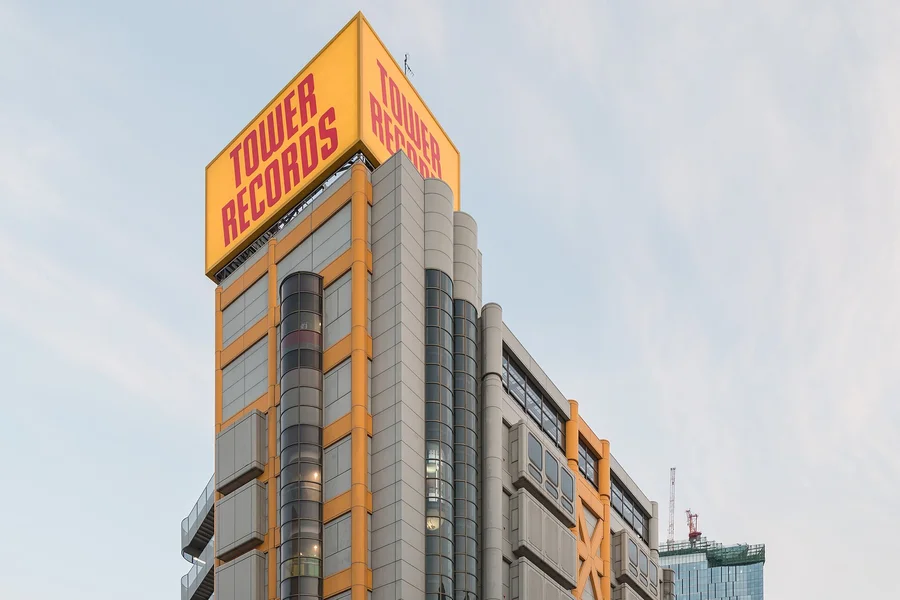
The clearest place to see it is Tower Records Shibuya, which opened in March 1995 and still fills a whole building near Shibuya Station. Tower Records Japan renovated five of its floors for a grand reopening on 28 February 2026, with the TOWER VINYL floor holding more than 100,000 titles. For smaller second hand shops, the record shops in Koenji, Tokyo’s vintage and live music neighbourhood, west of Shinjuku, are worth the trip.
Fax Machines and the War on Floppy Disks
In 2025, 23.5% of Japanese households still had a fax machine, down from 26.9% in 2023, according to the Ministry of Internal Affairs and Communications’ Communications Usage Trend Survey. Government offices held on even longer. In June 2024 the Digital Agency finished scrapping all but one of 1,034 regulations that required floppy disks, and digital minister Taro Kono declared: “We have won the war on floppy disks on June 28!”
Printed Newspapers
Japan’s newspapers still had a combined circulation of 24.87 million copies in 2025, or 0.42 copies per household, according to the Japan Newspaper Association. That is down from 35.09 million in 2019. Japan’s younger generation is taking a different route back to the decade: the fashion, gadgets and photo booths of the 90s and 2000s are now a trend of their own, which our guide to Heisei retro and Juminocore explains.
90s Japanese Style in Tokyo Today: JDM Cars, Harajuku and Retro Arcades
Even today, the legacy of 90s Japan continues to influence every corner of Japanese culture, from fashion and technology to art and social trends. The era’s vibrant individuality is reflected in the popularity of JDM cars. Unrestrained creativity is evident in Harajuku fashion, Jpop, and retro video games.
The decade’s spirit still lives on, shaping how Japan presents itself to the world and how it embraces both change and tradition. As we look back, the 90s remind us that the power of self-expression and cultural pride can leave a mark that lasts through generations, resonating in the hearts of both locals and admirers worldwide.