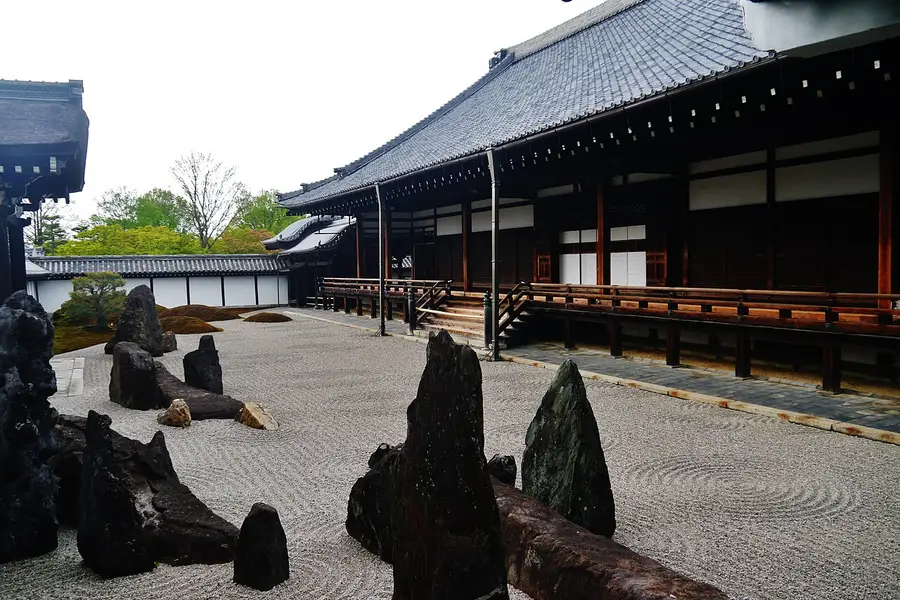
Karesansui (枯山水) is the Japanese dry landscape garden. Stones, gravel and often moss stand in for mountains, islands and water, and no real water is used at all. The word means “dry mountain water”. In English these gardens are usually called Zen gardens or Japanese rock gardens, and the most famous of them sit in front of the abbots’ halls of Kyoto’s Zen temples.
A dry garden is made to be looked at from one place, usually a wooden veranda, and nobody walks in it except the person who rakes it. Below is where the style came from, how to read the stones and the raked gravel, seven Kyoto gardens worth crossing the city for, and where to see one in Britain.
How a Karesansui Zen Garden Turns Stone into Water
What karesansui meant in an 11th century garden manual
The word is older than the gardens it now describes. It first appears in the Sakuteiki, a garden-making manual written in Japan in the 11th century for the pond gardens of Heian period aristocrats. There, karesansui meant something small: an arrangement of stones in a part of the garden with no pond or stream beside it, according to the Nara National Research Institute for Cultural Properties (Japanese Garden Dictionary).
So for several centuries a dry stone setting was one feature inside a larger garden full of water. Only later did the idea grow into whole gardens built with no water at all.
The English name came much later still. The garden historian Wybe Kuitert traces “Zen garden” to Loraine Kuck’s book One Hundred Kyoto Gardens, published in 1935. The Japanese equivalent did not appear in print until 1958. The label stuck, although dry gardens are also found at Shinto shrines and private houses. Shigemori Mirei, who designed the Tōfuku-ji gardens described below, made his last gardens for a shrine.


The Muromachi period and the riverbank gardeners
The dry garden as a complete garden appeared in the Muromachi period, roughly the 14th to 16th centuries, when the Ashikaga shoguns ruled from Kyoto. Zen Buddhism had arrived from China a century or two earlier, and its temples became the main patrons of the new style. Daisen-in and Ryoanji, both in Kyoto, are the best-known gardens surviving from this time.
Earlier Zen gardens already used dry stone arrangements inside larger landscapes. At Tenryū-ji in Arashiyama, the monk Musō Soseki’s 14th century pond garden includes a dry waterfall, a stack of stones that suggests falling water where none flows.
Much of the building work fell to senzui kawaramono, the “riverbank people who made landscapes”. Kawaramono were a class looked down on in medieval Japan, and some of them became highly skilled garden makers. The best known, Zen’ami, worked for the shogun Ashikaga Yoshimasa and was regarded as the leading garden maker of his day, though his own dates are unknown (Nara National Research Institute for Cultural Properties).
Painters were linked to the gardens too. The artist Sōami, who served the same shoguns, has been credited with several famous gardens, including Ryoanji’s. No document proves any of these attributions. The Edwardian writer Stewart Dick, in Arts and Crafts of Old Japan (1904), saw in Sōami’s gardens the same hand that painted misty landscapes of hills and lakes, and that comparison between a dry garden and an ink landscape painting is still made today. In both, empty space does as much work as the marks.
How to read the stones, the gravel and the moss
A karesansui works by suggestion. A garden maker places a stone and asks you to see a mountain. Gravel is laid around it and becomes the sea. Japanese garden writing calls this mitate, seeing one thing as another, and it runs through the whole tradition.
The stones
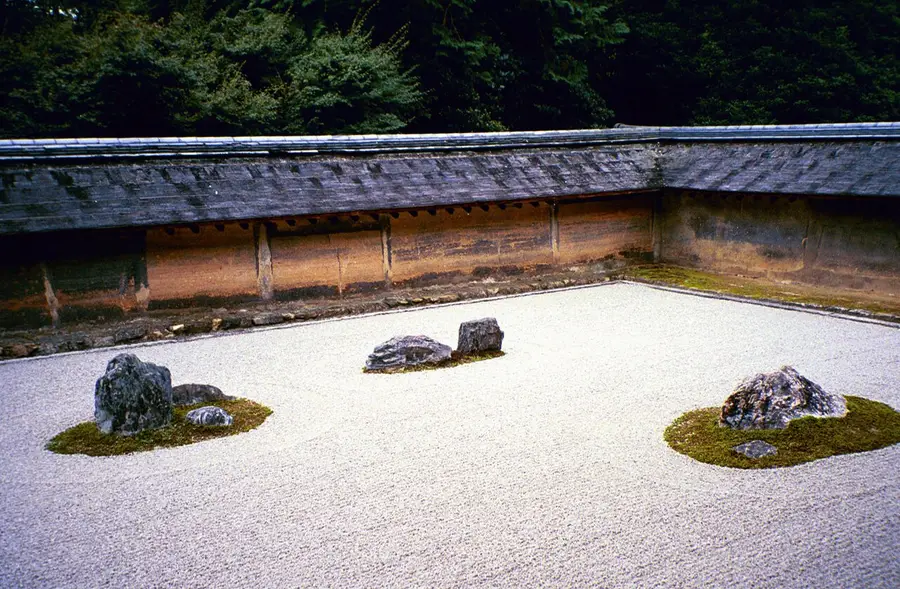
Stones are chosen for shape, colour and texture, and are set in groups more often than alone. A tall upright stone might be a peak or a waterfall. A low flat one might be an island or a bridge. Some layouts carry names that tell you how to read them: Ryoanji’s is known as “the tiger crossing the river with her cubs”, and Nanzen-ji’s garden has the same name. Two very old symbols turn up in gardens all over Japan, a crane island and a turtle island, both wishes for long life.
The gravel and the raking
The gravel is the water. Straight raked lines suggest a calm sea or a broad river. Rings drawn around a stone suggest waves breaking around an island, and wavy lines suggest a current. Kyoto gardens often use Shirakawa sand, a pale crushed granite from the Shirakawa area in the north-east of the city.
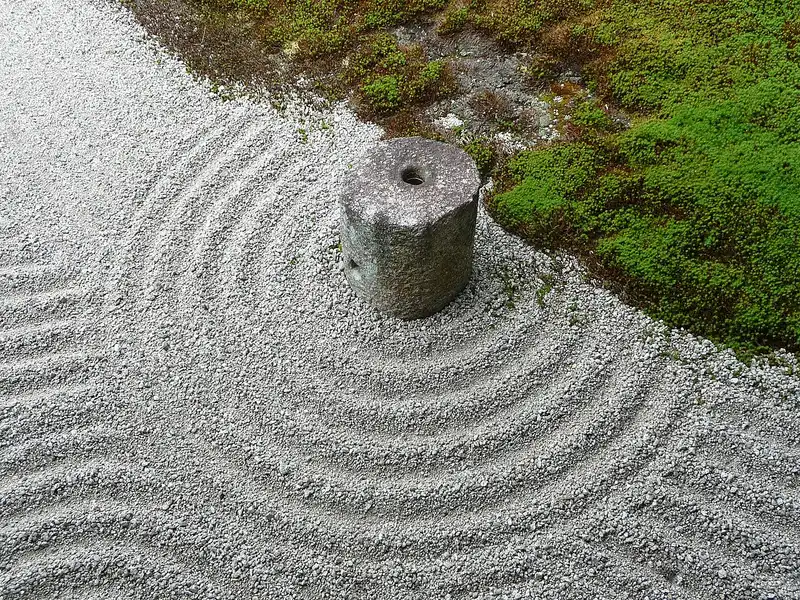
The patterns are why nobody walks across the garden. Florence Du Cane noticed this in The Flowers and Gardens of Japan (1908). She wrote that Japanese gardens used fine sand raked into patterns in place of lawns, and that stepping stones were a necessity because footprints, and the marks of wooden clogs in particular, would destroy the design. A dry garden goes one step further and leaves out the stepping stones altogether.
The moss and the view
Moss softens the edges of stone groups and, at some temples, covers whole sections of ground. It also needs shade and damp, so a dry garden is rarely as dry as its name suggests.
Every dry garden is designed around a main viewing position, usually the veranda of the hall that faces it, so take a seat there and give it a few minutes. Stone groups that look scattered at first glance start to relate to each other the longer you look.
How a dry garden differs from a pond garden, a stroll garden and a tea garden
Japanese gardens come in several broad types, and a karesansui is the only one with no water in it at all. Knowing the others helps you recognise a dry garden when you meet one inside a larger temple.
Pond gardens are the oldest. Heian period nobles built them around a lake with islands, sometimes for boating, and the Sakuteiki was written for gardens like these. Ryoanji’s own Kyoyochi pond, below the rock garden, is a survivor of that older style.
Stroll gardens are made to be walked through. A path leads around a pond, and each turn opens a new view of bridges, lanterns and tea houses. Katsura Imperial Villa, on the western edge of Kyoto, is one of the most celebrated examples. It is designed to be seen on the move, one view after another.
Tea gardens, or roji, are paths of stepping stones, moss and lanterns leading to a tea room. Their job is to leave the outside world behind before the tea ceremony begins.
Dry gardens borrow the islands of the pond garden and the restraint of the tea garden, then take the water away. Many temples have both kinds side by side: a dry garden in front of the abbot’s hall and a pond or moss garden elsewhere in the grounds. Our guide to Japanese Zen gardens covers the wider tradition, including the tea garden path and the stone lore recorded by early Western visitors.








Seven dry gardens to see in Kyoto
These seven gardens show how far the style stretches, from a 15th century temple to a 1939 design that still looks modern.
Ryoanji
Japan’s best-known dry garden: fifteen stones in five groups on 248 square metres of raked white gravel, set inside an earthen wall made of clay and rapeseed oil. The temple says the ground slopes towards one corner and the wall lowers towards its far end, both of which make the garden appear deeper. Nobody knows who designed it. Our Ryoanji guide covers its history, the cloud dragon paintings on show until July 2027, and how to get there. Adults pay ¥600.
Daisen-in, Daitoku-ji
Founded in 1509 by the priest Kogaku Sōkō, this subtemple of Daitoku-ji has a garden that tells a story. Stones and white gravel show water rising in the mountains and flowing on as a river until it reaches the sea. It is a National Historic Site and a Special Place of Scenic Beauty. Entry is ¥500 and opening hours are 9:00 to 16:30. Visitor guides report that photography is not allowed in the garden.
Ryōgen-in, Daitoku-ji
A few minutes’ walk from Daisen-in, this smaller subtemple has several dry gardens. One of them, Tōtekiko, is often called the smallest stone garden in Japan, at about seven square metres. A few stones sit in a tiny patch of raked gravel, and the ripples around them are the whole garden.
Tōfuku-ji
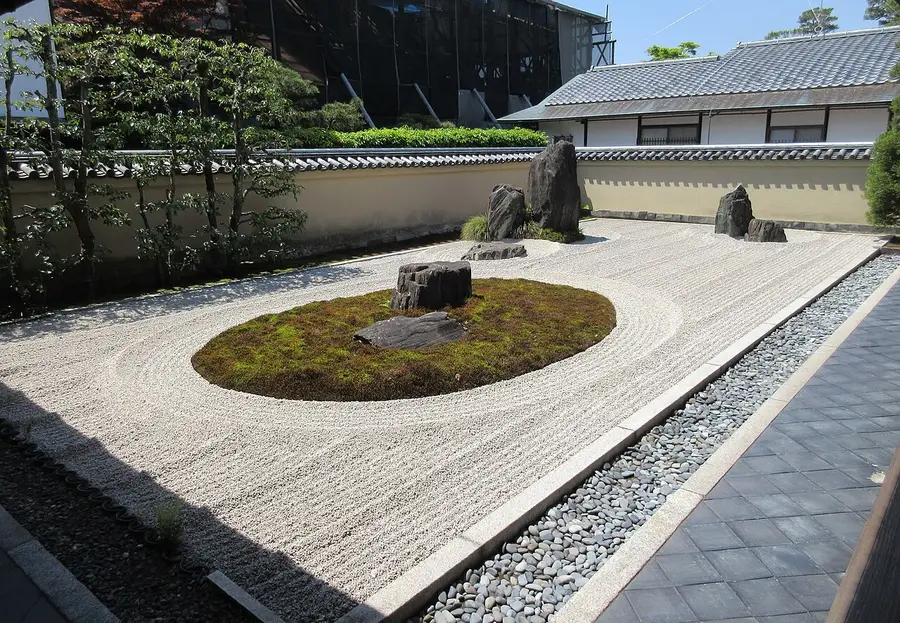
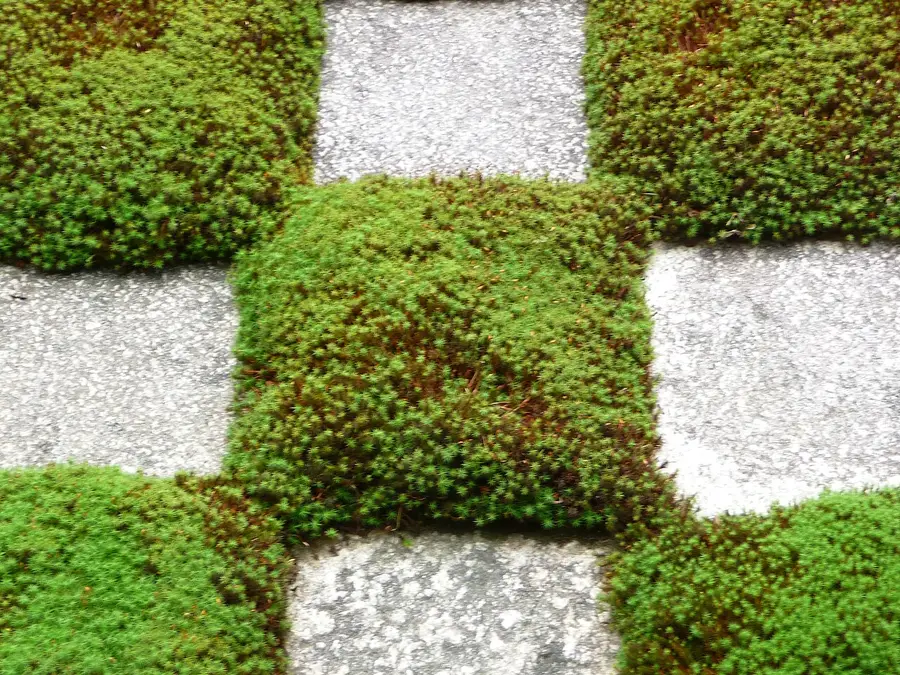
In 1939 the garden designer Shigemori Mirei made new gardens on all four sides of Tōfuku-ji’s abbot’s hall. Together they are called Hassō no Niwa. The south garden has tall rough stones on raked gravel. The north garden is a small chequerboard of moss and square cut stones, reused from the paving of the temple’s imperial gate. In the east garden, short stone pillars are set out in the shape of the Big Dipper (Tōfuku-ji). Entry to the Hōjō gardens is ¥600 from 1 November 2026.
Ginkaku-ji
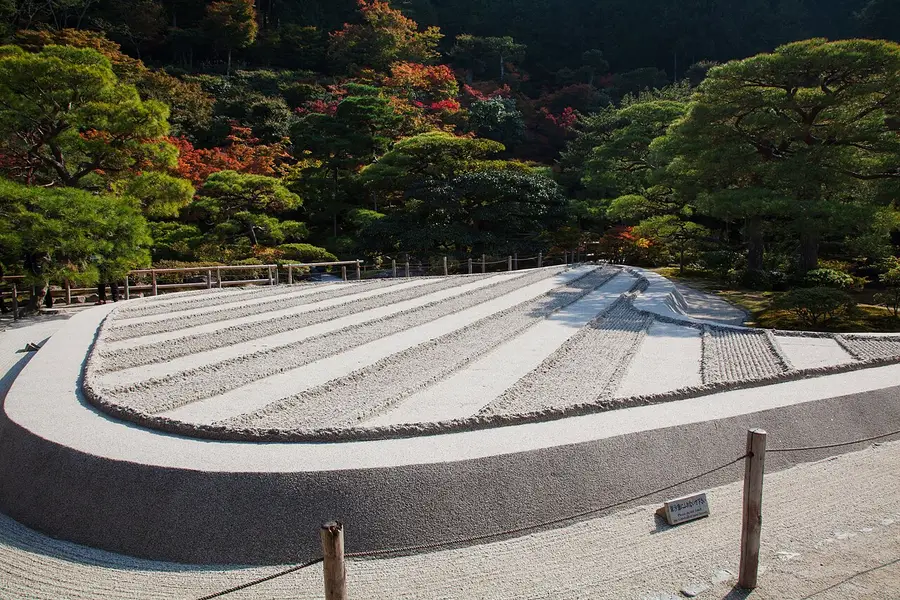
The Silver Pavilion’s garden includes two famous sand forms. The Ginshadan is a broad flat bed of white sand raked into stripes, and the Kōgetsudai beside it is a tall flat-topped cone. They are often said to catch moonlight or to have been made for moon viewing. The temple itself calls those stories folklore, and says neither form can be traced back to the Muromachi period; both probably date from the Edo period or later (Shōkoku-ji, Ginkaku-ji guide). Opening hours are 8:30 to 17:00 from March to November and 9:00 to 16:30 in winter. Our Ginkaku-ji guide covers the rest of the temple.
Nanzen-ji
The dry garden in front of Nanzen-ji’s abbot’s hall is popularly called Tora no Ko Watashi, the tiger cubs crossing, and is traditionally attributed to Kobori Enshū, a tea master and garden designer of the early Edo period. It was designated a Place of Scenic Beauty in 1951 (Nanzen-ji). Nanzen-ji sits at the southern end of the Philosopher’s Path, so it pairs easily with Ginkaku-ji at the northern end.
Kennin-ji
Kyoto’s oldest Zen temple, in the Gion district, has a dry garden called Daiōen in front of its abbot’s hall. Its present layout was made in the early Shōwa period by the gardener Katō Kumakichi and is modelled on the mountain monastery of Baizhang in China (Kennin-ji). It is one of the easiest dry gardens to reach from central Kyoto.
How Western writers and artists read the dry garden
Visitors from Europe and America have been writing about dry gardens for more than a century.
Stewart Dick, writing in 1904, described karesansui as “dried-up water scenery”, in which the bed of a stream or the hollow of a lake was shown dry, as if in a time of drought. He took the gardens literally, as pictures of a landscape after the water had gone. Today the gravel is more often read as the water itself.
Four years later Florence Du Cane described a competition in Kyoto for miniature tray landscapes. She expected the judges to choose a perfect little seascape, accurate down to every ripple. They chose a simpler scene, a river of white sand winding through moss below stone mountains, and condemned the seascape for its very perfection. The same preference for suggestion runs through the full-size dry gardens.
The Italian novelist Italo Calvino visited Ryoanji in November 1976 and turned it into “The sand garden”, a chapter of his novel Mr Palomar (1983). His hero arrives hoping for wordless contemplation and finds the veranda crowded with tourists, then decides to read the sand grains as the crowd itself and the stones as the world. A 2021 Durham University study by Claudia Dellacasa traces how that trip fed into Calvino’s later writing (Italo Calvino in Japan, Japan in Italo Calvino). He also visited Ginkaku-ji and the gardens of Daigo-ji on the same trip.
The American composer John Cage visited Ryoanji in 1962. Two decades later he made around 170 Ryoanji drawings by tracing around fifteen stones from his own collection, each placed on the paper by chance (National Gallery of Art, Washington).
Where to see a karesansui in the UK
You do not need to fly to Kyoto to sit in front of raked gravel. These two gardens in Britain were designed or restored by the same Japanese garden designer, Professor Masao Fukuhara, and both use the dry style.
The Japanese Landscape at Kew Gardens, London
Around the Chokushi-Mon, the wooden Gateway of the Imperial Messenger at Kew, three gardens represent peace, activity and harmony. The Garden of Activity uses raked gravel and large rocks to suggest the movement of water. It was laid out in 1996 by Professor Fukuhara (Kew). Our guide to Japanese gardens in London covers Kew alongside Holland Park’s Kyoto Garden and the others in the capital.
Cowden Garden, Clackmannanshire
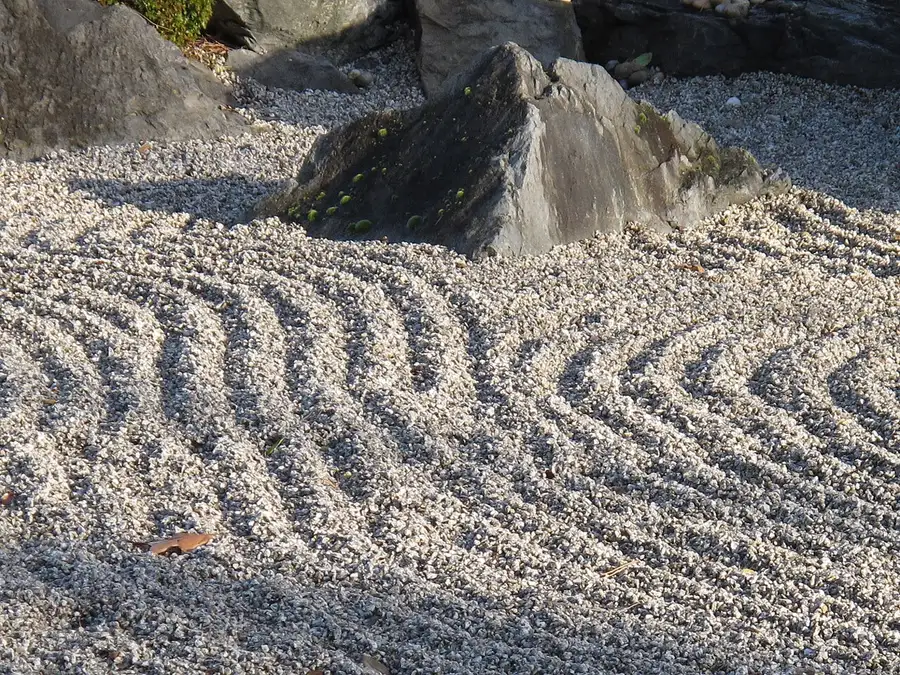
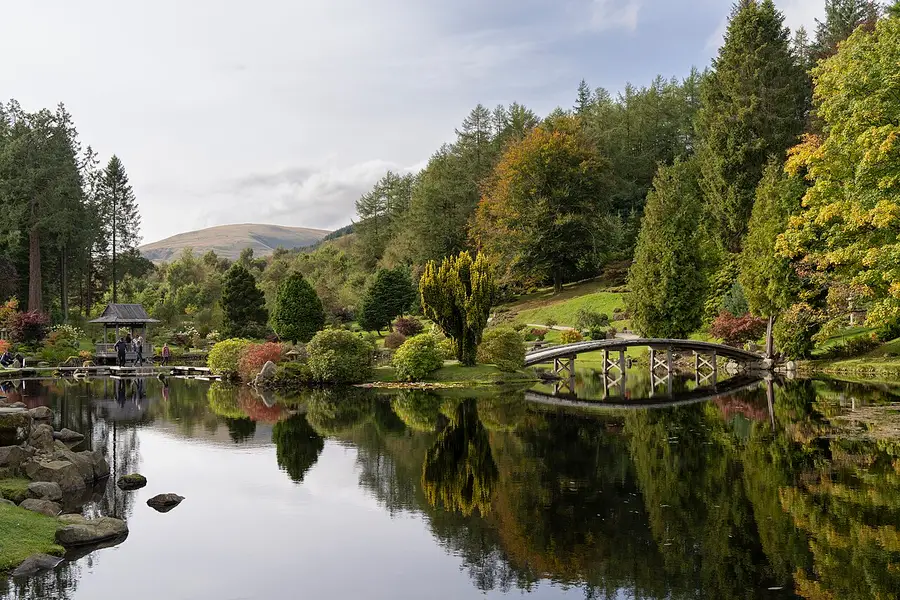
Near Dollar, at the foot of the Ochil Hills, Cowden’s Japanese garden includes a karesansui with four moss islands representing the turtle and the crane. Professor Fukuhara led its restoration. The garden reopened to visitors in 2017, and the work was completed in 2022 (Cowden Garden). The dry garden sits within a larger stroll garden laid out around a pond.
Karesansui Questions and Answers
Karesansui (枯山水) means “dry mountain water”. It describes a garden that uses stones, gravel and moss to suggest a landscape with water in it, without using any real water.
Mostly. “Zen garden” is an English term first used in print in 1935, and most famous dry gardens are in Zen temples. Dry gardens also appear at Shinto shrines and private houses, so not every karesansui is a temple garden.
The raked lines show water. Straight lines suggest a calm sea, rings around stones suggest waves, and curves suggest a current. Raking also clears leaves and keeps the surface even.
No. Dry gardens are designed to be viewed from a fixed spot, usually the veranda of a temple hall, and walking on the gravel would spoil the raked patterns.
Ryoanji in Kyoto, where fifteen stones sit in 248 square metres of raked white gravel. Its designer is unknown.
The Garden of Activity in the Japanese Landscape at Kew Gardens uses raked gravel and rocks in the dry style, and Cowden Garden in Clackmannanshire has a karesansui with four moss islands.
Sources and further reading
- Nara National Research Institute for Cultural Properties, Japanese Garden Dictionary: Dry landscape garden, Kawaramono gardener and Zen’ami
- Stewart Dick, Arts and Crafts of Old Japan (1904), chapter on gardens and flower arrangement
- Florence Du Cane, The Flowers and Gardens of Japan (1908)
- Wybe Kuitert, on the origin of the term “Zen garden”
- Claudia Dellacasa, Italo Calvino in Japan, Japan in Italo Calvino, doctoral thesis, Durham University, 2021