Ikebana (生け花) is the Japanese art of arranging cut branches, leaves and flowers in a vase or a shallow dish, using as few stems as possible and leaving space around them so the plants look as they might grow outdoors. It began with flower offerings in Buddhist temples, took shape in Kyoto with the Ikenobo school, first recorded in 1462, and is taught in London today by teachers of the Ikenobo, Sogetsu and Ohara schools.
This guide covers the history, styles and schools, the three-stem structure, the tools and a first arrangement at home, then where to learn ikebana in London, with dates and prices checked on 2 November 2026.
Ikebana at a glance
Name: 生け花, literally living flowers; also called kadō, the way of flowers.
Oldest school: Ikenobo, at Rokkakudo temple in Kyoto, first recorded in 1462.
Three main stems: called shin, soe and hikae in the Sogetsu school; each school has its own names.
The tool to buy first: a kenzan, the spiked metal holder also sold as a flower frog.
Try it in London: Ohara workshops at Amitabha Garden, Greenwich, on 7, 14 and 21 November 2026 (£80), or Rie Day’s Ikenobo workshop at Cecil Sharp House on 28 November 2026.
Ikebana Schools, Tools and London Classes
Rokkakudo, 1462: How Ikebana Began in Kyoto
The Ikenobo school traces ikebana to flowers placed on Buddhist altars, which merged with two older Japanese habits: setting out flowers to be admired, and raising branches as yorishiro, objects that call down the gods. Frank Brinkley, writing in 1915, explained the name simply: ike-bana means “living flower”, and the blossoms “must look as though they were actually growing” (A History of the Japanese People, 1915).
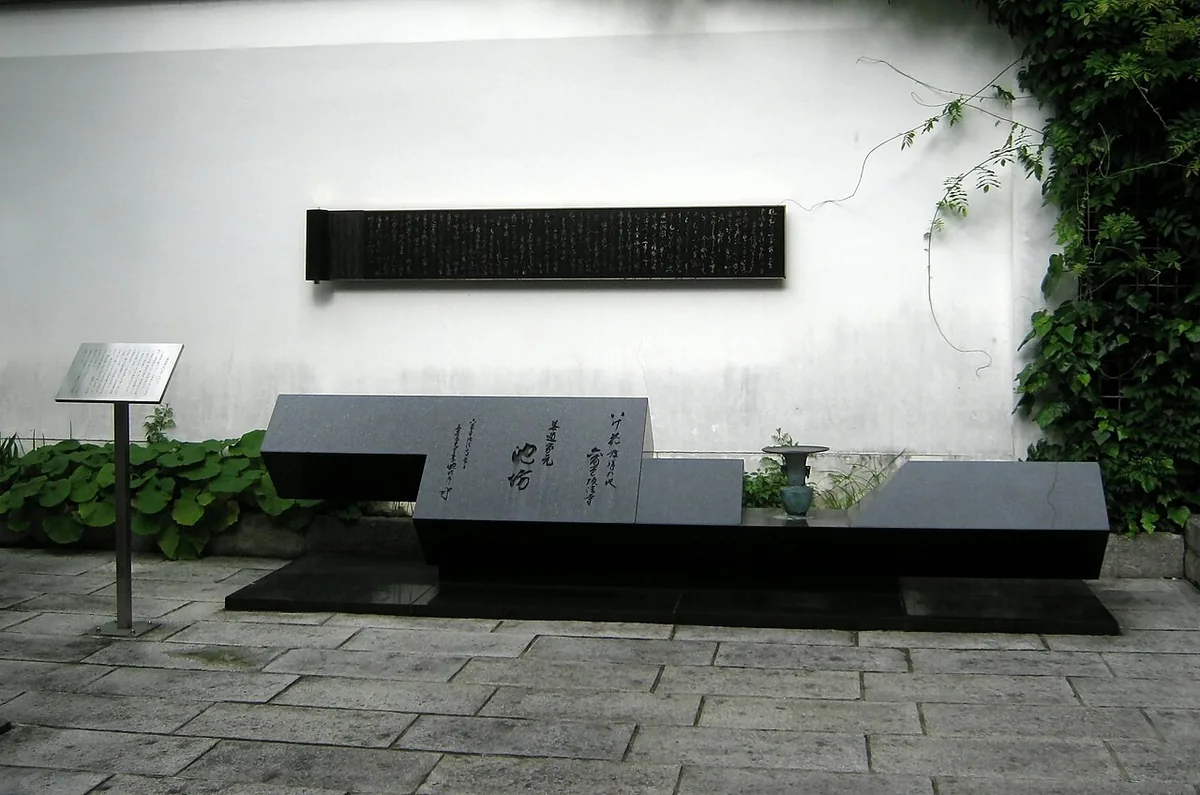
The school’s home is Rokkakudo, the Hexagonal Hall, a temple that tradition says Prince Shōtoku founded in 587. According to Ikenobo’s history of the school, the first written record of flower arranging as an admired art comes from 1462, in Hekizan Nichiroku, the diary of a Zen monk at Tofukuji temple: Ikenobo Senkei, a priest at Rokkakudo, arranged flowers for a warrior, and the people of Kyoto praised them. Rokkakudo still stands in central Kyoto, and a stone monument in its grounds marks it as the birthplace of ikebana.
Over the next century the teaching was written down. Ikenobo Senno’s instructions survive in a copy handed down in 1537, and in 1545 his successor, Sen’ei, drew a tall arrangement built on seven key branches, the outline of the style later called rikka. Senko Ikenobo II refined it at the turn of the 17th century, and in 1692 the school made a rikka for the Great Buddha at Todaiji in Nara.
Flowers grew up alongside the tea ceremony. Kakuzo Okakura, in The Book of Tea (1906), dated both to the 15th century. From the middle of the 17th century, he wrote, flower masters took the art out of the tea room, and by the mid 19th century one writer “could count over one hundred different schools”.
The modern schools came later. Unshin Ohara (1861 to 1916), who trained in the Ikenobo tradition, designed shallow dishes and bowls for arranging Western flowers low and wide, and his school dates its founding to 1895. Sofu Teshigahara, born in Sakai in 1900, parted ways with his father, the ikebana artist Hisaji Teshigahara, and founded Sogetsu in 1927; the school marks its centenary in 2027. After the Second World War, the looser nageire and moribana styles came to be called jiyuka, free style.

Rikka, Shoka, Nageire and Moribana: The Classic Styles
Four classic styles cover most traditional ikebana.
Rikka, standing flowers, is the grand formal style. Many kinds of plant go into a tall vase to picture a natural landscape, and it remains an Ikenobo speciality.
Shoka, also read seika, is much simpler. It uses one to three kinds of plant and aims to show what Ikenobo calls the beauty of a plant’s life as it grows. Ikenobo set down its rules in the mid 18th century, building on the freer nageire.
Nageire, thrown in, is the tall-vase style without a spiked holder. The stems are bundled tightly at the mouth of a narrow vase or held by a wooden crosspiece fixed inside it, the two methods Kids Web Japan’s ikebana pages give for tall vases.
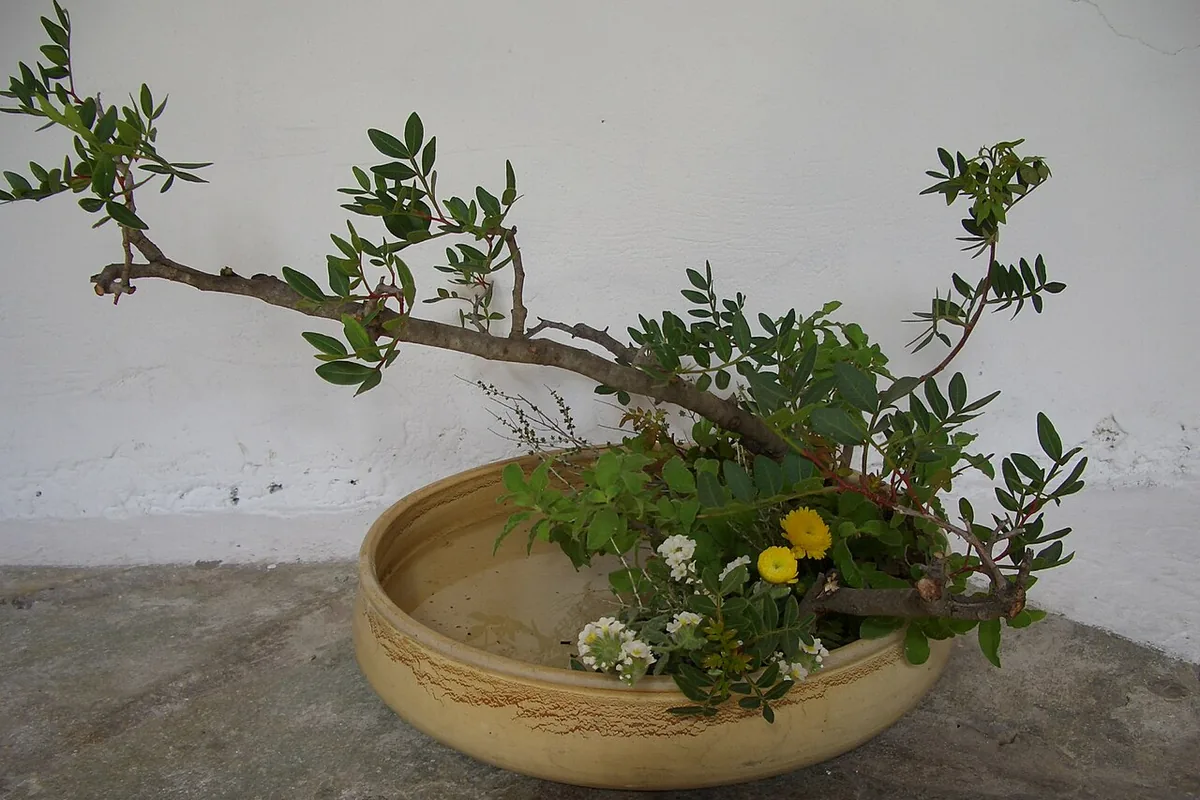
Moribana, piled flowers, is arranged in a low, wide dish called a suiban, with the stems fixed on a spiked holder under the water. The Ohara school says the familiar picture of flowers on a kenzan in a suiban began with its founder. Because the holder does the work, moribana is where most beginners start.
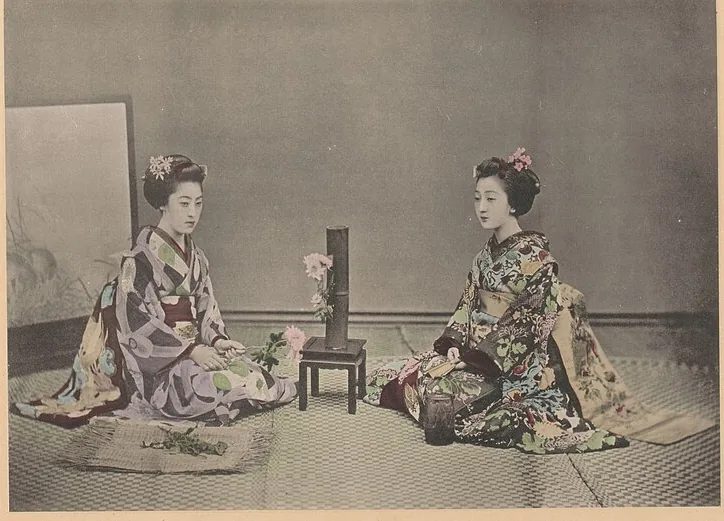
Ikebana Schools Compared: Ikenobo, Sogetsu and Ohara
Ikebana is learned through schools, each led by a headmaster called the iemoto, who heads the family line and the curriculum. Many smaller schools exist, and the Ikebana International London Chapter lists teachers of six in Britain, but these three are the ones you are most likely to find in London.
| School | Founded | Founder | Known for | Its names for the three main stems | Headmaster today | In the UK |
|---|---|---|---|---|---|---|
| Ikenobo | First recorded 1462 | Ikenobo Senkei, priest at Rokkakudo, Kyoto | Rikka, shoka and jiyuka free style | Shin, soe and tai (in shoka) | Sen’ei Ikenobo | Ikenobo Ikebana Society UK London chapter, led by Rie Day; Ikenobo UK and Ireland group, west London |
| Sogetsu | 1927 | Sofu Teshigahara | Basic upright and slanting styles, then free creative work with unusual materials | Shin, soe and hikae | Akane Teshigahara, fourth iemoto since 2001 | Sogetsu London Branch, with an annual exhibition in Hampstead |
| Ohara | 1895, by the school’s own date | Unshin Ohara | Moribana in a shallow suiban; also landscape and Rinpa styles | Shushi, fukushi and kyakushi | Hiroki Ohara, fifth iemoto | Ohara-ryu England Chapter; workshops at Amitabha Garden, Greenwich |
Ikenobo teaches the oldest forms, from shoka to rikka. Ohara’s moribana is the easiest way in, since the kenzan holds each stem where you put it. Sogetsu suits people who want to experiment early; Sofu Teshigahara’s own Objet Ikebana used plants coated in plaster or coloured. Japanese encyclopedias date Ohara later than the school does, between 1897 and 1916, because it separated from Ikenobo in stages.
Shin, Soe and Hikae: Heaven, Earth and Human in Three Stems
Most arrangements are built on three main stems of different lengths. Okakura described the rule as the flower masters taught it: arrangements referred to “the Leading Principle (Heaven), the Subordinate Principle (Earth), the Reconciling Principle (Man)”, and one without them “was considered barren and dead”.
Each school still names the three stems in its own words. In Ikenobo shoka they are shin, soe and tai, modelled on sansai, the old idea of heaven, earth and humankind as the foundations of all things. Sogetsu uses shin, soe and hikae, and its lessons swap the soe and hikae positions to make variations. Ohara calls them shushi, fukushi and kyakushi, the main, secondary and guest stems, and adds shorter middle stems called chukan.
The lengths follow simple ratios. In an Ohara upright moribana, the main stem is about as long as the container’s width and depth added together, the secondary stem two thirds of that and the third stem half, and seen from above the three tips form a triangle. Jukichi Inouye, describing Tokyo homes in 1910, added that the stems are always odd in number and balanced on either side, but never perfectly symmetrical, “which is never to be found in nature” (Home Life in Tokyo, 1910). Brinkley called it “a balance of inequalities”.

Kenzan, Suiban and Hasami: Ikebana Tools Explained
A beginner needs very little. The kenzan is a metal holder packed with sharp points about 1cm high, which grips each stem upright or at an angle; it is also sold as a flower frog. The suiban is the low, flat dish that holds the kenzan and the water for moribana. Hasami are ikebana scissors, and cutting each stem at an angle helps it sit firmly on the points.
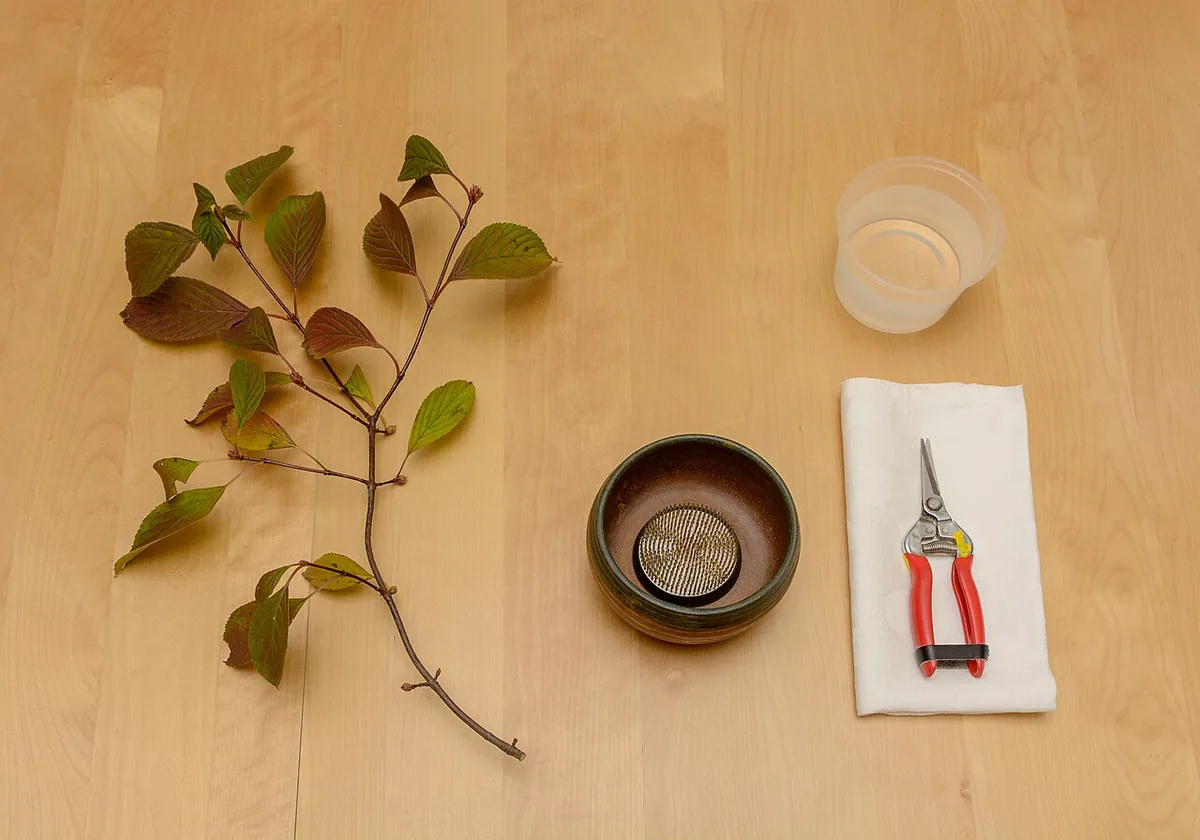
For nageire you need a tall vase, the kabin, and a few sticks to cut as crosspieces. Any shallow bowl wide enough for the kenzan, with water showing around it, will do as a first suiban. If a favourite vase gets chipped, our guide to kintsugi workshops in London compares classes for mending ceramics with gold.
Plum in Late Winter, Pine at New Year: Seasonal Materials
Ikebana uses what is in season, and the branch matters as much as the flowers. Inouye listed the flowering branches Tokyo households cut in 1910, among them plum, camellia, cherry, Japanese quince and wisteria, along with pine and fruiting nandina and loquat.
The tea masters took seasonal matching furthest. Okakura described a late winter tea room with “a slender spray of wild cherries in combination with a budding camellia”, and recorded that the master Sekishu banned white plum blossom when snow lay in the garden.
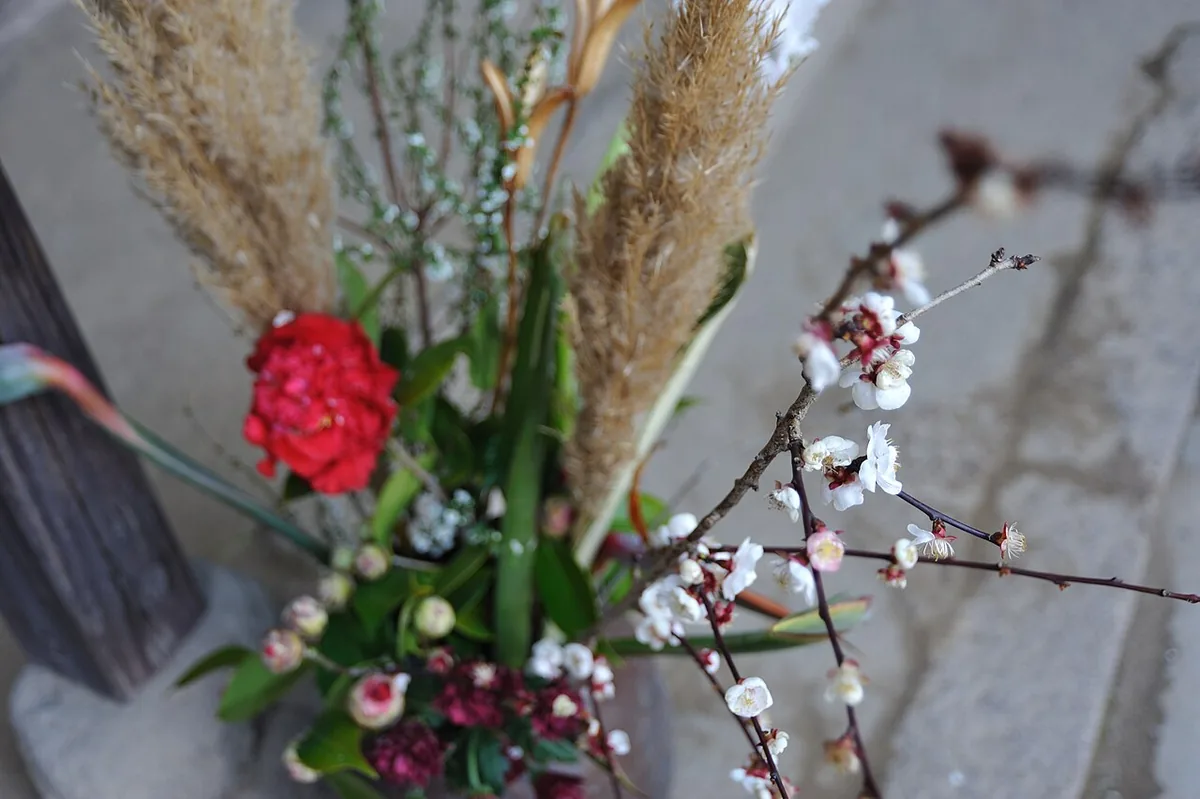
Some combinations belong to particular days. Florence Du Cane, writing in 1908, found pine, bamboo and plum arranged together at New Year in almost every house in Japan. She also quoted Josiah Conder’s The Floral Art of Japan on a moon-viewing arrangement of pine, in which a gap left in the foliage stands for the moon and a special branch, “fancifully called the moon-shadow-branch”, appears to cross it (The Flowers and Gardens of Japan, 1908).
In Britain, use whatever your garden or florist has that week. In November, chrysanthemums are an easy choice, since Japan holds its chrysanthemum shows that month, and our guide to Japanese flowers and their meanings has a month-by-month calendar.
A First Moribana in Seven Steps
This basic upright moribana uses the proportions from Kids Web Japan’s ikebana guide, whose examples come from the Ohara school. You need a shallow bowl, a kenzan, sharp scissors, one leafy branch and two or three flowers.
- Put the kenzan in the bowl and pour in enough water to cover its points.
- Measure the bowl across and add its depth. That total is the length of your main stem, usually the branch.
- Cut the main stem to length with an angled cut and press it straight down onto the kenzan, standing upright.
- Cut a second stem to two thirds of the main stem and tilt it about 45 degrees towards the front left.
- Cut a third stem to half the main stem and tilt it about 60 degrees towards the front right.
- Look down from above: the three tips should form a triangle. Add a few shorter flowers inside it to hide the kenzan.
- Leave an area of water showing at the front, and top it up as the plants drink.
When the flowers fade, the old masters treated them kindly. Okakura wrote that a master “tenderly consigns it to the river or carefully buries it in the ground”, and a compost bin is the modern equivalent.
Where to Learn Ikebana in London and the UK
London has teachers from all three main schools, plus the Ikebana International London Chapter, which brings them together. Dates and prices were checked on each organiser’s page, or the official listing named, on 2 November 2026; prices are per person.
| Where | School | What | Price | Next date | Address |
|---|---|---|---|---|---|
| Amitabha Garden | Ohara | 90-minute workshop with Anli, all materials included | £80, or £150 for two | Saturdays 7, 14 and 21 November 2026, 3pm to 4.30pm | 10 Wood Wharf, SE10 9FL |
| Cecil Sharp House | Ikenobo | Monthly Saturday workshop with Rie Day, morning, afternoon or all day | Not published; ask when booking | Saturday 28 November 2026, 10.30am to 3.30pm | 2 Regent’s Park Road, NW1 7AY |
| Hiromi Takahashi, through ClassBento | Sogetsu | 90-minute lesson for up to six, flowers and tools provided | £60 | Sold out when checked; waitlist open | Near Marble Arch |
| Ikebana International London Chapter | Several schools | Christmas Bazaar; an “Ikebana for All” beginners’ workshop is planned for June 2027 | Not published | 7 December 2026 | Daiwa Anglo-Japanese Foundation, NW1 4QP |
| Sogetsu London Branch | Sogetsu | Annual exhibition with 30-minute “Let’s Try Ikebana” sessions | Free entry; sessions £10 in 2026 | 2027 date not yet announced (2026 show: 30 May) | Rosslyn Hill Chapel, 3 Pilgrim’s Place, NW3 1NG |
Map of Cecil Sharp House
Amitabha Garden, Greenwich: Ohara workshops in November
The soonest beginner class we found is at Amitabha Garden in Greenwich. Its 90-minute Ohara workshops are taught by Anli, listed as a fourth master of the Ohara school, and you take your flowers home. Book through the Royal Borough of Greenwich events listing, which links to the garden’s booking page.
Address: Amitabha Garden, 10 Wood Wharf, London SE10 9FL.
Niwaki, the Japanese tool shop on Chiltern Street, ran one-hour Ohara workshops with Ruriko Kojima in 2025, each with a kenzan to keep, but listed no new dates when we checked. The same shop hosts the workshops in our guide to sashiko stitching in London.
Ikenobo with Rie Day at Cecil Sharp House, Camden
Rie Day, a first grade professor of Ikenobo with more than 30 years’ experience and president of the Ikenobo Ikebana Society UK London chapter, teaches at Cecil Sharp House, home of the English Folk Dance and Song Society. Her Saturday workshops run monthly until July 2027, as a morning or afternoon session or a full day, for beginners and returning students. Bring two vases and garden scissors, or borrow a vase, kenzan and scissors from her. Ask the price on the English Folk Dance and Song Society’s event page or on 07947 019 301.
Address: Cecil Sharp House, 2 Regent’s Park Road, London NW1 7AY.
Sogetsu London Branch and Hiromi Takahashi’s lessons
The Sogetsu London Branch holds four or five workshops a year with teachers from Japan, Europe and the UK. Its annual exhibition, which the Embassy of Japan calls one of the largest ikebana events in the UK, lets visitors make an arrangement of their own with a certified teacher.
Hiromi Takahashi, a first grade Sogetsu teacher with more than 30 years’ practice, teaches small groups through ClassBento at a venue its class page places about 100 metres from Marble Arch station.
Ikebana International London Chapter, founded 1957
Ikebana International was founded in 1956 by Ellen Gordon Allen and is based in Tokyo. Its London Chapter, set up in 1957, was the first in Europe, and membership is open to anyone. Besides the Christmas Bazaar, its events page plans a February 2027 workshop and a March demonstration for people with some experience, and the annual exhibition in May.
Japan House London, Kensington
From 14 to 17 May 2026 Japan House London showed more than 20 arrangements by Ikebana International London Chapter members, free, for the organisation’s 70th anniversary. Earlier in the year its £75 Hyakkō in bloom workshops had Ohara and Ikenobo teachers guide eight people at a time in arranging flowers in ceramics from its craft exhibition. No ikebana events for this winter were on the Embassy of Japan’s UK events calendar when we checked. Our guide to Japan House London covers opening hours, and its shop is one of the stockists compared in our furoshiki wrapping guide.
Beyond the schools, the booking site ClassBento listed 17 ikebana classes across London on 2 November 2026. A single workshop there started at £55.
Ikebana: Questions and Answers
Ikebana is the Japanese art of arranging cut branches, leaves and flowers in a vase or shallow dish, using few stems and the space around them to suggest how plants grow. It grew from Buddhist flower offerings and took shape in Kyoto, where the Ikenobo school’s first recorded arrangement dates from 1462. It is also called kadō, the way of flowers.
Ikebana (生け花) means living flowers. The historian Frank Brinkley explained in 1915 that the name sums up the art’s aim: the blossoms should look as though they were still growing on the plant. Japanese also calls it kadō, the way of flowers, in the same pattern as sadō, the way of tea.
The three best known are Ikenobo, the oldest, first recorded at Rokkakudo temple in Kyoto in 1462; Ohara, which the school dates to 1895 and which created moribana in a shallow dish; and Sogetsu, founded by Sofu Teshigahara in 1927 and known for free, experimental work. All three have teachers in London.
A kenzan is the spiked holder used in ikebana, with metal points about 1cm high that grip each stem. It sits under the water in a shallow dish called a suiban and is the basis of the moribana style. In Britain it is often sold as a flower frog. Cutting stems at an angle helps them sit firmly on the points.
They are the Sogetsu school’s names for the three main stems of an arrangement. Other schools use their own names: shin, soe and tai in Ikenobo shoka, and shushi, fukushi and kyakushi in Ohara. In a basic Ohara moribana, the main stem equals the container’s width plus depth, the second two thirds of that and the third half.
Amitabha Garden in Greenwich runs Ohara workshops on 7, 14 and 21 November 2026 at £80, and Rie Day teaches Ikenobo at Cecil Sharp House in Camden monthly, next on 28 November 2026. The Sogetsu London Branch and the Ikebana International London Chapter run workshops and exhibitions through the year, including a beginners’ workshop planned for June 2027.
On 2 November 2026, Amitabha Garden’s 90-minute Ohara workshop cost £80, or £150 for two, and Hiromi Takahashi’s 90-minute Sogetsu lesson cost £60. Single workshops on the booking site ClassBento started at £55. The Sogetsu London Branch charged £10 for a 30-minute taster at its 2026 exhibition, and Japan House London’s 2026 workshops were £75.