Thirty-six Views of Mount Fuji is a series of 46 woodblock prints by Katsushika Hokusai, published in Edo (now Tokyo) from about 1830 to 1832, when he was in his seventies. It began as 36 views; it sold so well that the publisher added ten more. The best known print in it is the Great Wave. Until 17 January 2027 the complete set is on show together for the first time in the UK, at Dulwich Picture Gallery in south London.
| Japanese title | Fugaku sanjūrokkei (富嶽三十六景) |
| Artist | Katsushika Hokusai (1760 to 1849) |
| Publisher | Nishimuraya Yohachi (Eijudō), Edo |
| Dates | About 1830 to 1832 (Dulwich gives 1830 to 1833) |
| Number of prints | 46: the original 36 plus 10 added |
| Format | Horizontal ōban colour woodblock prints, roughly 25 by 37 centimetres |
| See it in the UK | All 46 at Dulwich Picture Gallery until 17 January 2027; 38 of the 46 are in the V&A’s collection and can be seen by appointment |
What Thirty-six Views of Mount Fuji is
Each print shows Mount Fuji from a different place, season or kind of weather. Sometimes the mountain fills the sheet; more often it is small, glimpsed between roofs, through a wave or behind people working. The V&A describes it as the first series made entirely of large landscape prints, which was new for a print market built on actors and courtesans.
Hokusai's 36 Views of Mount Fuji, Print by Print
Mount Fuji mattered to its buyers. It was a sacred mountain, climbed each summer by pilgrims, and members of Edo’s Fuji worship groups were among the people who bought these prints. Stewart Dick, writing in Arts and Crafts of Old Japan (1904), saw the series as something quite new: pictures of real, named places, each with its own character, where older Chinese style landscapes had shown imagined scenery.
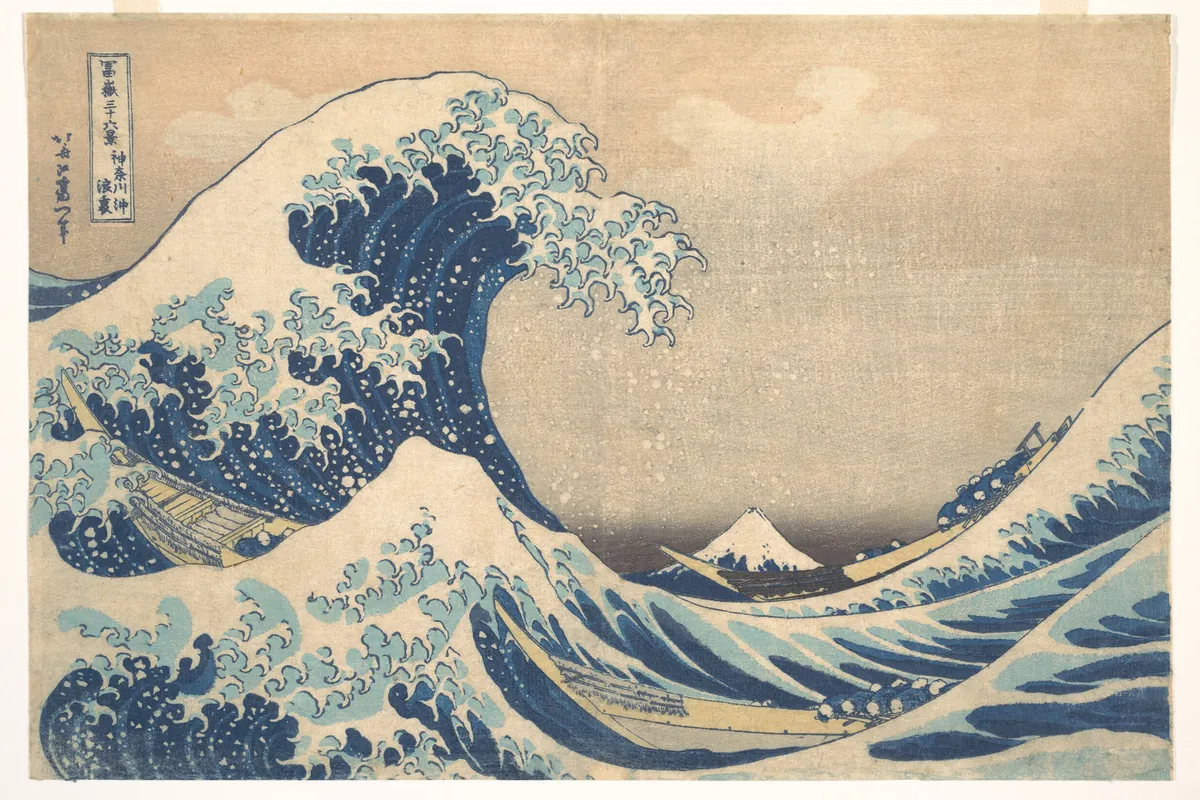
The story of the series’ most famous image, how it was made and what a copy cost, is in our article on the Great Wave off Kanagawa.

Prussian blue and why the series sold
The earliest prints were printed almost entirely in blue, including the outlines. The pigment was Prussian blue, a synthetic colour from Europe that had only recently reached Japan and was, according to the V&A, both expensive and rare. Its deep, stable blues suited water and sky, and Dulwich credits its use with the series’ success, which led the publisher to expand it with ten more prints. Wikipedia’s summary of the scholarship adds that Nishimuraya had planned to take it past one hundred prints before publication stopped at 46.
Because the blocks were used for many printings, no two impressions are quite alike. Frederick Gookin noted as early as 1913, in Japanese Colour-Prints and Their Designers, that prints from Hokusai’s Thirty-six Views turn up in widely different colourings, and that the series survived better than most because many owners pasted the sheets into albums. How a print went from the artist’s drawing to the carver and the printer is explained in our guide to how a ukiyo-e print was made.
The prints most worth knowing
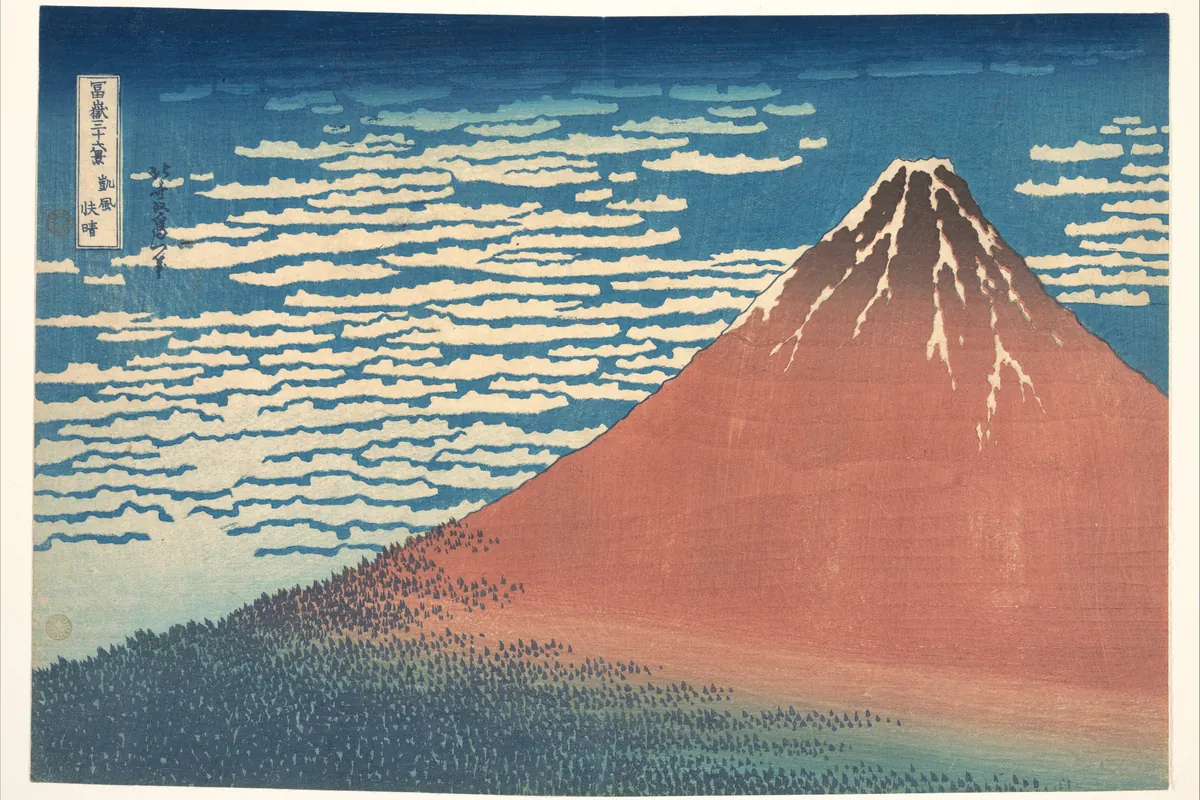
South Wind, Clear Sky, or Red Fuji
Fuji alone, red against a sky of rows of small white clouds, with a dark band of forest at its foot. The V&A notes that the mountain is said to take on this reddish colour in late summer and early autumn. Dulwich is showing a rare variant of this print, which it calls Blue Fuji, never seen in the UK before.
Storm below Mount Fuji
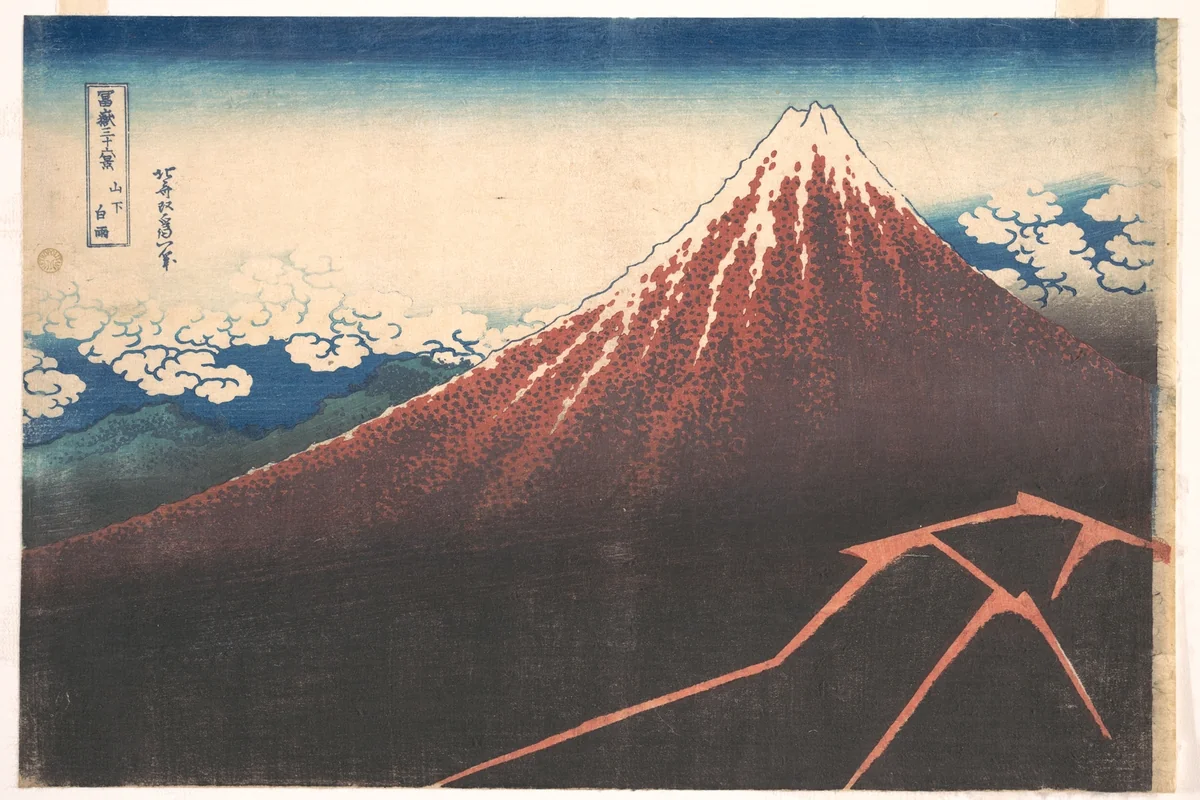
A similar view to Red Fuji, turned into weather. The summit sits in clear sky while lightning flashes across the dark lower slopes. The V&A points out that much of the print’s effect depends on the printer’s skill with the colours.
Ejiri in Suruga Province
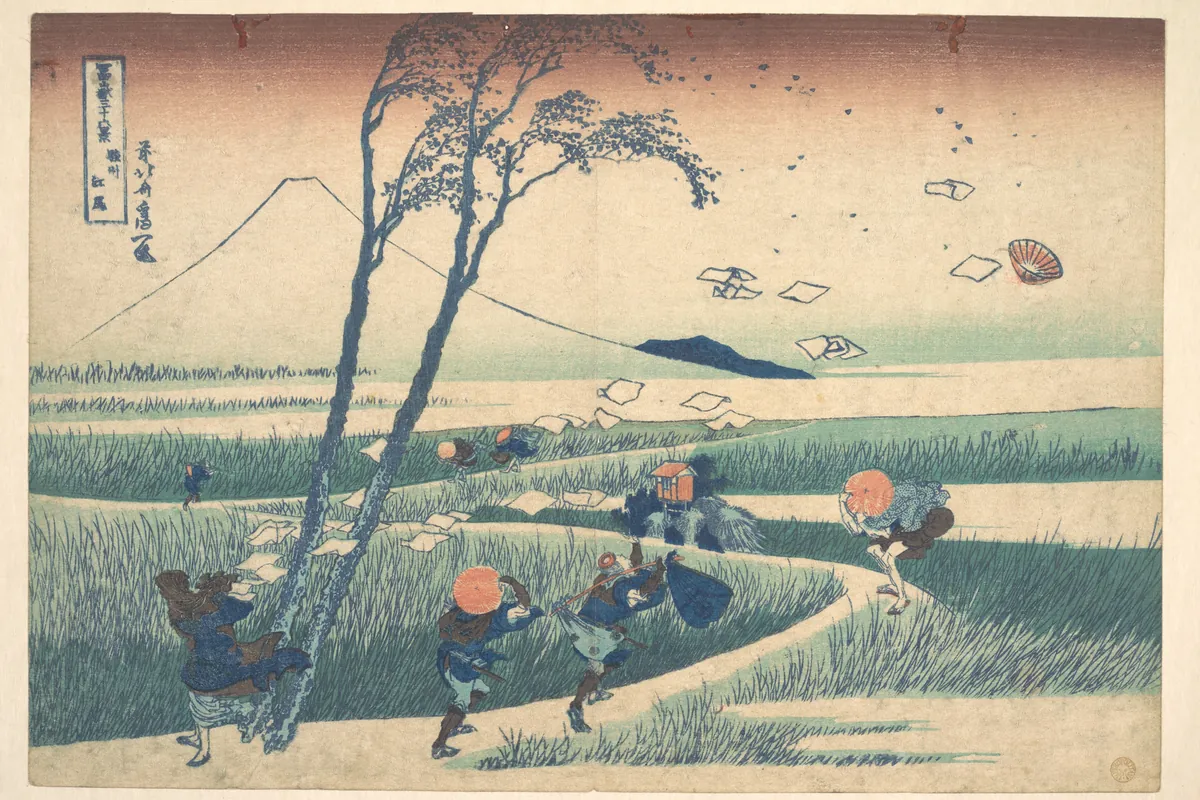
A sudden gust catches travellers on a road through the marshes, whipping sheets of paper and a hat into the air. Fuji is drawn as a single outline. It is a print about a moment more than a place.
Kajikazawa in Kai Province
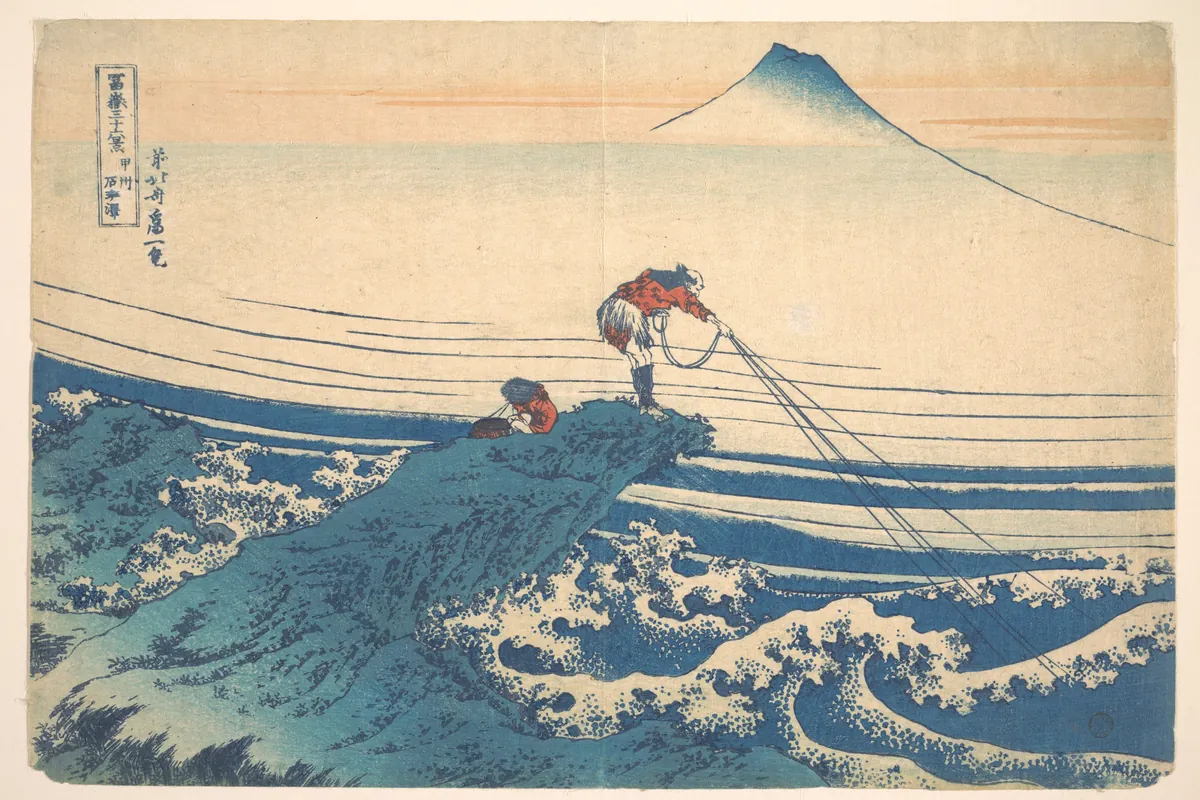
A fisherman leans out over the rapids of the Fuji River with his lines spread like a fan, the lines of the rock, the man and the mountain making one triangle. It is less famous than the Great Wave but often counted among the best in the set.
Mitsui Shop at Surugachō in Edo
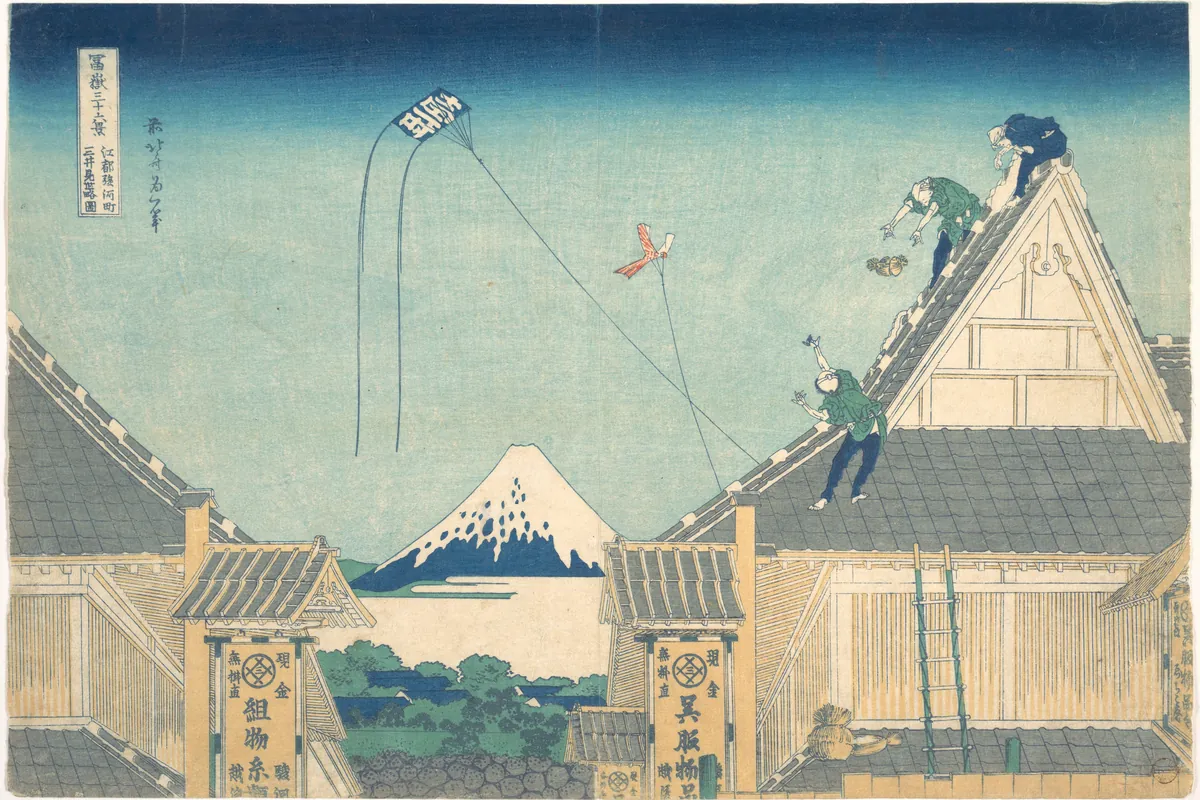
Roofers work on the steep roofs of the Mitsui drapery, the business that grew into today’s Mitsukoshi department store, while a kite flies overhead and Fuji sits neatly in the gap between the buildings. Several of the Edo views work this way: city life in front, the mountain framed in the distance.
Reflection in Lake at Misaka in Kai Province
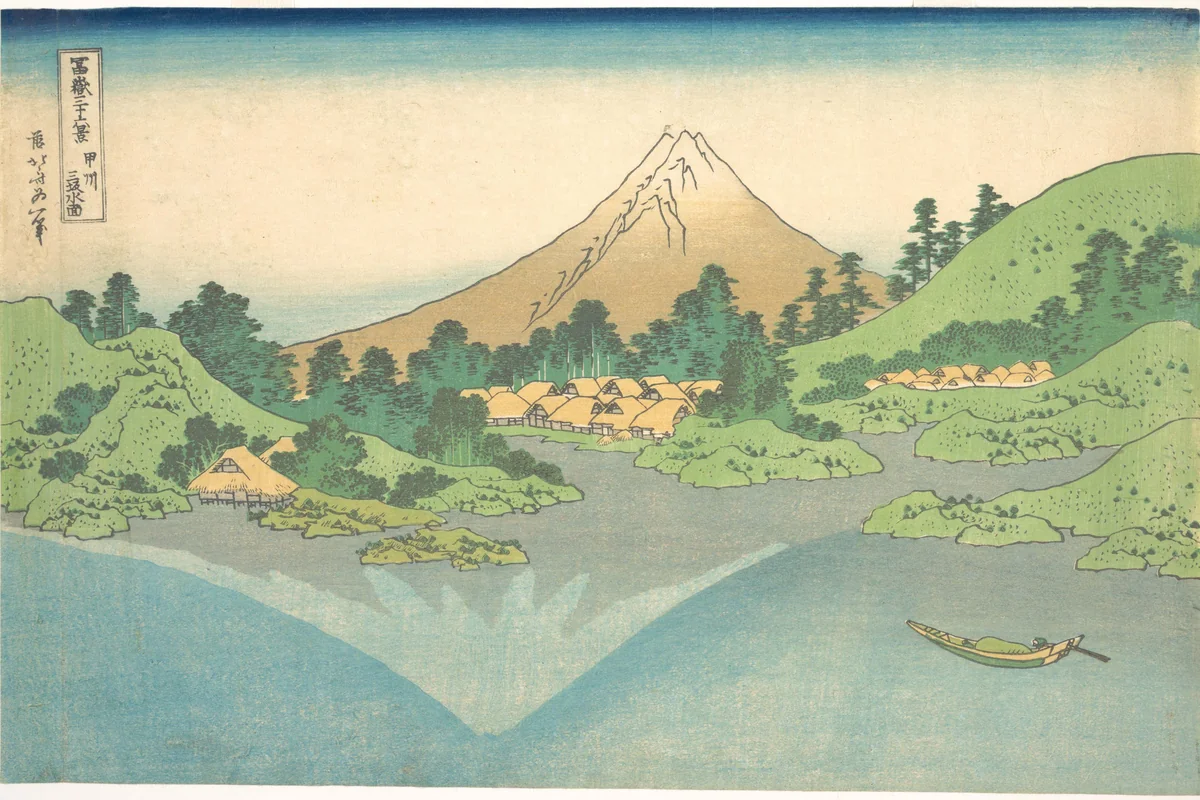
Look twice at the lake. The mountain above is brown with summer, but its reflection is a white, snow covered peak, and it does not sit directly below the real one. Hokusai drew the reflection for effect, whatever real water would show.
The ten extra prints
The ten views added after the first 36 include some of the most human scenes in the series: the timber yard at Honjo, the pleasure quarter at Senju, the tea fields at Katakura and, finally, the mountain itself under the feet of pilgrims.
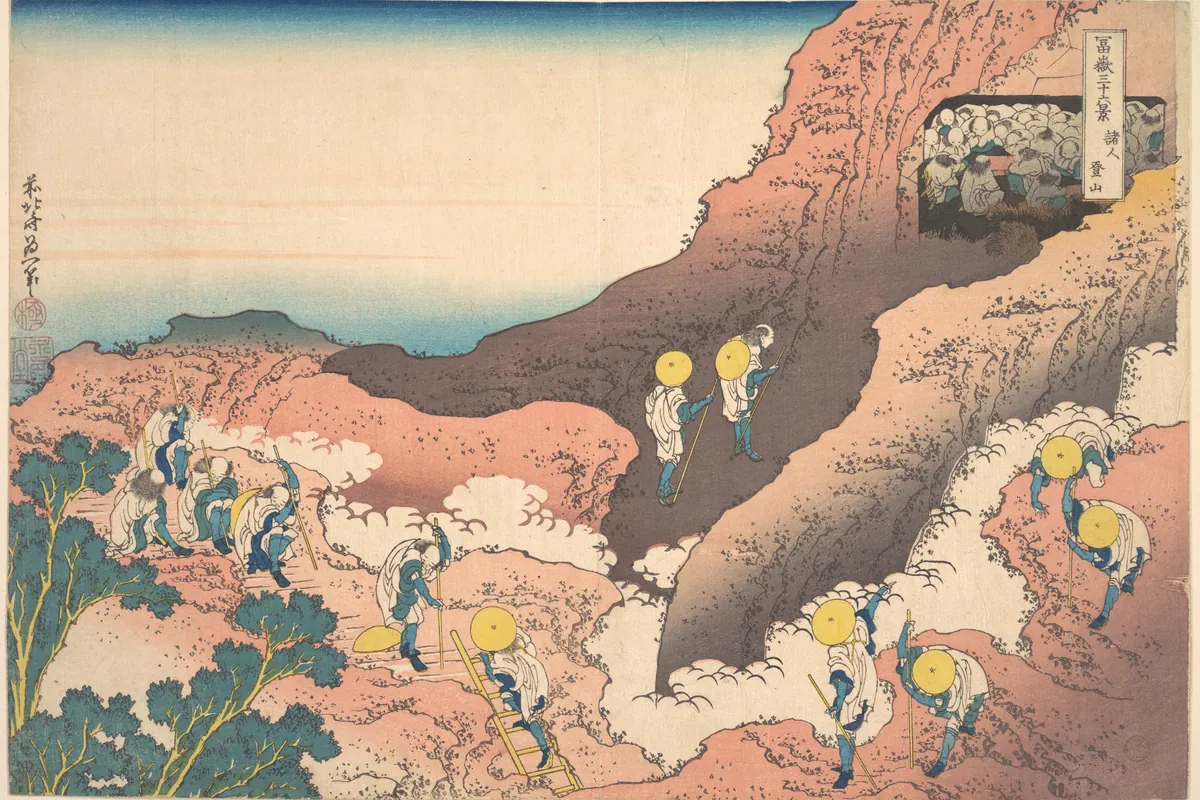
In Groups of Mountain Climbers, the 46th print, the view of Fuji disappears: we are on it. Pilgrims in white haul themselves up the slope on ladders and rest packed into a cave below the summit. Painters had shown Fuji from a distance for centuries, as our article on Mount Fuji in Japanese painting explains; here Hokusai puts the crowds on its slopes.

All 46 Thirty-six Views of Mount Fuji prints
Numbers 1 to 36 are the original set and 37 to 46 the additions. The order follows the standard modern listing; Hokusai’s prints carried no numbers. The V&A column gives the museum number of an impression in the V&A’s collection, checked on its online database on 31 October 2026. All 46 are on show at Dulwich Picture Gallery until 17 January 2027.
| No. | English title | Japanese title | Where it is today | V&A impression |
|---|---|---|---|---|
| 1 | Under the Wave off Kanagawa (The Great Wave) | 神奈川沖浪裏 | Sea off Kanagawa, Yokohama | E.210-1915 |
| 2 | South Wind, Clear Sky (Red Fuji) | 凱風快晴 | Mount Fuji | E.4813-1916 |
| 3 | Storm below Mount Fuji | 山下白雨 | Mount Fuji | E.4814-1916 |
| 4 | Under Mannen Bridge at Fukagawa | 深川万年橋下 | Fukagawa, Kōtō, Tokyo | E.4831-1916 |
| 5 | Surugadai in Edo | 東都駿台 | Surugadai, Chiyoda, Tokyo | E.4840-1916 |
| 6 | The Cushion Pine at Aoyama | 青山円座松 | Aoyama, Tokyo | E.4834-1916 |
| 7 | Senju in Musashi Province | 武州千住 | Senju, Adachi, Tokyo | E.647-1901 |
| 8 | Tama River in Musashi Province | 武州玉川 | Tama River, Tokyo and Kanagawa | E.4835-1916 |
| 9 | Inume Pass in Kai Province | 甲州犬目峠 | Yamanashi | E.4821-1916 |
| 10 | Fujimigahara in Owari Province | 尾州不二見原 | Nagoya, Aichi | E.4810-1916 |
| 11 | Honganji at Asakusa in Edo | 東都浅草本願寺 | Asakusa, Taitō, Tokyo | E.648-1901 |
| 12 | Tsukudajima in Musashi Province | 武陽佃島 | Tsukuda, Chūō, Tokyo | Not in V&A online catalogue |
| 13 | Shichirigahama in Sagami Province | 相州七里浜 | Kamakura, Kanagawa | E.2184-1909 |
| 14 | Umezawa Manor in Sagami Province | 相州梅沢左 | Near Ninomiya, Kanagawa | E.4829-1916 |
| 15 | Kajikazawa in Kai Province | 甲州石班沢 | Fuji River, Yamanashi | E.658-1901 |
| 16 | Mishima Pass in Kai Province | 甲州三嶌越 | Near Kagosaka Pass, Yamanashi | E.3779-1953 |
| 17 | Lake Suwa in Shinano Province | 信州諏訪湖 | Lake Suwa, Nagano | E.662-1923 |
| 18 | Ejiri in Suruga Province | 駿州江尻 | Shimizu, Shizuoka | Not in V&A online catalogue |
| 19 | In the Mountains of Tōtōmi Province | 遠江山中 | Western Shizuoka | E.4819-1916 |
| 20 | Ushibori in Hitachi Province | 常州牛堀 | Itako, Ibaraki | E.644-1901 |
| 21 | Mitsui Shop at Surugachō in Edo | 江都駿河町三井見世略図 | Muromachi, Chūō, Tokyo | E.4838-1916 |
| 22 | Sunset across Ryōgoku Bridge from Ommayagashi | 御厩川岸より両国橋夕陽見 | Kuramae, Taitō, Tokyo | E.4842-1916 |
| 23 | Sazai Hall at the Temple of the Five Hundred Arhats | 五百らかん寺さざゐどう | Kōtō, Tokyo | Not in V&A online catalogue |
| 24 | Morning after a Snowfall at Koishikawa | 礫川雪の旦 | Koishikawa, Bunkyō, Tokyo | E.702-1923 |
| 25 | Lower Meguro | 下目黒 | Meguro, Tokyo | E.484-1890 |
| 26 | The Waterwheel at Onden | 隠田の水車 | Onden, near today’s Harajuku, Tokyo | E.4820-1916 |
| 27 | Enoshima in Sagami Province | 相州江の島 | Enoshima, Fujisawa, Kanagawa | Not in V&A online catalogue |
| 28 | Tago Bay near Ejiri on the Tōkaidō | 東海道江尻田子の浦略図 | Suruga Bay, Shizuoka | Not in V&A online catalogue |
| 29 | Yoshida on the Tōkaidō | 東海道吉田 | Toyohashi, Aichi | E.4825-1916 |
| 30 | At Sea off Kazusa | 上総の海路 | Tokyo Bay off Chiba | E.3223-1953 |
| 31 | Nihonbashi in Edo | 江戸日本橋 | Nihonbashi, Chūō, Tokyo | E.659-1901 |
| 32 | Sekiya Village on the Sumida River | 隅田川関屋の里 | Near Keisei Sekiya station, Adachi, Tokyo | E.2188-1909 |
| 33 | Noboto Bay | 登戸浦 | Chūō ward, Chiba | E.4811-1916 |
| 34 | The Lake at Hakone in Sagami Province | 相州箱根湖水 | Lake Ashi, Hakone, Kanagawa | Not in V&A online catalogue |
| 35 | Reflection in Lake at Misaka in Kai Province | 甲州三坂水面 | Lake Kawaguchi, Yamanashi | E.4822-1916 |
| 36 | Hodogaya on the Tōkaidō | 東海道保土ケ谷 | Hodogaya, Yokohama | E.4824-1916 |
| 37 | Tatekawa in Honjo | 本所立川 | Sumida, Tokyo | E.646-1901 |
| 38 | Fuji Seen from the Pleasure Quarter at Senju | 従千住花街眺望の不二 | Senju, Adachi, Tokyo | Not in V&A online catalogue |
| 39 | Fuji from Gotenyama at Shinagawa on the Tōkaidō | 東海道品川御殿山の不二 | Shinagawa, Tokyo | E.4837-1916 |
| 40 | Nakahara in Sagami Province | 相州仲原 | Hiratsuka, Kanagawa | E.2183-1909 |
| 41 | Dawn at Isawa in Kai Province | 甲州伊沢暁 | Isawa, Yamanashi | E.645-1901 |
| 42 | The Back of Fuji from the Minobu River | 身延川裏不二 | Minobu, Yamanashi | Not in V&A online catalogue |
| 43 | The New Fields at Ōno in Suruga Province | 駿州大野新田 | Fuji city, Shizuoka | E.2173-1909 |
| 44 | Fuji from the Katakura Tea Fields in Suruga | 駿州片倉茶園の不二 | Fuji city, Shizuoka | E.4809-1916 |
| 45 | Fuji Seen from Kanaya on the Tōkaidō | 東海道金谷の不二 | Shimada, Shizuoka | E.2181-1909 |
| 46 | Groups of Mountain Climbers | 諸人登山 | On Mount Fuji | E.657-1901 |
Where to see Thirty-six Views of Mount Fuji in the UK
Dulwich Picture Gallery, until 17 January 2027
Hokusai: Thirty-six Views of Mt. Fuji from the Iuchi Collection shows all 46 prints together, the first time the complete series has been exhibited in the UK. The prints come from the Iuchi Collection in partnership with the National Museum of Western Art, Tokyo. Highlights include a fine impression of the Great Wave and the rare Blue Fuji variant of South Wind, Clear Sky. Adult tickets start at £21.50 including a donation, and Friends of the gallery go free. Details are in our Hokusai at Dulwich event guide.
The V&A, by appointment
The V&A holds impressions of 38 of the 46 prints, listed in the table above, almost all of them in store. Its free Order an Object service lets anyone pick stored objects and book a time to see them; items marked “view by appointment” without an order button can be requested through the Prints and Drawings Study Room. Search the museum number on the V&A collections website, then follow the booking link on the object’s page. Details: V&A Order an Object.
Other UK collections
The British Museum is among the handful of museums worldwide with prominent holdings from the series, and its prints rotate through the Japanese galleries. The Ashmolean in Oxford features Hokusai alongside Hiroshige in its online Japanese landscape prints collection. The Whitworth in Manchester has its own historic Japanese print collection. For new prints of Fuji made a century later, see our guide to shin hanga and Hiroshi Yoshida’s Ten Views of Mount Fuji.
Questions about Thirty-six Views of Mount Fuji
Why does Thirty-six Views of Mount Fuji have 46 prints?
The first 36 sold so well that the publisher, Nishimuraya Yohachi, commissioned ten more and kept the original title. Dulwich Picture Gallery credits Hokusai’s use of the newly imported Prussian blue for that success. The publisher is said to have planned more than one hundred prints, but the series stopped at 46.
When was Thirty-six Views of Mount Fuji made?
About 1830 to 1832, when Hokusai was in his seventies. The Metropolitan Museum dates its impressions to about 1830 to 1832, and Dulwich Picture Gallery gives 1830 to 1833. Hokusai followed it in 1834 with a picture book, One Hundred Views of Mount Fuji.
Is the Great Wave part of Thirty-six Views of Mount Fuji?
Yes. Under the Wave off Kanagawa, known as the Great Wave, is the most famous print in the series and is usually listed first. Mount Fuji is the small peak in the distance, framed by the trough of the wave. Impressions are held by the V&A, the British Museum and the Metropolitan Museum of Art, among others.
Where can I see Thirty-six Views of Mount Fuji in London?
The complete set of 46 is at Dulwich Picture Gallery until 17 January 2027, with adult tickets from £21.50 including a donation. After that, the V&A holds 38 of the 46 prints and lets visitors book a free appointment to see stored objects through its Order an Object service.
How many complete sets of Thirty-six Views of Mount Fuji exist?
Fewer than ten complete sets are thought to survive. Most famous impressions are held individually by museums. In March 2024 a complete set assembled by the collector Jitendra Singh sold at Christie’s in New York for $3.559 million.
What is the Red Fuji?
Red Fuji is the popular name for South Wind, Clear Sky (Gaifū kaisei), which shows the mountain alone, coloured red, under a sky of small white clouds. The V&A notes that Fuji is said to take on this reddish colour in late summer and early autumn. A rare variant, called Blue Fuji, is on show at Dulwich.