The Muromachi period, spanning from the 14th to 16th centuries and nestled between the Kamakura and Azuchi–Momoyama periods, was a time of huge political turbulence, civil wars and shifting centres of power. But at the same time, the collapse of order provided fertile ground for the seeds of new art forms and culture to flourish that endure to this day.
Ruling precariously over the entire period was the Ashikaga shogunate, a bakufu or military government whose seat of power was in the Muromachi district of Kyoto, which gives the period its name. Japan was still a long way from the unified country we know it as today, and unanswered questions from previous centuries as to who truly held power meant that legitimacy was a currency that could – and would – be won and lost.
Table of Contents
From Kamakura to Ashikaga
To understand how the Ashikaga clan strengthened their grip over Japan, it is essential to understand the chaos from which they emerged. For anyone familiar with Japanese history, the concept of a shogunate is probably best associated with the Tokugawa clan, who presided over the Edo period and famously fell during the Meiji Restoration. However, the Tokugawa was only the last in a line of shogunates, and were an exceptionally powerful one at that. Not all shogunates were created equally, though, and the shogunate of the Kamakura period (1185–1333) was perhaps the nadir of bakufu control.

Established by Minamoto no Yoritomo in Kamakura in 1192, the Kamakura shogunate had successfully marginalised the emperor to a figurehead, with all real power being held by the shogun. Just seven years later, Minamoto’s death transferred power to the well-placed Hojo clan, who in turn marginalised the shogun and ruled indirectly as shikken (regents). [1] This chain of divesting power meant that who truly ruled Japan was too fluid, a weakness that was brutally laid bare during the Mongol invasions of Japan in 1274 and 1281.
With coffers emptied and powerful families expecting compensation, the Hojo shikken attempted to further consolidate their rule by massively centralising power, albeit without the money or manpower to support such a move. [2]

Kenmu Restoration – A Brief Imperial Interlude
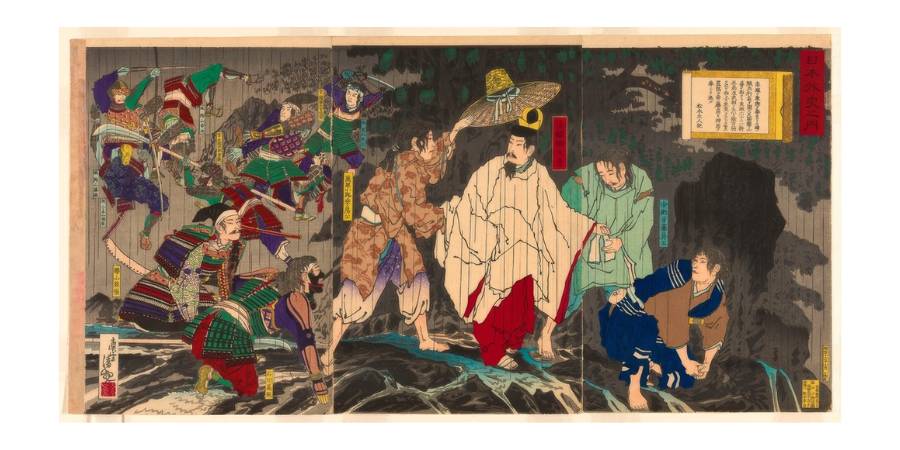
This, expectedly, created deep grievances, and emperor Go-Daigo (1288–1339, r. 1318–1339), sensing a chance to restore imperial rule, rebelled against the Hojo and the bakufu, launching a coup in 1331 that burst the dam of rage against the Hojo. The Kamakura shogunate finally fell in 1333. [3] Feeding on this groundswell, Go-Daigo ascended to the height of power with the help of shugo, landowning officials appointed by the shogun to administer lands and their people who would eventually come to be called daimyo.
His efforts to restore direct imperial rule, known as the Kemmu Restoration, swung the pendulum too aggressively; his land-reform policies greatly incensed small- and medium-sized landowners. [4] His civilian-led court was increasingly at odds with the military families that supported him, which left the door open for a strongman to muscle in amidst the chaos.
Ashikaga Ascends
That strongman was Ashikaga Takauji, a distant descendant of the Minamoto family, seized the chance to reclaim his family’s legacy. Initially supportive of Go-Daigo, Ashikaga too became disillusioned with the former’s bestowing titles and land on nobles. After the emperor rejected his wishes to be appointed shogun, Ashikaga travelled with his forces to Kamakura without permission, finished off the remaining Hojo forces and established a defensive position where Minamoto no Yoritomo had once ruled from.
Now a legitimate locus of power, disaffected samurai rushed to support him, and in 1336 Ashikaga led an assault on Kyoto, toppling the imperial court. [5] The Ashikaga clan ruled from the imperial court until 1378, when the third shogun, Ashikaga Yoshimitsu, relocated the bakufu to the Muromachi district of Kyoto. From this moment, Ashikaga and his descendants would rule for over two-hundred years.

Northern and Southern Courts
The Muromachi bakufu’s grasp was always limited, however. After Go-Daigo escaped from Kyoto, he set up the Southern Court in Nara, and Ashikaga installed Komyo, a noble from the Northern Court, as a puppet emperor. [6] Go-Daigo continued to stage sporadic rebellions against the bakufu. The Southern Court’s efforts were bolstered when Ashikaga Tadayoshi, the younger brother of the ruling Takauji, was exiled for attempting to assassinate an official, and defected to the Southern Court in 1349.
Two years later, Tadayoshi defeated his brother in battle in Kyoto, but Takauji was able to retake the capital. Although Tadayoshi died suddenly in 1352, his descendants continued to serve the Southern Court. [7] This internecine battle lasted until 1392 when the third Ashikaga shogun, Yoshimitsu, finally persuaded the Southern Court’s Emperor Go-Kameyama to hand over authority to Emperor Go-Komatsu of the Northern Court. While they agreed to share the succession between both branches, Go-Komatsu broke the agreement by appointing his son as his heir, thus ensuring that all emperors would descend from the Northern Court lineage.
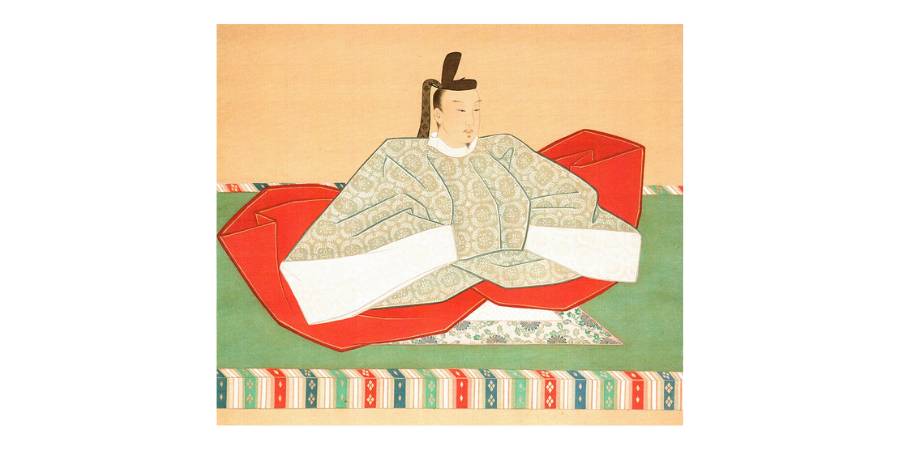
This did not resolve all of the bakufu’s woes, however. The squabbles that characterised the start of the Ashikaga shogunate decentralised power to the extent that shugo were still largely autonomous in their regions. Vested with the power to collect taxes and implement laws in their own lands, the shogun became a largely ceremonial figure with little in the way of real power. [8]

The Onin War and the Collapse of Order
While some shogun, like Yoshimitsu, were able to play off shugo rivalries to balance power, a series of weak and politically inept shoguns plunged the bakufu into crisis. After being invited to a Noh play, the sixth shogun Yoshinori was assassinated in 1441 by a shugo aggrieved by Yoshinori’s handing out of titles. [9] As a result, Yoshinori’s nine-year-old son inherited the seat of power. After only one year, his death resulted in another child, eight-year-old Yoshimasa, becoming the eighth shogun in 1443. And when a succession crisis ensued in 1464 between Yoshimasa’s brother, Yoshimi, and Yoshimasa’s newborn son, Yoshihisa, the unchecked and opportunistic shugo families threw their weight behind whichever candidate they thought would grant them the most power. Thus began the Onin War (1467–77).
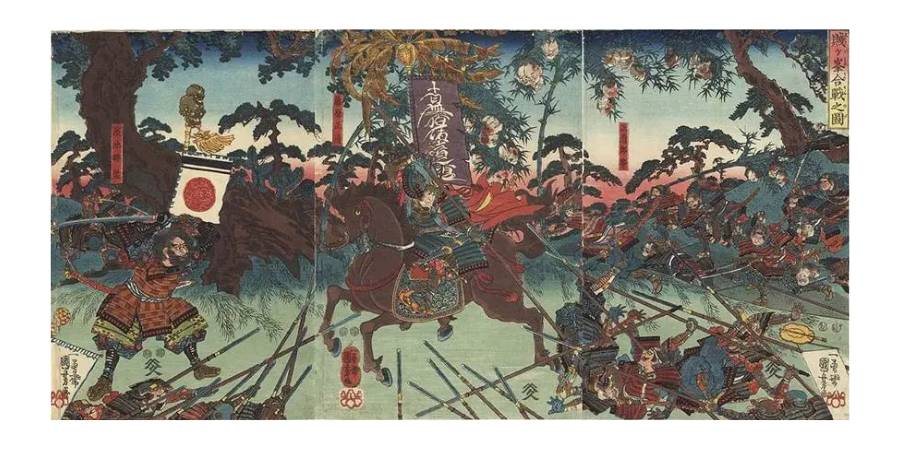
Source: War History Online
The Onin War plunged Japan into chaos, paving the way for a century of war and strife. Source: War History
After countless battles and the deaths of all the instigators of the war, Yoshimasa presided over a burning capital, devoting all his energy to cultural pursuits. From this point, the Ashikaga were powerless remnants of a shogunate that could no longer control the continual wars between shugo families in what would become known as the Sengoku period. [10] War and strife would only end when Japan’s ‘three great unifiers’ – Oda Nobunaga, Toyotomi Hideyoshi and Tokugawa Ieyasu, subjugated the entire country and ushered in the more stable Edo period.
Cultural Flourishing
Despite, or indeed perhaps because of, the political chaos, the Muromachi period was a time of remarkable cultural development, giving Japanese culture a distinctiveness it still bears today. The bakufu’s lack of power over daily life in much of Japan meant that local traditions could flourish, and also left a giant power vacuum for an authority to give ordinary people’s lives a sense of purpose and order. Into that vacuum stepped religion.
Shinto
While Shinto had existed in a primal form since the Yayoi Period (c. 300BC–c. 300AD), the Muromachi period saw it crystallise into an emperor-centred belief system. Again, turmoil and crises made fertile grounds for consolidating the religion: in the Kamakura period, the Mongol invasions – which were seen to have failed thanks to divine intervention in the form of kamikaze (‘divine wind’) that destroyed the Mongol fleet – enforced a sense that Japan was a protected land watched over by the gods and the emperors as their descendants. The division of the imperial line into the Northern and Southern Courts complicated things, but this would become the impetus to further strengthen Shinto in the face of adversity. What resulted was Kitabatake Chikafusa’s Jinno Shotoki (‘A Chronicle of Gods and Sovereigns’) which claimed that the emperors of Japan, directly descended from the sun goddess Amaterasu, and as a result, any quarrel over succession would be resolved by ‘the unalterable mandate of Amaterasu’. [11] His concept of an unbroken succession and the divinity of the emperor would come to hold sway in Japan over the next 600 years.

Details on Aburahi-Jinja, a shrine in Koka city that became a popular point of worship for samurai. Source: Shinobinosato
Shinto developments, however, were seen as extensions of Buddhism rather than separate doctrines, and during the Muromachi period this mix of religions flourished into something completely separate and uniquely Japanese. This process, later to be known as kenmitsu Buddhism, allowed for multiple strands of Buddhism and even other religions, like Confucianism and Shinto, to coalesce under the banner of Buddhism without contradicting it. [12] The most influential school to emerge from this melting pot was Zen Buddhism.
Zen Buddhism
Originally introduced to Japan from Chinese monks in earlier centuries, Zen grew in influence during the Muromachi era, especially through powerful monks like Muso Soseki. With the ears of both emperors and shogun, Muso moved Japan in the direction of Zen Buddhism, and shogun such as Ashikaga Yoshimitsu used Zen to bolster their legitimacy among the ruling classes. [13] This transformed monasteries from religious centres into hubs of culture and art. Zen’s aesthetics of minimalism, introspection and simplicity – a stark contrast to the political turbulence of the time – thus came to colour all forms of Japanese art.
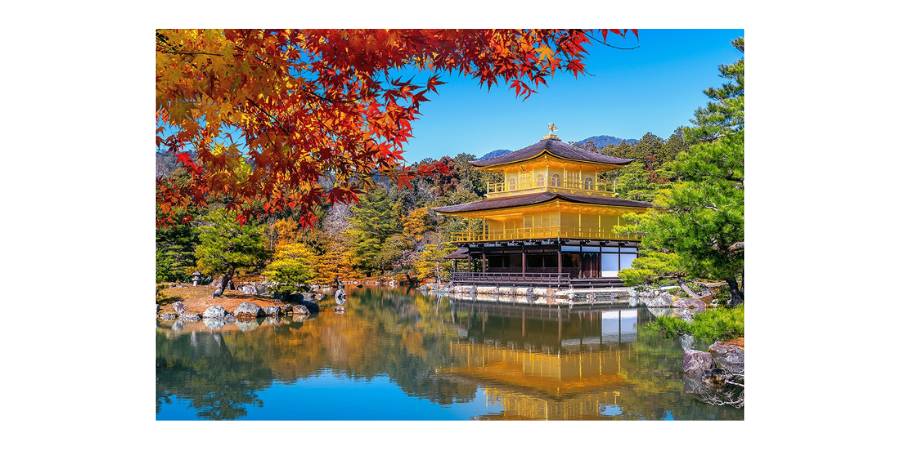
The Kinkaku-ji temple was bought by shogun Ashikaga Yoshimitsu and, after his death, was transformed by his son into a Zen Buddhist complex. Source: Agoda
Suibokuga and sumi-e
One of the most characteristic artistic developments of the era was ink painting, known both as suibokuga (water-and-ink painting) or sumi-e (ink drawings). An exemplary artist was the monk Sesshun Toyo, who fused Chinese art styles with Zen sensibilities to produce some of the period’s most iconic landscape paintings. His exclusive use of blank ink portrayed the landscape as close to its essence as possible, viewing the world through a Zen lens that removes the individual experience in favour of oneness. [14] Zen painting’s connection to the shogunate was formalised with the rise of the Kano school, named after Kano Masanobu, the son of a samurai family who was appointed the official shogunal painter in the late 1400s.
Shoguns commissioned works to decorate castles and depict famous historical and religious scenes (known as yamato-e), further providing legitimacy to the Ashikaga rulers. [15] This school would dominate the visual-arts landscape until well into the nineteenth century.
Noh
But the cultural transformation went beyond painting. Zen aesthetics and philosophy found their way into myriad other mediums, perfecting old forms and creating new ones. Noh, for instance, was honed and refined into the precise and beautiful art form it is today. Like Zen Buddhism, Noh was brought over from China in a protean form known as sangaku, which eventually evolved into sarugaku and dengaku. [16] Various schools cropped up in Japan, and Noh became a fusion of stylised and highly symbolic movement, recited poetry, music and masked performance. Derived from stories in classical Japanese literature, Noh plays usually depict figures in turmoil, such as the ghosts of famous warriors of spurned lovers, with the ultimate goal of achieving yugen (a dark and mysterious beauty).
Critical to Noh’s artistic expression is the masks the shite or main performer wears. There are various types, each carved with a neutral expression designed to express multiple emotions at once, and the mask is so crucial to a good performance that donning the mask takes on a ritualistic form. The actor affixes the mask to their face in a kagami no ma (mirror room), where they face themselves with the mask on in an attempt to embody the mask and its emotions. [17]
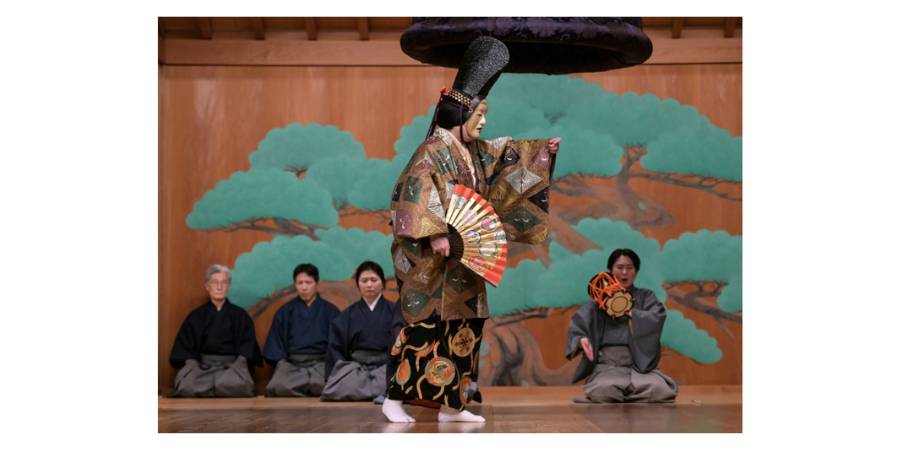
Source: Britannica
Noh became formally entrenched in Japanese culture during the Muromachi period. One Noh actor, Kanami Kiyotsugu, and his son, Zeami Motokiyo, codified the aesthetics of Noh, and many Noh plays are attributed to them. Zeami, in particular, found the favour of shogun Ashikaga Yoshimitsu, who patronised his school of Noh, ensuring that it would dominate the art form up to the present day. [18] This was crucial for Noh’s survival beyond the chaos of the Muromachi period, as shogunal support created a link between Noh and the samurai class, who would grow in power and come to inherit the country. Indeed, the Tokugawa shoguns heavily patronised Noh, and in their time as in our own, the Noh they watched remained unchanged since Zeami’s time.
Conclusion
The Muromachi period was fraught with difficulties, raising questions about the power of the emperor and the shogun alike. The decline of the Ashikaga shogunate plunged Japan into the Sengoku period, a century of civil war and bloodshed that would see the emperor reduced to a mere figurehead and the warrior classes controlling the entire country.
At the same time, the period witnessed the complete reorientation of Japanese culture. While the Heian period represented the pinnacle of court-based culture and traditions, this era drew its culture from myriad sources, including monks and provincial lords. Shogunal patronages deeply affected the direction of Japanese culture, and its most striking cultural expressions continue to shape how we conceptualise Japan. Most importantly, it shows that cultural and artistic achievements can shine through war, chaos and disorder.
Sources
[1] P L Kessler, ‘Hojo Regents (Shikken)’, The History Files (1999)
[2] Victoria Hartley and Thomas Connelie, ‘Japan in Chaos: Sengoku Period’, Old Dominion University, p. 3
[3] George Sansom, A History of Japan 1334–1615 (Stanford University Press, 1961), p. 21
[4] Ibid., p. 37
[5] Ju, ‘日本史上最悪だった男~足利尊氏’ [Japanese history’s worst man – Ashikaga Takeuji’, Guidoor Media (2019)
[6] Ogawa Makoto, ‘南北朝時代’ [Northern and Southern Courts period], ジャパンナレッジ
[7] Ju, op. cit.
[8] Yasutaka Yumoto, ‘名ばかり将軍たちの悲哀...室町幕府ははぜ“ゆるブラック企業”的な存在に?トップの無力ぶりを検証‘, Japaaan Magazine (2025)
[9] Ju, ‘足利義教「くじ引き将軍」は万人恐怖の独裁者だったのか?」Guidoor Media (2023)
[10] ‘室町幕府の崩壊は本当に八代将軍足利義政から始まったのか?56年の生涯まとめ’, BUSHOO!JAPAN (2025), https://bushoojapan.com/jphistory/middle/2025/01/06/113332
[11] Adam Wheeler, ‘The Contradictions of Kitabatake Chikafusa’s Jinno Shotoki: How the Jinno Shotoki Shows that Japan is Not Shinkoku’, BYU Asian Studies Journal, vol. 3 (2010), p. 6
[12] Kuroda Toshio, ‘Shinto in the History of Japanese Religion’, Journal of Japanese Studies (1981), trans. James C. Dobbins and Suzanne Gay, p. 20
[13] Yoshiyuki Tomishima, ‘Imperial Authority and Esoteric Space in Medieval Japan’, Panel: The Rise of Zen: Changes in the Medieval Buddhist Landscape, European Association for Japanese Studies (2017)
[14] Shigenori Nagatomo, ‘Japanese Zen Buddhist Philosophy’ in Zalta and Nodelman (eds), The Stanford Encyclopedia of Philosophy (2024)
[15] Joseph Dewey, ‘Kano School (painting)’, EBSCO (2022)
[16] ‘Origins of History’, TheNoh.com
[17] Museum of Fine Arts, Boston, ‘Essence of Noh Theater’, YouTube.com (2024). For more information on each of the masks, please see this link.
[18] Matthew R. Dubroff, ‘Cutting-Edge Samurai Theater: Noh Then, Noh Now, Noh Tomorrow’, Association for Asian Studies, Education About Asia, Volume 21:1 (Spring 2016)