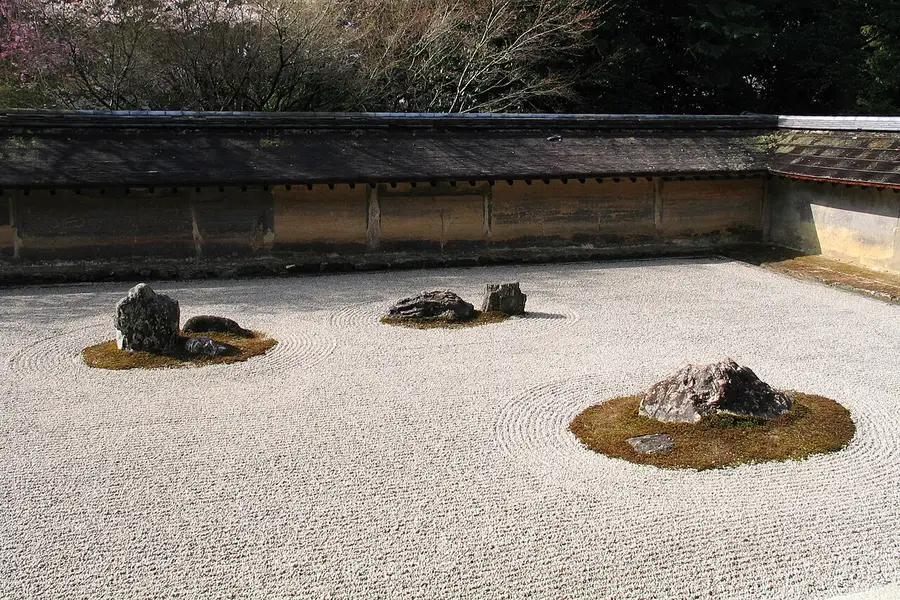
Ryoanji is a Zen temple in north-west Kyoto, famous for a single rectangle of raked white gravel. Fifteen stones sit on it in five groups, enclosed by a low earthen wall. Nobody knows for certain who made the garden, and the temple itself lists that as one of its mysteries.
The warlord Hosokawa Katsumoto founded the temple in 1450, and since 1994 it has been part of the UNESCO World Heritage Site covering the historic monuments of ancient Kyoto. The garden is built to look deeper than it is, and the hall behind it has new dragon paintings on show until July 2027. The Italian writer Italo Calvino sat on its veranda in 1976 and turned the visit into a chapter of a novel.
How Kyoto's Most Famous Zen Rock Garden Works
Fifteen stones in 248 square metres of raked gravel
The garden in front of the abbot’s quarters (the Hōjō) measures about 25 metres wide and 10 metres deep, or 248 square metres. The temple counts its stones in groups of five, two, three, two and three, reading from the east. Each group sits on a low island of moss, and everything else is white gravel raked into straight lines, with rings drawn around each island.
That is the whole garden. There are no trees inside the wall, no water and no path. The style is called karesansui, the Japanese dry landscape garden, and Ryoanji is Japan’s best-known example.
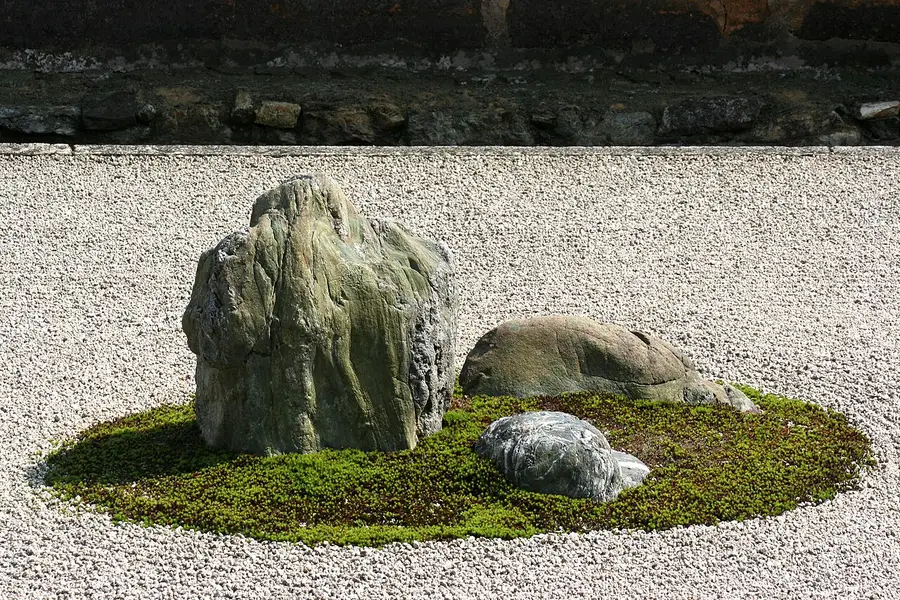
Sit anywhere along the veranda and at least one stone stays hidden behind another. Britannica notes that the fifteen cannot all be seen from any single point on the ground, so you would need to look down from above to see every one at once. Some guides read this as a lesson about the limits of what one person can see. The temple does not say that was the intention.
The temple’s own name for the layout is “the tiger crossing the river with her cubs”, and the garden is also known by the numbers seven, five and three. Other readings see islands in a sea, or mountain peaks above cloud. Whoever set the stones left no explanation, so each reading remains an interpretation.
What a 2002 study in Nature found in the empty gravel
In 2002 the journal Nature published a short study by Gert van Tonder, Michael Lyons and Yoshimichi Ejima (Visual structure of a Japanese Zen garden). They mapped the empty space between the stone groups and found that it had a hidden structure, aligned with the building. The researchers reported that the shape traced by the gaps branches like a tree, with its trunk running back to the best viewing spot in the Hōjō.

The sloping ground and oil-and-clay wall behind the illusion of depth
Ryoanji’s official guide lists four things nobody can fully explain, and two of them are about how the garden tricks the eye.
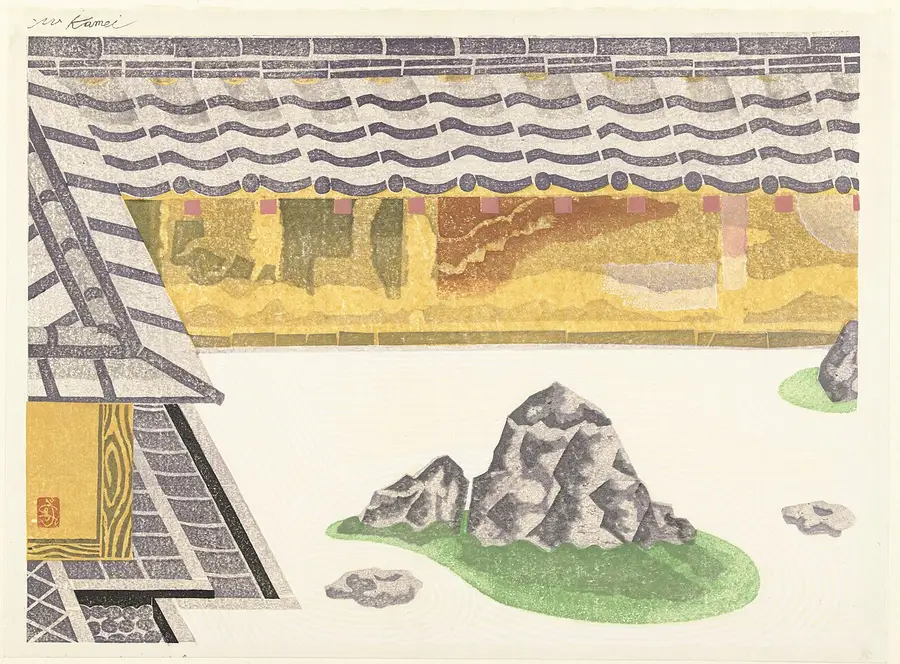
The first is the ground. The gravel bed is not flat. It slopes gently down towards the south-east corner, which drains rain away and also makes the far side of the garden appear further off than it is.
The second is the wall. The west wall gets lower towards its far end, so it reads as receding into the distance. The temple describes it as 180 centimetres of clay mixed with rapeseed oil, and the garden behind it sits about 80 centimetres higher than the ground on the outside. Look closely and its surface is mottled in browns and greys.
The other two mysteries are the designer and the stones’ arrangement. Names are carved on the back of one stone: “Kotarō” and a second name ending “jirō”, its first character worn away. They are thought to belong to the garden workers who set the stones. Tradition has long credited the painter Sōami, and the temple says plainly that there is no definite proof.
Founded by Hosokawa Katsumoto in 1450, rebuilt after the Ōnin War
The site began as a villa of the Tokudaiji family of court nobles. In 1450 Hosokawa Katsumoto, one of the most powerful men in the shogun’s government, turned it into a Zen temple, with the monk Giten Genshō as its first abbot. It belongs to the Myōshin-ji branch of the Rinzai school of Zen.
Within twenty years Katsumoto was leading the Eastern Army in the Ōnin War, the decade of fighting from 1467 that left much of Kyoto in ashes, Ryoanji included. His son Hosokawa Masamoto rebuilt it. The temple dates its Hōjō to 1499 and says the rock garden was presumably laid out at the same time, though historians still debate the date.
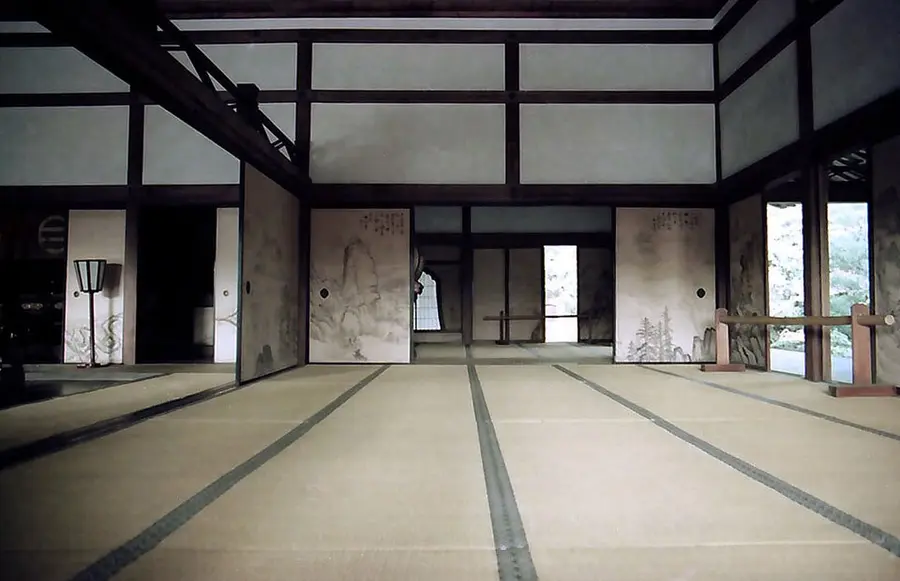
A fire in 1797 destroyed the Hōjō again. The hall you sit in today was moved here from Seigen-in, one of Ryoanji’s subtemples, and was built in the early 1600s by Oda Nobukane, a younger brother of the warlord Oda Nobunaga. It is an Important Cultural Property.
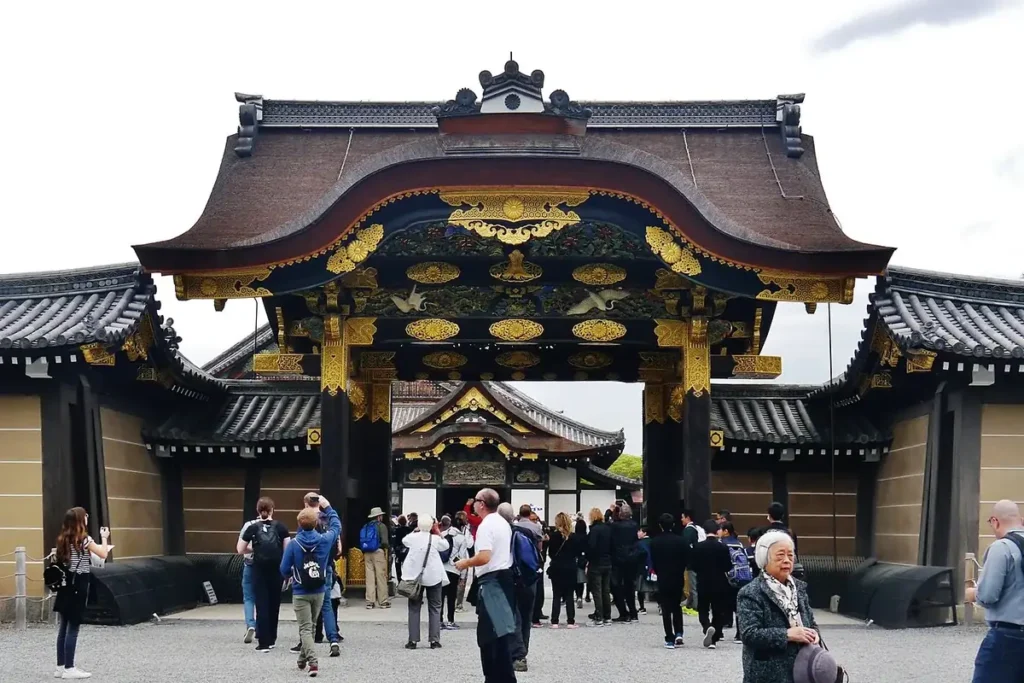
On 10 May 1975 Queen Elizabeth II came to Ryoanji during her state visit to Japan. The temple records that she and the Duke of Edinburgh entered through its Karamon gate and viewed the garden from the Hōjō.
The tsukubai water basin and Kyoyochi pond
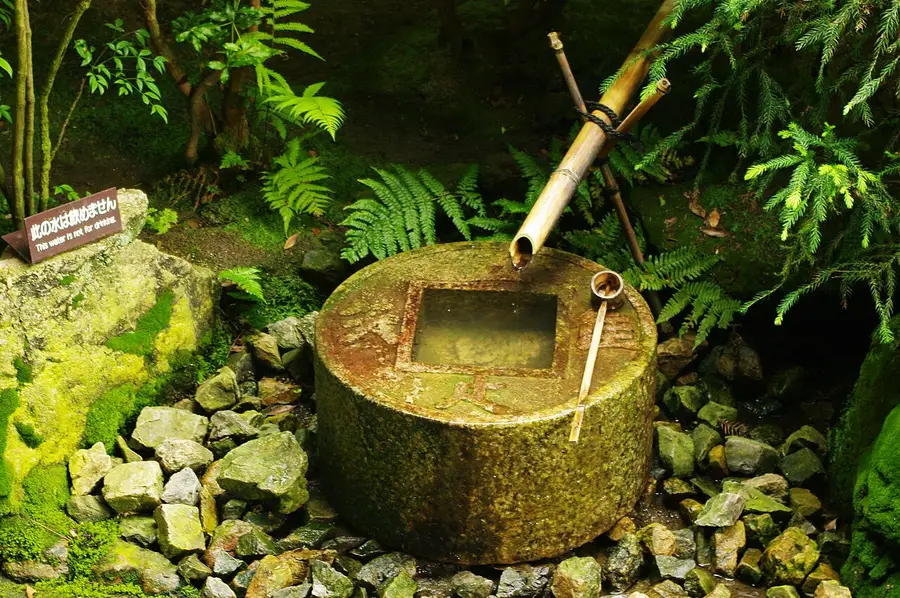
Follow the path round the back of the Hōjō and you reach a small stone basin, a tsukubai, low enough that you have to crouch to use it. A tsukubai is where guests rinse their hands and mouths before a tea ceremony.
The basin is a visual puzzle. Four characters are carved around its square water hole, and the square itself completes each one. Read together they say 吾唯足知 (ware tada taru wo shiru), “I only know contentment”, the Buddhist idea that a person who is satisfied with what they have is rich even when poor. The temple says the basin is traditionally held to be a gift from Tokugawa Mitsukuni, a grandson of the first Tokugawa shogun. The one beside the path is widely reported to be a replica, with the original kept near a tea room that is closed to visitors.
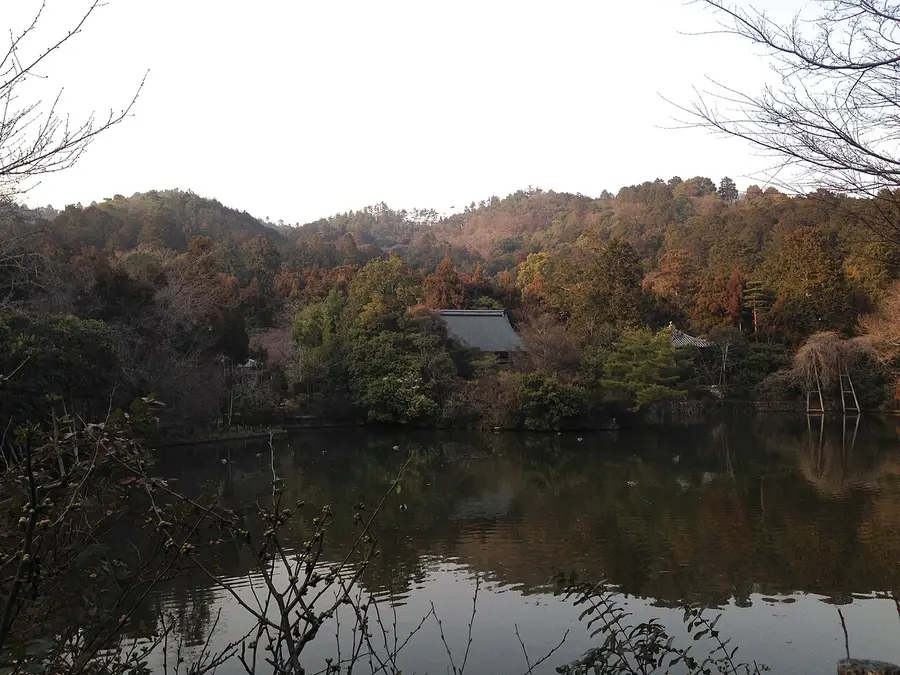
The grounds carry on well beyond the rock garden. Below the Hōjō lies Kyoyochi pond, where the temple says Heian period nobles once went boating. It was famous for mandarin ducks, and the temple says ducks and herons are still seen there today. A path loops all the way round it. Seigen-in, the subtemple that gave Ryoanji its Hōjō, runs a restaurant in the grounds serving yudofu (tofu simmered in kelp broth).


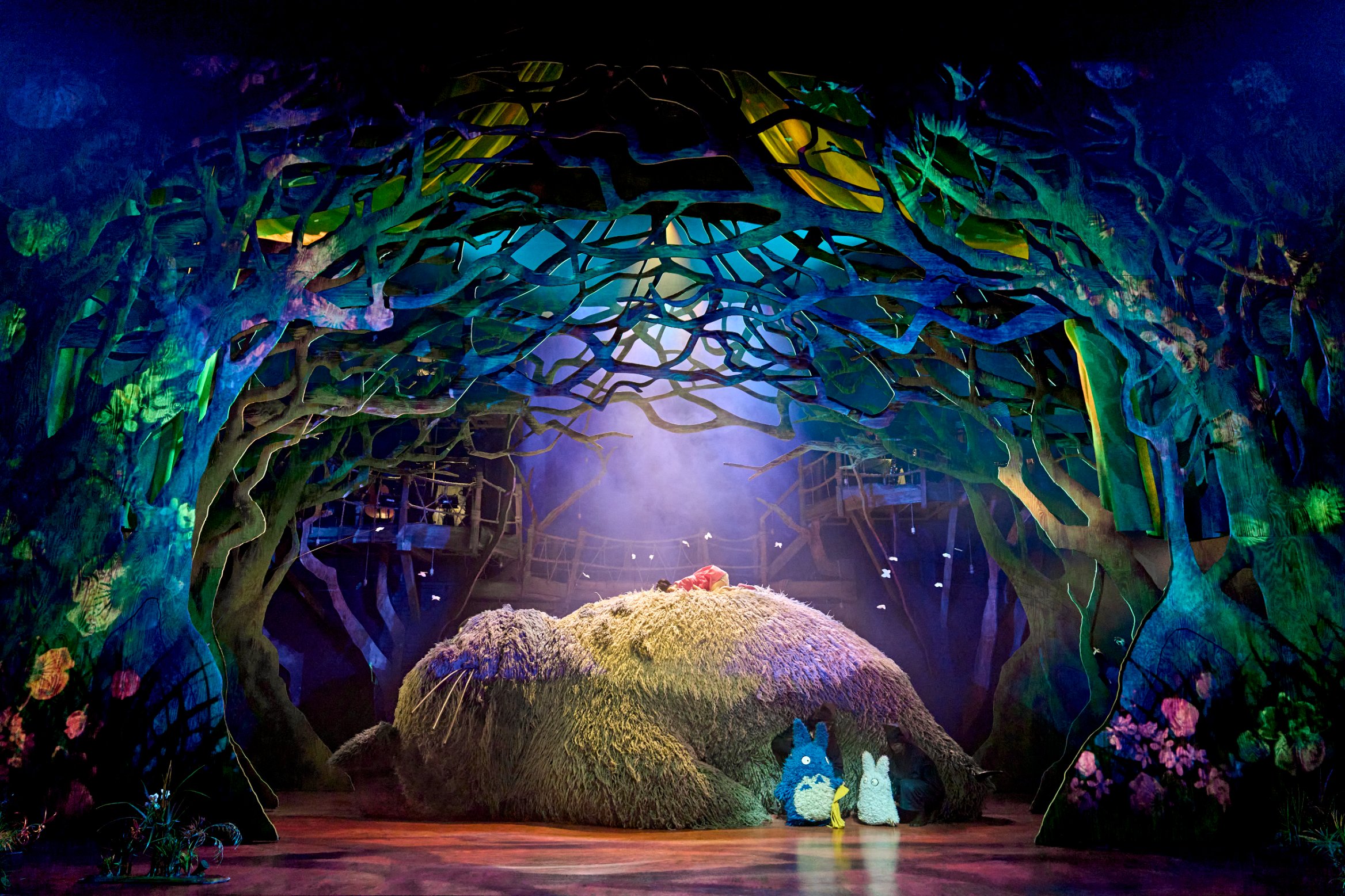


Hosokawa Morihiro’s cloud dragon paintings, on show until July 2027
Ryoanji has new art inside the Hōjō this year. Hosokawa Morihiro, Japan’s prime minister in 1993 and 1994 and later a painter and potter, comes from the same Hosokawa clan that founded the temple. He has completed a set of 92 painted panels for the hall, including 42 sliding door paintings (fusuma). Their subject, the temple’s notice says, is dragons among clouds.
From 12 September 2026 to 25 July 2027, 32 of the sliding door paintings and some of the wooden doors are on display at normal admission, with no extra charge (temple notice, in Japanese).
The full set of 92 can be seen only on special evening openings, on Saturdays and Sundays until 29 November 2026, from 16:00 to 18:30. They cost ¥5,000, take up to 20 people a day, are guided in Japanese only, and have to be booked in advance through the Kyoto City Tourism Association. Children of primary school age and younger are not admitted.
What Italo Calvino and John Cage took from the garden
Two Western artists came to Ryoanji for a single visit and carried it into their work for years afterwards.
Italo Calvino and the sand garden in Mr Palomar
The Italian novelist Italo Calvino spent 5 to 18 November 1976 in Japan as a guest of the Japan Foundation, travelling between Kyoto, Nara, Tokyo and Nikko. In Kyoto a young student of Italian literature, Wada Tadahiko, was his guide around the gardens, and later translated Mr Palomar into Japanese. These details come from a 2021 Durham University study by Claudia Dellacasa, Italo Calvino in Japan, Japan in Italo Calvino, which pieces the trip together from the Japan Foundation’s records, a postcard Calvino sent to a friend and interviews with the people he met (Dellacasa, 2021).
Calvino wrote up the visit for the Italian newspaper Corriere della Sera, and his Ryoanji piece became “The sand garden”, a chapter of the last novel published in his lifetime, Mr Palomar (1983; English translation by William Weaver, 1985). It sits in the book’s third part, “The Silences of Mr. Palomar”.
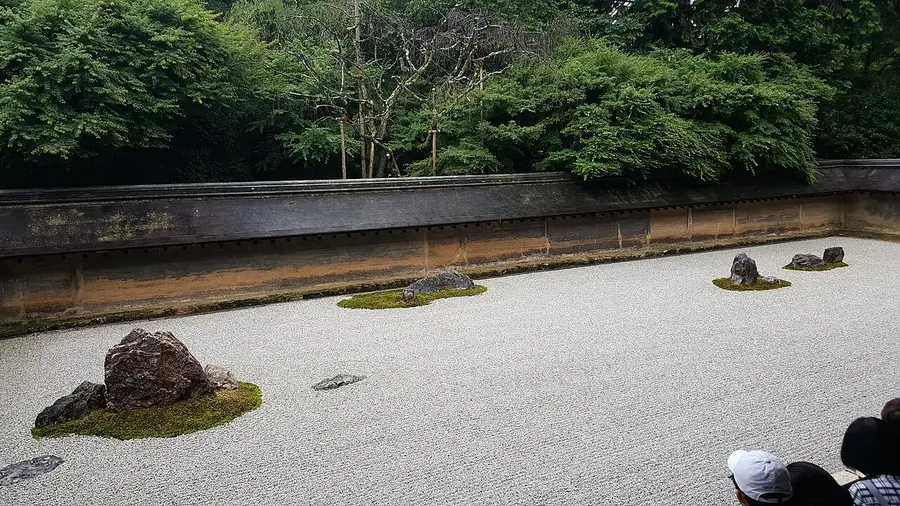
The chapter is honest about the crowds. Mr Palomar arrives expecting to contemplate the absolute with the simplest means and without words, as Zen teaching promises, and finds the veranda full of tourists. He can only see the garden by craning his neck between other people’s. Instead of giving up, he decides to look at it the only way it can be seen today. The thousands of sand grains become the crowd, a levelled mass that is still made of separate people, and the stones become the world. Between the two he senses a possible harmony, joining the balance of forces in the natural world with the human urge to arrange things in geometric or musical order.
Calvino also walked the stroll garden at Katsura Imperial Villa on the same trip, and wrote about it in his essay collection Collection of Sand.
John Cage’s Ryoanji
The American composer John Cage visited Ryoanji in 1962 while touring Japan. Twenty years later it gave its name to a series of works. His Ryoanji pieces for solo instruments, including oboe, voice, flute, double bass and trombone, were written between 1983 and 1985.
At the same time he made about 170 Ryoanji drawings, from 1983 to 1992. For these he traced around fifteen stones from his own collection, placing each one on the paper by chance operations taken from the I Ching, the ancient Chinese book of divination, and even choosing the pencils by chance (National Gallery of Art, Washington). His drawings borrow the garden’s central idea, a fixed number of objects set in open space.
Ryoanji opening hours, admission and how to get there
Opening hours and admission
These are the temple’s own figures (ryoanji.jp), checked on 9 November 2026.
| 1 March to 30 November | 8:00 to 17:00 |
| 1 December to end of February | 8:30 to 16:30 |
| Adults | ¥600 |
| High school students | ¥500 |
| Primary and junior high school students | ¥300 |
| Open | Every day |
The temple suggests allowing 30 to 40 minutes. Shoes come off at the entrance to the Hōjō. Visitors coming by car can park free for one hour.
Getting there from Kyoto Station and the city centre
Ryoanji sits in the north-west of Kyoto, and the temple gives these routes:
- From Kyoto Station: city bus 50 to Ritsumeikan Daigaku-mae, then a seven-minute walk.
- From Keihan Sanjō Station: city bus 59 to Ryoanji-mae, which stops at the gate.
- By train: the Keifuku Kitano Line (the Randen tram) to Ryoanji Station, then a seven-minute walk.
Our Kyoto guide explains Kyoto’s city buses and day passes.
When to go
The quietest time is straight after the gate opens at 8:00. Tour groups and school parties arrive through the morning, and by then the veranda looks much as Calvino found it in 1976. Late March to early April brings cherry blossom over the top of the wall, and late November to early December brings maples around the pond.
Ryoanji makes an easy half day with other Zen gardens. Our seven-day itinerary pairs Ryoanji with the Daitoku-ji subtemples in a single morning, about 2.5 kilometres east.
Ryoanji Questions and Answers
There are fifteen, set in five groups of five, two, three, two and three, counting from the east. From the veranda at least one is always hidden behind another.
Nobody knows. The painter Sōami is the traditional attribution, but the temple says there is no proof. Two names, Kotarō and a second ending in “jirō”, are carved on the back of one stone and probably belonged to the workers who set it.
The temple names the layout “the tiger crossing the river with her cubs”. Other readings see islands in the sea or mountain peaks above cloud. The garden came with no written explanation, so every reading is an interpretation.
Adults pay ¥600, high school students ¥500, and primary and junior high school students ¥300. The cloud dragon paintings in the Hōjō are included until 25 July 2027.
The temple suggests 30 to 40 minutes, which leaves time for the rock garden, the basin and a walk round Kyoyochi pond.
Yes. It has been part of the Historic Monuments of Ancient Kyoto site since 1994.
Sources and further reading
- Ryoanji official site: ryoanji.jp
- Claudia Dellacasa, Italo Calvino in Japan, Japan in Italo Calvino. A Cross-cultural Encounter, doctoral thesis, Durham University, 2021
- Italo Calvino, Mr Palomar, translated by William Weaver (Vintage)
- G. van Tonder, M. J. Lyons and Y. Ejima, Visual structure of a Japanese Zen garden, Nature 419 (2002)
- UNESCO, Historic Monuments of Ancient Kyoto