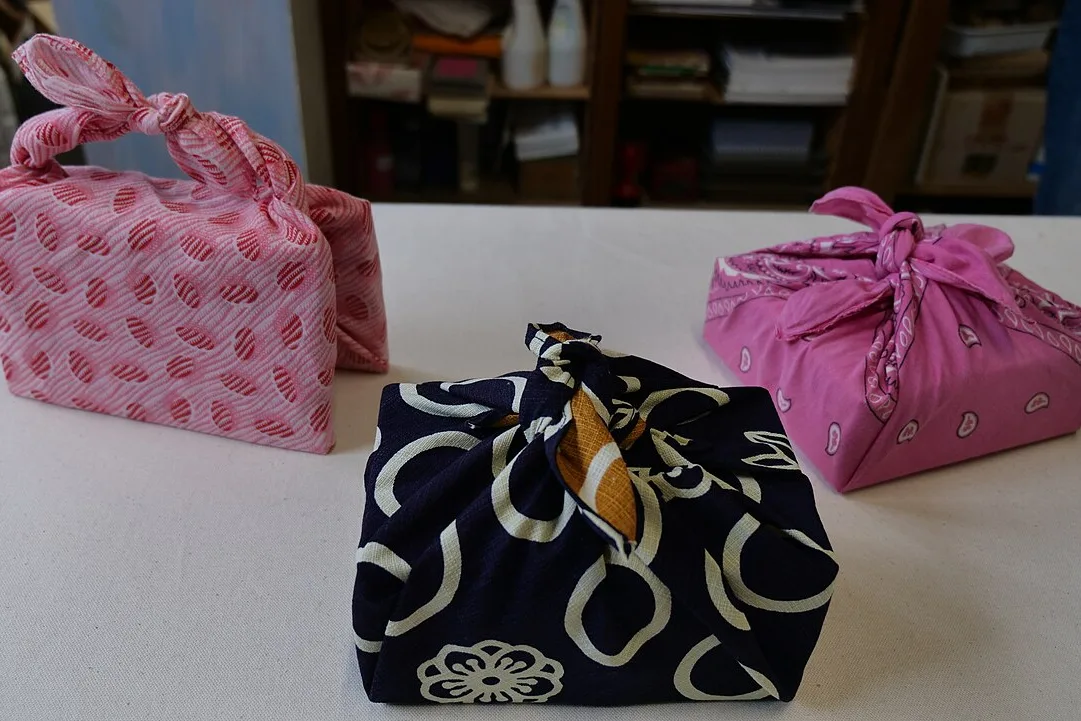
A furoshiki is a square Japanese cloth for wrapping and carrying things, tied with a knot and used again and again. A 70cm cloth is enough to wrap a wine bottle or a gift box, and the name, bath spread, comes from the bathhouses where people once bundled their clothes in it.
This guide explains where furoshiki came from and which size to buy, gives step-by-step wraps for a bottle, a book and a gift box, and lists where to buy furoshiki in London, with prices checked on 1 November 2026.
Furoshiki at a glance
Name: 風呂敷, from furo, bath, and shiki, to spread.
Most useful size: about 70cm square, which the Heibonsha World Encyclopedia calls the usual size today.
Materials: cotton, silk and polyester.
Buy in London: Japan House London’s shop on Kensington High Street, from £12 for a 45cm cloth.
How to Wrap With Furoshiki, and Where to Buy One
From Heian Bundles to Edo Bathhouses: Where the Furoshiki Came From
Wrapping things in cloth is far older than the word furoshiki. Yamada Sen-i, the Kyoto furoshiki maker founded in 1937, cites records from the Nara period (710 to 794) of valuables kept wrapped in cloth, and Japanese dictionaries trace a square carrying cloth called hirazutsumi, a flat wrap, to Heian-period picture scrolls. In medieval Japan it was also called koromo-zutsumi, a clothes wrap.
The new name arrived with the bathhouse. Japanese encyclopedias link it to the spread of public baths from the late Muromachi period, and Yamada Sen-i explains that bathers wrapped their clothes in the cloth so they would not get mixed up with anyone else’s, then stood on it to dress. The company notes that the word furoshiki appears in the list of belongings left by the shogun Tokugawa Ieyasu (1543 to 1616), and by the middle of the Edo period the two names had merged, with hirazutsumi fading out of use.
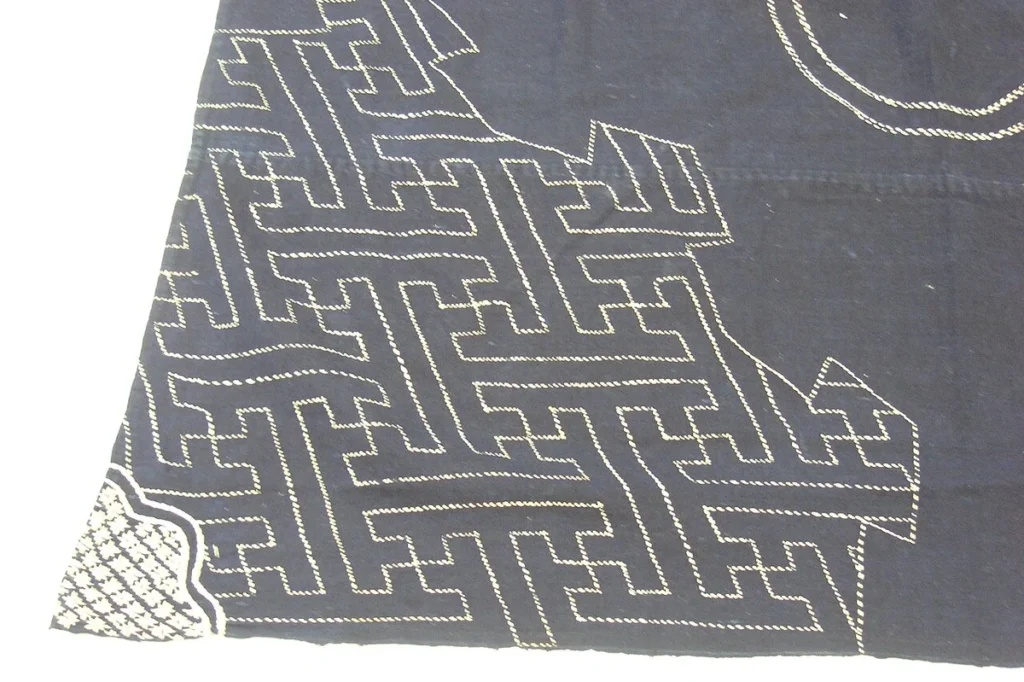
Edo merchants and peddlers then made the cloth a working tool. Heibonsha’s encyclopedia describes merchants’ hemp furoshiki three to seven cloth widths across, and Nipponica notes that large ones also wrapped apprentices’ bedding. The scrolling karakusa vine became the classic furoshiki pattern, and some cloths were reinforced with sashiko stitching to make them last.
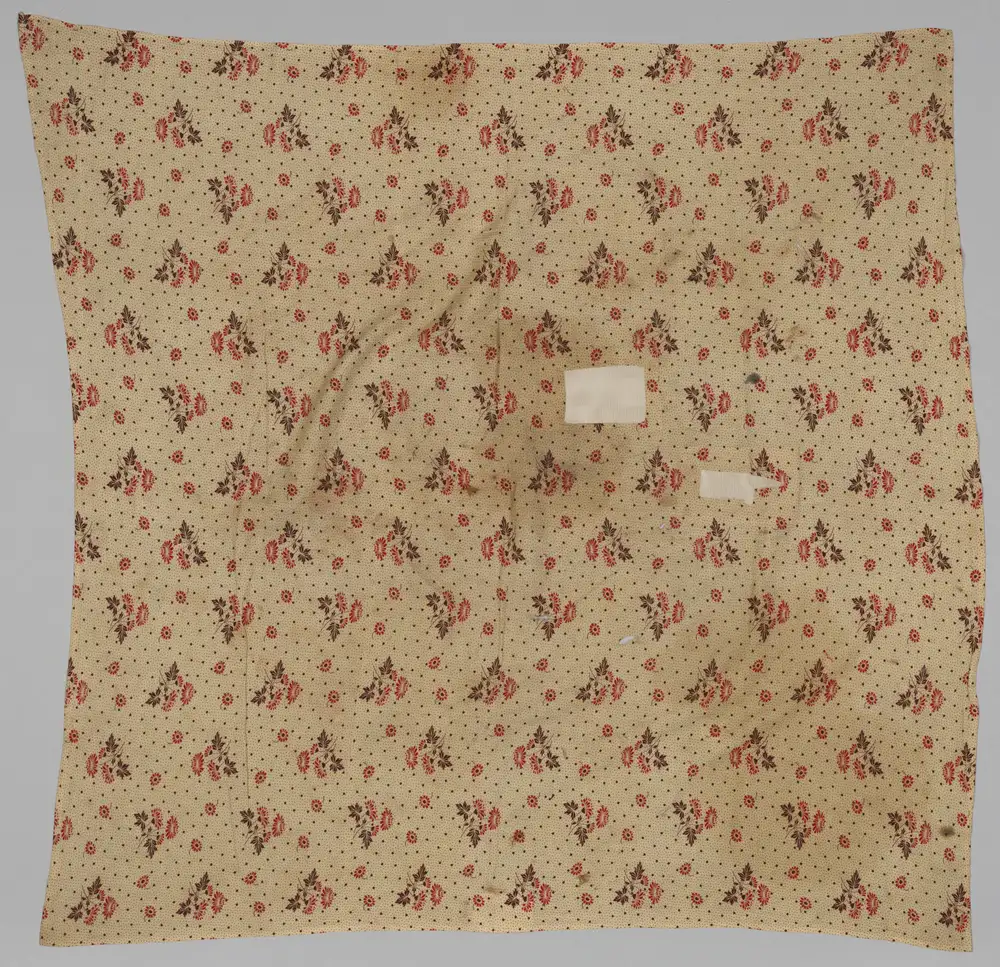
Wrapping a gift well mattered too. The American writer Eliza Scidmore, writing in 1891 about Kyoto’s cloth dealers, described the fukusa, a square of embroidered satin or crêpe that etiquette required to be laid over a box holding a gift, admired, and returned to the sender with the box. The season, the gift, the giver and the receiver all decided which cloth was chosen, and symbols of long life such as pine, plum and bamboo carried that wish along with the present. The same thinking works for furoshiki: choose the cloth for the person.


Furoshiki Sizes, From 45cm Lunch Cloths to 120cm Bags
Furoshiki are sold by the length of one side. Yamada Sen-i groups its range into four sizes, and the table matches each to a job, with an example you can buy in London.
| Size | Side length | Good for | London example, checked 1 November 2026 |
|---|---|---|---|
| S | 45 to 50cm | A lunchbox or a small gift box | Japan House London, Yamada Sen-i Toki-iro Rikyubai, 45cm, £12; Japan Nakama shop, Bento Furoshiki, 50 x 52cm, £19.99 |
| M | 68 to 70cm | A wine bottle, a hardback book, most gift boxes | Japan House London, Yamada Sen-i Kompeito, 70cm, £22 |
| L | 90 to 120cm | Large boxes, or tying into a bag | Japan House London, Yamada Sen-i Isa Monyo Chrysanthemum, 90cm, £22 |
| XL | 130 to 195cm | Bedding and large parcels | None found in stock in London |
Older Japanese sizes were counted in haba, the width of a bolt of cloth. The Mypedia encyclopedia gives a futahaba, two widths, as about 75cm, and Nipponica records cloths of about 136cm as large furoshiki. If you buy one cloth, make it the M size: Yamada Sen-i sells its 68 to 70cm range for gift wrapping and wine bottles. The 50cm size is the one sold for lunches, and our history of the bento box shows what usually goes inside.
How to Wrap a Wine Bottle in a Furoshiki
You need an M cloth (68 to 70cm) for a standard 75cl bottle. The finished wrap has a carrying loop at the top.
- Lay the cloth flat, wrong side up, and stand the bottle in the centre.
- Lift two opposite corners up over the bottle and tie them together in a square knot just above the cap.
- Take the two remaining corners and wrap them round the bottle in opposite directions, so they cross behind it.
- Bring both ends round to the front and tie a second square knot against the bottle.
- Smooth the cloth, then tuck in or spread out the ends of the top knot to form a handle.
Tie a square knot by passing the right end over the left and under, then the left end over the right and under. Pulled tight, it sits flat; to untie it, pull one end straight and the knot slides off.
How to Wrap a Book With No Knot: Hira Tsutsumi
Hira tsutsumi, the flat wrap, uses no knot, which suits a book and gives a neat, formal finish. Use an S cloth for a paperback and an M cloth for a hardback.
- Lay the cloth as a diamond, wrong side up, and place the book in the centre with its spine facing you.
- Fold the near corner over the book.
- Fold the left corner over, then the right, keeping the edges tight against the book.
- Fold the far corner over the top, so its point sits over the centre of the book.
- Tuck the point under the folds, or let it lie flat if the cloth is heavy.



How to Wrap a Gift Box: Otsukai Tsutsumi
Otsukai tsutsumi, the errand wrap, is the basic furoshiki wrap. Yamada Sen-i recommends it for cube-shaped and long boxes and for cylinders.
- Lay the cloth as a diamond, wrong side up, and put the box in the centre.
- Fold the near corner over the box and tuck any spare cloth under the box’s far edge.
- Fold the far corner over the top towards you.
- Lift the left and right corners up over the box.
- Tie them in a square knot in the middle of the top, and spread the ends into two neat ears.
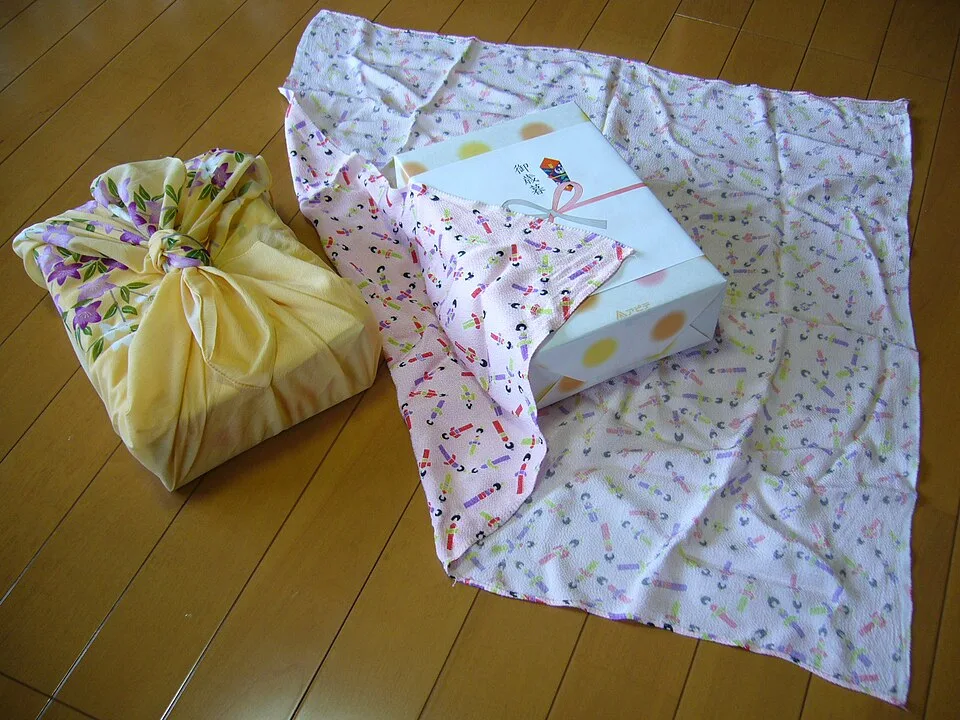
Scidmore’s fukusa went back to the sender with the box. Giving the cloth along with the present makes it part of the gift, which suits Christmas: our guide to Christmas in Japan covers what people give and how.
Mottainai Furoshiki: The Environment Ministry’s 2006 Wrapping Cloth
Furoshiki became government policy in 2006. Yuriko Koike, then Japan’s Minister of the Environment, produced a “Mottainai Furoshiki” as an alternative to plastic carrier bags and paper bags, made of cloth recycled from PET bottles and printed with paintings by the Edo-period artist Itō Jakuchū. It came in two designs from his Colourful Realm of Living Beings series in the Imperial collection: red with Peonies and Small Birds, and green with Insects at a Pond. In a government email newsletter on 22 December 2005, Koike wrote that furoshiki can be reused many times, unlike wrapping paper or carrier bags, and that carrier bags were then producing about 600,000 tonnes of rubbish a year.
The ministry’s own page records where the cloth went next. On 22 January 2006 it was given to the Japanese team for the Turin Winter Olympics, on 6 March 2006 Koike showed it to about 80 delegates at a reception for senior officials of the 3R Initiative, the international effort to reduce, reuse and recycle waste, and from 3 to 28 April 2006 it was shown at a FUROSHIKI exhibition at Creation Gallery G8 in Ginza. Mottainai means a feeling of regret at waste, and Koike later carried the idea to Paris as Governor of Tokyo, as an organiser of FUROSHIKI PARIS outside Paris City Hall with the city’s mayor, Anne Hidalgo.
Where to Buy Furoshiki in London
Checked on each shop’s own site on 1 November 2026. Stock moves quickly before Christmas, so check before you travel.
| Where | What | Price | Address or how to buy |
|---|---|---|---|
| Japan House London shop | Yamada Sen-i (MUSUBI) furoshiki from 45cm to 90cm, and a black walnut furoshiki bag handle | £12 to £22; handle £43 | 101-111 Kensington High Street, W8 5SA |
| Japan Nakama shop | Japanese Bento Furoshiki, 50 x 52cm, nine designs | £19.99, free shipping | Online |
| Yokimono Japanese Christmas markets | Japanese makers and vintage stalls; furoshiki demonstrations ran at the 2025 market | Free entry | The Factory, Dalston, 5 and 6 December 2026; Queen Elizabeth Olympic Park, Stratford, 13 December 2026 |
Map of Japan House London
Japan House London, Kensington
The shop at Japan House London stocks furoshiki by Yamada Sen-i, the Kyoto maker behind the MUSUBI brand. On 1 November 2026 its shop listed the 45cm Toki-iro Rikyubai and the Katami-gawari at £12, the 70cm Kompeito, the 90cm Isa Monyo Chrysanthemum and the reversible Isa Monyo Wave at £22, and a 90cm cloth with a design by the Taishō-era artist Takehisa Yumeji at £20. A black walnut handle (£43) turns a large cloth into a bag. Yamada Sen-i’s own Ms Yamada ran a furoshiki workshop in the shop in November 2025, and in December 2025 Japan House held a free drop-in evening with furoshiki and tenugui wrapping workshops; dates for 2026 had not been announced when we checked. See the Japan House London shop.
Address: 101-111 Kensington High Street, London W8 5SA. Open: Monday to Saturday 10am to 8pm, Sundays and bank holidays 12pm to 6pm (closed from 4pm on 10 November 2026). Nearest Tube: High Street Kensington.
The Japan Nakama shop, online
The Japan Nakama shop’s Japanese Bento Furoshiki is a 50 x 52cm cloth in nine designs, sized for a lunchbox or a small gift, at £19.99 with free shipping.
Yokimono Christmas markets, Dalston and Stratford
The Yokimono Japanese market holds two Christmas markets this year: at The Factory, 21-31 Shacklewell Lane, Dalston, on 5 and 6 December 2026, and at Queen Elizabeth Olympic Park in Stratford on 13 December 2026. Its 2025 Christmas market had furoshiki wrapping demonstrations, and in May 2026 Tamakurya Boutique, which makes furoshiki from Ankara textiles, taught a furoshiki workshop at the Stratford market. The traders for December had not been published when we checked.
Furoshiki: Questions and Answers
A furoshiki is a square Japanese cloth used to wrap and carry things, tied with a knot and reused. The name means bath spread: Japanese encyclopedias link it to the public baths of the late Muromachi and early Edo periods, where bathers wrapped their clothes in it. Older names for the same cloth include hirazutsumi, which appears in Heian-period picture scrolls.
For one all-purpose cloth, buy about 70cm square. Yamada Sen-i, the Kyoto maker founded in 1937, sells its 68 to 70cm size for gift wrapping and wine bottles, its 45 to 50cm size for lunchboxes and small gifts, and 90 to 120cm cloths for large boxes and bags. In London, Japan House London sold a 70cm Yamada Sen-i cloth for £22 on 1 November 2026.
Use a 70cm cloth. Stand the bottle in the centre, tie two opposite corners together in a square knot above the cap, wrap the other two corners round the bottle in opposite directions so they cross behind it, then bring them to the front and tie a second square knot. The top knot doubles as a carrying handle.
It is a furoshiki produced in 2005 and 2006 by Yuriko Koike, then Japan’s Minister of the Environment, as an alternative to plastic and paper bags. According to the ministry’s own page, it was made of cloth recycled from PET bottles and printed with paintings by Itō Jakuchū, and it was given to Japan’s team for the 2006 Turin Winter Olympics.
Japan House London’s shop at 101-111 Kensington High Street stocks Yamada Sen-i furoshiki from £12 for 45cm to £22 for 90cm, checked on 1 November 2026. The Japan Nakama shop sells a 50 x 52cm Bento Furoshiki for £19.99 online, and the Yokimono Japanese Christmas markets run in Dalston on 5 and 6 December and in Stratford on 13 December 2026.
It can be used again and again. Yuriko Koike, launching the Mottainai Furoshiki as Environment Minister, wrote that furoshiki can be reused many times, unlike wrapping paper or carrier bags, and that carrier bags were then producing about 600,000 tonnes of rubbish a year in Japan.