Nishiki Market is a covered food street in central Kyoto, about 390 metres long, running east from Takakura-dori to Teramachi-dori one block north of Shijo-dori. There is no single opening time: each of its 130 or so shops sets its own hours, and most trade from about 9am or 10am until 5pm or 6pm, with many closed on Wednesdays.
The market’s own association asks one thing of visitors above everything else: do not walk along eating. Eat at the counter or inside the shop where you bought the food. Here is how that works in practice, which stalls to head for and when to go to avoid the worst of the crowds.
Nishiki Market Opening Hours, Stalls and Rules
| Address | Nishikikoji-dori, Nakagyo-ku, Kyoto. Association office: 609 Nishidaimonji-cho |
| Hours | Set by each shop, typically 9am or 10am to 5pm or 6pm |
| Closed | No market-wide closing day. Many shops close on Wednesdays, and many from 1 to 3 January |
| Entry | Free. It is a public street under an arcade roof |
| Nearest stations | Shijo (Karasuma subway line) and Karasuma (Hankyu), about 3 minutes on foot |
| Best time | Weekday mornings, soon after 9am to 10am |
Nishiki Market opening hours and closing days
The market association’s FAQ is clear that Nishiki has no closing day as a whole, because it is a street of independent shops, and that many of them close on Wednesdays. Most stay open through the end of the year, then many shut from 1 to 3 January. These are the hours the association’s own shop directory listed for the shops in this guide on 30 October 2026.
| Shop | What it sells | Hours | Closed |
|---|---|---|---|
| Miki Keiran (三木鶏卵) | Dashimaki rolled omelette | 9am to 5pm | No regular closing day |
| Uchida (打田) | Kyoto pickles | 9:30am to 6pm | 1 January |
| Konnamonja (こんなもんじゃ) | Tofu, soy milk doughnuts and soft serve | 10am to 6pm | Irregular |
| Fuka (麩嘉) | Fresh wheat gluten and fu-manju | 10am to 5:30pm | Mondays |
| Kimura (木村) | Fish, with small tables for eating | 9am to 5:30pm | Sundays |
| Nishiki Daimaru (錦大丸) | Fish, grilled dishes and seafood bowls, with seating | 10am to 6pm | Sundays |
| Aritsugu (有次) | Kitchen knives and cookware | 10am to 5pm (new sales stop at 4:30pm) | Wednesdays, 1 to 4 January, 31 January |
So a Wednesday or a Sunday will always find some shutters down, and nothing much happens after 6pm. If you are building a whole day in the centre, the Kyoto travel guide lays out which districts suit mornings and which suit evenings.


Eating at Nishiki Market: the no-walking rule and where to sit
The market’s own request to visitors say the same thing: please do not walk while eating, because in a crowded street food ends up on other people’s clothes. Eat in front of the shop where you bought it, or inside if it has space.
The association also lists shops where you can sit down with food bought anywhere in the market, as long as you follow each shop’s house rules:
- Tango TABLE (丹後TABLE): an antenna shop for the Tango coast of northern Kyoto Prefecture, with local craft beer and sausages. One order per person, children included. 10am to 6pm, irregular closures.
- Sake to Meshi Nishiki Shokudo (酒とめし 錦食堂): a Showa-style canteen with terrace seats and a menu built from market ingredients. One order per person. 10am to 6pm, closed Tuesdays.
- Hanayori Kiyoe (花よりキヨエ): fried snacks made with Kiyoe olive oil from the Kiyoe Olive Farm in South Australia. Eat-in until 5pm, closed 1 January.
- Nishiki Uoriki (錦 魚力): a fishmonger specialising in sea bream and hamo pike conger, with hamo tempura and hamo katsu to eat on site. 10am to 6pm, irregular closures.
Two fishmongers also give you a seat. Kimura, which the association says has traded since the Genna era (1615 to 1624), will grill or slice whatever you point at and has small tables and drinks. Nishiki Daimaru starts preparing at 6am and has seating for its sashimi, grilled eel and seafood bowls. If the eating has put you in the mood for a proper meal, our guide to the best restaurants in Kyoto picks up from here.
Six Nishiki Market shops and what to buy at each
The market’s 130 or so shops are mostly fish, vegetables, pickles, tofu and dried goods, with a growing number of takeaway counters. These six are long-established, verified as trading in October 2026, and each does one thing better than anyone else on the street.
Miki Keiran: dashimaki tamago since 1928
Miki Keiran has made dashimaki tamago, Kyoto’s dashi-soaked rolled omelette, since 1928. Watch the counter: the cooks use long copper pans and roll the egg from the near side to the far side over high heat, which the shop says is the Kyoto method, called kyomaki. The dashi is made with the market’s groundwater, Rishiri kombu and dried bonito, and the shop also sells u-maki, omelette wrapped round eel from the Nishiki eel specialist Notoyo. It sits west of Tominokoji-dori and opens at 9am every day.
Konnamonja: soy milk doughnuts and tofu
On the north-west corner of the Sakaimachi crossing, Konnamonja is the market shop of Kyotofu Fujino, a tofu maker with almost 60 years beside Kitano Tenmangu shrine. Its tofu is made in Yosano in the Tango region from Japanese soybeans. Most visitors come for the small, warm soy milk doughnuts and the soy milk soft serve, which the shop has made since it opened at Nishiki about 30 years ago.
Uchida: Kyoto pickles in wooden tubs
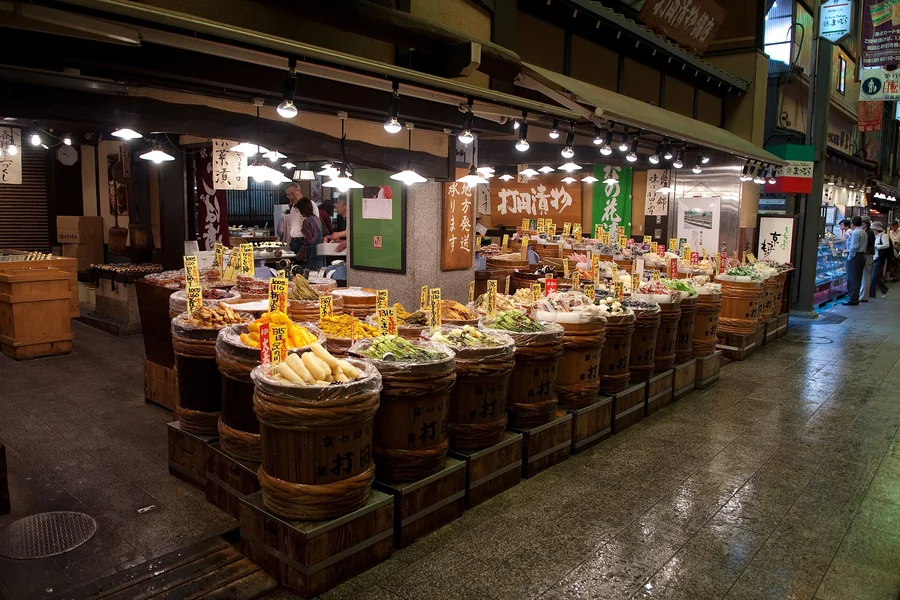
Uchida opened in Kyoto’s Shimabara district in 1940 and keeps more than 50 kinds of tsukemono out in tubs at its Nishiki shop, west of Yanagibaba-dori. Its best sellers are Kyo no Sato, a shibazuke of cucumber, and Onbu-zuke, daikon pickled in vinegar.
Fuka: fresh wheat gluten and the original fu-manju
Fuka has records of supplying namafu, fresh wheat gluten, to the imperial palace in the Keio era (1865 to 1868). Its Nishiki shop opened as a retail outlet sometime between 1975 and 1984, with everything still made by hand at the main shop. Fu-manju, sweet bean paste wrapped in seaweed-flavoured namafu and rolled in a bamboo leaf, was invented here, and the association says the taiyaki-shaped version is now the favourite. Closed Mondays.
Kimura and Nishiki Daimaru: fish to eat at the counter
Kimura is one of the oldest names on the street and sells to restaurants and caterers, so its retail prices for restaurant-grade fish are reasonable. Its fish skewers, including marinated tuna and salmon, are the thing to order. Nishiki Daimaru, near the Takakura end, sets out sashimi, grilled saba and eel and simmered sea bream every morning, and you can eat any of it at its own seats. Both close on Sundays.
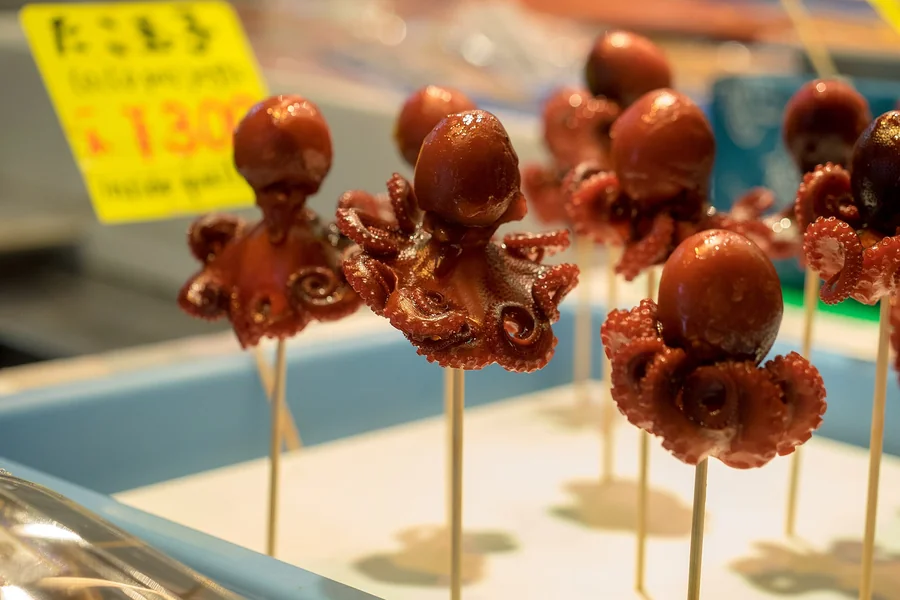
You will also see tako tamago, a small simmered octopus with a quail egg tucked into its head, sold on sticks at several counters along the street.
Aritsugu: knives from a swordsmith founded in 1560
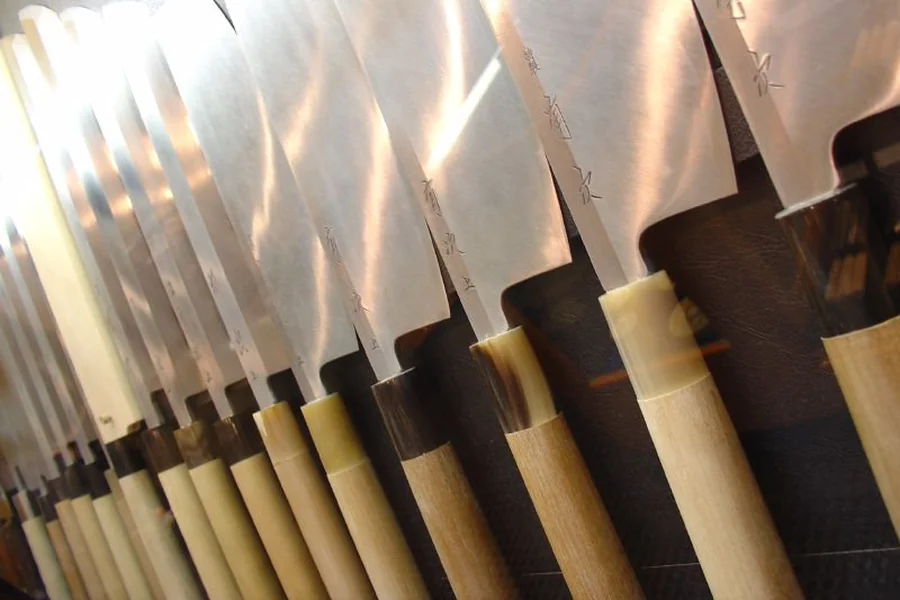
Aritsugu was founded in 1560 as the workshop of the swordsmith Fujiwara Aritsugu, and moved into smaller blades as the demand for swords fell in the peaceful Edo period. The Nishiki shop, near the east end west of Gokomachi-dori, sells hand-forged knives and pans to Kyoto’s top kitchens and home cooks, and it is known for sharpening and repairing what it sells for life. It opens 10am to 5pm, takes no new sales after 4:30pm and closes on Wednesdays.
Kyoto’s Kitchen: 400 years of Nishiki Market history
Fish traders were probably selling on this street in the Heian period, according to the market’s own history, but the documented start is 1615, when the shogunate licensed three privileged fish wholesalers in Kyoto, and Nishiki was one of them. The reason was water. The groundwater under the street stays at 15 to 18 degrees all year, and every shop once had its own well, used as a refrigerator for fish and fowl.
The street was once called Gusoku-koji, because it was where people took off their armour on the way in and out of the palace, and picked up the less flattering nickname kuso-koji (dung alley) along the way. The association credits Emperor Goreizei with renaming it Nishiki-koji in 1054.
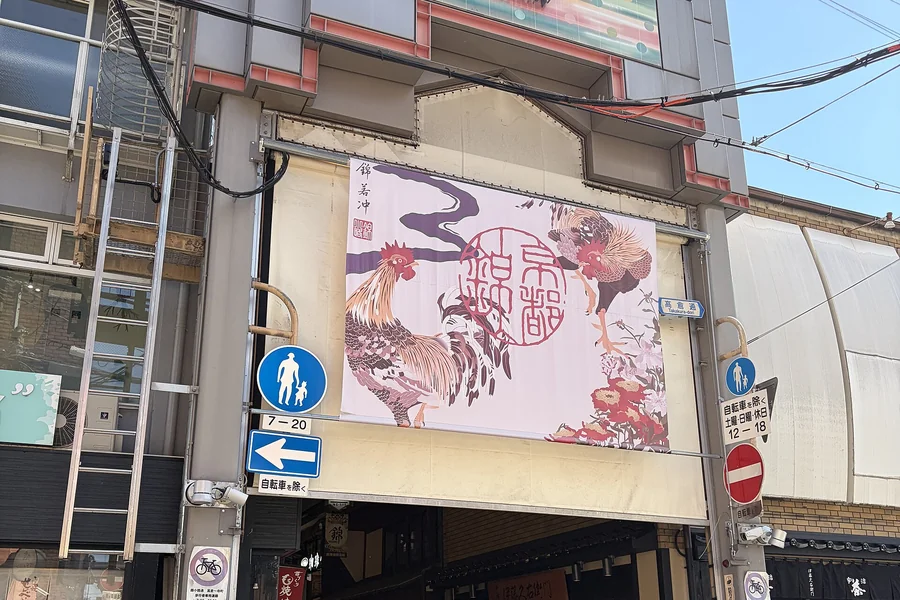
The painter Ito Jakuchu (1716 to 1800) was born here, into a family of greengrocery wholesalers. As head of his district between 1771 and 1774, he helped win the market’s legal fight to keep trading after a rival market had it shut down, and the authorities recognised the market in 1774. His roosters and vegetables still appear on shutters and banners along the street, and a monument marks the site of his family home near the west entrance.



How to visit Nishiki Market with fewer crowds
- Go early on a weekday. Miki Keiran opens at 9am and most counters by 10am. The street fills from late morning and stays packed through lunch.
- Avoid Wednesdays if you have a list. The association warns that many shops close that day, Aritsugu included.
- Walk east to west. Starting at Teramachi-dori puts the knife and kitchenware shops behind you before the bags fill up, and leaves the fish counters near Takakura for lunch.
- Keep to the left and stop at counters, not in the middle. The street is only 3.3 to 5 metres wide.
- Bring cash. Payment methods vary from shop to shop, and the association tells visitors to ask each one.
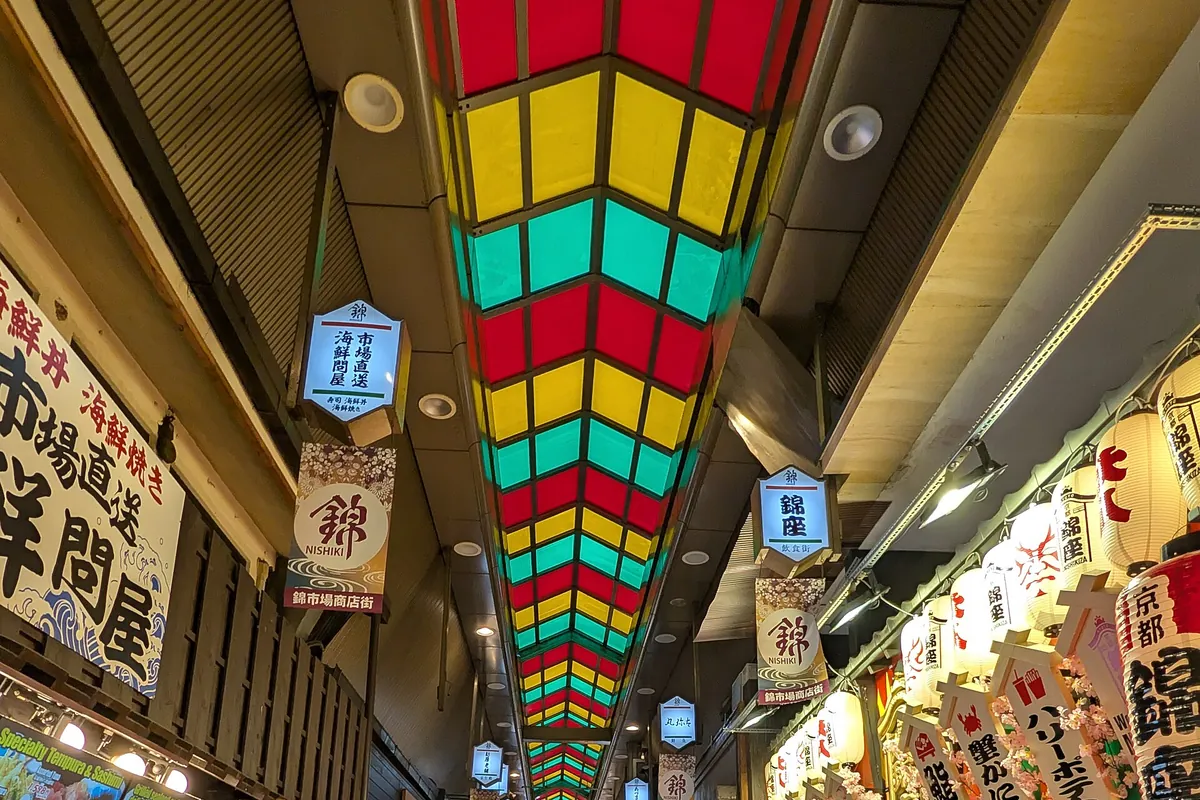
- Rain is not a problem. The red, yellow and green arcade roof covers the whole length.
Public toilets are limited. The association’s office has one, open 10am to 5pm. Lost property goes to the Tominokoji police box, on Tominokoji-dori just south of Rokkaku-dori. Ten minutes east over the Kamo river, Shijo-dori leads into Gion’s geisha quarter, which is at its best once the market shutters come down.
Teramachi, Shinkyogoku and Nishiki Tenmangu at the east end
The market ends at Teramachi-dori, one of two covered shopping streets that cross it. Teramachi is a temple street by design: in 1590 Toyotomi Hideyoshi moved about 80 temples to the east side of what had been the Heian capital’s eastern avenue, and traders in prayer beads, books and brushes followed. Today the Teramachi Kyogoku shopping street has about 180 shops between Sanjo and Shijo, and Honno-ji, rebuilt on Teramachi-dori by Hideyoshi after Oda Nobunaga died at its earlier site in 1582, stands further north on the same street. It is a pedestrian street: cycling through it and smoking on it are both banned.
One block further east, the Shinkyogoku shopping street runs parallel. Nishiki Tenmangu stands in the middle of it, directly facing the end of the market. The shrine is dedicated to Sugawara no Michizane, the patron of learning, opens from 8am to 8pm and has a karakuri omikuji, a mechanical fortune-telling machine.
The Samurai and Ninja Museum, about four minutes’ walk away, is the easiest add-on, and our guide to samurai experiences in Kyoto covers its hour-long tour.
Getting to Nishiki Market
- Shijo Station (Karasuma subway line): about 3 minutes on foot
- Karasuma Station (Hankyu Kyoto Line): about 3 minutes
- Kyoto-Kawaramachi Station (Hankyu Kyoto Line): about 4 minutes
- Gion-Shijo Station (Keihan Line): about 10 minutes
- City Bus 5 from Kyoto Station to Shijo Takakura, in front of the Daimaru department store, then about 2 minutes
From Nijo Castle, take the Tozai Line two stops to Karasuma Oike and walk about ten minutes south.
Map of Nishiki Market
Osaka has its own version of the idea in Kuromon Ichiba Market, longer at about 580 metres, with about 150 shops where visitors graze on skewers, sushi and fruit cups.
Nishiki Market questions answered
What time does Nishiki Market open and close?
Each shop sets its own hours. Most open between 9am and 10am and close between 5pm and 6pm, so by early evening the street is largely shuttered. Miki Keiran’s dashimaki counter opens at 9am every day, Uchida at 9:30am, and Aritsugu stops new sales at 4:30pm.
Is Nishiki Market open on Wednesdays and Sundays?
The market as a whole never closes, but many shops take Wednesday as their day off, according to the market association, Aritsugu among them. Several fishmongers, including Kimura and Nishiki Daimaru, close on Sundays. Weekday mornings other than Wednesday give you the most open shutters.
Can you eat while walking at Nishiki Market?
The association asks visitors not to, because food gets onto other people’s clothes in the crowd. Eat in front of or inside the shop where you bought it. Tango TABLE and Nishiki Shokudo let you sit with food bought elsewhere in the market if you order one item each.
What is Nishiki Market famous for?
It is known as Kyoto’s Kitchen and supplies home cooks and restaurants with Kyoto vegetables, Lake Biwa freshwater fish, hamo, yuba, fu and pickles. For visitors the stand-outs are dashimaki omelette at Miki Keiran, soy milk doughnuts at Konnamonja, pickles at Uchida and knives at Aritsugu.
How long do you need at Nishiki Market?
Walking the 390 metres takes ten minutes, but allow one to two hours to eat at a few counters and shop. Add another hour if you continue into the Teramachi and Shinkyogoku arcades, Nishiki Tenmangu shrine or the Samurai and Ninja Museum nearby.
Is Nishiki Market open at New Year?
Most shops stay open through the end of December, and the last days of the year are some of the busiest. Many then close from 1 to 3 January, and Aritsugu stays shut until 4 January. Check each shop before planning a New Year visit.