Deciding to go on an autumn city break is like taking a much needed breath between the hectic summer season and the impending winter hibernation to come. If you’re considering such a breath, why not consider a slightly longer Japan city break?
Before you book a trip to Tokyo or Kyoto, however, let me introduce you to an alternative city to explore, one that offers an experience for all tastes and presents a perfect autumnal atmosphere as if made for the occasion: the Japanese city of Hiroshima.
Although it’s best known for its complete destruction by the atomic bomb on 6 August 1945, the city has since grown into the thriving capital of Hiroshima Prefecture, home to spectacular scenery, a wealth of museums and gardens, an active nightlife scene and some of the best street food in Japan. All in all, it is a perfect place for an autumn city break.
Hiroshima in Autumn
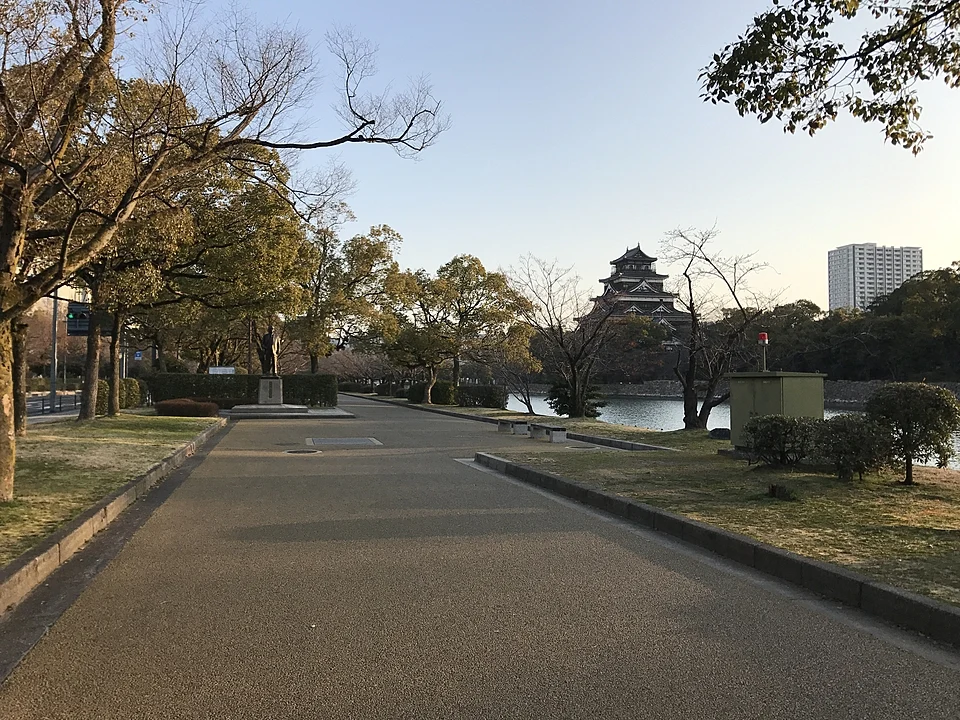
Autumn Leaves in Hiroshima, Mid November to Early December
If you’ve never seen Japan in the autumn, then you’ve never seen Japan at one of the best times of the year. Sure, cherry blossoms in the spring are great and summer can be beautiful (if you don’t mind sweltering temperatures), but autumnal colours cascading down Japanese mountains in a cool and gentle breeze is truly a marvel to behold.
This is part of what makes Hiroshima a perfect autumn destination: the geography of the city plays an important role in creating this perfect environment.
Hiroshima sits in the west of Honshu, Japan’s main island, and its milder climate means the autumn leaves usually reach their best from mid-November and can last into early December.
The milder climate also brings milder temperatures, which make for more pleasant leaf viewing. Because the city is nestled among hillsides and mountain ranges, you can often see a breathtaking golden backdrop at the peak of the season.
Those hills are part of the city itself, and plenty of elevated spots put you right in the middle of the landscape. Mt Mitaki in Nishi Ward and Hijiyama Park in Minami Ward are both close to Hiroshima’s downtown Naka Ward. So when autumn truly comes, the city itself changes to match the season.
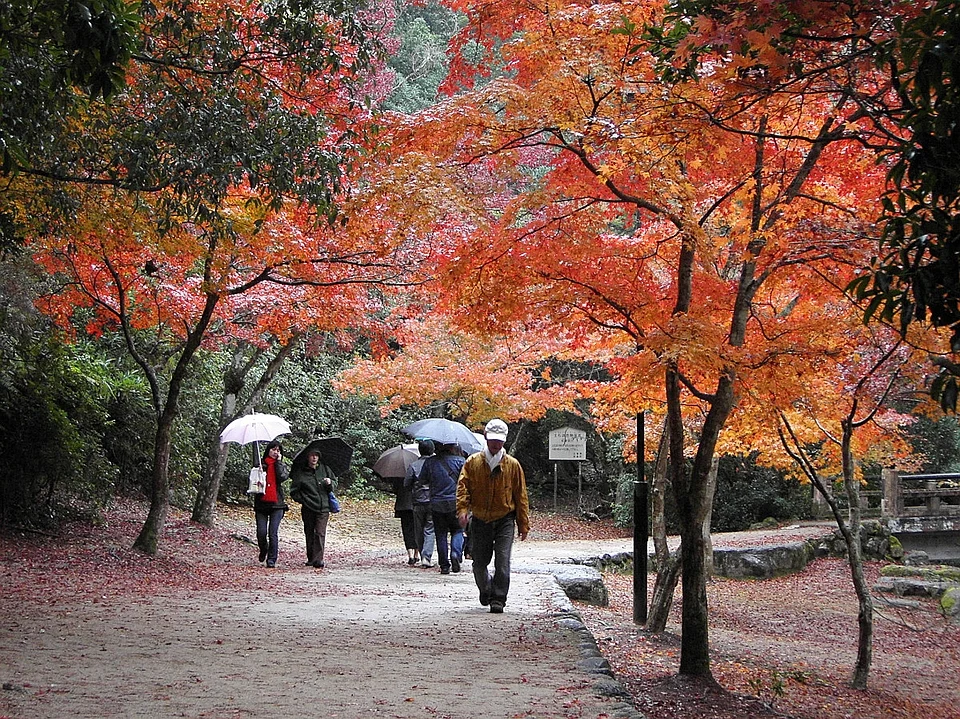


Hiroshima City and Miyajima Island in Autumn
At the heart of a great city break is the ability to get lost in everything that a city has to offer, and Hiroshima really does offer something for everyone. It’s very much a place of two halves in that ultra-modernity co-exists with tradition and culture.
Naka Ward: Trams, Okonomiyaki and Momiji Manju
Naka Ward, the downtown area, is home to a vast number of restaurants, hotels and bars, and some of the city’s most tourist friendly areas. The east side of the ward is where you will find plenty of shops, and where things begin to feel very Tokyo-esque, especially in districts such as Ebisucho with its neon glow and night-time buzz.
Across the city there is an abundance of museums and galleries, sports venues and golf driving ranges to keep you occupied. There are also plenty of green spaces where you can see the autumn colour without venturing far. In Naka Ward itself, the grounds of Hiroshima Castle and the Peace Memorial Park are both central and both good places to watch the leaves change.
Getting around is easy on Hiroden, Japan’s longest tram network, which covers much of the south side of the city and runs out to Miyajimaguchi for the ferry to Miyajima.
Food plays a big part here too, and okonomiyaki is a local favourite with a signature Hiroshima style: instead of the ingredients being mixed together, they are layered on top of each other, usually with noodles. You can find a wealth of okonomiyaki counters at Okonomimura, a building in the Shintenchi area of Naka Ward where 23 restaurants fill the second to fourth floors, about three minutes on foot from Hatchobori tram stop.
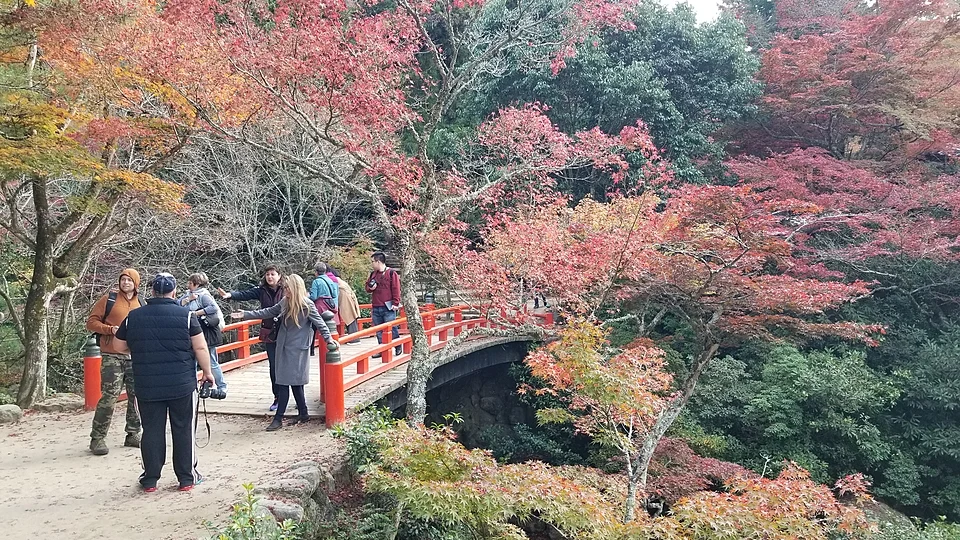
Another local speciality is momiji manju, a small cake shaped like a maple leaf and made with various different fillings, which once again shows off Hiroshima’s autumn affinity. The cake is closely linked to Momijidani Park on Miyajima, one of the most beautiful autumn spots in all of Japan.

Momijidani Park on Miyajima and Temples on the Mainland
Momijidani Park is one of several places in and around Hiroshima for anyone wanting an experience closer to rural Japan. It sits on the island of Itsukushima, better known as Miyajima, just off Hiroshima Bay in the Seto Inland Sea, a region renowned for its spectacular beauty. The JR Miyajima Ferry from Miyajimaguchi costs 160 yen each way for adults, and visitors to the island also pay the 100 yen Miyajima visitor tax, introduced in October 2023.
The park consists of a walking trail under the canopy of countless maple trees, surrounded by pristine streams and ponds. The experience will also lead you to some Shinto shrines, iconic red bridges and perhaps even some friendly deer, rivalling those found in the city of Nara.
The island itself is home to many other shrines and temples, climbing trails and mountaintop observation points that are beyond picturesque, all of which are easy to reach in a single day. It’s definitely one of the must see areas on a Hiroshima city break.
Back on the mainland, there are plenty more spots around the city with a similar atmosphere. Gokurakuji, on the mountain of the same name overlooking Hatsukaichi and Miyajima, and Mitaki-dera in Nishi Ward are two more worth visiting if you wish to stay off the island.
Now imagine all of these fantastic spots in the autumn season, and you may begin to understand why Hiroshima would be the perfect place to visit.
13 Places to See in Hiroshima in Autumn
I’ve already mentioned a handful of worthwhile places in and around Hiroshima, such as Mt Mitaki, Hiroshima Castle and Momijidani, but there are many more sights you should make time for. These are the 13 to put on your list:
- Itsukushima Floating Torii Gate: The famous torii gate of Itsukushima Shrine that seems to rise out of the sea at high tide. Entry to the shrine costs 300 yen for adults.
- Mt Misen: The highest peak on Itsukushima/Miyajima, reached by the Miyajima Ropeway from Momijidani Park (2,000 yen return for adults).
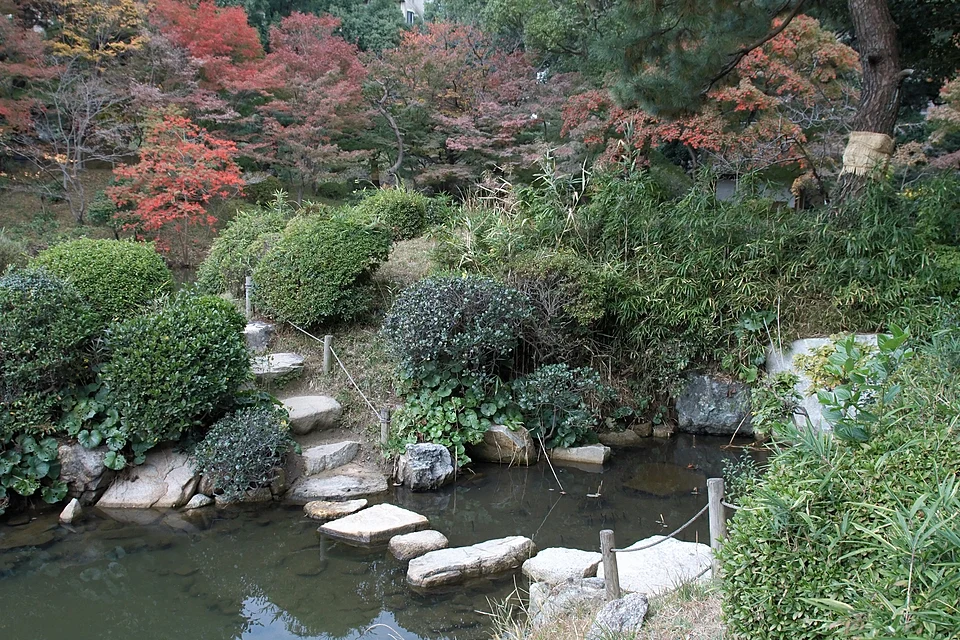
- Shukkeien: A beautifully scenic Japanese garden with central water features, diverse plant life and numerous viewpoints to enjoy it from. Entry is 350 yen, and from 16 September to 15 March it opens from 9am to 5pm.
- The Hiroshima Peace Memorial: A place of remembrance for the atomic bombing of 6 August 1945, where you can also see the A-bomb Dome. The Peace Memorial Museum charges adults 200 yen.
- Mazda Museum: For all the car lovers out there, covering the history and production of one of the biggest car manufacturers in Japan. Entry is free, but tours must be booked in advance on Mazda’s website and the museum is usually closed at weekends.
- Mitaki-dera: A temple on Mt Mitaki in Nishi Ward, traditionally dated to 809 and reached by a climbing mountain path. It is one of the best autumn leaf spots within the city.
- Ujina Natural Hot Spring: One of a number of public hot spring bath houses in Hiroshima, and one of the larger ones, in the Ujina port area of Minami Ward.
- Hiroshima Botanical Garden: A hilltop garden in Saeki Ward with around 200,000 plants from 10,000 species, both native Japanese and from across the world. Adults pay 510 yen, and it is closed on Fridays.
- Momijidani: A lush walking trail at the foot of Mt Misen that is a must see in the autumn season.
- Hiroshima Museum of Art: A small museum housing European and Japanese art.
- Mikumarikyo Forest Park: A scenic walking route in Fuchu Town, east of Hiroshima, with fantastic views and natural scenery.
- Hiroshima Castle: A late 16th century castle at the centre of Hiroshima. Its main keep, a 1958 reconstruction, has been closed to visitors since 22 March 2026, but the castle grounds are still open to explore.
- Gokurakuji: A historic Buddhist temple on Mt Gokurakuji, west of the city, overlooking Hatsukaichi and Miyajima. Another particularly beautiful autumn spot.
Hiroshima and Miyajima Entry Prices in 2026
| Place or ticket | Adult price | Good to know |
|---|---|---|
| Hiroshima Peace Memorial Museum | ¥200 | Booking required for the first hour after opening and the last 90 minutes; optional the rest of the day |
| Shukkeien Garden | ¥350 | University students ¥150, school pupils free; 9am to 5pm from 16 September to 15 March |
| Hiroshima Botanical Garden | ¥510 | Closed on Fridays |
| Mazda Museum | Free | Book a tour in advance on Mazda’s website; usually closed at weekends |
| Hiroden tram, single ride | ¥240 | Flat fare across the city; Suica and ICOCA accepted; one-day tram pass ¥700 |
| JR Miyajima Ferry, each way | ¥160 | Covered by the Japan Rail Pass |
| Miyajima visitor tax | ¥100 | Charged to every visitor to the island since October 2023 |
| Itsukushima Shrine | ¥300 | The floating torii is free to see from the shore |
| Miyajima Ropeway to Mt Misen | ¥2,000 return | ¥1,100 one way; walking up from Momijidani Park is free |
Hiroshima Compared with Tokyo, Kyoto and Nara
In case you have yet to decide that Hiroshima is the perfect autumn Japan city break, let us consider what it offers in comparison to other Japanese cities.
You might be considering Tokyo for its vibrant nightlife and neon glow. Hiroshima has that. You may be considering Kyoto for all its temples, shrines and autumn spots. Hiroshima’s are just as good. You may even be considering Nara for its famous bowing deer, or a city further north for its rural feel. Hiroshima has those too.
In essence, Hiroshima brings together a taste of some of the best parts of Japan in a single package, and does it exceedingly well. Add in its natural affinity with the autumn season, and very few places in Japan can top it at this time of year.








Getting to Hiroshima From Tokyo, Osaka and the Airport
Hiroshima is on the Tokaido and Sanyo Shinkansen line, so most visitors arrive by bullet train. Direct Nozomi trains from Tokyo take about four hours, and the regular one-way fare is ¥18,380 for a non-reserved seat. With a Japan Rail Pass, ride the Hikari or Sakura trains and change at Shin-Osaka, which takes about five hours, or pay a supplement of ¥6,500 to ride the Nozomi direct. Trains from Osaka and Kyoto run along the same line, so Hiroshima is an easy next stop after Kansai.
Flights from Tokyo Haneda take about 90 minutes, and the airport bus into the city takes about 50 minutes and costs ¥1,500. Overnight buses from Tokyo cost roughly ¥6,000 to ¥18,000 depending on the company and the date.
Once there, the trams do most of the work. Lines 2 and 6 run from Hiroshima Station to the A-bomb Dome in 15 minutes, and line 2 continues to Miyajima-guchi for the ferry. For the Miyajima day, a one-day tram pass with the Matsudai ferry included costs ¥1,000 (the ¥700 tram pass plus ¥300), covers the visitor tax and brings the Miyajima Ropeway down to ¥1,500 return. With a Japan Rail Pass, take the JR Sanyo Line to Miyajimaguchi instead and use the JR ferry, which the pass covers.
Hiroshima in Autumn: Questions and Answers
When are the autumn leaves at their best in Hiroshima?
Usually from mid November into early December, a little later than in northern Japan because of Hiroshima’s milder climate. Momijidani Park on Miyajima, Mitaki-dera in Nishi Ward and Shukkeien Garden in the city centre are the most reliable spots. Check a foliage forecast in early November, as a warm autumn pushes the peak later.
How do you get from Tokyo to Hiroshima?
Take the Shinkansen. Direct Nozomi trains take about four hours and cost ¥18,380 one way for a non-reserved seat. Japan Rail Pass holders ride Hikari and Sakura trains via Shin-Osaka in about five hours, or pay ¥6,500 extra for the Nozomi. Flights from Haneda take about 90 minutes plus a 50 minute bus from Hiroshima Airport.
How do you get from Hiroshima to Miyajima?
Ride tram line 2 or the JR Sanyo Line to Miyajimaguchi, then take a ferry across. The JR ferry costs ¥160 each way and is covered by the Japan Rail Pass. Every visitor also pays the ¥100 Miyajima visitor tax. A tram day pass with the Matsudai ferry included costs ¥1,000 and covers the tax.
Do you need to book the Hiroshima Peace Memorial Museum?
Only for the first hour after opening and the last 90 minutes of the day, when timed reservations are required. At other times booking is possible but optional. Adult entry costs ¥200. Overseas visitors book online through Klook, and visitors in Japan through Asoview. Hours run from 7:30am, closing at 6:00pm from December to February.
Can you go inside Hiroshima Castle in 2026?
No. The main keep, a 1958 concrete reconstruction, closed to visitors on 22 March 2026 because of concerns about its earthquake resistance. The castle grounds and moat remain open and free to walk, and they are a good place to see the autumn colours in the city centre.
How many days do you need in Hiroshima?
Two days covers the essentials: one for the Peace Memorial Park, museum, Shukkeien and an okonomiyaki dinner, and one for Miyajima, Momijidani Park and Mt Misen. Add a third day in autumn for Mitaki-dera and a slower walk, or a day trip to the castle towns and gorges further inland.