Disclosure: this article contains affiliate links to MagicalTrip. If you book through them, Japan Nakama may earn a commission at no extra cost to you. Tour details were checked on MagicalTrip’s website on 1 November 2026.
Kappabashi Dougu Street is Tokyo‘s kitchen town: an 800-metre street midway between Ueno and Asakusa where more than 170 shops sell knives, tableware, plastic food samples and restaurant equipment, and almost all of them sell to visitors as well as to the trade. Most shops open from about 10am to 5pm, and only around 30% open on Sundays, so a weekday or a Saturday is the day to go.
This guide picks out the knife shops, food sample makers and ceramics stores worth your time, with hours from the street association’s own directory (checked on 31 October 2026). It also explains how tax-free shopping works since Japan changed the system on 1 November 2026, and what the law says about getting a Japanese kitchen knife home to the UK.
| Where | Kappabashi Dougu Street, Matsugaya and Nishi-Asakusa, Taito City, Tokyo. Street association office: 3-18-2 Matsugaya |
| Hours | Set by each shop, mostly about 10am to 5pm |
| Closed | No street-wide closing day. Most shops open on Saturdays; about 30% open on Sundays |
| Nearest station | Tawaramachi (Tokyo Metro Ginza Line), 5 minutes on foot |
| Entry | Free. It is a public street |
| Best time | A weekday or Saturday, from 10am |
| Tax-free | On purchases of 5,000 yen or more (before tax) at one shop in one day, refunded after a customs check when you leave Japan |
Kappabashi Street Shops, Hours and Getting There
Kappabashi Street opening hours and the best day to go
The street itself never closes, but every shop sets its own hours and days off. The Kappabashi Dougugai Promotion Association says most shops open on Saturdays and about 30% open on Sundays, and its monthly opening notice puts typical hours at around 10am to 5pm. That notice, in Japanese, links to a calendar showing roughly how many member shops trade on each Sunday and public holiday of the month, which is worth a look if a Sunday is your only free day.
The pattern is easy to read once you know it. Trade suppliers such as Niimi (tableware), Kikyoya (lanterns and shop curtains) and Okuda Shoten (bamboo and lacquerware) close on Sundays and public holidays. The shops that serve visitors most, including Kamata Hakensha, Kama-asa and Ganso Shokuhin Sample-ya, open almost every day of the year, closing only for New Year (and, at Kamata, a short summer break). Every shop hands out a free paper map of the street, and the association publishes an English map as a PDF to download before you go.


Kappabashi knife shops: Kamata Hakensha, Kama-asa and Tsubaya
Knives are the reason many visitors come, and the association’s directory lists at least ten member shops that specialise in them. Three of the longest established are a good place to start.
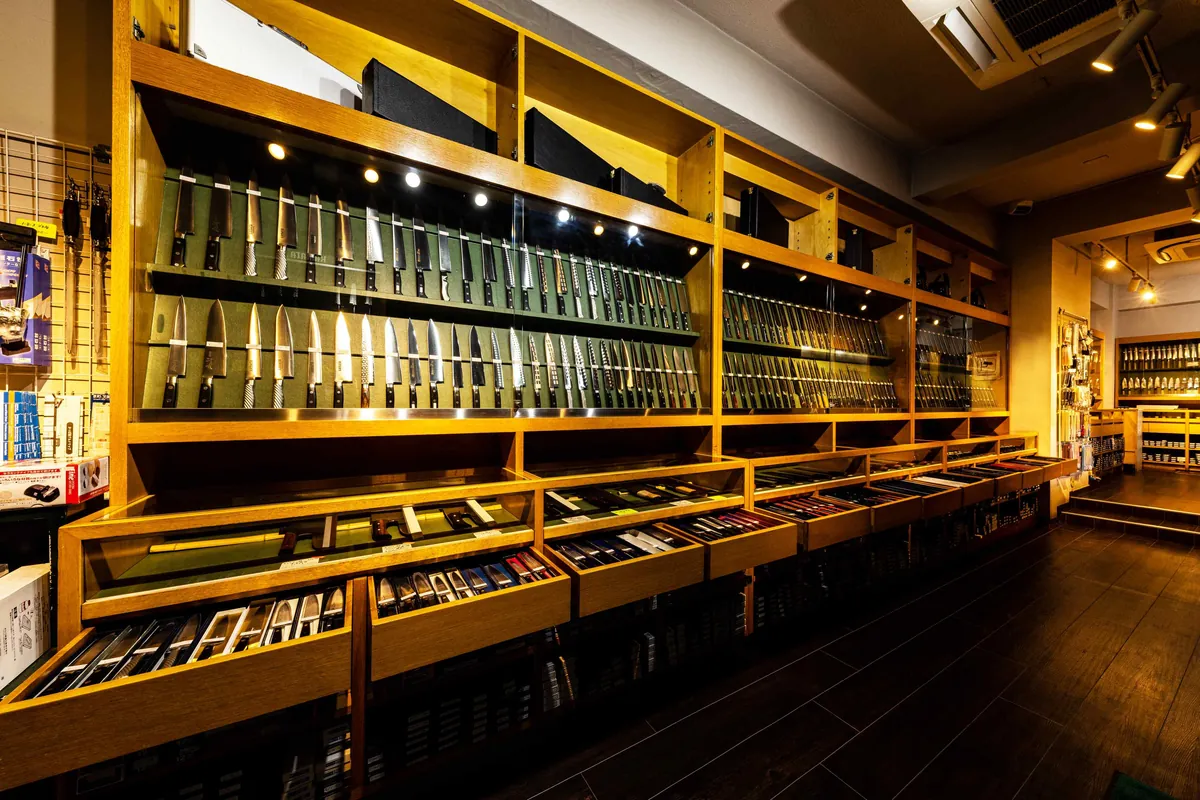
Kamata Hakensha: 800 knives and free name engraving
Kamata Hakensha began in 1923, when Kosuke Kamata set up as a knife sharpener in Asakusa after the Great Kanto Earthquake, and the family is now in its fourth generation. The shop keeps more than 800 types of knife in stock, from its own hand-forged Sakai blades to brands such as Misono, Masamoto, Sugimoto and Glestain. Engraving your name on a knife you buy here is free and takes about three minutes; it is done in kanji or katakana, with alphabet stamps possible for short initials. Kamata knives also get their final edge put on free while you wait.
One thing to know before you go: the shop’s FAQ says it accepts all major credit cards but not debit cards or electronic payment, so bring a credit card or cash.
Kama-asa: knives and kitchen tools since 1908
Kama-asa was founded on Kappabashi in 1908 by Minosuke Kumazawa. Alongside its own knives it sells iron frying pans, rice pots, graters and other cooking tools chosen from makers across Japan, and its staff are known for explaining the drawbacks of a product as well as its strengths. The fourth-generation owner opened a Paris branch in 2018, at 12 Rue Jacob, which makes it the nearest Kama-asa to London.
Tsubaya and the other knife counters
Cutlery Tsubaya has sold cooking knives on the street since 1956 and supplies chefs in Asakusa and beyond. The association’s directory also lists Tojiro Knife Gallery, Seisuke Knife, Knife Shop Washin-Do, Tokuzo Knives, Togijin and Koshinoitto among its member knife shops, so it is easy to compare prices on the same blade within a few doors.
| Shop | Since | Hours | Closed | Address |
|---|---|---|---|---|
| Kamata Hakensha | 1923 | 10am to 6pm | No fixed holidays (summer and New Year breaks) | 2-12-6 Matsugaya |
| Kama-asa | 1908 | 11am to 5:30pm (4:30pm on the last day of each month) | Open all year apart from the New Year period | 2-24-1 Matsugaya |
| Cutlery Tsubaya | 1956 | 9am to 6pm weekdays, 10am to 5pm weekends and holidays | New Year period | 3-7-2 Nishi-Asakusa |
If you are not sure which knife suits the way you cook, our guide to the kitchen tools Japanese home cooks rely on explains what each one is for. Whatever you buy, keep it boxed and bagged as the shop hands it over until you are back at your hotel: Article 22 of Japan’s swords and firearms law bars anyone from carrying a blade longer than 6cm without a work-related or other legitimate reason.
Food samples at Kappabashi: Ganso Shokuhin Sample-ya and the replica makers
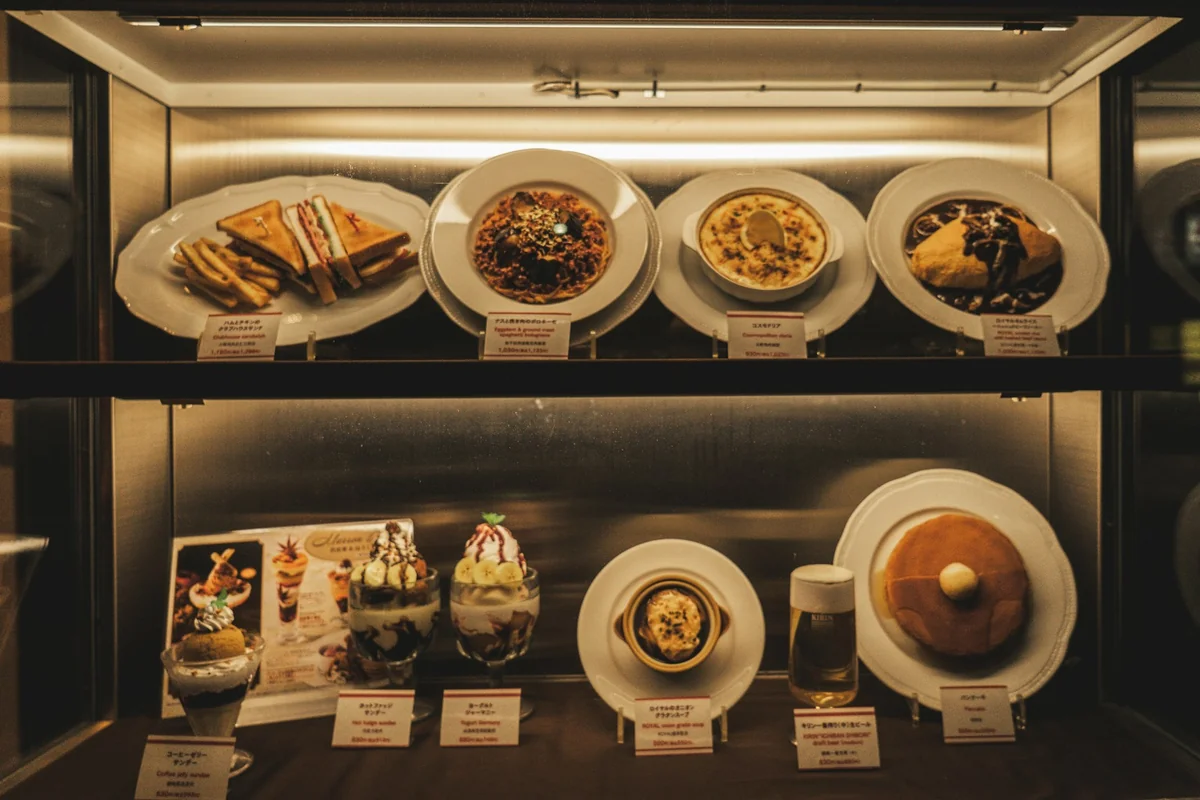
The plastic dishes in Japanese restaurant windows are made to order, and Kappabashi is where restaurants buy them. Three makers on the street also sell to visitors.
Ganso Shokuhin Sample-ya, near the Kappabashi crossing at 3-7-6 Nishi-Asakusa, is the shop of Iwasaki Co., one of Japan’s leading food replica makers, which says Kappabashi is where the Ganso shop began. It sells replica sushi magnets, key rings and stationery, along with Sample’n kits for making your own at home, and opens daily from 10am to 5:30pm apart from the New Year holidays. If you want to know how food replicas began, our feature on the history of Japan’s food replicas tells the story.
Upstairs, Ganso runs a 40-minute workshop in which you make two pieces of tempura and a lettuce leaf from hot wax. The details from its booking page:
- Price: 3,300 yen per person including tax. Up to two companions can watch for 500 yen each.
- Booking: required. Classes take up to six people, with last arrival times from 10:50am to 4:20pm.
- Age: from the first year of Japanese primary school (age six or seven).
- Language: the instructor explains in Japanese, with only the English needed for safety, and the shop suggests one interpreter for every four people.
- Good to know: you put your hands in hot water, wax can stick to nail art, and filming is not allowed during the class.
Sato Food Samples at 3-7-4 Nishi-Asakusa opened in 1925, when replicas were still made in wax, and sells miniature replicas made with professional materials as souvenirs. It opens 10am to 5pm and closes on Fridays. Tokyo Biken at 1-5-15 Nishi-Asakusa has replica key chains, straps and magnets, and opens on Sundays from 11am.
Ceramics, noren curtains and lacquerware along the street
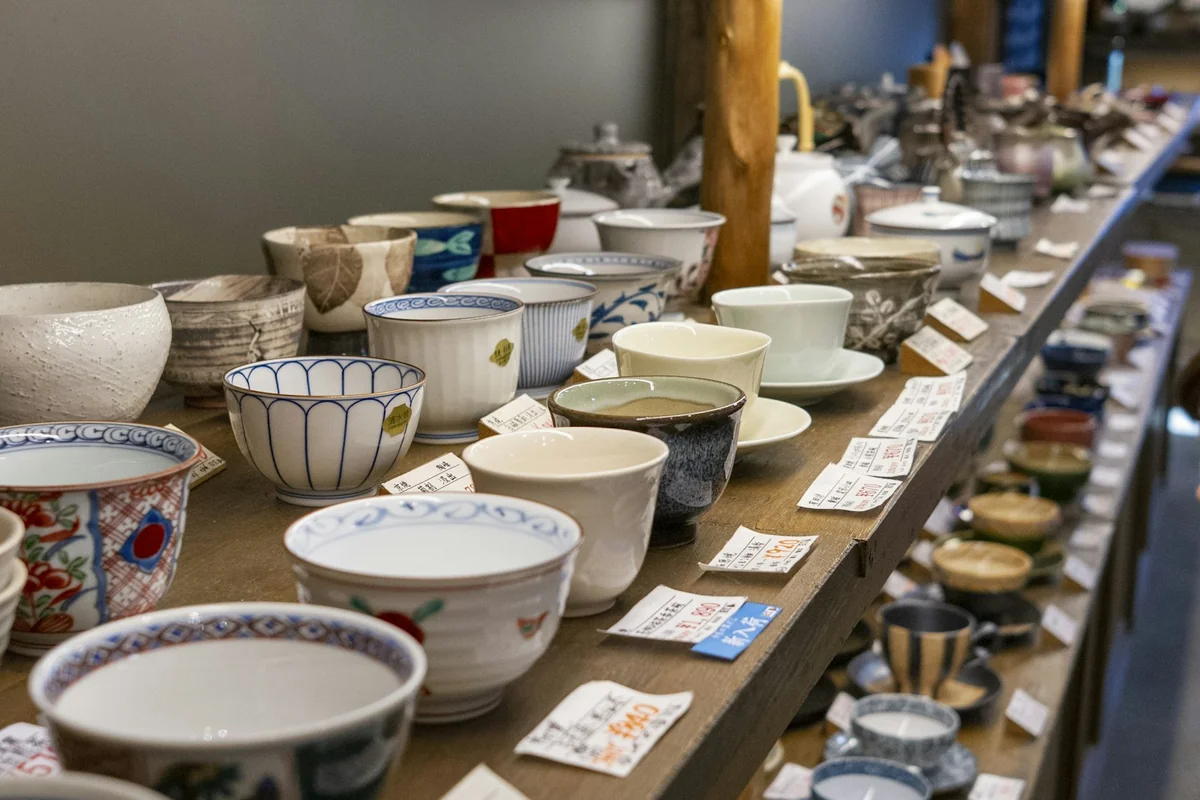
GO TOKYO, the city’s official guide, names noren curtains, ceramic cups and chopstick rests among the most popular things visitors take home from Kappabashi. These shops, all members of the street association, cover the range:
- Dengama: Japanese tableware from across the country, including Mino, Arita, Kutani, Mashiko and Kyoto wares, from pieces by named potters to everyday bowls. Open 10am to 6pm.
- Kikyoya: menus, paper lanterns, banners and noren shop curtains. It will put your name on a lantern with no minimum order. Open 9:30am to 5:30pm, closed Sundays and public holidays.
- Tanaka Shikki-ten: lacquerware and soba-making tools, plus Edo wooden chopsticks shaped by hand with a plane. Open 10:30am to 5pm, closed Sundays and public holidays.
- Okuda Shoten: bamboo kitchenware, wooden tubs and lacquerware, and it recoats old lacquer. Open 9am to 5:30pm, closed Sundays and public holidays.
- Kanaya Brush: 60 kinds of cooking brush, from horsehair sushi brushes to palm scrubbers for vegetables. Open daily 10:30am to 5pm.


The giant chef on the Niimi building and the golden kappa
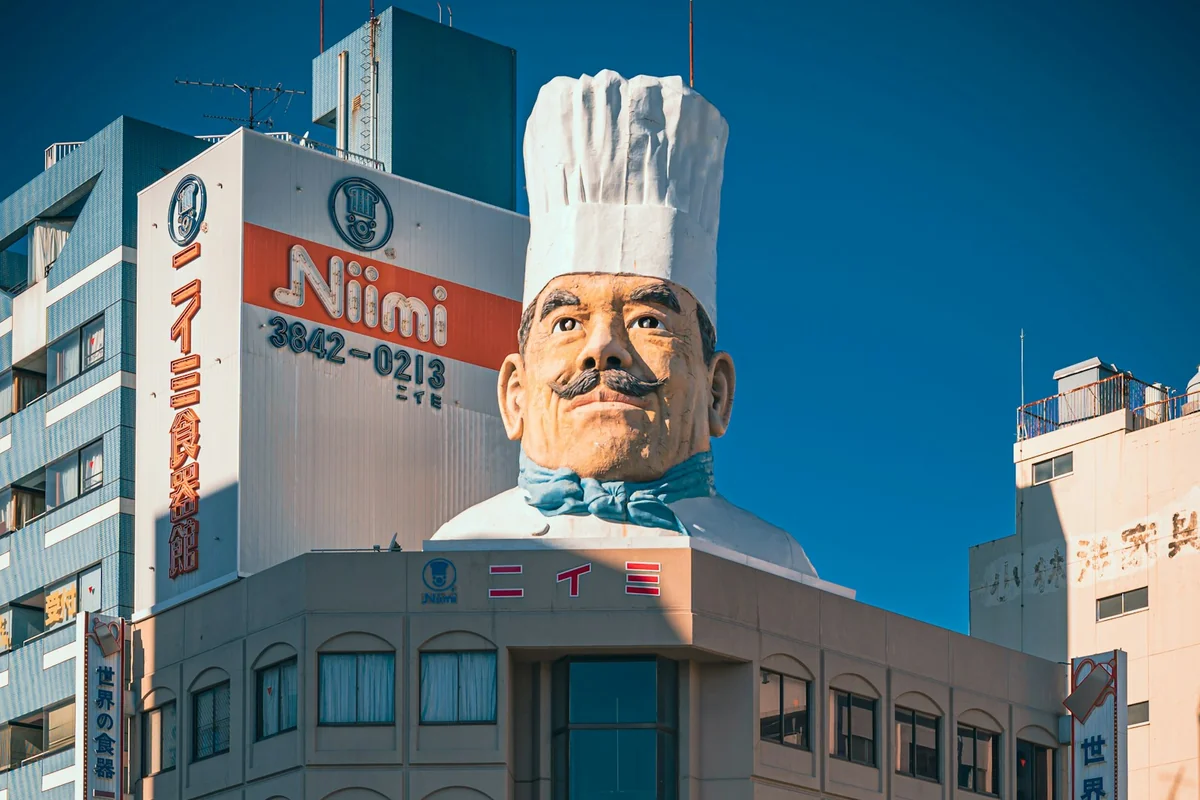
The southern entrance to the street is marked by a giant chef’s head in a tall white hat, on top of the Niimi building at 1-1-1 Matsugaya. Niimi has traded since 1907 and stocks more than 20,000 items of tableware and kitchen equipment. In the middle of the street, a golden statue of Kappa Kawataro looks up at the sky and, in the association’s words, prays for the success of its customers’ businesses.
That kappa is the street’s mascot, and the association’s history page gives two stories for the name. In the first, low-ranking samurai from a lord’s residence nearby made rain capes (kappa) as a side job and hung them to dry on a bridge. In the second, a raincoat merchant called Kappaya Kihachi paid for drainage works on the flood-prone land in the early 1800s, and kappa, the water spirits of the Sumida River, came out at night to help him dig. In Japanese folklore the kappa is a river creature; Lafcadio Hearn, writing in Glimpses of Unfamiliar Japan, Second Series (1894, chapter “By the Japanese Sea”), calls it “not properly a sea goblin, but a river goblin”. Look out for smaller kappa statues as you walk; GO TOKYO notes children enjoy finding them.
The bridge was real. The Shinbori River ran along the line of today’s street, and shops selling second-hand tools began opening on its banks around 1912. After the 1923 earthquake the river was covered over and trams ran on top until 1969; the names of its two bridges, Kappabashi and Kikuyabashi, survive as crossing names. Each October, around 9 October (Tool Day in Japan), the street holds the Kappabashi Dougu Matsuri; the 41st ran from 6 to 12 October 2026, with the road closed to traffic on the final day.
Tax-free shopping at Kappabashi since 1 November 2026
Japan switched to a refund method for tax-free shopping on 1 November 2026. You no longer get the tax taken off at the till. According to the Japan Tourism Agency, it now works like this:
- At the shop: show your passport, pay the full price including consumption tax, and register how you want the refund paid, such as a credit card. Purchases must come to 5,000 yen or more, before tax, at one shop on one day.
- At the airport: within 90 days of buying, go to the Customs Tax Refund Kiosk in the departures hall before you check in your luggage and before security. Some airports let you use Visit Japan Web instead.
- The check: a green result means you are done. A red result means customs staff will ask to see the goods.
- The refund: the shop, or the refund company it uses, pays you once the customs check is complete.
For knife buyers, step two matters most. You must have every item from a receipt with you at the kiosk, and the agency says you cannot get a checked bag back to show customs. So keep the boxed knives with you until the kiosk, then put them in your hold luggage before you check it in.
Kamata Hakensha’s FAQ sends tax-free shoppers to Smart Refund Kappa-bashi at 3-17-5 Matsugaya, a shared tax-free counter for member shops, open daily from 10am to 6pm. Bring your passport, your purchases and the shops’ paperwork. The counter also changes 13 currencies including pounds sterling and arranges overseas delivery, which is one way to send heavy cookware home. Ask it how your refund will be paid under the new system before you leave Kappabashi.
Bringing a Japanese knife home to the UK
Japanese kitchen knives are not on the UK’s list of banned weapons, so you can bring them home. Four rules apply on the way:
- On the plane: under UK hand luggage rules, a knife with a sharp or pointed blade, or a blade longer than 6cm, cannot go in your hand luggage. It can go in the hold, subject to your airline’s rules, and Kamata Hakensha gives the same advice.
- Arriving in the UK: the allowance for goods brought into Great Britain is £390. Go over it and import VAT and duty are charged on the full value of everything you bring in, so a high-end gyuto plus a set of pans can tip you over.
- Items that are banned: the gov.uk list includes curved swords with a blade of 50cm or more, ninja swords, flick knives and zombie-style knives. These are illegal to bring into the UK, whatever the shop in Japan says.
- Once you are home: it is illegal in the UK to carry most knives in public without a good reason, and a court decides what counts as one. Take the knife straight home, still packed.
Getting to Kappabashi and pairing it with Asakusa
The association’s access page gives these walking times:
| Station | Line | Walk |
|---|---|---|
| Tawaramachi | Tokyo Metro Ginza Line | 5 minutes |
| Asakusa | Tsukuba Express | 5 minutes |
| Iriya | Tokyo Metro Hibiya Line | 6 minutes |
| Asakusa | Toei Asakusa Line or Tobu Line | 13 minutes |
| Ueno or Uguisudani | JR Yamanote and Keihin-Tohoku lines | 15 minutes |
Kappabashi runs along the western side of Asakusa’s main entertainment district, and GO TOKYO puts it within walking distance of Senso-ji. The simplest plan is to shop from 10am, when most counters are open, then walk east for lunch and Senso-ji in the afternoon; our Asakusa guide maps that walk leg by leg. Our Taito City guide covers Senso-ji and the rest of the ward that both sit in. If you would like a guide for the Asakusa half of the day, MagicalTrip’s Asakusa Cultural Walk and Matcha Making Tour meets at the Kaminarimon gate at 11am and spends three hours on Nakamise, Senso-ji, a matcha tea house and Hoppy Street.
Coming from the other direction, JR Ueno is a 15-minute walk away, so Kappabashi also fits a morning before the museums. If you are staying there, our Ueno guide has hotels, food and the museums in Ueno Park. For a second old-Tokyo shopping street with a very different feel, Yanaka Ginza is a few stops north of Ueno at Nippori.
Kappabashi Dougu Street
Kappabashi questions and answers
Some of it. The street association says about 30% of its shops open on Sundays, while most open on Saturdays. Visitor favourites such as Kamata Hakensha, Kama-asa and Ganso Shokuhin Sample-ya open almost every day of the year, but many trade suppliers close on Sundays and public holidays, so a weekday gives you the full street.
Each shop sets its own hours, and the association puts the usual range at about 10am to 5pm. Some open earlier, such as Cutlery Tsubaya from 9am on weekdays, and some stay later, such as Kamata Hakensha until 6pm. Arriving at 10am gives you the most shops open at once.
Yes. The association says almost every shop sells to individual customers, not only to restaurants. Kamata Hakensha and Kama-asa both publish their shop information in English, and Kamata engraves your name free in about three minutes. Bring a credit card or cash, because Kamata does not take debit cards.
Yes, kitchen knives are not banned in the UK. Pack them in your hold luggage, because UK hand luggage rules bar knives with blades over 6cm. Declare goods worth more than £390 in total, and carry the knife straight home, since carrying most knives in public without a good reason is illegal in the UK.
Many shops offer tax-free sales to overseas visitors on purchases of 5,000 yen or more, before tax, at one shop in one day. Since 1 November 2026 you pay the full price, then claim the tax back after a customs check at the airport within 90 days. Smart Refund Kappa-bashi at 3-17-5 Matsugaya handles the paperwork for member shops.
Ganso Shokuhin Sample-ya at 3-7-6 Nishi-Asakusa runs a 40-minute class in which you make two pieces of tempura and a lettuce leaf from hot wax, for 3,300 yen. Booking is required, classes take up to six people, and the explanation is given in Japanese.
Close enough to walk. Kappabashi runs along the western side of Asakusa’s main entertainment district, and GO TOKYO describes it as within walking distance of Senso-ji. Ganso Shokuhin Sample-ya, at the Asakusa end of the street, is 5 minutes on foot from Asakusa Station on the Tsukuba Express.