The Tokyo Imperial Palace is the home of Japan’s Emperor, built on the site of Edo Castle a ten to fifteen minute walk from Tokyo Station. You can see it three ways without paying a yen: a free guided walk through the palace grounds that you book with the Imperial Household Agency, the East Gardens, which are open to walk-ins on most days, and the two public greeting days, 2 January and 23 February, when the inner gates open to everyone.
This guide covers all three, with booking rules, opening hours and closed days taken from the agency’s own pages on 31 October 2026, plus the museum of the imperial collections that reopens inside the East Gardens on 3 November 2026.
Imperial Palace Tokyo: Tours, Gardens and Visiting Days
| Address | 1-1 Chiyoda, Chiyoda City, Tokyo |
| Price | Free (palace tour, East Gardens and greeting days). The Sannomaru Shozokan museum charges for its special exhibitions |
| Guided tour | Morning and afternoon, about one hour and 2.2 km. No tours on Sundays, Mondays, national holidays (unless a Saturday), 28 December to 4 January, or afternoons from 1 July to 30 September |
| Booking | Online from 5am Japan time on the 1st of the month before your visit, until 4 days before. Same-day tickets at Kikyo-mon Gate |
| East Gardens | From 9am, closing between 4pm and 6pm by season. Closed Mondays, Fridays and 28 December to 3 January |
| Greeting days 2027 | 2 January (New Year) and 23 February (Emperor’s Birthday) |
| Nearest stations | Nijubashi-mae (Chiyoda Line), Otemachi (five subway lines), Tokyo Station (JR, Marunouchi exits) |
| Bring | Original passport or photo ID for the tour. Bags are checked at every entrance |
Imperial Palace Tokyo guided tour: free, 2.2 km and booked a month ahead
The Imperial Household Agency’s guided tour is the only way to walk inside the palace grounds on an ordinary day. It runs twice a day, morning and afternoon, takes about an hour, covers about 2.2 km with little shade, and does not go inside any building. It costs nothing. Tours have run since June 1954.
There are three ways to get a place:
- Online. Applications open at 5am Japan time on the 1st day of the month before your visit and close at 11.59pm four days before it. Each tour takes up to 200 people booked in advance, with up to 50 in one group. For a visit on 15 March, the window opens at 5am on 1 February Japan time, which is 8pm on 31 January in London.
- In person. The Tour Office (reached through Sakashita-mon Gate) takes applications from 8.45am on the 1st of the previous month until seven days before. Phone first on +81 3 5223 8071.
- On the day. Numbered tickets are handed out at Kikyo-mon Gate from 9am for the morning tour and from 12.30pm for the afternoon tour, one per person, first come first served, with up to 300 places per tour.
Bring an original passport or photo ID; photocopies are refused. Bags are inspected, so leave large luggage in a station locker. Under-18s must be with an adult. The tour runs in rain but can be cancelled in severe weather, and the afternoon tour does not run at all from 1 July to 30 September. There are no tours on Sundays, Mondays, national holidays that are not Saturdays, from 28 December to 4 January, or on days of court events.
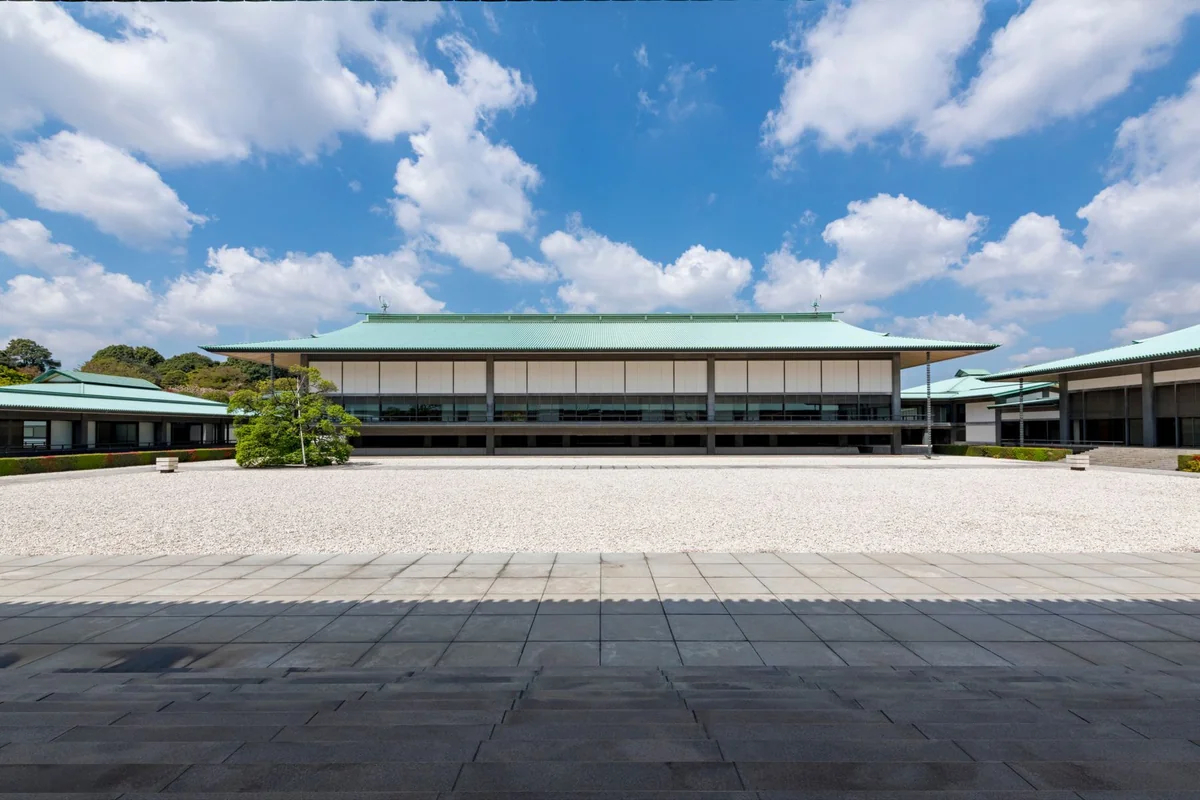
The route starts at the Someikan rest house inside Kikyo-mon Gate and passes the Fujimi-yagura keep, the Lotus Moat, the Imperial Household Agency building, the gravel court in front of the palace’s state buildings, the iron Main Gate Bridge and the Fushimi-yagura keep. Until 24 December 2026, tour groups can also see a small photo exhibition at the Someikan, Celebrating 100 Years of Showa, which shows the same route as it looked in earlier decades.
The same agency runs the bookings for Kyoto’s imperial sites, so if you are also heading west, the Katsura Imperial Villa tour is booked through the same system.


Imperial Palace East Gardens: free entry, three gates and the base of Edo Castle’s keep
If you cannot get on a tour, the East Gardens of the Imperial Palace are the easier way in. They cover 210,000 square metres of the old Honmaru, Ninomaru and Sannomaru compounds of Edo Castle, have been open to the public since 1 October 1968, and need no booking and no ticket.
You enter and leave by one of three gates: Ote-mon Gate (closest to Otemachi Station), Hirakawa-mon Gate on the north-east side, and Kitahanebashi-mon Gate on the north side, near Takebashi. There is a bag check at the entrance.
| Dates | Opening hours | Last entry |
|---|---|---|
| 1 March to 14 April | 9am to 5pm | 4.30pm |
| 15 April to 31 August | 9am to 6pm | 5.30pm |
| September | 9am to 5pm | 4.30pm |
| October | 9am to 4.30pm | 4pm |
| 1 November to end of February | 9am to 4pm | 3.30pm |
The gardens close every Monday and Friday, and from 28 December to 3 January. They open on national holidays that fall on a Monday or Friday, except the Emperor’s Birthday on 23 February; when a national holiday falls on a Monday, they close on the Tuesday instead. The agency publishes a closing day calendar for extra closures on court occasions.
Inside, the main sights are:
- Tenshudai, the stone base of Edo Castle’s keep on top of the Honmaru lawn. The keep that stood here burned in the Great Fire of Meireki in 1657, the blaze Zoë Kincaid describes in Kabuki: The Popular Stage of Japan (1925) as having destroyed the business centre of the city, and it was never rebuilt.
- Three surviving castle guardhouses on the way up from Ote-mon: Doshin-bansho, Hyakunin-bansho and O-bansho.
- Ninomaru Garden, a strolling garden with a pond and the Suwa no Chaya teahouse, which the agency photographs with azaleas in spring and red maples in autumn.
- The prefectural trees, a grove with one tree for each of Japan’s 47 prefectures, and the Bairin-zaka plum slope.
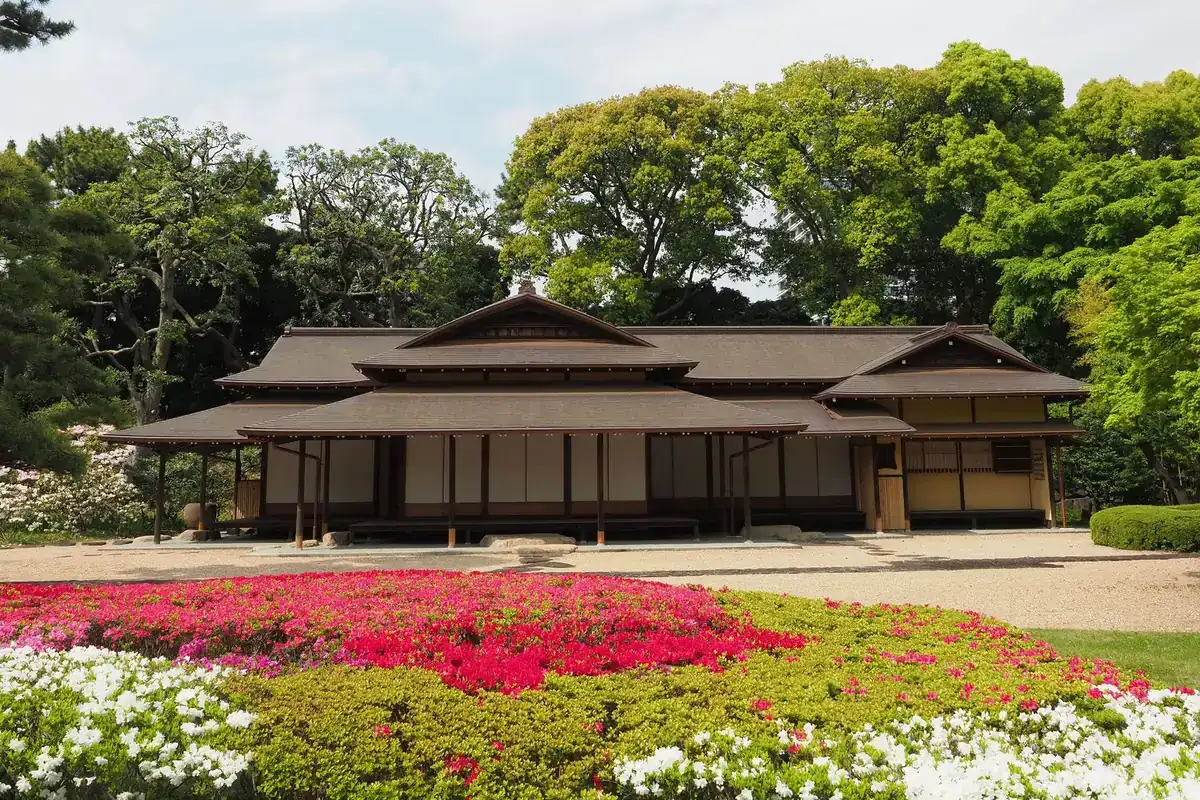
A walk round the gardens fits easily into a morning, and pairs well with lunch in Marunouchi or an afternoon in the department stores of Ginza, a short walk south of Tokyo Station.
Sannomaru Shozokan: the imperial collections museum reopens on 3 November 2026
Just inside Ote-mon Gate, The Museum of the Imperial Collections, Sannomaru Shozokan holds artworks once owned by the Imperial Family. It closed temporarily in 2025 and reopens on 3 November 2026 with a run of Grand Opening Special Exhibitions. These use timed tickets that must be booked in advance; none are sold at the door.
| Exhibition | Dates | Adult ticket |
|---|---|---|
| Beauty Through the Ages: Treasures of the Imperial Collections (three changes of display) | 3 November 2026 to 24 January 2027 | ¥2,500 |
| Sacred Garden of Birds and Flowers: Itō Jakuchū’s Colorful Realm of Living Beings and Painting in Kyoto | 4 February to 14 March 2027 | ¥3,000 |
| Japanese Calligraphy: A 1,300-Year Legacy of Beauty | 25 March to 16 May 2027 | ¥2,500 |
Visitors under 23 get in free but still need to book a time slot; children of primary school age and under need no booking. The museum opens from 9.30am to 5pm (last entry 4.30pm) and closes on Mondays, over New Year, on the Emperor’s Birthday and between exhibitions. It stays open on Fridays, when the rest of the East Gardens are shut: on a Friday you enter through Ote-mon Gate and go straight to the museum.
For more of the city’s art collections, our guide to the best art museums in Tokyo picks out the others worth a morning.
Nijubashi and the Main Gate: the view from Kokyo Gaien
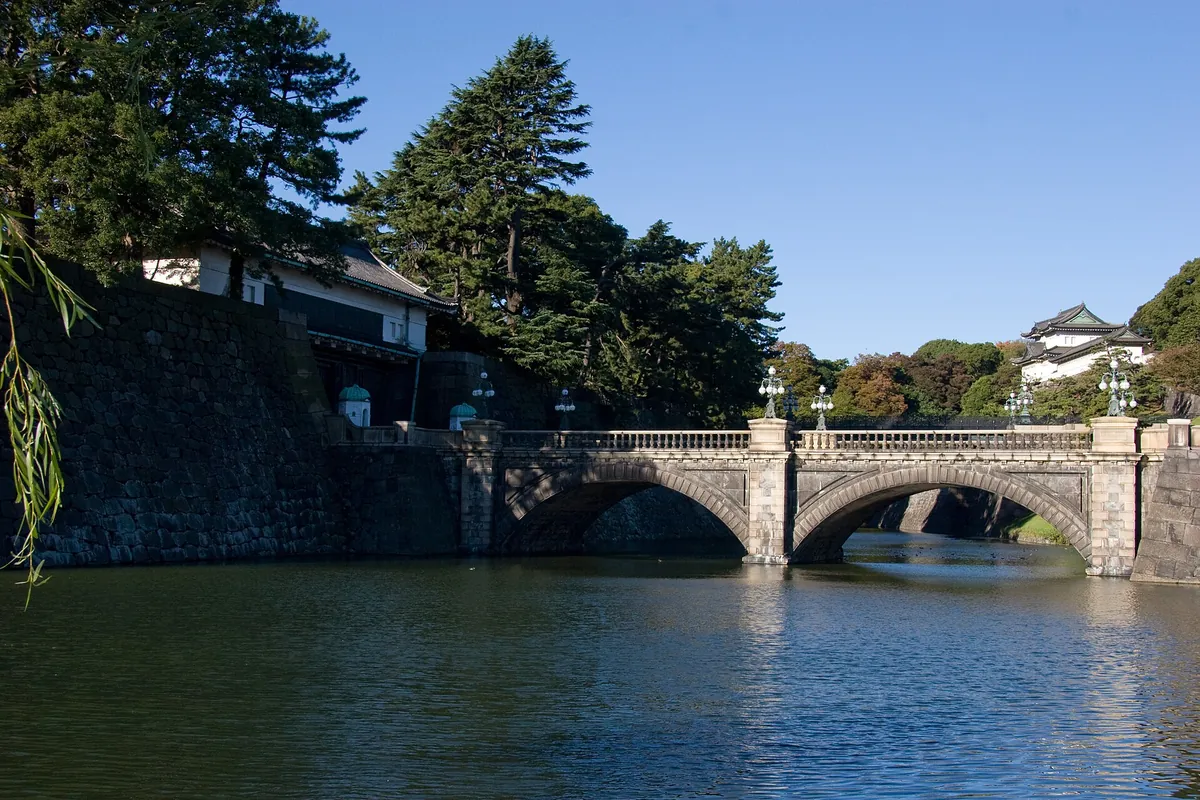
The postcard view of the palace is from Kokyo Gaien National Garden, the open gravel and pine plaza in front of the palace, which is free to enter. From the plaza you look across the moat at two bridges: a granite double arch in front, and an iron bridge set further back, with the white Fushimi-yagura keep on the bank above.
Most people call the whole view Nijubashi, the “double bridge”. On its own tour map, the Imperial Household Agency gives the name Nijubashi to the iron bridge at the back, the Main Gate Bridge (Seimon-tetsubashi), which the guided tour stops beside and which everyone crosses on the two greeting days. The stone bridge in front leads to the Main Gate itself.
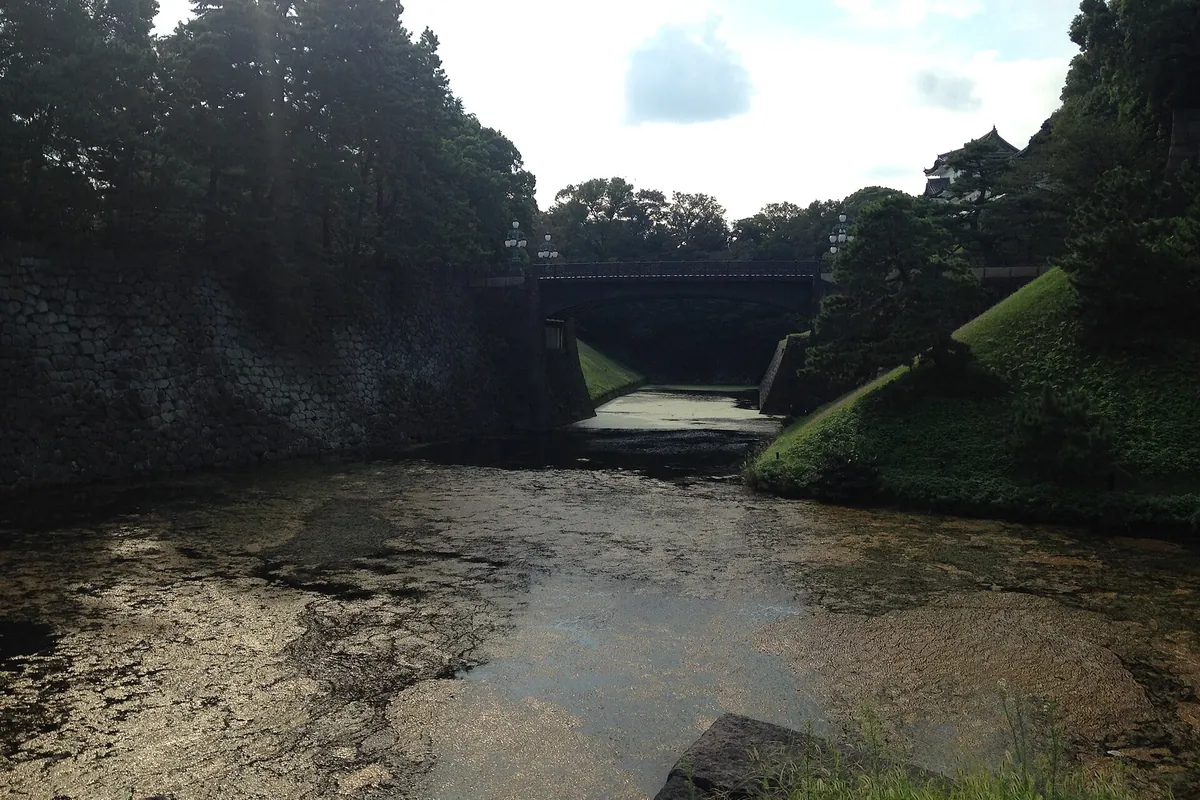
Kokyo Gaien is part of the same historic site. The Ministry of the Environment, which runs it, dates the first castle here to 1457, and says the Tokugawa shoguns, who ruled from 1603 to 1867, expanded it into the largest castle ever built in Japan. Its moats, gates, watchtowers and stone walls are what you see today.


Map of Nijubashi Bridge
New Year greeting on 2 January and the Emperor’s Birthday on 23 February 2027
On two days a year, anyone can walk through the Main Gate, cross Nijubashi and stand in the East Court below the palace while the Emperor and Empress appear on the balcony of the Chowa-den Hall. There is no ticket and no booking; you queue at the Main Gate. The Imperial Household Agency had not posted the 2027 times when we checked on 31 October 2026, so the times below are the 2026 arrangements, given as a guide.
| New Year greeting | Emperor’s Birthday greeting | |
|---|---|---|
| 2027 date | Saturday 2 January | Tuesday 23 February |
| Entry (2026 times) | Main Gate (Nijubashi), 9.30am to 2.10pm | Main Gate (Nijubashi), 9.30am to 11.20am |
| Balcony appearances (2026) | Five: about 10.10am, 11am, 11.50am, 1.30pm and 2.20pm | Three: about 10.20am, 11am and 11.40am |
| Afternoon | As above | No appearances. Signing a congratulations book near the agency building, entry by Sakashita-mon Gate 12.30pm to 3.30pm |
| East Gardens | Closed, but you may leave through them to Ote-mon | Closed, but you may leave through them |
The agency asks people not to start queuing on the evening before or in the early hours of the day itself, and on busy years it may send late morning arrivals to the afternoon book signing instead. Expect a bag check, wear flat shoes for the gravel, and leave selfie sticks, tripods and large bags behind. Please see only one appearance, so others can get in. Full rules for each day are on the agency’s New Year greeting page.
If you are in Japan in February, our guide to Japan in February lists what else is on that month.
Inui-dori: the cherry blossom and autumn leaf openings
For about nine days in spring, and in some years again in autumn, the agency opens Inui-dori, the road that runs about 750 metres through the palace grounds from Sakashita-mon Gate to Inui-mon Gate. It is timed for the cherry blossom and the autumn leaves. In 2026 it ran from 21 to 29 March, and the last autumn opening was from 29 November to 7 December 2025. The autumn 2026 dates had not been announced on 31 October 2026, so check the Inui Street page from mid November. You enter only at Sakashita-mon, queues can take 30 minutes from the nearest stations, and eating and drinking (other than water) are not allowed.
From Edo Castle to Kokyo: 1457 to 1968
The palace grounds have changed hands and names more than once:
- 1457. The first castle at Edo is built. The historian Frank Brinkley, in A History of the Japanese People (1915), credits Ota Dokan, a vassal of the Uesugi family, with building “at Yedo a fort destined to have world-wide celebrity”.
- 1603 to 1867. The Tokugawa shoguns rule Japan from Edo Castle and enlarge it.
- 1868. After the Meiji Restoration, the castle becomes the Emperor’s residence.
- May 1873. Fire destroys the shogun’s old palace buildings. The travel writer Eliza Scidmore, in Jinrikisha Days in Japan (1891, chapter XII), records the court moving to a lord’s former mansion in Akasaka while a new palace was built.
- 1888. The Emperor moves into the new palace, six years in the building, which Scidmore describes as a mix of Japanese halls and European rooms. From 1888 to 1948 the palace is officially called Kyujo, the “palace castle”.
- 1948 onwards. The name becomes simply Kokyo, the Imperial Palace.
- October 1968. The present palace, a two-storey building of steel-reinforced concrete with long eaves in a traditional style, is completed. It comes into use in April 1969. The East Gardens open in the same year.
Dates from 1868 onwards come from the Imperial Household Agency’s Imperial Palace page.
Running the Imperial Palace loop: anticlockwise, and passing on the right
The pavement around the palace moats is one of Tokyo’s most popular running routes. The Ministry of the Environment, which manages Kokyo Gaien, publishes the local rules agreed with Chiyoda City:
- Run anticlockwise around the moats.
- Do not force your way past in narrow sections; overtake on the right, after checking it is safe.
- Do not run on the gravel plaza.
- Groups of 20 or more need permission in advance, and no group running is allowed in the cherry blossom period (15 March to 15 April).
On Inui-dori opening days and greeting days, runners are asked to detour around the crowds at the gates.
Getting to the Imperial Palace from Tokyo Station, Otemachi and Nijubashi-mae
- For the guided tour (Kikyo-mon Gate): about 10 minutes on foot from Nijubashi-mae Station (Chiyoda Line) Exit 6, or from Otemachi Station (Mita Line) Exit D2, and about 15 minutes from the Marunouchi Central Exit of JR Tokyo Station. You cannot reach Kikyo-mon through the East Gardens.
- For the East Gardens and the museum (Ote-mon Gate): 5 minutes from Otemachi Station Exit C13a, or 15 minutes from the Marunouchi North Exit of Tokyo Station.
- For the Nijubashi view: walk west from the Marunouchi exits of Tokyo Station across Gyoko-dori into Kokyo Gaien.
There is no parking for visitors. If you want to stay within walking distance, the Tokyo Station and Marunouchi section of our guide to where to stay in Tokyo lists hotels a short walk from the moats.
Imperial Palace Tokyo: questions and answers
Can you go inside the Imperial Palace in Tokyo?
Not inside the buildings. The free guided tour takes you through the palace grounds, past the state buildings and over the Main Gate Bridge, but enters no building. On 2 January and 23 February you can stand in the East Court while the Imperial Family appear on the balcony. The East Gardens are open on most days without booking.
Is the Imperial Palace in Tokyo free?
Yes. The guided tour, the East Gardens, Kokyo Gaien and the two greeting days are all free. The only charge is for the special exhibitions at the Sannomaru Shozokan museum inside the East Gardens, from ¥2,500 for an adult, and visitors under 23 get in free with a booking.
How do I book the Imperial Palace tour?
Apply online on the Imperial Household Agency’s visit site from 5am Japan time on the 1st of the month before your visit, up to four days before. Each place needs the visitor’s name, nationality and age. Alternatively, collect a free numbered ticket at Kikyo-mon Gate on the day, from 9am for the morning tour or 12.30pm for the afternoon.
Which days are the East Gardens closed?
Every Monday and Friday, from 28 December to 3 January, and on some days of court events. The gardens open on national holidays that fall on a Monday or Friday (except 23 February), and when a holiday falls on a Monday they close on the Tuesday. The museum inside stays open on Fridays.
When can you see the Emperor of Japan?
At the public greetings on 2 January and on the Emperor’s Birthday, 23 February. In 2026 the Emperor and Empress appeared five times on 2 January, from about 10.10am to 2.20pm, and three times on the morning of 23 February. Entry is by the Main Gate, with a bag check, and no ticket is needed.
How long does the Imperial Palace tour take?
About an hour, on a route of about 2.2 km with little shade, according to the Imperial Household Agency. Allow time before the start for the ID and bag check at Kikyo-mon Gate. Add another hour if you want to walk through the East Gardens afterwards, which you reach from Ote-mon Gate rather than from the tour route.
Which bridge is Nijubashi?
Visitors use the name for the view of both bridges across the moat. The Imperial Household Agency applies it to the iron bridge at the back, the Main Gate Bridge, which the tour stops beside and visitors cross on greeting days. The granite double-arched bridge in front leads to the Main Gate and is the one most photographed.