Few cities celebrate their history quite like Kyoto. On 22 October each year, the city turns back time for the Jidai Matsuri (時代祭) literally the Festival of the Ages. This elegant Kyoto historical parade isn’t about fireworks or fanfare; it’s a living timeline. Thousands of costumed participants retrace more than a millennium of Kyoto’s past, walking from the Kyoto Imperial Palace to Heian Jingu Shrine.
The Jidai Matsuri, in Kyoto, is one of the city’s three great processions, alongside the Aoi Matsuri in May and Gion Matsuri in July. Yet among the Kyoto October festivals, Jidai Matsuri stands apart for its stately rhythm and historical depth.
Overview
At a glance
- Date: Always 22 October (the day Kyoto became Japan’s capital in 794 AD)
- Duration: Around two hours
- Participants: Roughly 2,000 people in traditional dress
- Route: Kyoto Imperial Palace Parade to Heian Shrine
- First held: 1895, marking Kyoto’s 1,100th anniversary and the founding of Heian Jingu
- Next event: Thursday, 22 October 2026. The festival is held on the same date every year

A festival born from Kyoto’s identity

A historical photo of the Jidai Matsuri procession, showcasing costumes and character from successive epochs in Japanese history. Source: Old Tokyo
The festival began during the Meiji Restoration, when Japan’s imperial capital had just moved from Kyoto to Tokyo. In 1895, Kyoto officials created Heian Jingu Shrine to honour Emperor Kanmu (who founded the city); Emperor Komei (its last resident emperor) was enshrined alongside him in 1940. The accompanying Heian Shrine Festival celebrated the city’s 1,100-year legacy, symbolising pride and continuity after losing capital status.
Since then, history has mirrored Kyoto’s enduring spirit. It has only paused for national emergencies such as wartime or pandemics, always returning as a tribute to the city’s layered past.
Heian-kyo in 794: the capital the procession celebrates
The festival looks back to the founding of Heian-kyo, the city that became Kyoto. In 784 Emperor Kanmu moved the capital from Nara to Nagaoka-kyo, then abandoned it only a decade later for a new site to the north-east. Heian-kyo, whose name means capital of peace and tranquillity, was established there in 794 and remained the seat of the imperial court for more than a thousand years.
The new capital was laid out as a grid modelled on Chang’an, the capital of Tang dynasty China, in a rectangle about 4.5 kilometres from east to west and 5.2 kilometres from north to south. Its avenues running east to west were numbered from north to south, from Ichijo (First Avenue) down to Kujo (Ninth Avenue), and that numbering survives in Kyoto’s street names today. Sanjo-dori, which the procession follows on its way to Heian Jingu, is literally Third Avenue, and Shijo-dori, the main street of Gion, is Fourth Avenue.
The parade: Kyoto’s timeline in motion
The two-hour procession begins around midday, making its way through Marutamachi Street and Sanjō-dōri before arriving at Heian Jingu around 2:30 pm. The full Jidai Matsuri route covers approximately four kilometres and unfolds in historical order—from the Meiji era back to the Heian period.
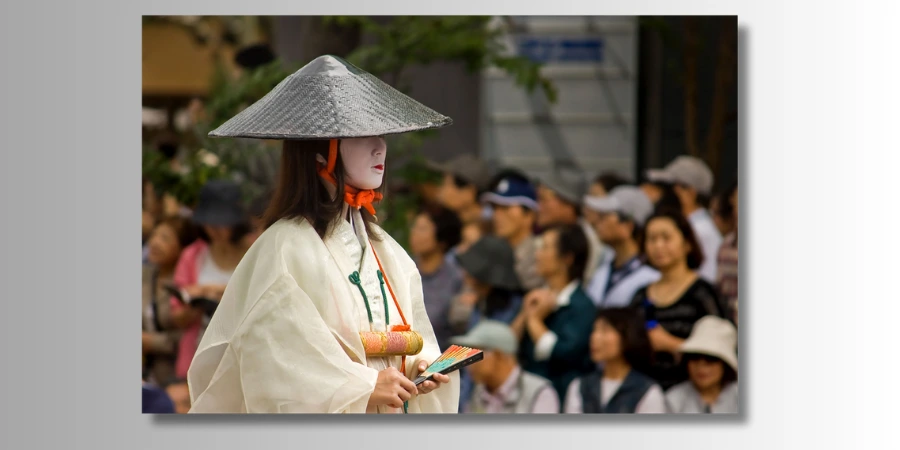
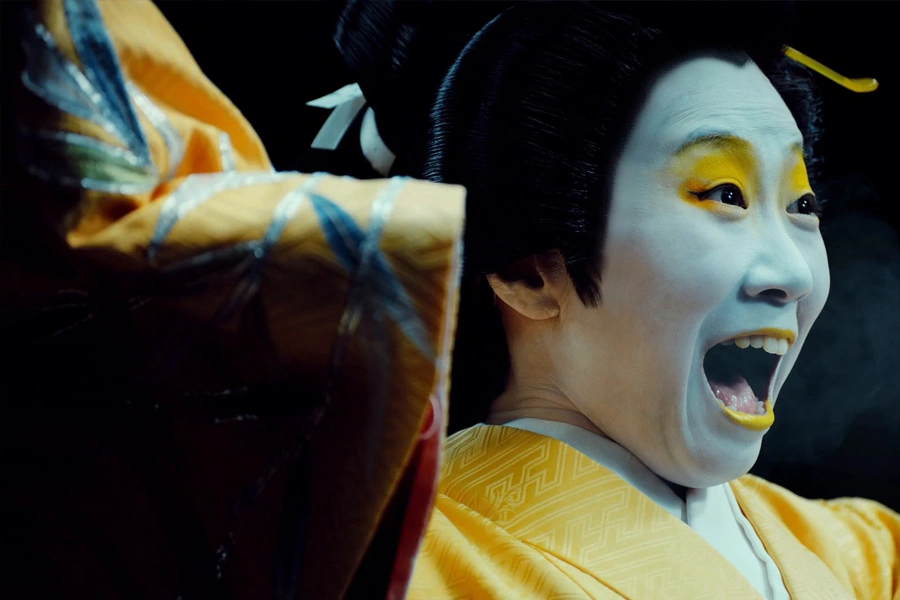
A participant in traditional attire, including white makeup and a large straw hat, during Kyoto’s Jidai Matsuri. Source: GaijinPot
Each era is represented by authentic reproductions of costumes, from samurai armour to silk robes of court ladies. The level of detail is extraordinary; everything, down to the stitching, is verified by historians and craftsmen. Around 2,000 participants take part, many of them Kyoto residents who volunteer through local associations.
You’ll see imperial messengers, Edo-period merchants, Heian nobles, and women’s processions inspired by famous figures such as Murasaki Shikibu, author of The Tale of Genji. The atmosphere is respectful yet festive—a moving museum on Kyoto’s streets.
Murasaki Shikibu, Tomoe Gozen and Shizuka Gozen in the Heian women’s procession
All three women walk in the Heian period women’s procession. Murasaki Shikibu served as a lady in waiting at the imperial court in the early 11th century, the world she drew on for her novel. Tomoe Gozen was a woman warrior celebrated in The Tale of the Heike for fighting beside the general Kiso Yoshinaka, and tradition says she became a nun after his death. Shizuka Gozen was a shirabyoshi, a dancer who performed in male court dress, and the beloved of Minamoto no Yoshitsune; she appears in the costume of her dancing days.
Best viewing spots and seating
There’s no admission fee, but tickets for reserved seating are worth considering. Paid sections are set up in Kyoto Gyoen and in front of Heian Jingu’s Otenmon Gate, priced from ¥5,000 to ¥15,500 in 2026 depending on location and row. These guarantee good views and shade, which is welcome in the autumn sun.
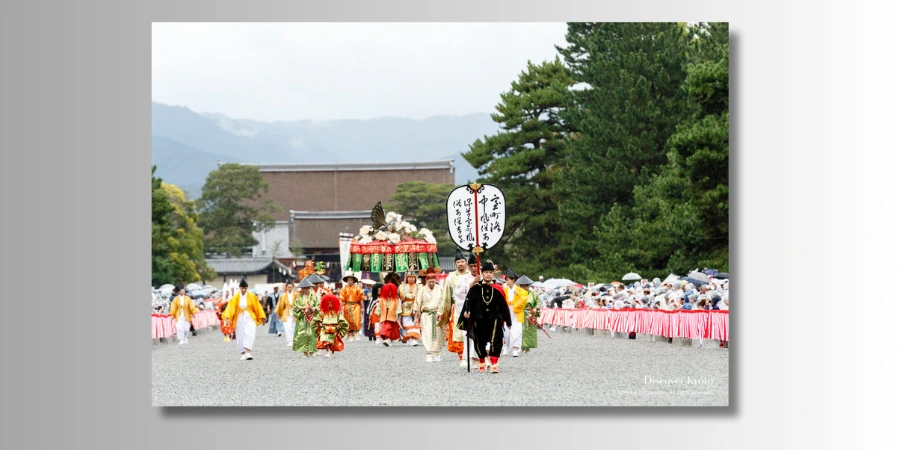
Participants in historical costumes and a highly decorated palanquin lead the Jidai Matsuri procession from the Kyoto Imperial Palace. Source: Discover Kyoto
The best viewing spots are near the Kyoto Imperial Palace, where the parade assembles, or near Heian Shrine, where the energy peaks. The Jidai Matsuri parade route map is typically published by Kyoto City Tourism in early October—check it if you plan to arrive later along the course.
If you’re planning photography, note that lighting improves around Oike-dōri after noon. For enthusiasts, Jidai Matsuri photography tips include positioning slightly west of Heian Jingu for better backdrops and carrying a lens hood for glare.
Timing, weather, and logistics
The start time is usually 12:00 pm, with the procession finishing around 2:30 pm at Heian Jingu. The schedule may shift slightly for weather, but Kyoto rarely cancels unless there’s heavy rain.
For those checking the weather, expect crisp mid-autumn conditions: around 18–22°C with mild sunlight. Kyoto weather in late October makes it ideal for travel—cool mornings, warm afternoons, and trees just beginning to turn red.
As with many Kyoto autumn events, it’s wise to arrive early. Temporary traffic restrictions and Kyoto road closures on October 22 are enforced along Oike-dōri and around the Kyoto Imperial Park to Heian Shrine section. Public transport is best; the Marutamachi to Heian Jingu journey is easy via subway and bus, or a 30-minute walk if you prefer to follow part of the parade route.
Getting there
For smooth access, head to Marutamachi Station (Karasuma Line) or Karasuma Oike Station to view the start. To reach the finish point, how to get to Heian Jingu is simple: take the Tozai Line to Higashiyama Station, then walk ten minutes north.
Public transport runs on normal schedules, but some bus lines are rerouted due to the parade. If you’re cycling, park near Okazaki Park before Kyoto events on 22 October begin.



Tips for visitors
- Bring water and snacks; convenience shops near Kyoto Gyoen fill up early.
- Arrive at least one hour beforehand to secure good spots.
- For the best photos, avoid crowd edges—mid-route provides depth and movement.
- Volunteers distribute English pamphlets with the Matsuri map and era order—helpful for understanding what you’re watching.
When comparing Kyoto’s festivals, many travellers wonder about Aoi Matsuri and Jidai Matsuri. The former, held in May, honours Shinto ritual, while the latter, in October, celebrates Kyoto’s long history. Both embody the city’s spirit, yet Jidai Matsuri’s vivid pageantry makes it uniquely stirring.
Why visit in 2026?
The Jidai Matsuri 2026 takes place on Thursday 22 October, with paid viewing seats sold through Kyoto City’s official tourism site. It’s a highlight in any Kyoto October itinerary, especially for travellers seeking cultural depth over spectacle.
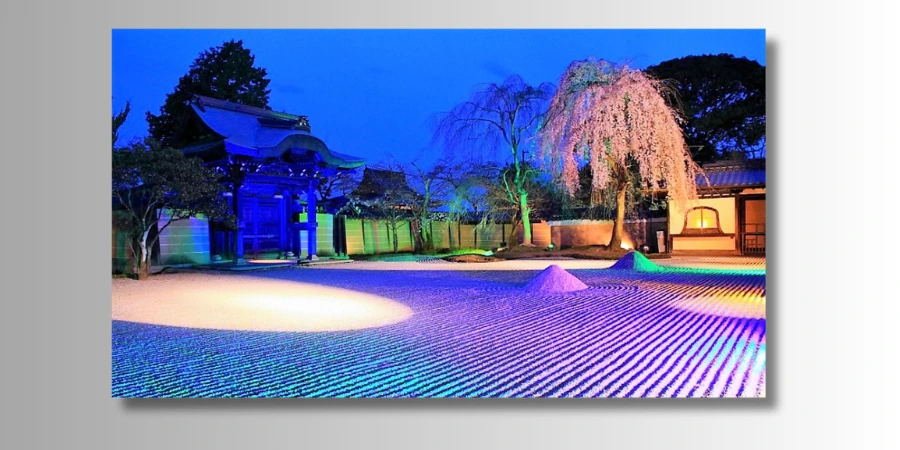
The dry Zen garden at Kodai-ji Temple, dramatically illuminated at night during the spring season. Source: 2Ponderful
Combine it with Kyoto autumn events such as temple illuminations at Kodai-ji or an evening stroll through Philosopher’s Path. For those planning things to do in Kyoto in October, the Festival of the Ages Kyoto offers a perfect balance of tradition, photography, and seasonal beauty.
Final thoughts
More than just a Kyoto period costume parade, the Jidai Matsuri Kyoto is a reminder that the past isn’t confined to museums—it still walks the streets. For one afternoon each October, Kyoto’s centuries breathe again in silk, steel, and solemn rhythm.
If you’re planning to experience Japan’s cultural seasons, begin by marking 22 October 2026 on your map. Then explore our other Kyoto guides on Japan Nakama for ideas on temple stays, night markets, and seasonal itineraries.