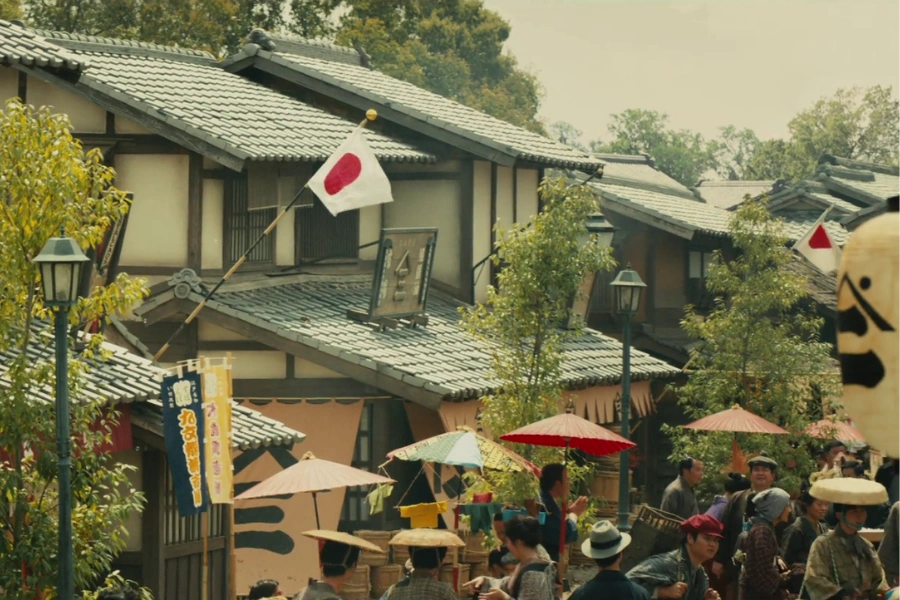
In 1603, Tokugawa Ieyasu formalised his control over newly unified Japan, giving rise to the Tokugawa shogunate, a military government that ruled from Edo (modern-day Tokyo) while the emperors and their courts, once the centres of power, entrenched themselves in archaic rituals and faded into irrelevance. For over 200 years, a succession of Ieyasu’s descendants ruled a relatively peaceful country, but by the mid-nineteenth century signs of stagnation were growing, and a looming threat beyond Japanese shores spurred a select few into action.
What followed was the Meiji Restoration of 1868, one of the most rapid and stark examples of national change in modern history. The Restoration – named for its reinstatement of the emperor as the head of the Japanese government – transformed Japan from a feudal society all but sealed off from the outside world to an industrialised global powerhouse in a few short decades.
The Meiji Restoration is usually dated to 3 January 1868, when direct imperial rule was proclaimed in Kyoto. The wider process ran from Tokugawa Yoshinobu’s resignation as shogun in November 1867 to the end of the Boshin War in June 1869, and the era name Meiji, meaning enlightened rule, was adopted in October 1868.
The Dirge of Tokugawa Japan
Since its accession after the decisive Battle of Sekigahara, the Tokugawa shogunate ruled through a bakuhan system of government, which divided power between the central shogunate and regional daimyo. While it was effective in preventing dissent, it was structurally rigid and fostered intense resentment. For one, daimyo who became vassals of the Tokugawa clan before Sekigahara – known as fudai daimyo – were favoured over those that hadn’t, known as tozama or ‘outsider’ daimyo. These lords were strategically placed in remote areas or sandwiched between more loyal lords to prevent any rebellion.
Regardless of classification, all daimyo were banned from fortifying their domains and all nobles were forbidden from trading, thus relying on the central government for resources and protection. Furthermore, policies such as sankin-kotai, which demanded each daimyo reside in Edo every other year, and for their family to be left as hostages in Edo once they returned to their han (feudal domain) imposed huge financial burdens on each vassal [1]. All power, therefore, was held tightly by the central government.

Portrait painting of Toyotomi Hideyoshi (1537–1598), a prominent figure in the unification of Japan. Source: nippon.com
After two centuries of relative peace and stability, however, the cracks in the foundations of the Tokugawa shogunate could no longer be papered over. In the 1830s and 1840s, a mixture of natural disasters and severe famine led to over 500 peasant uprisings and urban riots, which not only exposed severe gaps in the shogunate’s control, but also its ability to respond to crises [2]. In the wake of this dissent, policies handed down from the centre revolved solely around strengthening Tokugawa rule rather than allowing the daimyo the space to respond to their local crises themselves. As a result, opportunistic daimyo looking for change began to make their own moves in preparation for any conflict.
The Threat from the Seas – The Black Ships of Matthew Perry
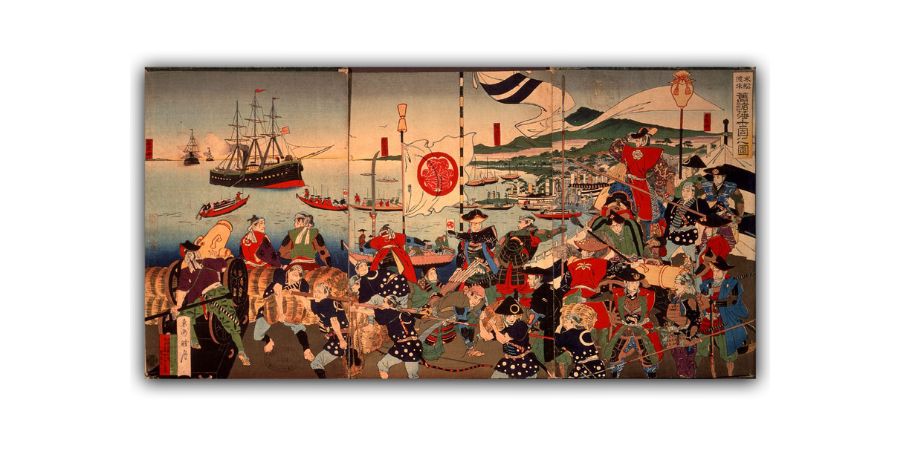
Historic ukiyo-e woodblock print illustrating the arrival of US Commodore Perry’s “Black Ships” and the signing of the Treaty of Kanagawa (1854), marking the end of Japan’s isolation. Source: Kanshudo
Unrest abroad added a further dimension to the calculations of increasingly nervous daimyo. While Japan had been more or less closed to foreigners since 1639 with the exception of Dejima in Nagasaki – where Dutch merchants were permitted to trade – the outside world had begun to unavoidably impinge on Japanese minds. In 1825, intellectual Aizawa Seishisai warned the government of the threat posed by Russia in the north and the British on the seas [3].
This was confirmed by the First Opium War (1839–1842), where China, seen by Japan as a natural bulwark against any invasion, suffered a crushing defeat at the hands of the British looking to pry it open for trade. Then, as the shogunate became aware of the overwhelming force that foreigners could deploy, and European powers found themselves distracted by the Crimean War, Commodore Matthew Perry sailed from the US, docking his warships in Edo Bay in 1853. The noxious clouds of black smoke that flew out of Perry’s steam frigates earned them a moniker that harken back to Japan’s earlier contact with Portuguese merchant vessels – the ‘Black Ships’. Perry’s message was stark: open up to foreign trade or face the same fate as China.
And just in case Perry’s interlocutors were in any doubt as to his motives, his gifts of history books extolling American victory in the Mexican–American War of 1848 subtly hammered the point home [4].
Under the weight of this existential threat, the Tokugawa shogunate unilaterally signed the Kanagawa Treaty when Perry returned in 1854, allowing the US to trade in Japan. The first crack in the dam now opened, the world’s powers all rushed to Japan to capitalise on the new market. In 1858 alone, the British, Dutch, Russians and French all signed treaties with Japan, granting them extensive trading and tariff rights. Crucially, the treaties provided the citizens of these countries with extraterritorial status, meaning they could not be held accountable under Japanese law or tried in Japanese courts. To many Japanese, this was a national humiliation, and the Tokugawa were permanently tarnished, seen as either unwilling or unable to defend the people it purported to rule over [5].


Sonno-joi
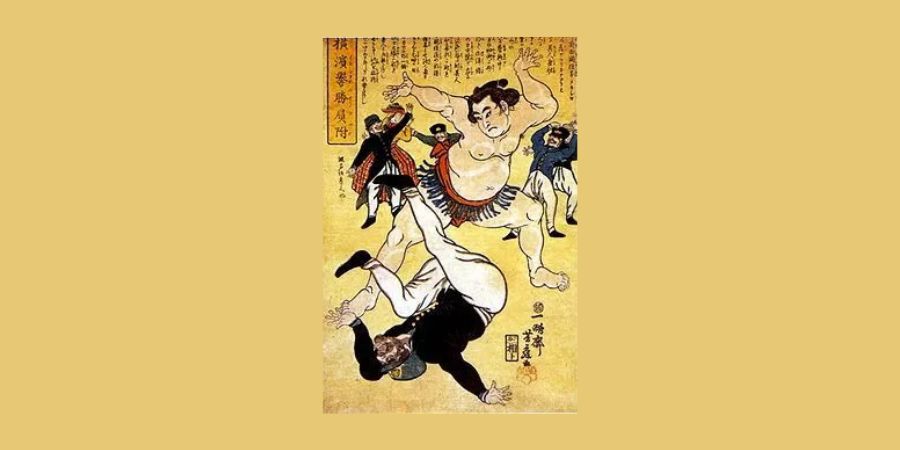
Satirical ukiyo-e woodblock print from the Meiji era, often symbolizing Japanese strength and resistance to Western influence. Source: Kazuhiro Nishimura
But with daimyo weakened and verging on bankruptcy, the political vacuum opened by the treaties had to be filled by something outside of the bakuhan. The lords of Mito (in present-day Ibaraki), despite being part of the Tokugawa clan, strongly believed that the emperor and the imperial court in Kyoto, were the natural rulers of Japan. Their slogan of sonno-joi (‘revere the emperor, expel the barbarian’) implored the shogun to serve the emperor as a good Confucian, but was seen by the shogunate as a direct threat to its rule [6].
The ‘revere the emperor’ half of the slogan also drew on National Learning (kokugaku), a movement that set out to recover a Japanese way of thinking from before Chinese and Buddhist influence. Motoori Norinaga (1730 to 1801) spent more than thirty years on his great commentary on the Kojiki, Japan’s oldest chronicle, and Hirata Atsutane (1776 to 1843), who called himself Motoori’s disciple although the two never met, turned that scholarship into a religious and political teaching centred on the divine descent of the emperor. Hirata’s followers were active among the loyalists of the 1860s. W. G. Aston, in Shinto: The Ancient Religion of Japan (1907), credits their teaching in part for the emperor’s restoration in 1868 as descendant of the Sun Goddess, and for the removal of Buddhist monks and ornaments from Shinto shrines that followed.
As such, the councillor Ii Naosuke executed or removed from the government and imperial court any who objected to the treaties in what became known as the Ansei Purge. This only infused sonno-joi with a deeper meaning and a greater urgency, and Ii was assassinated for his association with the treaties in 1860. Calls for sonno-joi reached fever pitch in March 1863 when, after breaking centuries of non-involvement in politics, Emperor Komei directly issued an edict to remove all foreign barbarians from Japan within two months [7].
Satsuma and Choshu – An Unlikely Alliance

Historic photograph of Satsuma samurai during the Boshin War period (circa 1868), gathered to study a map. Source: Wikimedia Commons
At this time, two powerful tozama han and long-standing rivals, Satsuma and Choshu (present-day Kagoshima and Yamaguchi, respectively), emerged as kingmakers. While Satsuma was traditionally in favour of union between the imperial court and the shogunate, its bombardment in August 1863 at the hands of the British after an Englishman was killed by a Satsuma retainer convinced its rulers of the need for more dramatic changes. Choshu, always a fiery hotbed of anti-Tokugawa dissidence, cleaved to sonno-joi as a means of righting the wrongs they faced at the hands of the shogunate, and following Komei’s edict fired on foreign ships without notifying the shogunate. Choshu intransigence reached its height on 20 August 1864, when its retainers stormed the imperial palace in Kyoto in an unsuccessful attempt to restore the emperor as the head of government.
A young British interpreter, Ernest Satow, saw much of this at first hand and later described it in A Diplomat in Japan (1921). He had reached Yokohama only days before the Namamugi incident of 14 September 1862, when the Shanghai merchant Charles Lennox Richardson and three companions, riding on the Tokaido highway near Yokohama, met the procession of Shimazu Hisamitsu, father of the lord of Satsuma, and were cut down by his retainers as they turned their horses. Richardson was killed. Satsuma refused Britain’s demands that the killers be tried and £25,000 be paid to the victims, so in August 1863 a British squadron sailed to Kagoshima, with Satow aboard HMS Argus, and shelled the town after the Satsuma batteries opened fire. A year later, in September 1864, he went ashore with the British, French, Dutch and American force that silenced Choshu’s batteries at Shimonoseki.
In response, the shogunate led a punitive expedition against Choshu, successfully forcing Choshu to hand over the ringleaders of the coup attempt. However, Tokugawa forces decided to punish Choshu yet again in another expedition in 1866, resulting in the shogunate’s crushing defeat. While the central government had been aggressively modernising since 1858, so too had individual daimyo, and the foreign trade and expertise that Choshu had independently amassed meant that their army was much stronger and more organised than the shogunate’s. Tokugawa Yoshinobu, who would turn out to be the final Tokugawa shogun, brokered a peace, and shrewdly set about further reforming the shogunate along Western lines.
Those reforms were real. Yoshinobu brought in a French military mission to retrain the shogunate’s army and British officers to advise its navy, pressed on with the French-built arsenal at Yokosuka, overhauled the shogunate’s government, and sent his younger brother Tokugawa Akitake to represent Japan at the Paris Exposition of 1867.
It was Yoshinobu’s modernising zeal and capability more than anything else that pushed Choshu to act [9]. Forming an alliance with Satsuma, these two tozama han felt that it was now or never to change the political order they had been subject to for generations. With the threat of yet another punishing war on the horizon, many daimyo called on Yoshinobu to cede control to the new emperor, Meiji, and, seeing no way out, Yoshinobu notified Meiji of his resignation on 9 November 1867.
The decisive nudge came from Tosa. In October 1867 the domain sent Yoshinobu a memorial, drafted by Goto Shojiro with the backing of its retired lord Yamauchi Yodo, urging him to return power to the emperor and proposing an assembly of two houses. When Tosa men later showed Satow a copy and asked him how a parliament worked, he admitted he could not tell them.
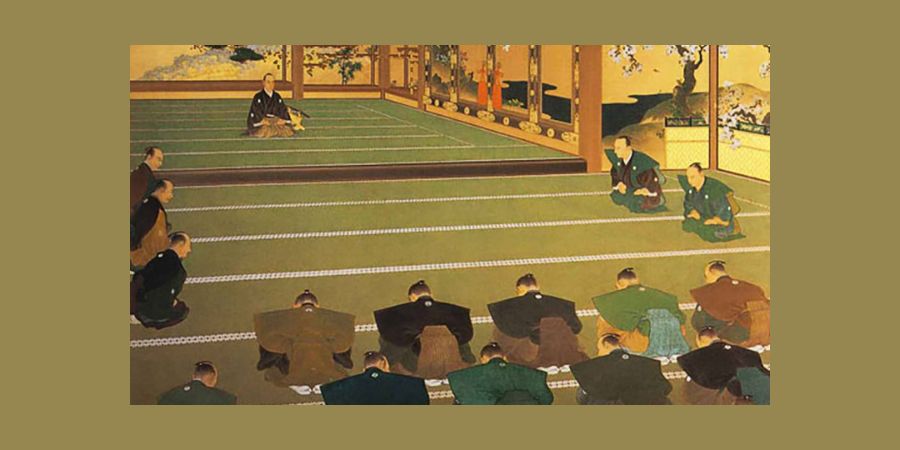
Painting illustrating a formal meeting or council (goyo-sho) held in a traditional Japanese room with sliding screen doors. Source: Japaaan Magazine
The Final Push and the Boshin War
While Yoshinobu hoped that by voluntarily resigning he could retain some influence in a new government, Satsuma and Choshu forces acted swiftly to bar the Tokugawa clan from ever holding power again. Either acquiring or, as many believe, forging, an imperial edict that allowed the use of force against Yoshinobu, they placed troops in Kyoto and barred him and his retinue from entering the city [10]. In January 1868 his army of around 15,000 was defeated by about 5,000 Satsuma and Choshu troops over four days at the Battle of Toba-Fushimi, the opening battle of the Boshin War. Fearing the end, Yoshinobu fled Osaka Castle for Edo by warship and announced his surrender.
Satow was in Osaka when the fighting began. On the evening of 27 January 1868 he saw a great blaze in the direction of Kyoto and was told it was the town of Fushimi burning as the two armies fought.
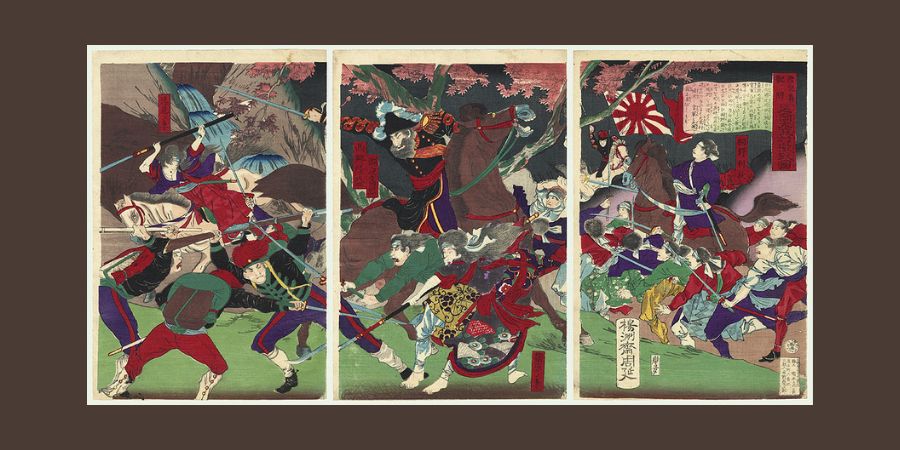
Historic ukiyo-e triptych illustrating a fierce battle during the Boshin War (1868–1869), which led to the Meiji Restoration. Source: Fuji Arts
The way now clear, lords from Choshu and Satsuma proceeded with imperial restoration, proclaiming direct imperial rule on 3 January 1868. While some Tokugawa loyalists continued fighting, they were quelled by June 1869, leading to the dawn of the Meiji era under a new, reformed government centred around the emperor.
The Boshin War takes its name from the year it began, 1868, the year of the earth dragon (boshin) in the traditional calendar. Saigo Takamori of Satsuma, a senior staff officer of the imperial army marching on Edo, negotiated the handover of Edo Castle with the shogunate’s Katsu Kaishu in the spring of 1868, sparing the city a battle. The war went on in the north, where Aizu fell after a month-long siege that autumn, and ended with the surrender of the last loyalist holdout at Hakodate in Hokkaido. Saigo later turned against the government he had helped to create and died leading the Satsuma Rebellion in 1877.
The Road to Modern Japan
In a few decisive years, a system of government that had reigned over Japan for around 250 years came to an end. In the decades after the Meiji Restoration, Japan transformed itself from a fragmented, feudal collection of domains into a unified body politic, and began to modernise at breakneck speed until they were considered among the ranks of the great powers who, just a handful of decades prior, had forced Japan to sign oppressively unequal treaties.
Not bloodless, nor without its hardships, the Restoration was only the beginning of Japan’s long and hard road to rebirth in the modern era.








References
[1] John Hall, ‘The bakuhan system’ in James McClain and John Hall (eds), The Cambridge History of Japan (Cambridge, 1991), p.161
[2] Harold Bolitho, ‘The Tempo Crisis’ in Marius B. Jansen (ed.), The Emergence of Meiji Japan (New Jersey, 1995), p.2, p.6
[3] Quoted in Bob Tadashi Wakabayashi, Anti-Foreignism and Western Learning in Early Modern Japan: The New Theses of 1825 (Cambridge, Mass., 1985), p.204
[4] Jeffrey A. Keith, ‘Civilisation, Race, and the Japan Expedition’s Cultural Diplomacy, 1853-1854’, Diplomatic History (April 2011), p.179
[5] H. D. Harootunian, ‘Late Tokugawa Culture and Thought’ in Jansen, The Emergence of Meiji Japan, pp.78-79
[6] Chushichi Tsuzuki, The Pursuit of Power in Modern Japan (Oxford, 2000), p.44
[7] Conrad Totman, ‘From Sakoku to Kaikoku: The Transformation of Foreign-Policy Attitudes, 1853-1868’, Monumenta Nipponica (Spring, 1980), p.12
[8] Marius B. Jansen, ‘The Meiji Restoration’ in Marius B. Jansen (ed.), The Cambridge history of Japan, Volume 5: The Nineteenth Century (Cambridge, 1989), p.357
[9] Michael R. Auslin, Negotiating with Imperialism: The Unequal Treaties and the Culture of Japanese Diplomacy (Cambridge, Mass., 2006), p.99
[10] Nihonsi Jiten. 【討幕の密勅とは】わかりやすく解説!!意味や内容は?偽物なの. Accessed 19/11/2025
Sources and further reading
- Ernest Satow, A Diplomat in Japan (1921)
- W. G. Aston, Shinto: The Ancient Religion of Japan (1907)
- Frank Brinkley with Dairoku Kikuchi, A History of the Japanese People (1915)