Tanabata is Japan’s star festival, held on 7 July in most of the country and on or around 7 August in places such as Sendai that keep to the older seasonal calendar. People write wishes on strips of coloured paper called tanzaku and tie them to bamboo, to mark the one night a year when the weaver star Orihime and the cowherd Hikoboshi are allowed to cross the Milky Way and meet.
This guide tells the legend, explains where the festival came from and what each paper decoration asks for, and gives the 2027 dates for the three big street festivals in Sendai, Hiratsuka and Tokyo’s Asagaya, checked on the organisers’ own pages on 1 November 2026.
Tanabata at a glance
Name: Tanabata (七夕), also read shichiseki, the evening of the seventh.
Date: 7 July (a Wednesday in 2027), or 6 to 8 August in Sendai.
Stars: Orihime is Vega, in the constellation Lyra; Hikoboshi is Altair, in Aquila.
Custom: wishes written on tanzaku and hung on bamboo, then floated away or burned.
Holiday: no. Tanabata is not one of Japan’s national holidays, so shops and offices stay open.
Tanabata Legend, Wishes and 2027 Festival Dates
Orihime and Hikoboshi: The Weaver, the Cowherd and the Milky Way
The story came to Japan from China. Orihime, the daughter of the Emperor of Heaven, was a weaver so devoted to her loom that she had no time for anything else. Her father married her to Hikoboshi, a cowherd who grazed his cattle on the far bank of the river of heaven, the Amanogawa, which is the Japanese name for the Milky Way. Once married, the pair were so happy together that the weaving stopped and the cattle wandered. The emperor sent Orihime back across the river and allowed the couple to meet on one night a year, the seventh night of the seventh month, if they both worked hard in between.
In the version Frank Rinder published in Old-World Japan in 1895, the lovers cross on a bridge made by a flock of magpies with their wings spread, and rain is the enemy: if it rains on the night, the river floods, the bridge is swept away, and they must wait another year. That is why a clear sky on 7 July matters to people who still follow the story. Rinder calls the pair Shokujo and Kingen, the Japanese readings of the Chinese star names; Orihime and Hikoboshi are the names Japanese children learn today.


From the Nara Court to Edo Rooftops: Where Tanabata Came From
In China, the seventh night of the seventh month was the night women prayed for skill at weaving and needlework, a rite called qiqiao, or kikkōden in Japanese. The Japanese court adopted it in the Nara period (710 to 794). Offerings of peaches, pears, aubergines, melons, soybeans, dried sea bream and abalone were laid out in the east garden of the imperial palace for the two stars, and court poets wrote about the lovers in the Man’yōshū, Japan’s oldest poetry anthology.
The Japanese name has its own history. The folklorist Orikuchi Shinobu traced it to the tanabatatsume, a maiden in Japanese tradition who wove cloth for a god in a hut built over the water and waited there for him to arrive. That older belief in purification by water explains why Tanabata customs so often involve rivers: the bamboo was floated away the next morning, and in many parts of Japan people once washed tools, cleaned wells or bathed their horses that day as the first step towards Obon.
By the Edo period (1603 to 1868), Tanabata had become one of the five seasonal festivals of the official calendar, and ordinary households in Edo set bamboo branches hung with five-coloured paper and thread above their roofs. Temple schools had pupils write wishes on paper strips as handwriting practice, which is where the custom of wishing for better calligraphy comes from. Hiroshige’s print of the city in 1857 shows exactly that scene.
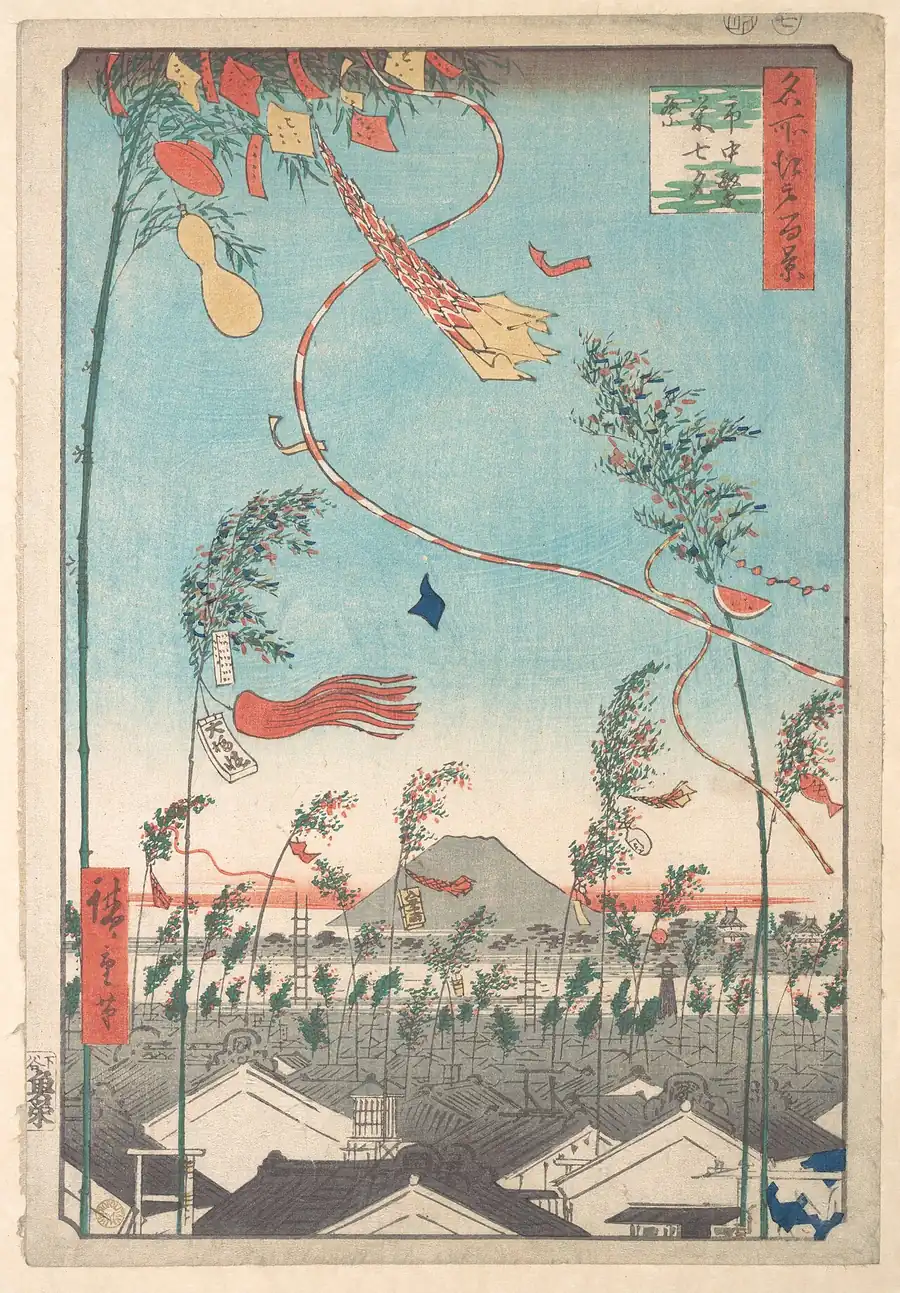
Two writers at the turn of the twentieth century saw very different pictures. On the seventh day of the seventh month, Osman Edwards travelled down from the spa town of Ikao to Takasaki and found every village doorway hung with a bamboo stem crowned with paper stars. A fellow passenger told him the long white streamers matched the number of children in each house, each one carrying a poem wishing that child happiness, and especially luck in love (Japanese Plays and Playfellows, 1901, chapter six). Nine years later, Jukichi Inouye recorded that Tokyo had all but stopped: Tanabata was one of two of the five great feasts “no longer celebrated in Tokyo” (Home Life in Tokyo, 1910, chapter 21). Asagaya’s Tanabata street festival in Tokyo was started by local shopkeepers in 1954.
Tanzaku Wishes and the Seven Paper Decorations of Sendai
The tanzaku is the decoration everyone takes part in. It is a narrow strip of coloured paper, and you write a wish on it, tie it to a branch of bamboo and leave it there for the night. Bamboo was chosen because it grows fast and straight towards the sky, and people believed it would carry the wishes up to the stars. Stations, city halls and shopping centres across Japan often put up bamboo in early July so that passers-by can add a wish of their own.
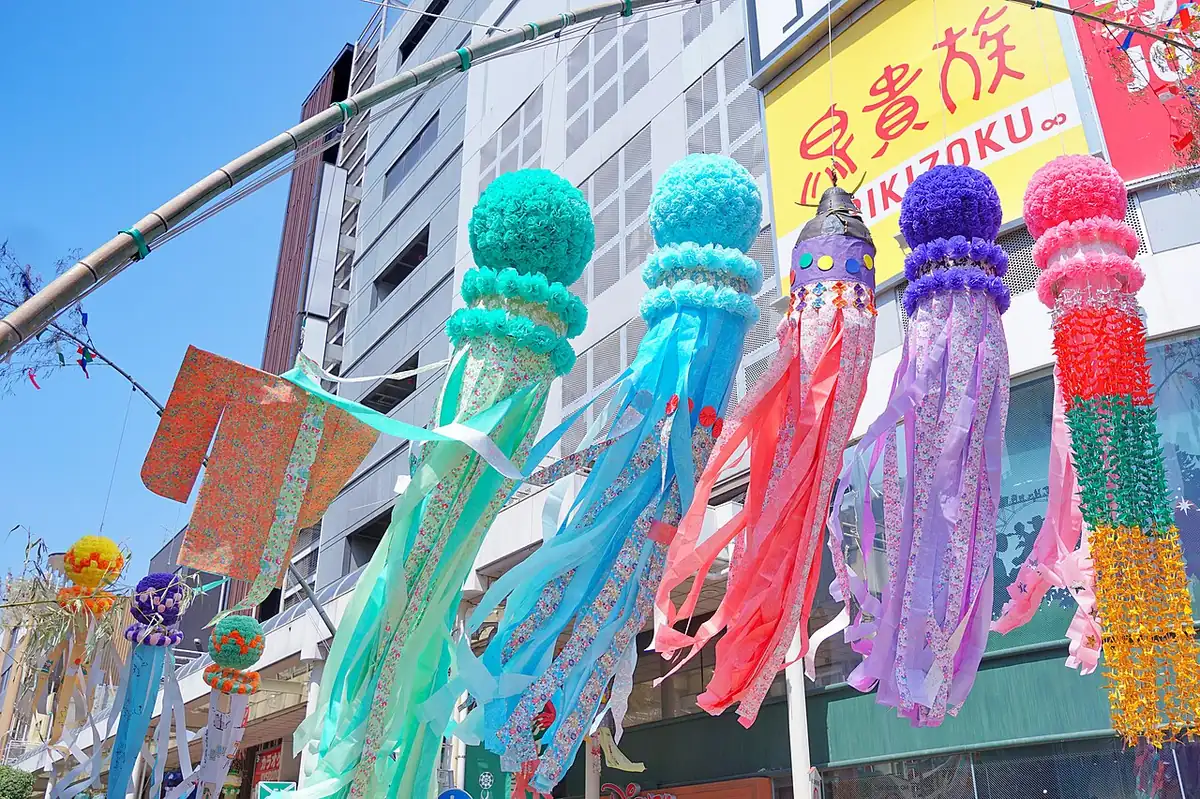
Sendai keeps a fuller set. The organisers of the Sendai Tanabata Matsuri describe seven traditional decorations, the nanatsu kazari, each with its own wish:
| Decoration | What it is | What it wishes for |
|---|---|---|
| Tanzaku (短冊) | Paper strip with a written wish or poem; ink was once ground with dew collected from taro leaves at dawn | Progress in study and calligraphy |
| Kamigoromo (紙衣) | Paper kimono | Protection from illness and misfortune, skill at sewing, and a stand-in to keep children safe |
| Orizuru (折鶴) | Folded paper cranes, once one for every year of the oldest person in the family | A safe household and a long life |
| Kinchaku (巾着) | Paper drawstring purse | Good business and never being short of money |
| Toami (投網) | Paper fishing net | A good catch from the sea off Sendai and a good harvest |
| Kuzukago (屑篭) | Waste basket filled with the offcuts from making the other six | Cleanliness and thrift |
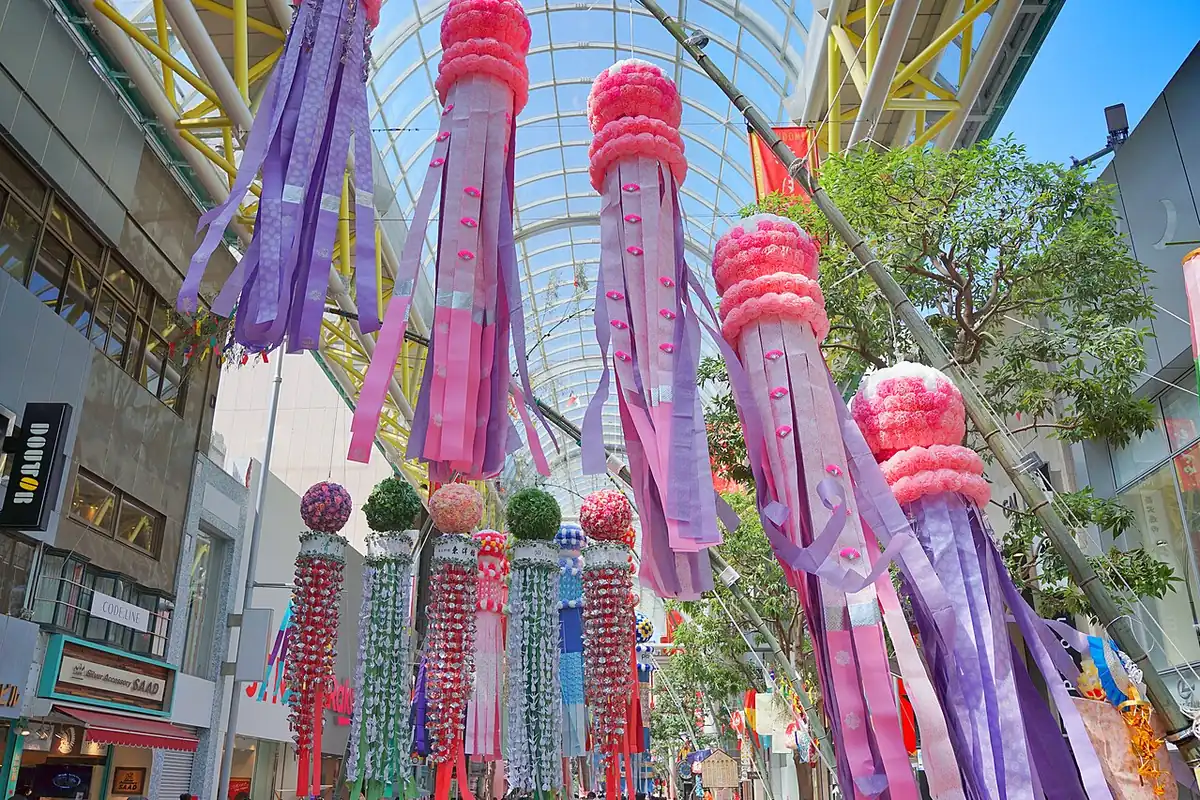
| Fukinagashi (吹き流し) | Long streamers, standing for Orihime’s weaving thread | Skill at weaving and handicrafts |
The food of the day is sōmen, very thin wheat noodles served cold. There are two explanations for it: the noodles look like the threads Orihime weaves, and wheat was once believed to ward off sickness.
Tanabata Dates in 2027: 7 July or 6 to 8 August
Tanabata belongs to the seventh day of the seventh month of the old lunisolar calendar, which ran roughly a month behind the calendar Japan adopted in 1873. Places chose different answers. Most of Japan, including Hiratsuka, moved the festival to 7 July. Sendai uses what folklorists call the middle calendar, holding it a month later from 6 to 8 August to keep the late summer feel the festival always had, and Asagaya in Tokyo follows the same August timing.
| Festival | Where | Usual timing | 2026 dates | 2027 dates |
|---|---|---|---|---|
| Tanabata day | Across Japan | 7 July | Tuesday 7 July | Wednesday 7 July |
| Shonan Hiratsuka Tanabata Festival | Hiratsuka, Kanagawa Prefecture | Three days in early July, Friday to Sunday | 3 to 5 July (74th festival) | Not yet announced |
| Sendai Tanabata Matsuri | Central Sendai, Miyagi Prefecture | 6 to 8 August every year | Thursday 6 to Saturday 8 August | Friday 6 to Sunday 8 August |
| Asagaya Tanabata Festival | Asagaya Pearl Center, Suginami, Tokyo | Five days in early August | 7 to 11 August (70th festival) | Not yet announced |


Sendai, Hiratsuka and Asagaya: Three Big Tanabata Festivals
Lists of Japan’s three great Tanabata festivals vary. Nippon.com names Sendai, Shonan Hiratsuka and Anjō in Aichi Prefecture, while the Asagaya shopping street counts itself among them. The three below are the easiest to reach from Tokyo or Tohoku.
Sendai Tanabata Matsuri, 6 to 8 August
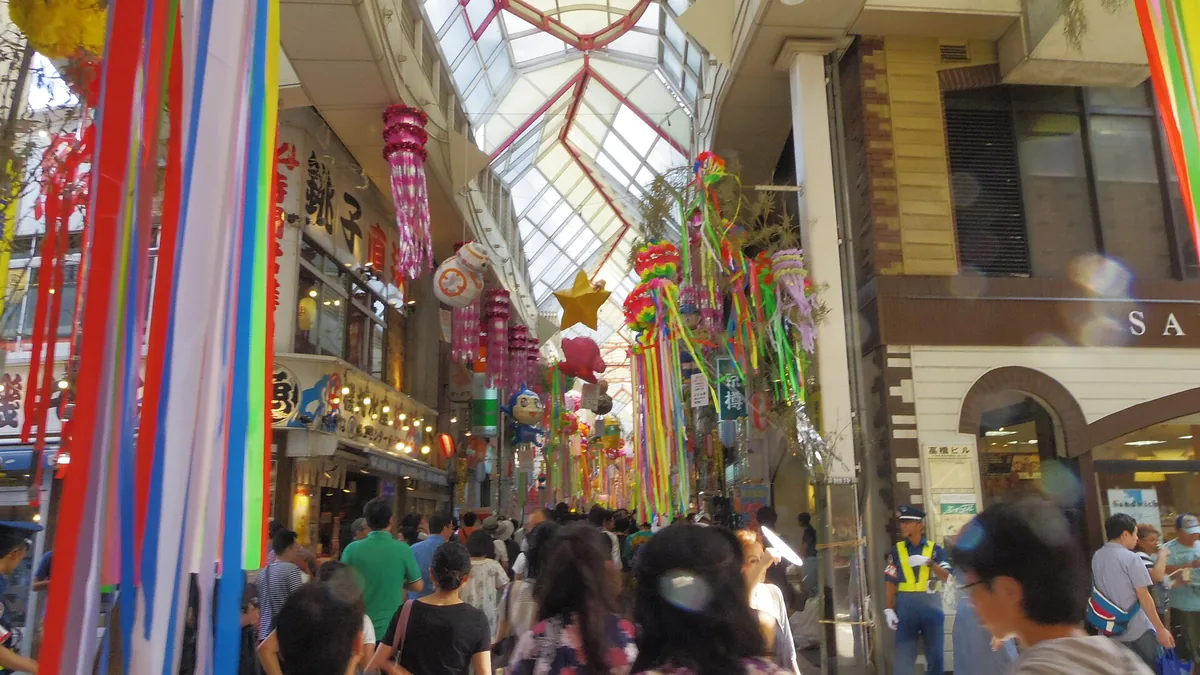
Sendai’s is the largest of the three, with more than two million visitors a year by its organisers’ count. Shopkeepers cut bamboo poles over ten metres long from the hills, and each shop’s decoration, made by hand over several months, is said to cost hundreds of thousands to millions of yen. The tradition is to hang streamers in sets of five. The designs are kept secret until the morning of 6 August, when they go up from about 8am along the covered arcades between Sendai Station, Chūō-dōri and Ichibanchō, and each street awards gold, silver and bronze prizes that afternoon. Rain is the great enemy: when a shower starts, shop staff rush out to cover the paper in plastic bags.
The history is long. Date Masamune, the lord who founded Sendai, wrote eight waka poems about Tanabata between 1618 and 1629. The festival faded after Japan changed its calendar, and Sendai’s merchants revived it in 1927 to lift spirits during a slump; the following year it moved to 6 to 8 August. It vanished again during the war. In August 1946, the first summer after it ended, 52 bamboo poles were raised on the burnt-out site of Ichibanchō, and the large paper balls on today’s streamers, the kusudama, were invented around then, according to the organisers, by a Sendai man who wanted the decorations to look like the dahlias in his garden. Sendai is the largest city in Tohoku, and our Tohoku travel guide puts the festival together with Aomori Nebuta and Akita Kanto in the same week.
Shonan Hiratsuka Tanabata Festival, Early July
Hiratsuka, on the coast of Kanagawa Prefecture on the JR Tokaido Line, holds one of the best-known July Tanabata festivals near Tokyo. It began after the war as a way to bring trade back to the town’s shops, and the first festival was held in 1951. About 300 decorations hang over the streets north of JR Hiratsuka Station, with the Shonan Star Mall as the main street, and around 100 food stalls line the roads. The town keeps the theme all year: the station’s departure melody is the children’s song Tanabata-sama. The 2026 festival ran from Friday 3 to Sunday 5 July; Japan Nakama will add the 2027 dates when they are announced.
Asagaya Tanabata Festival, Tokyo, Early August
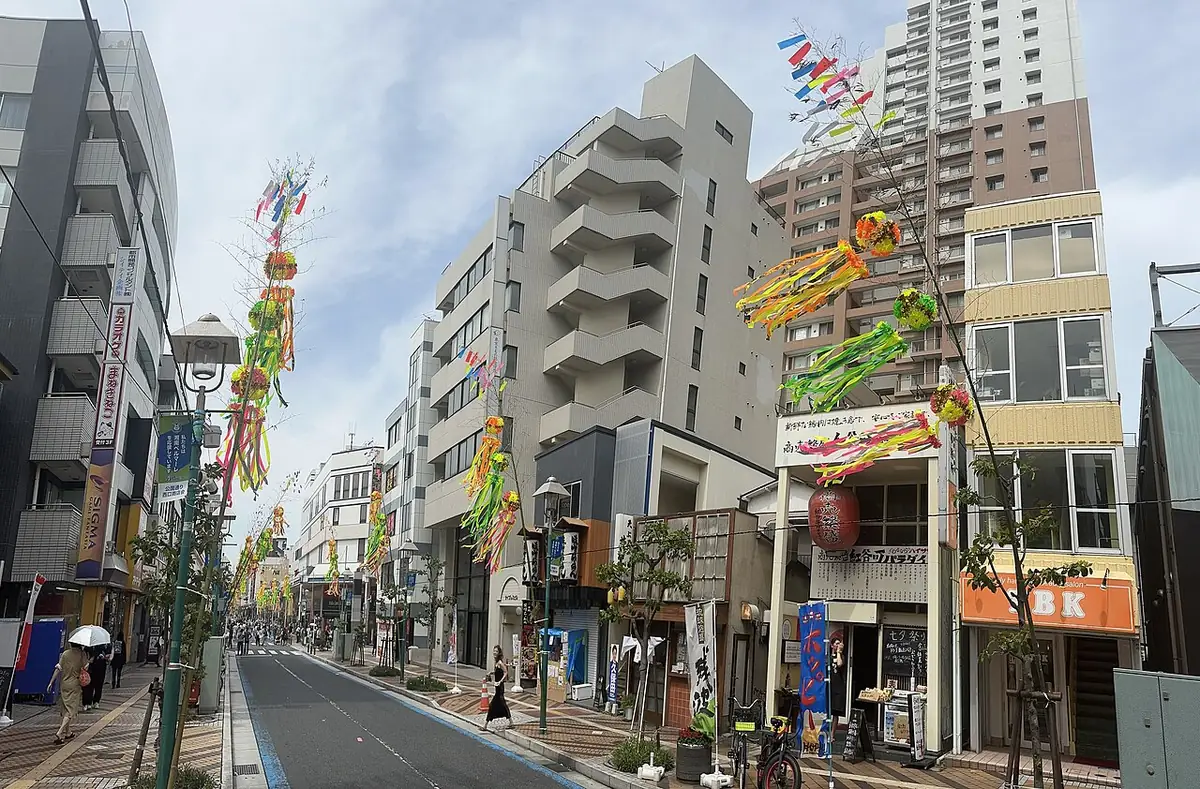
Asagaya’s festival started in 1954, when the shopkeepers of the Asagaya Pearl Center arcade went to see the Tohoku festivals and came back with a plan to fill their street in the quiet heat of August. Its trademark is the hariboten: around 100 papier-mâché figures made by shop owners and pupils from local schools, often anime characters or jokes about the year’s news, hung along the 700 metres of the arcade with traditional bamboo and streamers. The largest are about four metres long and take more than a month to make. In 2026 the 70th festival ran from 7 to 11 August, from 10am to 10pm (9pm on the last day), and on the first two evenings anyone could write a wish on a star-shaped tanzaku at JR Asagaya Station’s south exit. The arcade starts at the south exit, and Asagaya sits next to Koenji on the JR Chuo Line, so our guide to Koenji covers the rest of an evening in the area.
Seeing Tanabata in July or August 2027
All three festivals are free to walk through. If you are in Japan in early July, look for bamboo and blank tanzaku at stations and shopping centres from the start of the month, and plan a day trip to Hiratsuka once its dates are out; our guide to Japan in July lists the other festivals of the month, from the Gion Matsuri in Kyoto to the Sumidagawa fireworks.
In August, Sendai’s three days in 2027 run from Friday to Sunday, straight into the weekend, and in the same week as the big Aomori and Akita festivals, so book a room in Sendai early. Asagaya’s festival in Tokyo usually overlaps it. Our guide to Japan in August sets both against the month’s fireworks, dance festivals and the Obon travel peak.
Tanabata: Questions and Answers
Tanabata is Japan’s star festival, held on 7 July in most of Japan and from 6 to 8 August in Sendai. It marks the one night a year when the weaver Orihime, the star Vega, and the cowherd Hikoboshi, the star Altair, may cross the Milky Way to meet. People write wishes on paper strips called tanzaku and hang them on bamboo.
Tanabata day is Wednesday 7 July 2027. The Sendai Tanabata Matsuri runs from Friday 6 to Sunday 8 August 2027, as it does on the same dates every year. The Shonan Hiratsuka festival in early July and the Asagaya festival in Tokyo in early August had not announced 2027 dates by November 2026; in 2026 they ran from 3 to 5 July and 7 to 11 August.
Orihime, daughter of the Emperor of Heaven, wove cloth on one bank of the Milky Way, and Hikoboshi herded cattle on the other. After they married, both stopped working, so the emperor separated them and let them meet only on the seventh night of the seventh month. In older tellings, magpies form a bridge for them, and rain that night floods the river and keeps them apart.
Anything you hope for. Traditionally a tanzaku asked for progress in study and calligraphy, according to the Sendai Tanabata organisers, and poems were written on them as well as wishes. Today people write any wish on the narrow strip of coloured paper, tie it to a branch of bamboo and leave it for the night. Afterwards the strips are floated away or burned.
Tanabata belongs to the seventh day of the seventh month of the old calendar, which ran about a month behind the calendar Japan adopted in 1873. Sendai holds its festival a month later than 7 July, from 6 to 8 August, to keep the late summer timing of the original. The city fixed those dates in 1928, according to the festival organisers.
Sōmen, very thin wheat noodles served cold, is the traditional Tanabata dish. Nippon.com gives two explanations: the noodles look like the threads Orihime weaves, and wheat was once believed to ward off illness. Many families simply eat sōmen for dinner on 7 July, and supermarkets stock it in early July.
No. Tanabata is not on the Cabinet Office’s list of Japan’s national holidays, so schools, offices and shops are open on 7 July. The festival is marked in the evening at home, at school and in shopping streets. The nearest national holiday is Marine Day on the third Monday of July, which falls on 19 July in 2027.