Japan’s three great festivals, the Nihon sandai matsuri, are the Gion Matsuri in Kyoto, the Tenjin Matsuri in Osaka and the Kanda Matsuri in Tokyo. Gion fills the whole of July and Tenjin peaks on 24 and 25 July, while Kanda takes over central Tokyo in May at full scale only in odd-numbered years, so 2027 is a year when all three run in full.
The list is a tradition with no official body behind it, and some versions put Tokyo’s Sanno Matsuri in place of Kanda. This guide explains where each festival came from, what happens on its big days and the 2027 dates, then sets out the other famous lists of three, from old Edo to Tohoku.
Japan’s three great festivals in 2027 at a glance
Gion Matsuri, Kyoto: 1 to 31 July. Float processions on Saturday 17 and Saturday 24 July from 9am.
Tenjin Matsuri, Osaka: Saturday 24 and Sunday 25 July. Boat procession and fireworks on the evening of the 25th.
Kanda Matsuri, Tokyo: May 2027, a full-scale year. Kanda Myojin had not published the dates on 2 November 2026.
Entry: free to watch from the street at all three; Kyoto sells reserved seats for the Gion processions.
Gion, Tenjin and Kanda Matsuri Compared
Nihon Sandai Matsuri: Who Names Gion, Tenjin and Kanda as Japan’s Three Great Festivals
A matsuri is a Shinto shrine festival, the day or days when a shrine’s deity is carried out among the people of its neighbourhood. The scholar W. G. Aston described the annual matsuri of a local god in 1907: offerings are made, the god’s emblem is carried in a procession “which reminds one of the carnivals of Southern Europe”, and there are stalls, wrestling and fireworks. “In short,” he wrote, “the matsuri is not unlike an English fair” (Shinto: The Ancient Religion of Japan, 1907).
Sandai means “the three great”, and Nihon sandai matsuri is the name for the three festivals usually ranked above all others. Nippon.com gives the standard list as Kyoto’s Gion Matsuri, Osaka’s Tenjin Matsuri and Tokyo’s Kanda Matsuri. Each shrine claims its place: Yasaka Shrine calls the Gion Matsuri one of Japan’s three major festivals, the Osaka Convention and Tourism Bureau says the same of Osaka Tenmangu’s Tenjin Matsuri, and Kanda Myojin counts its festival among both Japan’s and Edo’s three great festivals.
Tokyo is where the list wobbles. The Sanno Matsuri of Hie Shrine, which takes turns with the Kanda Matsuri every other year, is also counted among Japan’s three great festivals in Shueisha’s Imidas reference calendar. The three on the standard list share a history worth knowing before you go: Nippon.com notes that all three are also known as festivals for calming vengeful spirits: the plague deities of ninth-century Kyoto, the scholar Sugawara no Michizane in Osaka and the warrior Taira no Masakado in Tokyo.


2027 Dates, Shrines and Origins of the Three Great Festivals
| Gion Matsuri | Tenjin Matsuri | Kanda Matsuri | |
|---|---|---|---|
| City and shrine | Kyoto, Yasaka Shrine | Osaka, Osaka Tenmangu | Tokyo, Kanda Myojin |
| When | All of July, every year | 24 and 25 July, every year | May, at full scale in odd-numbered years |
| 2027 dates | Processions Saturday 17 and Saturday 24 July; evening yoiyama 14 to 16 and 21 to 23 July | Saturday 24 July (eve); Sunday 25 July (land procession, boats, fireworks) | May 2027, a full-scale year; dates not yet announced |
| Main spectacle | 34 yama and hoko floats pulled through central Kyoto | A land procession, then about 100 boats on the Okawa River, then fireworks | An all-day procession of about 30km, then about 200 portable shrines brought to the shrine |
| Began | 869, after an epidemic | 951, with the first hokonagashi rite | Held every other year since the Enpō era (1673 to 1681) |
| Cost to watch | Free; reserved seats from ¥4,600 in 2025 | Free | Free |
Gion Matsuri, Kyoto: 34 Floats and a Month of Rites at Yasaka Shrine
The Gion Matsuri belongs to Yasaka Shrine in Kyoto’s Gion district. According to the shrine, it began in 869, when an epidemic swept Kyoto and the people set up 66 hoko, tall ceremonial spears, in the Shinsen-en garden to appease the gods believed to cause it. The festival now runs for the whole of July.
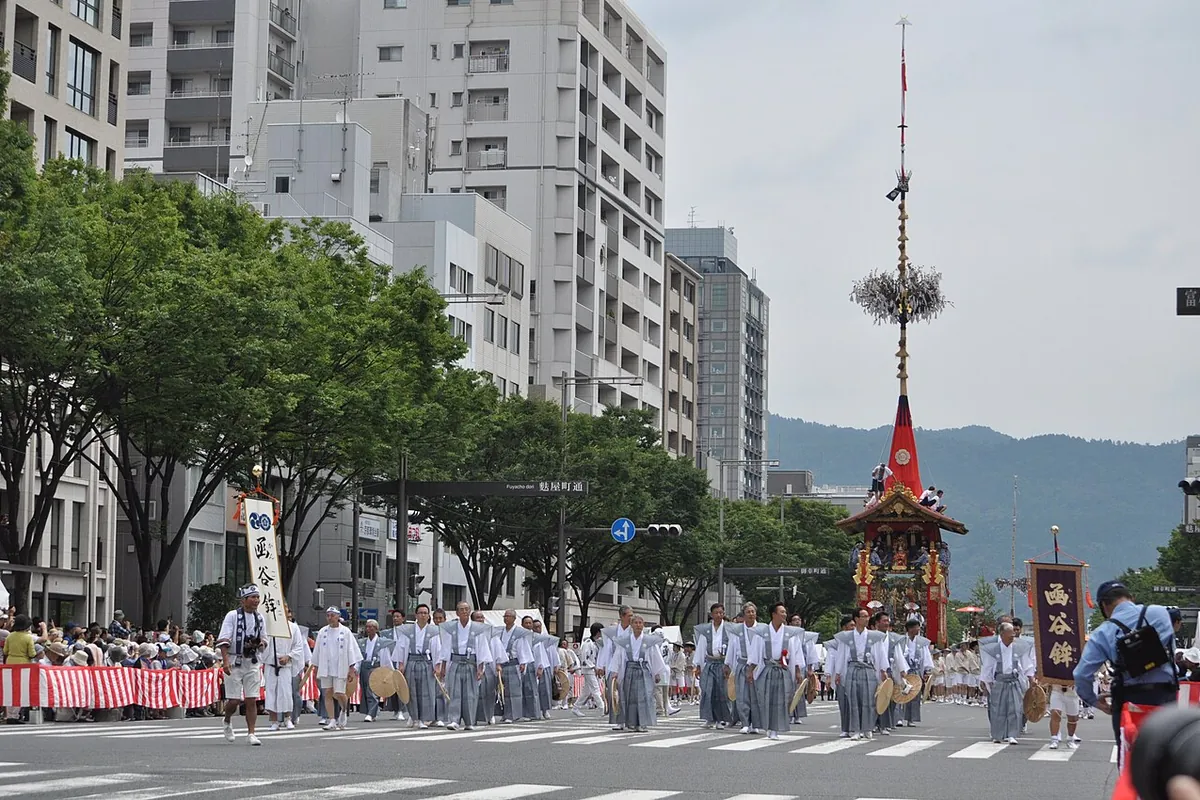
Its best-known sight is the yamaboko junko, the procession of 34 floats on the mornings of 17 and 24 July. The first procession, the saki matsuri, has 23 of them, and the second, the ato matsuri, has the rest. There are two kinds of float. UNESCO describes yama as floats built to look like mountains and hoko as floats topped by tall wooden poles, and calls them “moving museums” for their tapestries and carved and metal decoration. Each is built and looked after by the people of one Kyoto neighbourhood.
The first procession leaves Shijo Karasuma at 9am, after the child attendant on the Naginataboko float cuts a sacred straw rope to open the route. In the evening of 17 July the shrine’s three mikoshi, portable shrines carrying the deities, leave Yasaka Shrine at 6pm for their temporary home in the city, and on the evening of 24 July they are carried back.
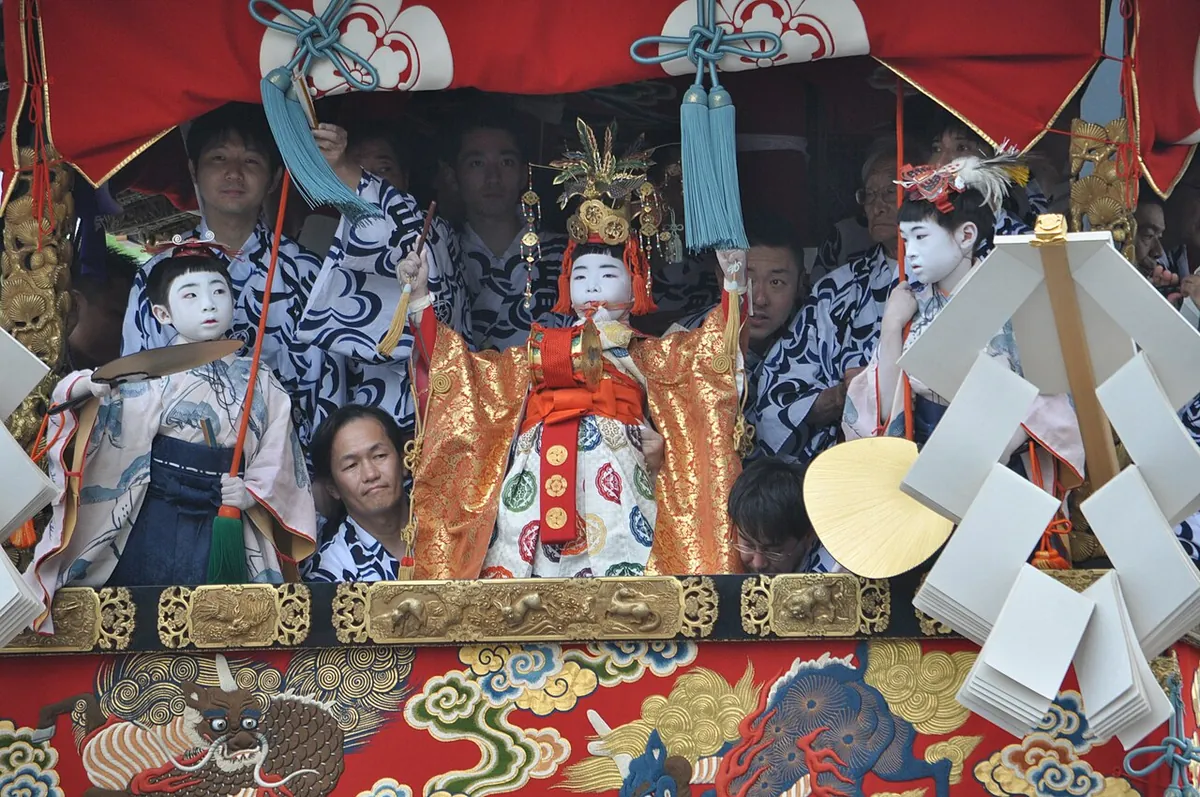
The traveller Eliza Scidmore first saw Kyoto on the last day of the Gion Matsuri and found the street from the shrine gate to Shijo bridge “one wavering, glittering line of light”, with every man in the crowd “carrying a paper lantern on the end of a short bamboo stick” (Jinrikisha Days in Japan, 1891, chapter XXII). In 2009 UNESCO inscribed the floats as “Yamahoko, the float ceremony of the Kyoto Gion festival”. In 2016 that listing was folded into “Yama, Hoko, Yatai, float festivals in Japan”, which covers 33 float festivals, and four more were added in 2025.
Yasaka Shrine has other big days in the year. At Setsubun in early February, geiko and maiko throw the lucky beans there.
Gion Matsuri 2027: Yoiyama Evenings, Corner Turns and Paid Seats
The three evenings before each procession are the yoiyama, when the floats stand finished in the streets with their lanterns lit. In 2027 they fall from Wednesday 14 to Friday 16 July and from Wednesday 21 to Friday 23 July. In 2026 Kyoto City closed parts of Shijo-dori and Karasuma-dori to traffic from 6pm to about 11pm on 15 and 16 July. The Kyoto City Tourism Association suggests the 14th, the quietest night, and arriving on Shijo-dori before dusk.
On procession morning the floats make tsuji mawashi, the turning of each float at a street corner, at three crossings. In 2026 the first procession reached Kawaramachi Shijo at 9.35am, Kawaramachi Oike at 10.20am and Shinmachi Oike at 11.20am. Some float neighbourhoods also let visitors climb aboard during the yoiyama if they buy a chimaki charm or another lucky charm.
Reserved seats line Oike-dori. In 2025 Kyoto City sold about 10,000 for the 17 July procession at ¥6,600 in the front row and ¥4,600 behind, plus pricier seats with an earphone commentary. Umbrellas and parasols are banned in the seating area, so bring a hat and water. Our guide to Japan in July sets the festival against the month’s weather and fireworks.
Tenjin Matsuri, Osaka: About 100 Boats on the Okawa River on 25 July
Osaka Tenmangu enshrines Sugawara no Michizane, worshipped as Tenjin, the god of scholarship, and its festival is more than a thousand years old. JNTO and Keihan, the Osaka railway company, date it to 951, when the first hokonagashi was held, the river rite that still opens the festival. It is held on 24 and 25 July every year, which in 2027 means a Saturday and a Sunday.
The 24th is the yoimiya, or eve. In 2026 the hokonagashi rite began at 8.50am, according to Keihan. The main day follows. At 3.30pm on 25 July the land procession, the rikutogyo, leaves the shrine for the Okawa River, where the portable shrines are loaded onto boats near Nakanoshima Park.
From about 6pm comes the funatogyo, a procession of about 100 boats moving up and down the river, some lit by bonfires and some carrying noh and bunraku puppet performances on floating stages. The Osaka Convention and Tourism Bureau lists Tenmabashi, Sakuramiya and Miyakojima as the stations for the boat procession. Fireworks offered to the god light the sky from about 7.30pm to 8.50pm.
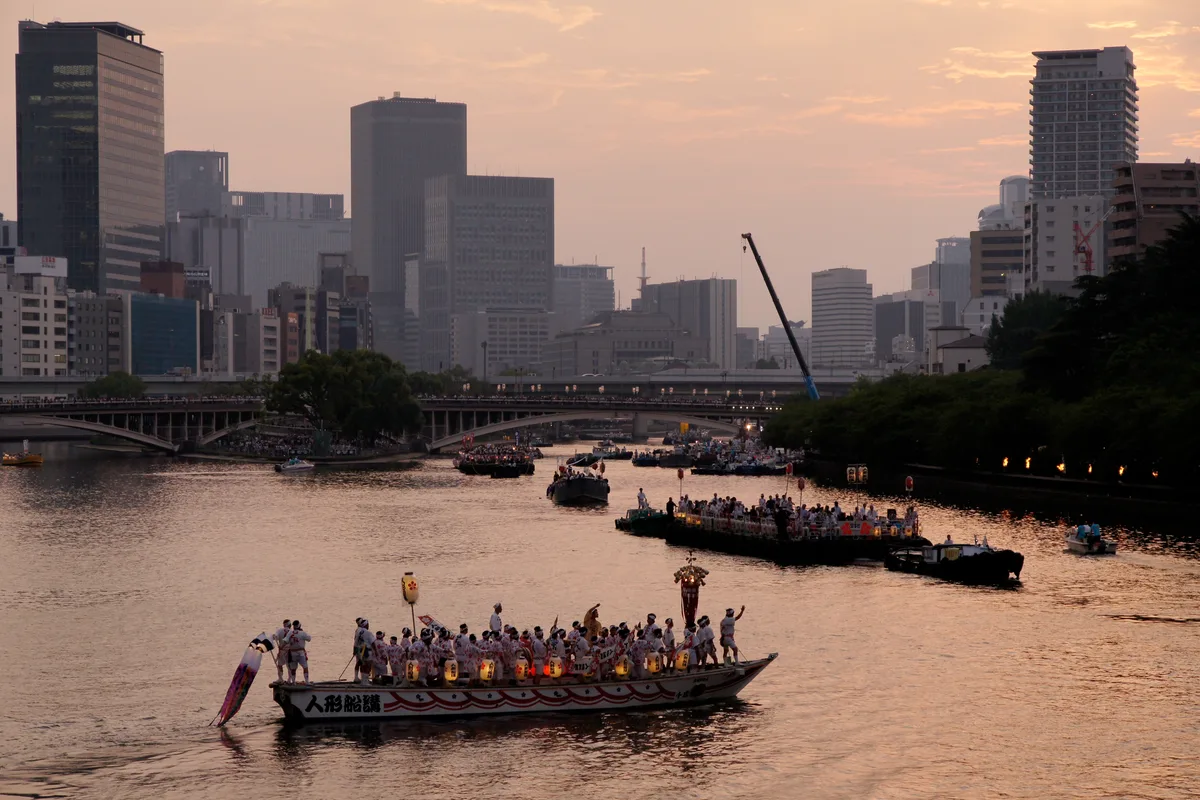
Walkerplus, Japan’s event listings site, puts the usual crowd at about 1.3 million. JNTO notes that visitors are welcome to wear a yukata and join the evening, and it suggests watching the land procession near Osaka City Central Public Hall in the late afternoon. The nearest stations to the shrine itself are Minamimorimachi and Osaka Tenmangu. Our Osaka travel guide covers where to stay and eat.



Kanda Matsuri, Tokyo: May 2027 Is a Full-Scale Year at Kanda Myojin
Kanda Myojin, in central Tokyo, honours three deities: Ōnamuchi, known as Daikoku, a god of matchmaking and nation-building; Sukunahikona, known as Ebisu, a god of trade and good health; and the tenth-century warrior Taira no Masakado. Its Kanda Matsuri was one of the two tenka matsuri, the “festivals of the realm”. In the Edo period its procession of two mikoshi and about 45 floats was allowed into the inner enclosure of Edo Castle, where the shogun and his wife watched it.
Until the Enpō era (1673 to 1681) the festival was held every year. It then began to alternate with the Sanno Matsuri, and the full festival has come round every two years ever since. In 2026 Kanda Myojin held only the shrine rites. 2027 is the next full-scale year, and the shrine had not announced its dates when we checked on 2 November 2026.
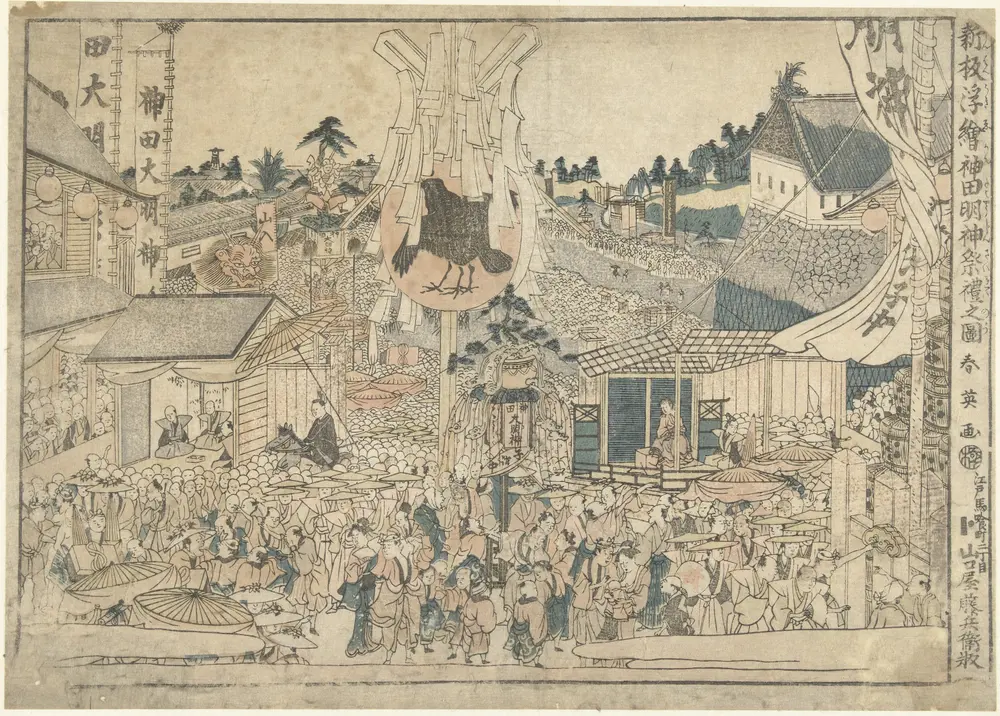
The 2025 festival shows the shape to expect. On Saturday 10 May the shinkosai procession left the shrine at about 7.20am and spent the whole day on a route of about 30km through Kanda, Nihonbashi, Ōtemachi, Marunouchi and Akihabara. The costumed tsukematsuri parade joined it in the afternoon, and the procession was back at the shrine by early evening. On Sunday 11 May the neighbourhoods carried their mikoshi up to the shrine all day; the shrine says about 200 large and small mikoshi take part. The main rite, the reitaisai, is always held on 15 May. Our guide to Japan in May puts Kanda beside the month’s other festivals and Golden Week.
Sanno Matsuri at Hie Shrine, Kanda’s Alternate-Year Partner
The Sanno Matsuri of Hie Shrine, in Tokyo’s Chiyoda ward, is held in June. The Chiyoda City tourism association describes it as the other tenka matsuri, watched by the shogun in the Edo period and counted among Edo’s three great festivals. Its full festival, with the shinkosai procession, comes round every two years. 2026 was a full year, from 7 to 17 June, so in 2027 Tokyo’s big shrine procession belongs to Kanda.
Kyoto, Old Edo and Tohoku: Japan’s Other Lists of Three Great Festivals
Japan likes lists of three, and festivals have several. Kyoto keeps its own: the Kyoto City Tourism Association counts the Aoi Matsuri on 15 May and the Jidai Matsuri on 22 October among the city’s three great festivals, with the Gion Matsuri as the third. Our guide to the Jidai Matsuri follows its costumed procession through a thousand years of Kyoto history.
Old Edo’s three great festivals always include the Sanno and Kanda festivals. GO TOKYO, the city’s official tourism site, adds the Fukagawa Hachiman Festival of Tomioka Hachimangu, held around 15 August, when crowds splash the mikoshi with water. Asakusa Shrine counts its own Sanja Matsuri, on the third weekend of May, as the third.
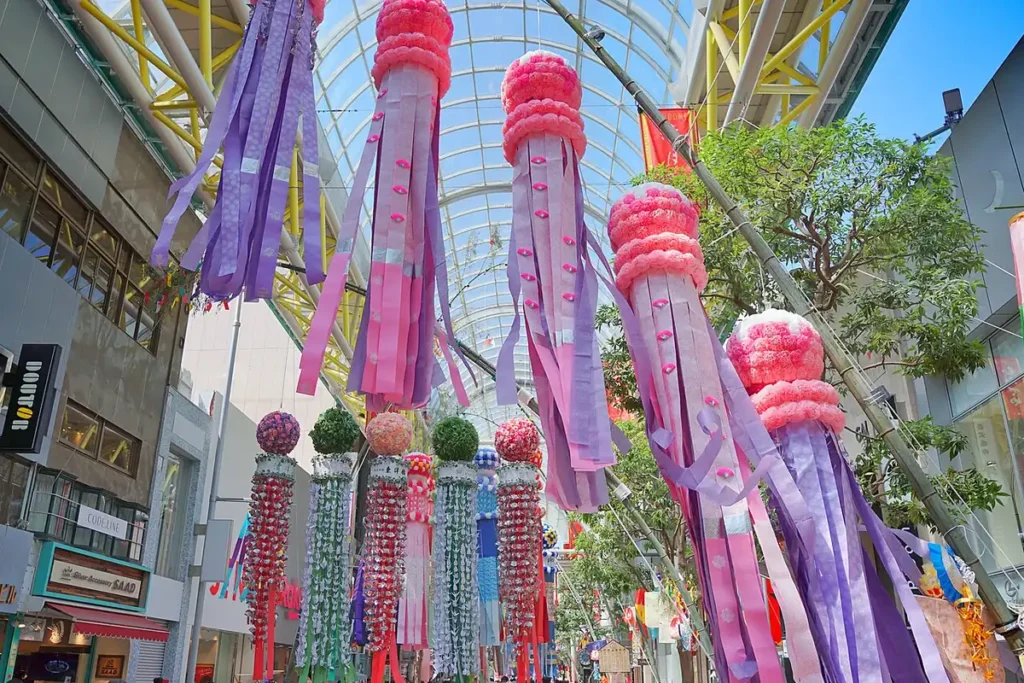
Tohoku, in the north of Honshu, has three great summer festivals within a week in August. Japan’s Tourism Agency names them as the Aomori Nebuta Festival, held from 2 to 7 August every year with giant illuminated figures, the Akita Kanto Festival, lit by lanterns, and the Sendai Tanabata Festival. In 2025 Akita ran from 3 to 6 August and Sendai from 6 to 8 August, so all three can be seen on one trip.
One more list returns to Kyoto. Imidas names the Gion Matsuri, the Takayama Matsuri in Gifu and the Chichibu Yomatsuri in Saitama, held on the night of 3 December, as Japan’s three great hikiyama festivals, the festivals of pulled floats. All three are among the float festivals on UNESCO’s 2016 listing.
Gion and Tenjin on One Trip: 24 and 25 July 2027
The calendar is kind in 2027. Gion’s second procession leaves at 9am on Saturday 24 July, the morning Osaka marks the Tenjin eve, and Tenjin’s boat procession and fireworks fill the evening of Sunday 25 July. Kyoto and Osaka are a short train ride apart, so a weekend can take in both.
Late July is hot and humid in both cities. Kyoto City asks Gion Matsuri visitors to rest often, drink plenty of water, use public transport and leave bicycles at home. With two of the three great festivals on one weekend, book rooms as soon as your plans are fixed. Kyoto’s next big night comes three weeks later, when the five mountain fires of the Gozan no Okuribi end Obon on 16 August.
Three Great Festivals of Japan: Questions and Answers
Japan’s three great festivals, the Nihon sandai matsuri, are the Gion Matsuri at Yasaka Shrine in Kyoto, the Tenjin Matsuri at Osaka Tenmangu in Osaka and the Kanda Matsuri at Kanda Myojin in Tokyo. The list is a tradition with no official status, and some versions name Tokyo’s Sanno Matsuri at Hie Shrine in place of Kanda.
The Gion Matsuri runs from 1 to 31 July 2027. The float processions are on Saturday 17 July and Saturday 24 July, leaving Shijo Karasuma at 9am. The yoiyama evenings, when the floats stand lit in the streets, fall from 14 to 16 July and from 21 to 23 July.
The Tenjin Matsuri is always held on 24 and 25 July, so in 2027 it falls on Saturday 24 and Sunday 25 July. The land procession leaves Osaka Tenmangu at 3.30pm on the 25th, about 100 boats sail the Okawa River from about 6pm, and fireworks run from about 7.30pm to 8.50pm, going by the 2026 timings.
The full Kanda Matsuri, with its all-day procession and the parade of portable shrines into Kanda Myojin, is held every two years, in odd-numbered years, because it alternates with the Sanno Matsuri. 2027 is a full-scale year. In 2025 the procession was on Saturday 10 May, and the main rite is always on 15 May.
Its floats are on UNESCO’s list of the Intangible Cultural Heritage of Humanity. They were inscribed in 2009 as Yamahoko, the float ceremony of the Kyoto Gion festival, and in 2016 that entry became part of Yama, Hoko, Yatai, float festivals in Japan, which covers 33 float festivals. Four more were added in 2025.
Yes, in small ways. JNTO says visitors are welcome to wear a yukata and join the Tenjin Matsuri evening in Osaka. During the Gion Matsuri yoiyama evenings, some float neighbourhoods let visitors climb aboard if they buy a chimaki or another lucky charm. Watching is free at all three festivals.
Yes. In 2027 the second Gion float procession leaves Shijo Karasuma in Kyoto at 9am on Saturday 24 July, and the Tenjin Matsuri boat procession and fireworks fill the evening of Sunday 25 July in Osaka. The two cities are a short train ride apart. Book hotels early, because both festivals fill central rooms.