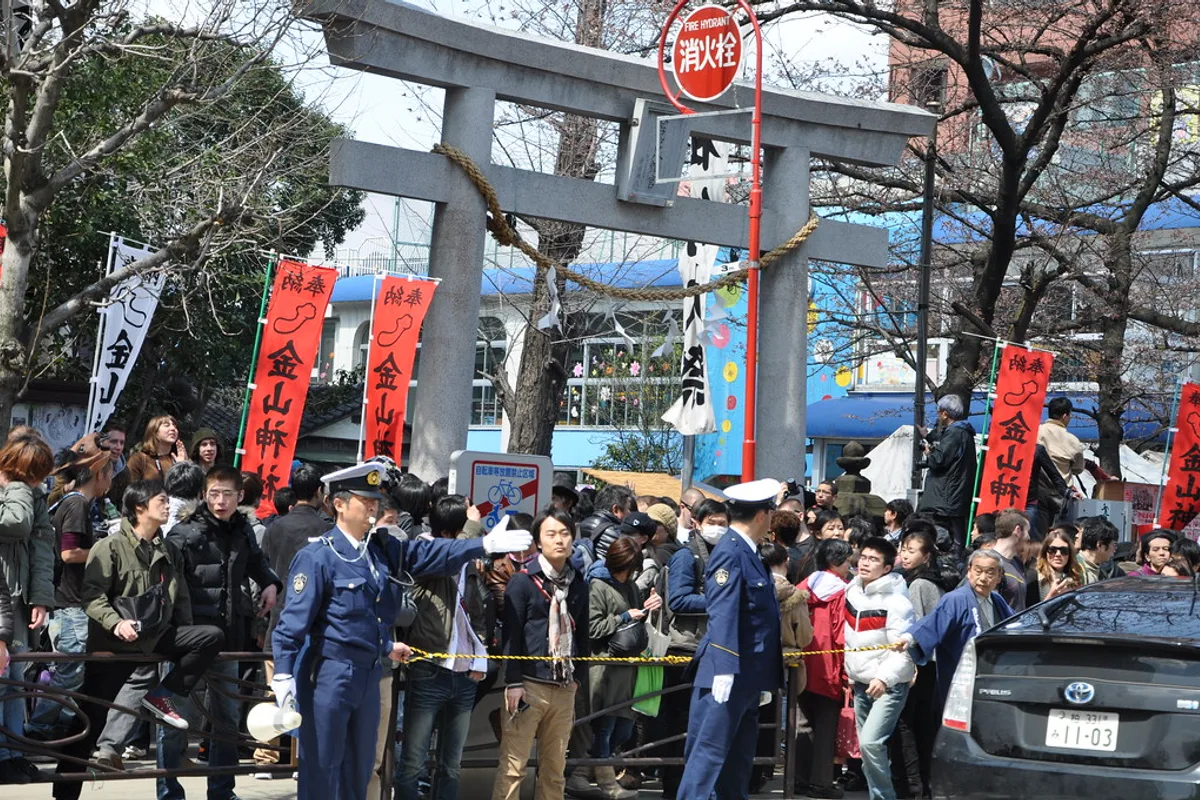
The Kanamara Matsuri is the spring festival of Kanayama Shrine in Kawasaki, just south of Tokyo, held on the first Sunday of April, when portable shrines carrying phallic emblems are paraded through the streets with prayers for children, safe childbirth, happy marriages and protection from sexually transmitted disease. In 2027 it falls on Sunday 4 April, and watching is free.
English-language guides often call it the penis festival, and the Kawasaki Daishi Tourist Information Center translates its name as the Festival of the Steel Phallus. This guide explains the shrine’s two blacksmith gods and the legend attached to them, how a rite for the women of an Edo period post town became an international festival, and the 2026 timetable as a guide to 2027. It ends with the journey from Tokyo, the famous candy and how to visit with respect.
Kanamara Matsuri 2027 at a glance
Main day: Sunday 4 April 2027, the first Sunday of April. The shrine had not published its 2027 programme on 3 November 2026.
Eve: Saturday 3 April 2027, if it follows the 2026 pattern.
Where: Kanayama Shrine, in the grounds of Wakamiya Hachimangū, 2-13-16 Daishi Ekimae, Kawasaki-ku, Kawasaki.
Station: Kawasaki-Daishi, on the Keikyu Daishi Line, about two minutes’ walk.
Cost: free to watch.
Gods: Kanayamahiko and Kanayamahime, deities of metal and the forge.
Kanamara Matsuri Dates, History and Mikoshi
Kanamara Matsuri: Kanayama Shrine’s Spring Festival in Kawasaki
Kanayama Shrine is a small shrine inside the grounds of Wakamiya Hachimangū, a Shinto shrine beside Kawasaki-Daishi Station. Locals know it as Kanamara-sama. Kana means metal, and mara, JNTO explains, first meant an obstacle to Buddhist practice before it became a polite word for the male organ. The Kanagawa Tourism Association notes that the shrine’s sacred object is a metal phallus.
People come to pray for children, safe childbirth, good matches and happy marriages, and for success in business, according to the Kawasaki Daishi Tourist Information Center. Since the 1980s many have also come to ward off AIDS, and JNTO now describes the festival as an event that fights against HIV.
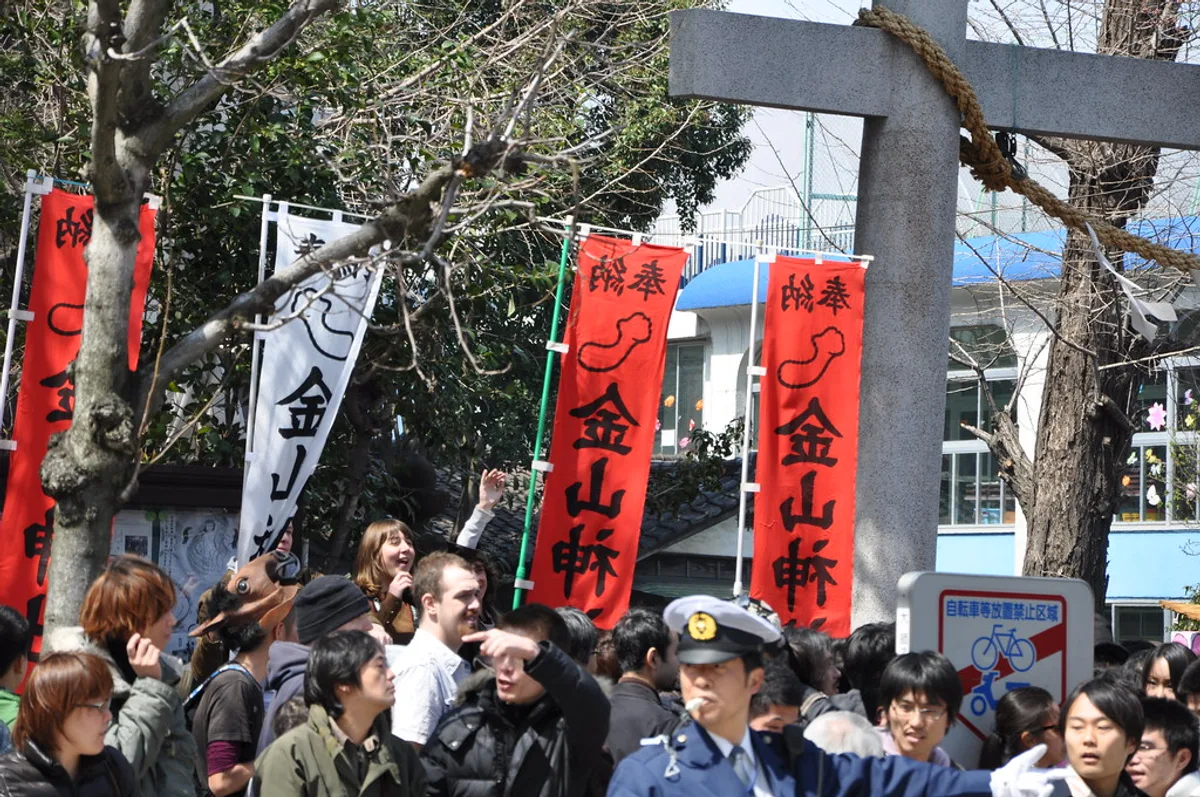
The shrine rites are only part of the day. Three mikoshi leave the grounds for the streets around the station, and stalls sell charms and novelty sweets. In 2016 about six in ten visitors came from overseas, the local paper Kawasaki Keizai Shimbun reported.


Kanayamahiko and Kanayamahime, the Blacksmith Gods of Kanayama Shrine
The shrine honours Kanayamahiko and Kanayamahime, a male and a female deity of metal. JNTO calls them the protectors of the forge, and many blacksmiths and metalworking companies worship there. The Kanagawa Shrine Agency, the prefecture’s association of Shinto shrines, lists the pair alongside Amaterasu, the sun goddess, and Ukanomitama, a god of food, and records a fuigo matsuri, a bellows festival, at the shrine every 1 November.
Both gods come from Japan’s oldest myths. When the creator goddess Izanami gave birth to the god of fire, she was fatally burned, and as she lay dying her body gave rise to deities of metal, water and clay. W. G. Aston retold the story in Shinto: The Ancient Religion of Japan (1907), and Frank Brinkley’s A History of the Japanese People (1915) names the first of them as the male and female Kami of metal mountains.
The Izanami Legend and Prayers for Safe Childbirth
Kanayama Shrine tells its own version. In the shrine’s origin story, as Kawasaki City records it, Izanami suffered severe burns to her lower abdomen when the fire god was born, and the two Kanayama gods treated her. That legend is why people pray here for help with illnesses of the lower body and for safe childbirth, and it ties the gods of the forge to a festival about fertility and health.
A different tale is widely repeated in English, about a sharp-toothed demon and an iron phallus forged by a blacksmith to break its teeth. It appears on Wikipedia and in many travel blogs. Neither the shrine’s listing with the Kanagawa Shrine Agency nor Kawasaki City’s page on the shrine tells it, so treat it as a retelling whose origin is unclear.
From the Inn Women of Kawasaki-juku to a Festival Against HIV
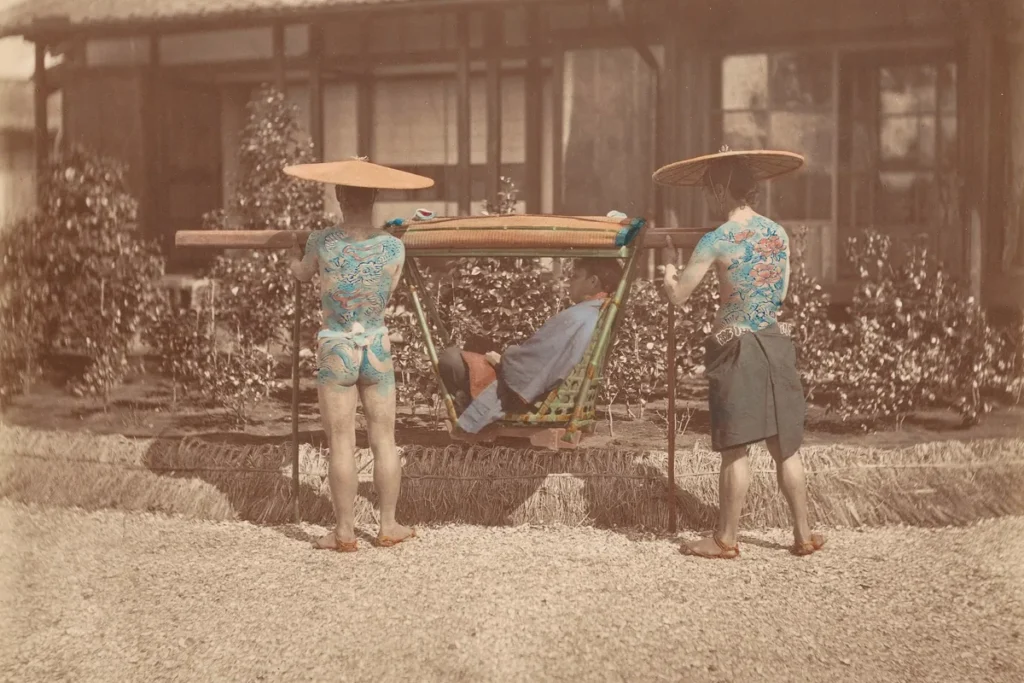
In the Edo period Kawasaki was a post town, Kawasaki-juku, on the Tōkaidō highway out of Edo. Kawasaki City traces the festival to the meshimori onna of its inns, women who served food to travellers and, as the city’s festival guide notes, also worked as prostitutes. They held a jibeta matsuri, a small rite on bare ground, to pray for protection from illnesses of the lower body. JNTO tells the same story, of local sex workers praying for protection from disease several hundred years ago.
Faith of this kind was once common in Japan. Aston wrote in 1907 that the emblems of the phallic roadside gods, the Sahe no Kami, had been “a familiar sight by the roadsides and at crossings in ancient Japan”, used to promote fertility and as charms against disease. William Elliot Griffis recorded in The Religions of Japan (1895) that the government abolished phallic shrines and emblems in 1872. Kanamara and the Hōnen Matsuri in Aichi, described below, keep that older faith in public view.
The shrine itself has moved once. It used to stand on the east side of Kawasaki-Daishi Station, and Kawasaki City records that it was moved into the grounds of Wakamiya Hachimangū when the railway took over its land. The city also lists a local history room at the shrine, the Kanayama Jinja Kyōdo Shiryōshitsu, among the ward’s treasures.
International fame came in the 1980s, when, JNTO says, worshippers began coming to ward off AIDS and the festival’s popularity spread beyond Kawasaki. Kawasaki Keizai Shimbun put the 2016 crowd at nearly 30,000, while the news site Netorabo gave the usual number in the shrine grounds as about 20,000. In 2023 the mikoshi were carried through the streets for the first time in four years, Town News, Kawasaki’s local weekly, reported.
Kimiko Nakamura, Wakamiya Hachimangū’s fifth chief priest, told Kawasaki Keizai Shimbun in 2017 that the festival’s roots in faith give it an openness about sexuality, and that anyone can enjoy it here without being boxed in by nationality, gender or age. The shrine’s official account on X, run by Wakamiya Hachimangū and Kanayama Shrine, carries the rainbow and transgender pride flags in its name.
The Three Kanamara Mikoshi and the Pink Elizabeth From Asakusabashi
A mikoshi is a portable shrine that carries a deity out among the people of its neighbourhood, and our guide to Japan’s three great festivals shows how central they are to matsuri across the country. At Kanayama Shrine each of the three carries a phallus.
The Kanamara Ōmikoshi is the oldest, with a carved wooden phallus under its roof. The Kanamara Funamikoshi, the boat mikoshi, holds one of black iron, and Kawasaki Keizai Shimbun reported in 2017 that the shipbuilder Hitachi Zosen had given it about 30 years earlier.
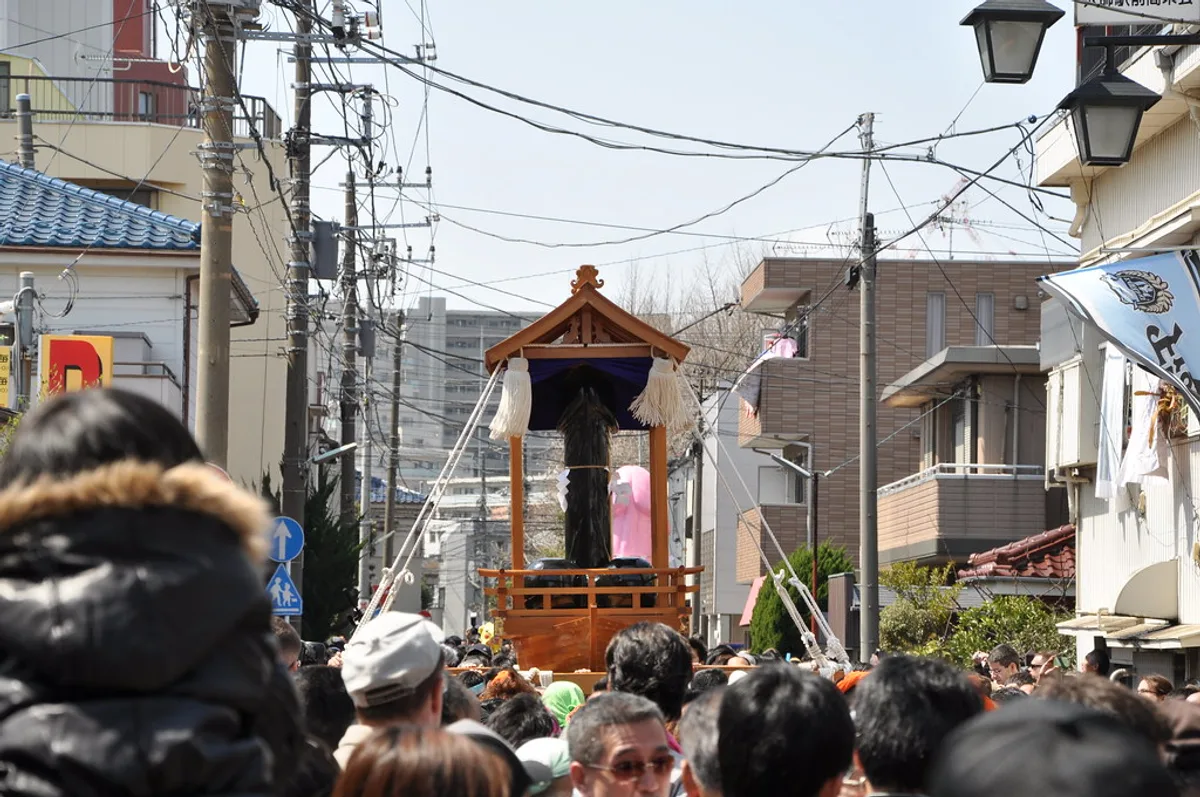
The third, Elizabeth, is a large pink phallus, and JNTO calls it the symbol of the festival. It was given by Elizabeth Kaikan, a cross-dressing club in Asakusabashi, Tokyo, which Netorabo described in 2016 as the oldest in Japan. The club gave it about 30 years before that, and for most of that time its own members carried it. In 2016, with the bearers getting older, it was wheeled on a cart instead.
Costume is part of the procession. Town News described bearers dressed as women carrying the mikoshi through the streets in 2023, and the shrine’s 2026 schedule calls the procession a menkake gyōretsu, a masked parade. Kawasaki City’s festival guide says anyone who wants to walk in the procession can borrow a costume by registering at the shrine by about 11am.








Kanamara Matsuri 2027 on Sunday 4 April, Going by the 2026 Timetable
The festival is held on the first Sunday of April, so the 2027 main day is Sunday 4 April. The shrine had not announced its 2027 programme when we checked on 3 November 2026. It posted the 2026 schedule on its X account on 12 March 2026, so look there for the 2027 details in March.
In 2026 the eve, Saturday 4 April, brought the daikon kezuri shinji, a rite of carving daikon radishes, and the yoimiya eve rite. The main day, Sunday 5 April, had the ohitori-sai fire rite, the reisai main rite and the mikoshi procession. The mikoshi rested at the Sakura-en Festival in Daishi Park, held the same day, where the famous candy went on sale early. The following weekend the shrine held a Kanamara Matsuri market, with the mikoshi on display.
| Day | 2026 | 2027 (expected) | What happens | Times |
|---|---|---|---|---|
| Eve | Saturday 4 April | Saturday 3 April | Daikon kezuri shinji (daikon carving rite) and the yoimiya eve rite | Not published |
| Main day | Sunday 5 April | Sunday 4 April | Ohitori-sai fire rite, reisai main rite, then the mikoshi procession and masked parade, resting at the Sakura-en Festival in Daishi Park | In 2023: fire rite 10am, main rite 10.15am, procession from 11.30am |
| Market | Saturday 11 and Sunday 12 April | Saturday 10 and Sunday 11 April | Kanamara Matsuri market: the mikoshi on display, stalls and a photo spot | 10am to 5pm in 2026 |
Watching is free. In 2017 the day ran from 10am to 4.30pm, according to Kawasaki Keizai Shimbun. Our guide to Japan in April covers the month’s cherry blossom dates and its other festivals.
Getting to Kanayama Shrine From Tokyo on the Keikyu Daishi Line
Kanayama Shrine is at 2-13-16 Daishi Ekimae, Kawasaki-ku, Kawasaki, in the grounds of Wakamiya Hachimangū. The nearest station is Kawasaki-Daishi on the Keikyu Daishi Line, about two minutes’ walk away. Take a Keikyu train to Keikyu Kawasaki and change there to the Daishi Line.
JNTO puts the journey at about 45 to 50 minutes from Shinjuku by the JR Yamanote Line and Keikyu lines, and 15 to 20 minutes from Yokohama Station. The procession leaves late in the morning, so arrive by about 11am if you want to see it set off. Our Tokyo guide covers where to stay for the trip.
The station takes its name from Kawasaki Daishi Heikenji, a great Buddhist temple about eight minutes’ walk away. Founded in 1128, it is known for yakuyoke, warding off misfortune, and JNTO suggests pairing it with the festival. The Nakamise shopping street that leads to its gate is where the festival’s best-known candy is sold.
Elizabeth Candy and Other Things to Buy at the Kanamara Matsuri
The most sought-after souvenir is Elizabeth ame, the shrine’s official candy, named after the pink mikoshi. It is made by Hyōbandō, a sweet shop on the Kawasaki Daishi Nakamise street, and the Tokaido Kawasaki-shuku Inbound Lab, a local tourism group that runs the festival’s information site, says a long queue forms for it every year.
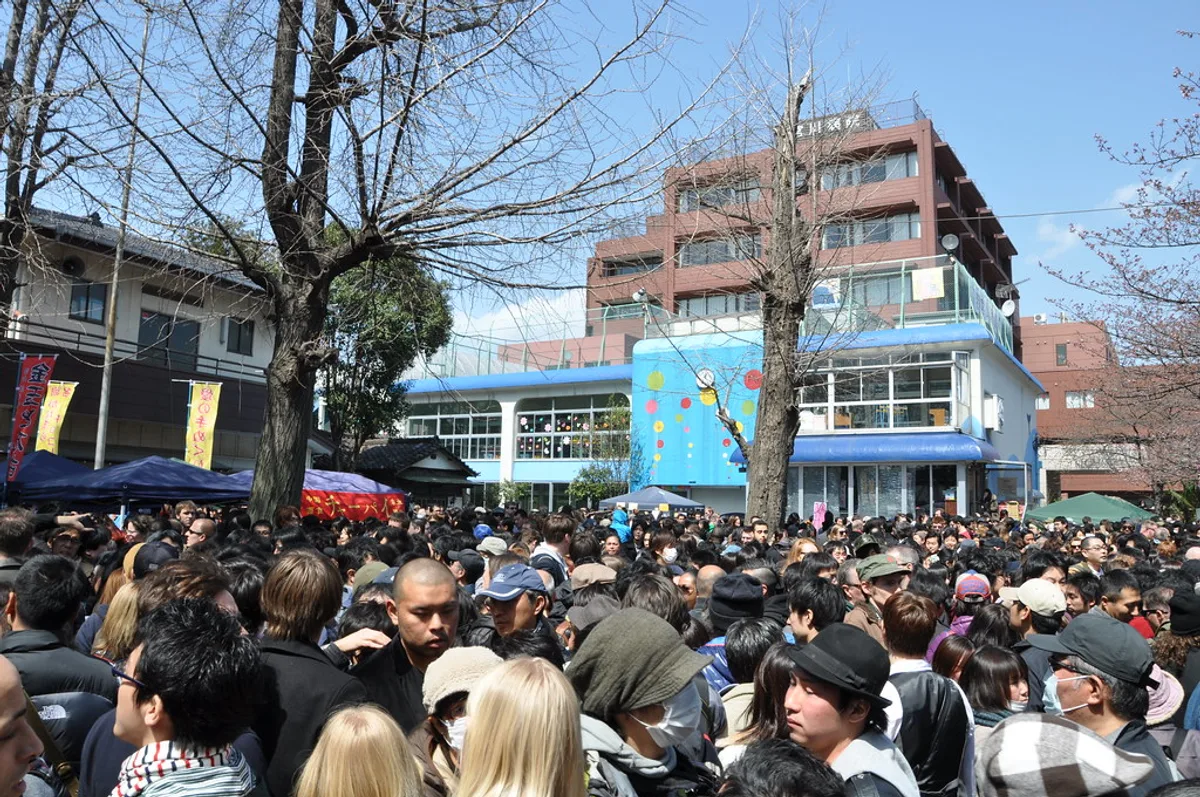
Stalls also sell kodakara ame, child-blessing candy, and the charms, key rings and small trinkets listed by the Kawasaki Daishi Tourist Information Center. JNTO mentions phallic candles in assorted colours, hand towels and carved daikon radishes in past years. Since 2016 most food and souvenir stalls have stood at the Sakura-en Festival in Daishi Park, away from the shrine grounds, according to Kawasaki Keizai Shimbun.
Shrine Etiquette and Photography on Festival Day
For all the novelty, the Kanamara Matsuri is a Shinto rite. JNTO notes that security staff are on hand to deal with lewd behaviour and harassment, and asks visitors to remember the festival’s sacred side. After incidents of indecent exposure in 2015, the shrine posted on X that performances ignoring the meaning of the festival were unacceptable, and in 2016 it stopped displaying the wooden phallic monument that visitors used to climb on, Netorabo reported.
Behave as you would at any shrine, and follow the stewards along the procession route. Ask before you photograph people in costume, because a face in a festival crowd can end up shared far beyond Kawasaki.
Kanamara Matsuri and the Hōnen Matsuri at Tagata Shrine, Aichi
Japan’s other well-known phallic festival is the Hōnen Matsuri of Tagata Shrine in Komaki, north of Nagoya. It is held every year on 15 March, which in 2027 is a Monday. According to Aichi Now, Aichi Prefecture’s official tourism site, men in their yakudoshi, an age believed to be unlucky, carry a wooden phallus of Kiso hinoki cypress, about 60 centimetres across and more than two metres long. The procession leaves the Shinmeisha, the festival’s resting shrine, at 2pm and reaches Tagata Shrine at 3.30pm.
The two festivals ask for different blessings. Hōnen means a bountiful year, and Tagata’s festival prays for a good harvest, the growth of all living things and the prosperity of descendants. Kanamara grew from prayers against disease and is now known for childbirth, marriage and protection against HIV. Tagata-jinja-mae Station on the Meitetsu Komaki Line is about five minutes’ walk from Tagata Shrine, and there is no general parking on festival day.
Both sit in a run of spring rites. Setsubun, the bean throwing on 3 February 2027, marks the eve of spring in the old calendar, and on 3 March families celebrate Hinamatsuri, the doll festival, with prayers for their daughters’ health. Tagata follows on 15 March, and Kanamara on the first Sunday of April.
Kanamara Matsuri: Questions and Answers
The Kanamara Matsuri is the spring festival of Kanayama Shrine, in the grounds of Wakamiya Hachimangū in Kawasaki, held on the first Sunday of April. Three mikoshi carrying phallic emblems are paraded through the streets with prayers for children, safe childbirth, happy marriages and protection from disease. The shrine honours Kanayamahiko and Kanayamahime, deities of metal and the forge.
The Kanamara Matsuri is held on the first Sunday of April, so in 2027 the main day is Sunday 4 April, with an eve rite the day before if the 2026 pattern holds. In 2026 the festival was on Sunday 5 April and a Kanamara Matsuri market followed on 11 and 12 April. The shrine posts its schedule on its X account in March.
Its mikoshi carry phallic emblems, and the shrine’s sacred object is a metal phallus, so English-language guides call it the penis festival. Kana means metal, and mara, JNTO explains, originally meant an obstacle to Buddhist practice before becoming a euphemism for the male organ. The Kawasaki Daishi Tourist Information Center translates the name as the Festival of the Steel Phallus.
Take a Keikyu train to Keikyu Kawasaki and change to the Keikyu Daishi Line for Kawasaki-Daishi Station. Kanayama Shrine, at 2-13-16 Daishi Ekimae in the grounds of Wakamiya Hachimangū, is about two minutes’ walk away. JNTO puts the journey at 45 to 50 minutes from Shinjuku and 15 to 20 minutes from Yokohama Station.
Elizabeth is the large pink phallus carried in the Kanamara Matsuri procession, which JNTO calls the symbol of the festival. It was given by Elizabeth Kaikan, a long-running cross-dressing club in Asakusabashi, Tokyo, whose members carried it for many years. The shrine’s official candy, Elizabeth ame, is named after it and sold on the Kawasaki Daishi Nakamise street.
Yes, in prayer. The festival began with the inn women of the Edo period post town praying for protection from disease, and from the 1980s worshippers came to ward off AIDS, which spread its fame beyond Kawasaki. JNTO describes it today as an event that fights against HIV, and the shrine’s X account carries the rainbow and transgender pride flags.
Yes. Watching the procession and visiting the shrine are free. You pay only for what you buy, such as charms, Elizabeth ame and the child-blessing candy called kodakara ame. Most food and souvenir stalls stand at the Sakura-en Festival in nearby Daishi Park, where the mikoshi rest during the procession.