Irezumi (入れ墨) is the Japanese word for tattooing, from ireru, to put in, and sumi, ink. In English it usually means the traditional Japanese style of large pictorial tattoos, the dragons and warriors that grew out of Edo-period woodblock prints, which many Japanese onsen still turn away today.
This guide explains the words irezumi and horimono, the history from a 3rd-century Chinese chronicle to the 2020 Supreme Court ruling, the hand technique called tebori, and the traditional meanings of the best-known motifs. It ends with practical advice on onsen and the places in the UK where Japanese tattoo art has been shown.
Irezumi at a glance
Irezumi (入れ墨): tattooing, literally “putting in ink”. Horimono (彫物): “a carved thing”, the Edo-period word for a decorative pictorial tattoo.
Are tattoos legal in Japan? Yes. Tattooing is legal, and in 2020 the Supreme Court ruled that a tattooist does not need a medical licence.
Onsen: many baths still refuse visible tattoos, but private baths and tattoo-friendly towns such as Kinosaki Onsen welcome them.
Irezumi History, Motifs and Tattoos in Japan Today
Irezumi and Horimono: What the Japanese Words Mean
Japanese has several words for a tattoo. Irezumi is the everyday one, and the Heibonsha World Encyclopedia lists shisei (刺青, “pierced blue”) and bunshin (文身, “patterned body”) as other names. Irezumi also covers the plain marks once given to criminals, so it is a broad word.
Horimono (彫物) means “a carved thing”. It was the Edo-period name for decorative pictorial tattoos, and the Obunsha dictionary of Japanese history dates their fashion to the years after the Kansei Reforms of 1787 to 1793. Tattooists still use the related word horishi (彫師) for a tattoo artist, and many sign their work with a professional name beginning “Hori”.

Tattooed Fishermen in a Chinese Chronicle and Punishment Tattoos From 1720
The earliest written description of tattooing in Japan is Chinese. The account of the Wa people in the Records of the Three Kingdoms, compiled by the historian Chen Shou in the late 3rd century and known in Japan as the Gishi Wajinden, says that the men, young and old, all tattooed their faces and decorated their bodies. Kotobank’s encyclopedia entries summarise the rest of the passage: designs differed between communities and by rank, and the marks were thought to ward off large fish and water birds when the men worked at sea.
Japan’s own early annals use tattooing as a penalty. Frank Brinkley, in A History of the Japanese People (1915, chapter XIII), describes the Emperor Richū condemning a rebel, Hamako, to a tattooed face, in a year the annals give as 400. The old names for it, Brinkley explains, meant “slicing the brow” and “splitting the eyes”, but in practice they meant tattooing on the forehead or round the eyes.
The shogun Tokugawa Yoshimune brought the punishment back in 1720, in place of cutting off ears and noses, and thieves were marked on the arm or forehead. Brinkley notes that this tattooing was used “not less for purposes of subsequent identification than as a disgrace” (chapter XLII). Former convicts became known as irezumi-mono, “tattooed people”.
Edo Firemen and Kuniyoshi’s Suikoden Heroes of 1827
Decorative tattoos started small. According to the Heibonsha World Encyclopedia, early horimono were mostly written characters, with no pictures and no specialist tattooists. They spread among working men with a reputation for daring: tobi scaffolders, who also fought Edo’s fires, fishmongers, palanquin bearers and boatmen. The Royal Ontario Museum notes that a firefighter without a tattoo was a rare sight.
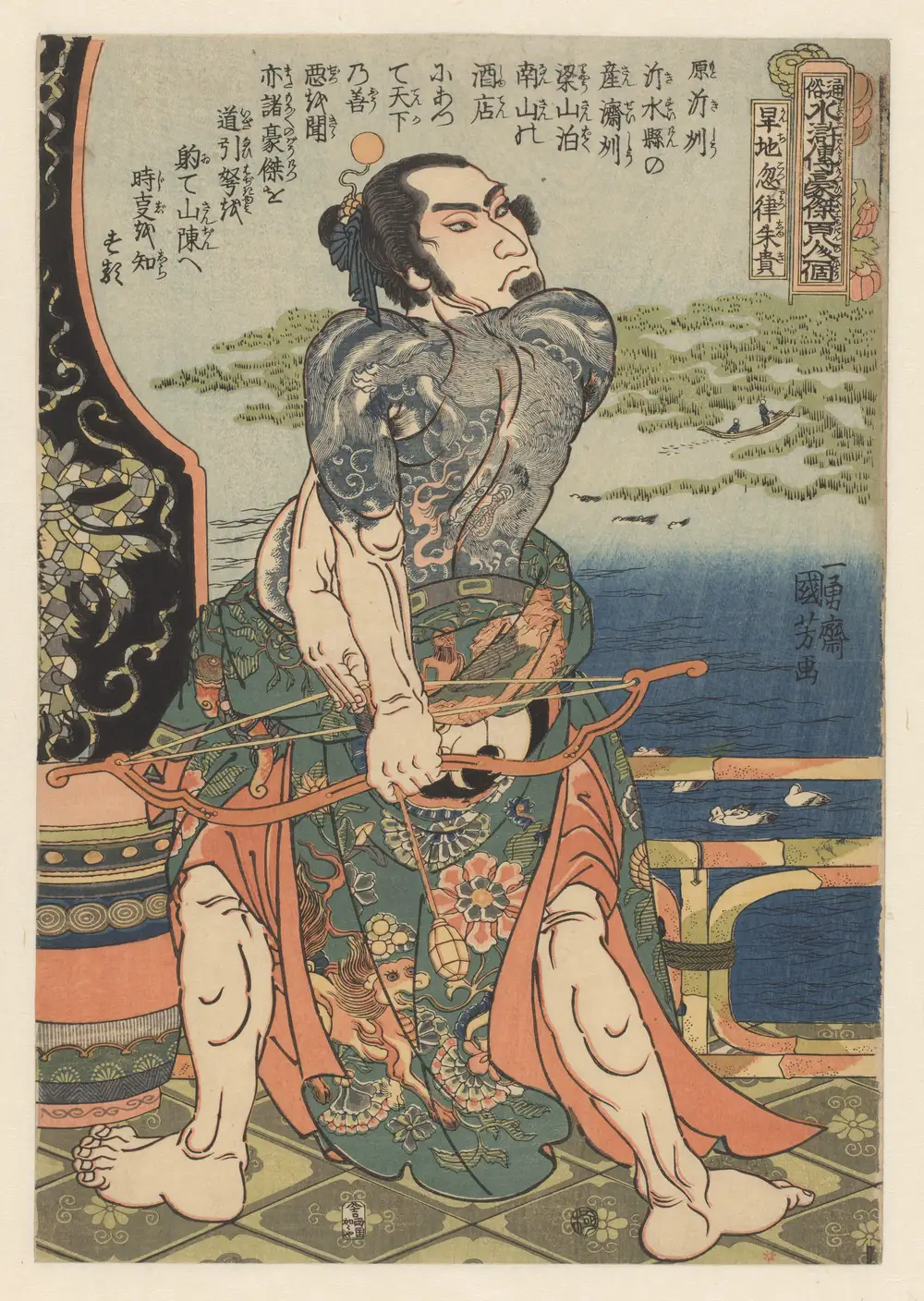
The pictures came from the print shops. From 1827 to 1830 Utagawa Kuniyoshi published One Hundred and Eight Heroes of the Popular Suikoden, a series of ukiyo-e woodblock prints based on the Chinese outlaw novel known in English as The Water Margin. The novel describes six of its heroes as tattooed, and Kuniyoshi drew fifteen of them with tattoos. The Asian Art Museum in San Francisco credits the series with starting a fashion for pictorial tattoos in late 1820s Japan.
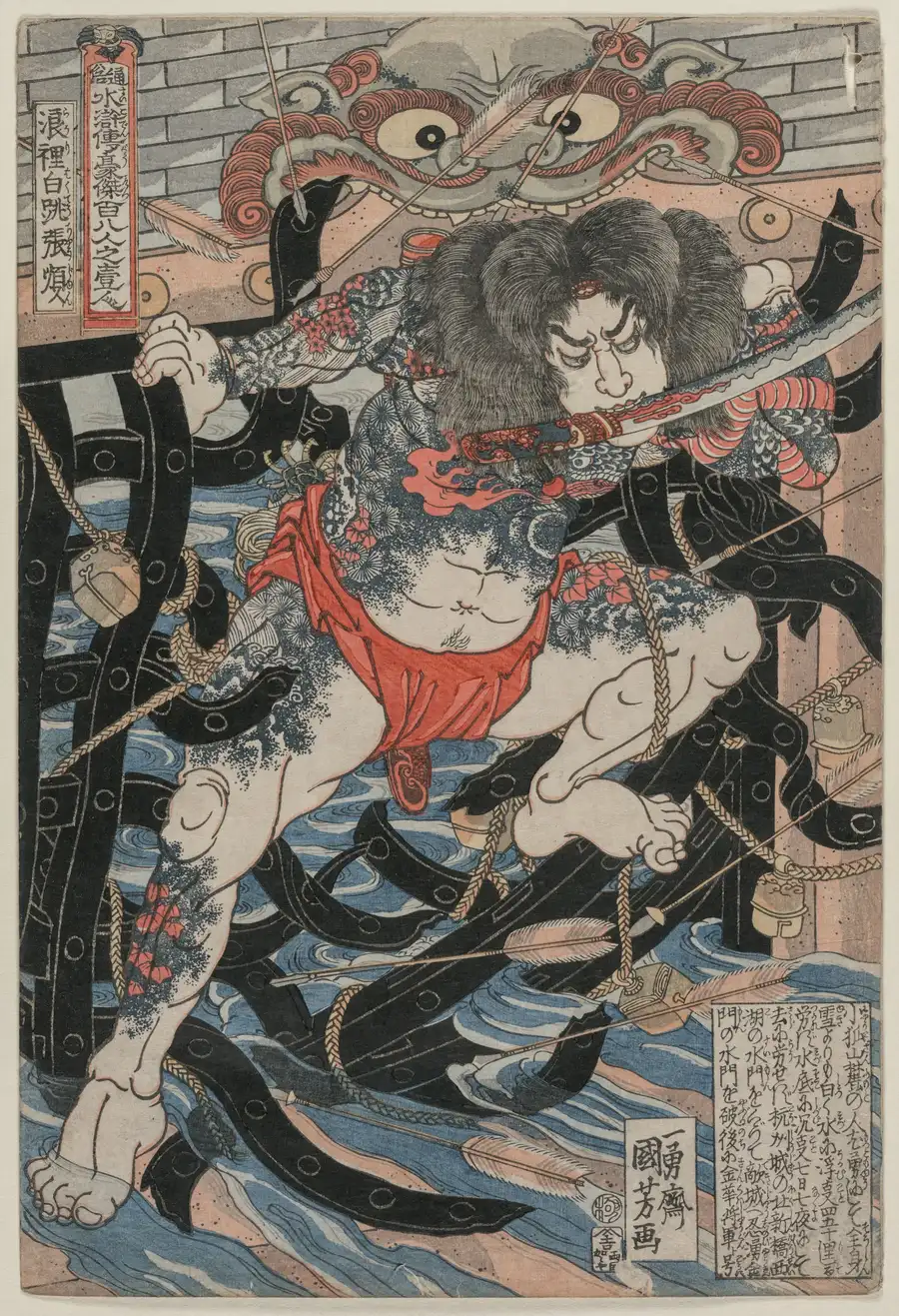
Kuniyoshi also chose the designs. The Museum of Fine Arts, Boston points out that the novel never says what the wrestler Yan Qing’s full-body tattoo shows, so Kuniyoshi gave him lions among peonies, a symbol of courage. The museum adds that Kuniyoshi reportedly had tattoos himself. The Nihon Daihyakka Zensho encyclopedia goes as far as saying that Edo-period tattooing is said to be the best in the world for its technique and colour.
Banned in 1872, Legal Again in 1948
The Meiji government banned tattooing by a Council of State notice in 1872, part of what the Asian Art Museum calls its effort to modernise the country. Our article on how the Meiji era changed Japanese bodily practices covers the same laws, which also targeted public nudity and mixed bathing.
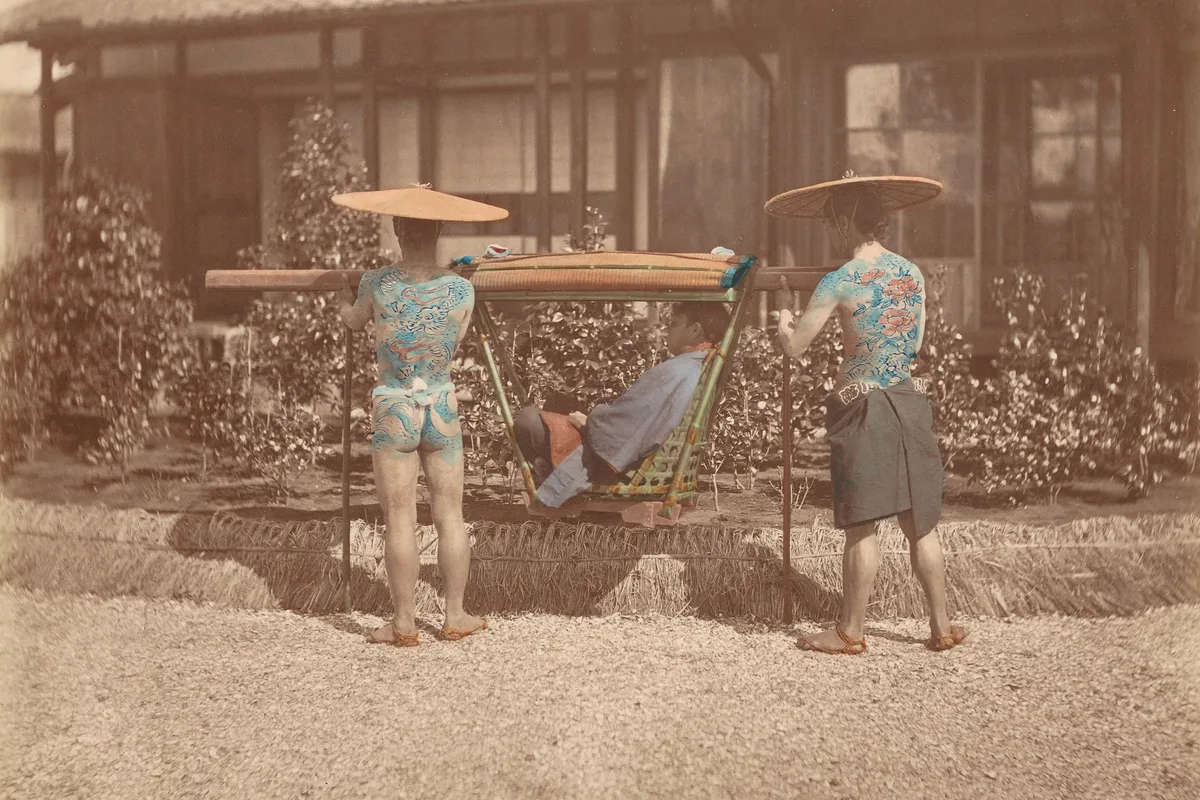
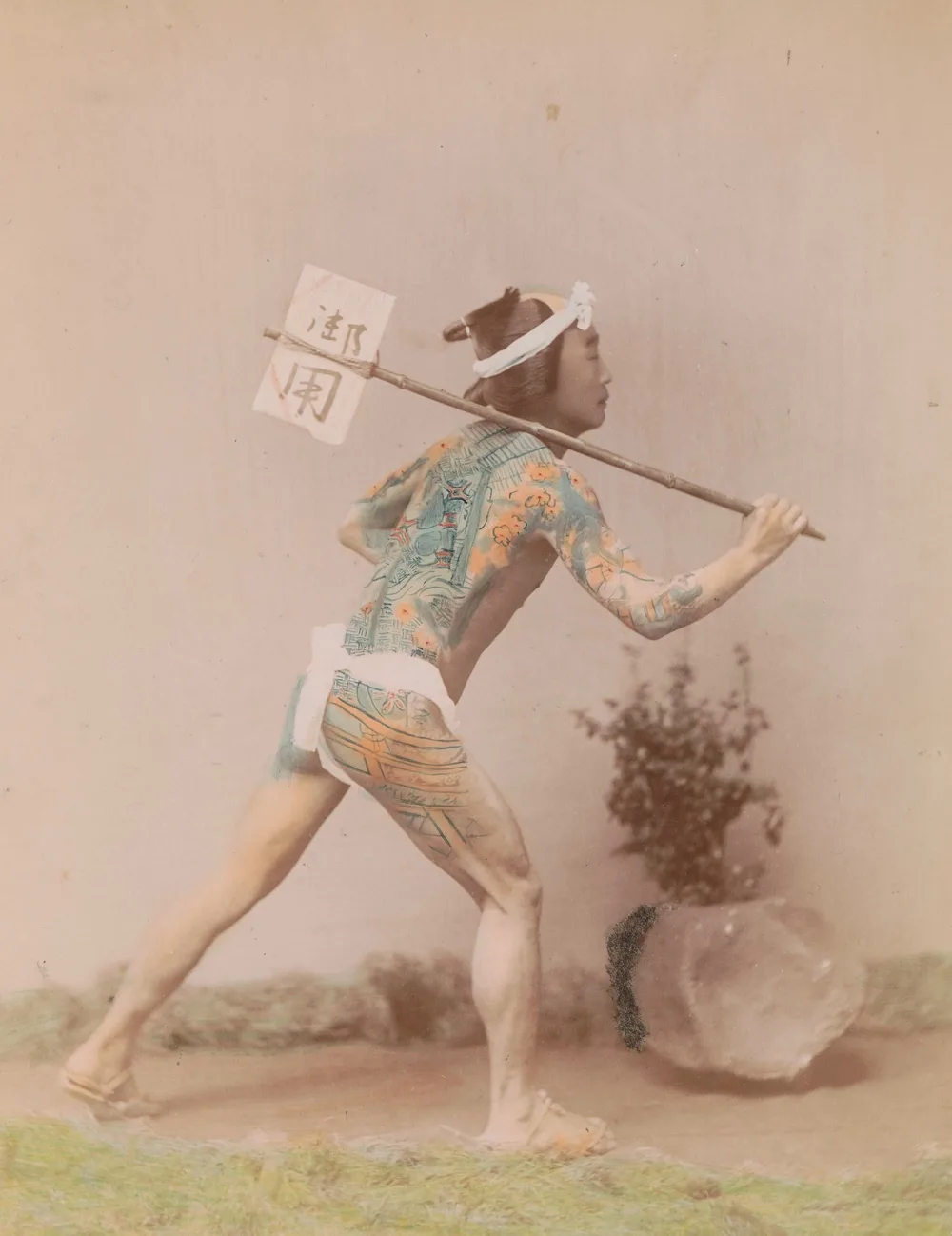
The ban drove tattooing out of sight more than it ended it. Eliza Scidmore, writing about Japanese labourers in 1891, said a working man would cover himself in “gorgeous pictures, which he would never hide were there not watchful policemen and Government laws to compel him into some scanty covering” (Jinrikisha Days in Japan, 1891, chapter XXV). Hand-coloured studio photographs of tattooed workers, such as the courier below attributed to Kusakabe Kimbei, were still being made in the 1880s and 1890s.
The Japan Times records further crackdowns in 1880 and 1908. The prohibition ended in 1948, more than 70 years after it began, when the Minor Offences Act came into force on 2 May and repealed the Police Offences Ordinance of 1908. Akimitsu Takagi’s detective novel The Tattoo Murder opens at a meeting of Tokyo tattoo enthusiasts in 1947, the year before.
Japanese Tattoo History: A Timeline
| Date | What happened |
|---|---|
| Late 3rd century | The Chinese Wei chronicle describes the Wa men as tattooed on the face and body |
| 1720 | Tokugawa Yoshimune makes tattooing a punishment for theft |
| After 1787 to 1793 | Decorative horimono becomes fashionable in Edo |
| 1827 to 1830 | Kuniyoshi’s Suikoden heroes series sets the style for pictorial tattoos |
| 1872 | The Meiji government bans tattooing |
| 1880 and 1908 | Further crackdowns, the second under the Police Offences Ordinance |
| 2 May 1948 | The Minor Offences Act replaces the 1908 ordinance and the ban ends |
| 2015 | A Japan Tourism Agency survey finds about 56% of responding hotels and ryokan refuse bathers with tattoos |
| 16 September 2020 | The Supreme Court rules that tattooing is not a medical act |

Tebori: Hand-Tapped Irezumi and the Tattoo Machine
Tebori (手彫り) means “carving by hand”. In the traditional method, the Nihon Daihyakka Zensho explains, a painter drew the design and the horishi then pricked the skin with needles and rubbed the pigment in. Mypedia lists the colours as sumi ink, vermilion and rokushō, a verdigris green.
A tebori artist works with needles fixed to the end of a rod, pushed into the skin by hand with what CNN described as a repetitive digging motion. A Tokyo tebori artist, Ryugen, told CNN in 2019 that machines have a depth setting while hand tattooists work by feel, and that the method takes longer to learn and longer to finish, so it costs more when artists charge by the hour. Ryugen himself uses a machine for outlines and keeps tebori for the shading and colour.
Irezumi Motifs and Their Traditional Meanings, From Koi to Fudō Myōō
Most irezumi motifs come from the same stock of images as Japanese painting, prints and textiles, so museums are the best guide to what they traditionally stood for. The table gives those associations with the museum or scholarly source for each. What a tattoo means to the person wearing it is their own choice.
| Motif | Traditional association | Source |
|---|---|---|
| Koi (carp) | A Chinese legend tells of a carp that swam up a waterfall and became a dragon, a parable of effort and success. The carp stands for good fortune and perseverance, and carp streamers fly on Boys’ Day, 5 May. | JAANUS, Columbia University; Cleveland Museum of Art |
| Dragon (ryū) | The rising dragon was believed to produce clouds, and it is often paired with the tiger. | The Metropolitan Museum of Art |
| Tiger (tora) | The tiger was believed to make the wind blow, and tiger pictures served as amulets against bad luck and evil spirits. | The Metropolitan Museum of Art |
| Peony (botan) | Known as the king of flowers, a symbol of good fortune, prosperity and honour. Paired with lions it signals courage. | National Diet Library; Museum of Fine Arts, Boston |
| Cherry blossom (sakura) | The transience of beauty and of life, because the blossom lasts so briefly. Kuniyoshi tattooed the warrior monk Lu Zhishen with cherry blossom. | Perlman Teaching Museum, Carleton College; Royal Ontario Museum |
| Hannya mask | The Noh theatre mask of a female serpent-demon filled with jealousy and hatred, worn in plays such as Aoi no Ue and Dōjōji. | V&A |
| Fudō Myōō | The Immovable Wisdom King, a fierce Buddhist protector who overcomes evil, shown with a sword, a lasso and a halo of flames. | The Metropolitan Museum of Art; Asian Art Museum |
Peonies and cherry blossom carry the same meanings in kimono and painting, and our guide to Japanese flowers and their meanings explains where the peony’s pairing with the lion comes from. Motifs are often combined in one design, and Kuniyoshi’s hero Zhu Gui, below, has a dragon among clouds across his back and a lion among peonies on his robe.
Why Irezumi Became Linked With the Yakuza
In the 20th century, full-body irezumi became closely tied to the yakuza, Japan’s organised crime groups. The Japan Times wrote in 2014 that many Japanese people see tattooing as synonymous with gangsterism. The same report placed the peak of tattooing in the criminal underworld in the 1970s, and found that it has since gone out of fashion among many yakuza while the stigma has grown stronger.
That reputation is what visitors run into today: the Japan Times noted that people with even small tattoos can be refused entry to swimming pools and public baths.
Taiki Masuda and the 2020 Supreme Court Tattoo Ruling
Tattooing is legal in Japan, and a 2020 court case settled whether a tattooist needs to be a doctor. Taiki Masuda, a tattooist in Suita, Osaka Prefecture, was prosecuted under the Medical Practitioners’ Act, which allows only doctors to practise medicine, for tattooing three women between July 2014 and March 2015. The Osaka District Court found him guilty in September 2017 and fined him ¥150,000, according to Jiji Press, and the Osaka High Court overturned the conviction in November 2018.
On 16 September 2020 the Second Petty Bench of the Supreme Court of Japan dismissed the prosecutors’ appeal. Tattooing, it ruled, is a decorative and artistic social custom that needs artistic skills outside medical training, so it is not a medical act. Justice Kōichi Kusano added that if tattooing needs regulating for safety, that should be done with new legislation.
Tattoos at Onsen in Japan: JNTO Advice and Tattoo-Friendly Baths
Many Japanese baths still refuse guests with tattoos. In a 2015 Japan Tourism Agency survey, about 56% of the 581 hotels and ryokan that replied said they refused bathers with tattoos, about 31% allowed them, and about 13% allowed them with conditions such as covering up. The agency’s suggestions to operators in March 2016 were covering the tattoo with a sticker, bathing at quieter times and offering private baths.
Japan’s national tourism organisation, JNTO, says in its guide to Japanese manners that tattoos are generally not permitted in hot springs, public bathhouses, pools or gyms, with no definitive list of exceptions. It notes that outdoor-style bathhouses, municipal hot springs and local sento tend to be more tolerant. Its advice is to check in advance, cover the tattoo with a waterproof bandage, or book a private charter bath (kashikiriburo) or a room with its own bath.
Some towns now advertise themselves to tattooed visitors. Kinosaki Onsen in Hyōgo Prefecture says all seven of its public baths accept tattoos of any size without covering, though its ryokan set their own rules. In Hakone, our guide to the best ryokan in Hakone lists each inn’s published tattoo policy and a day spa that dropped its restriction in April 2025.
Irezumi in the UK: Horiyoshi III at Somerset House and Kuniyoshi at the British Museum
Britain’s link with Japanese tattooing goes back to the Meiji era. The Japan Times records that Prince Alfred, Queen Victoria’s son, was tattooed in Japan in 1869, the first of several British royals to be.
The Japanese tattoo master Horiyoshi III, born in 1946, had a London exhibition in 2012. Kokoro: The Art of Horiyoshi III ran at Somerset House in the South Wing Courtyard Rooms from 21 March to 1 July 2012, with his paintings on silk of Japanese nature and legends. The Japan Society’s review noted the striking number of dragons, alongside ghost pictures and gentler subjects such as bamboo, with his tattooing tools on show in the second room.
The British Museum holds prints from Kuniyoshi’s Suikoden series, among them the hero Yang Xiong (registration number 1906,1220,0.1275), and they can be seen in its online collection. The V&A has a carved cypress Hannya mask made between 1650 and 1750 (museum number 578J-1886), the Noh mask behind the hannya tattoo design.
Irezumi and Tattoos in Japan: Questions and Answers
Irezumi (入れ墨) is the Japanese word for tattooing, from ireru, to put in, and sumi, ink. In English it usually means the traditional Japanese style of large pictorial tattoos. The older word horimono, meaning a carved thing, was the Edo-period name for those decorative designs, while irezumi also covers the plain marks once given to criminals.
No. Tattooing was banned in 1872 and became legal again in 1948, when the Minor Offences Act replaced the 1908 Police Offences Ordinance. In 2020 the Supreme Court ruled in the case of the Osaka tattooist Taiki Masuda that tattooing is not a medical act, so tattooists do not need a medical licence.
Sometimes. In a 2015 Japan Tourism Agency survey about 56% of responding hotels and ryokan refused bathers with tattoos. JNTO advises checking in advance, covering a tattoo with a waterproof bandage, or booking a private bath or a room with its own bath. All seven public baths in Kinosaki Onsen accept tattoos of any size without covering.
In the 20th century, full-body irezumi became closely tied to Japan’s organised crime groups, and The Japan Times reported in 2014 that many Japanese people see tattooing as synonymous with gangsterism. Tattooing among yakuza peaked in the 1970s and has declined since, but the stigma remains, and it is why many baths, pools and gyms still refuse tattooed guests.
Tebori (手彫り) means carving by hand. The tattooist uses needles fixed to a rod and pushes them into the skin by hand, rubbing in sumi ink and colours. The Tokyo tebori artist Ryugen told CNN in 2019 that hand work relies on feel where a machine has a depth setting, and that it takes longer, so it usually costs more.
The koi, or carp, comes from a Chinese legend of a carp that swam up a waterfall and became a dragon. Columbia University’s JAANUS dictionary calls the theme a parable of effort and success, and the Cleveland Museum of Art links the carp with good fortune and perseverance. In Japan, carp streamers also fly for Boys’ Day on 5 May.
The hannya is a Noh theatre mask. The V&A, which holds one carved between 1650 and 1750, describes it as a female serpent-demon filled with jealousy and hatred, worn in plays such as Aoi no Ue and Dōjōji, where women are betrayed or spurned by their lovers. Its meaning in a tattoo is chosen by the wearer.