It’s the dead of night. A vengeful spirit oozes out of a videotape, striking fear into the person unfortunate enough to watch the tape. Within seven days, the viewer dies a gruesome death. This is the core premise of Ringu, one of the most famous Japanese horror films of all time. It’s also a microcosm of the themes and motifs that are common in Japanese horror (J-horror).
While Japanese horror is best known internationally through films like Ringu and Ju-On, it is far older than cinema. In fact, it’s rooted in the genres of theatre and dance that conjure ancient tales of onryō (vengeful ghosts) and yōkai (supernatural creatures).
Nowadays, these traditional J-horror storytelling methods are making a comeback. And one of the most creative performances in recent memory is Naraku, a spine-tingling production created by dancer Yoshimitsu Kushida. Naraku is steeped in the kind of psychological dread found in the most enduring of Japanese folktales. It bridges the past and the present to continue Japan’s horror lineage.
Let’s explore the early history of J-horror to understand the traditions Naraku draws from.
Horror in traditional Japanese performing arts
Japanese folklore is a strange melting pot of ghosts, demons and dark spirits that have been brought to life over the centuries in the performing arts. Noh theatre is arguably the first genre to tell Japanese horror stories vividly because of the mixture of costumes, physical performance and body movements.

Image Credit: Wikimedia Commons. Photo of a ‘hawk’ noh mask with different angles on the expression.
The haunting stillness of noh
Noh became popular in the 14th century and developed from earlier 8th century performances called sangaku, which blended magic and acrobatics. These original performances leaned more into comedy. Over time, as new theatre schools developed, noh turned into a mixture of comedy and tragedy meant to capture the essence of the human condition.
Eventually, horror elements became more prominent, as the actors in noh plays became conduits between the human and supernatural worlds. This was achieved through noh masks that turned into sacred symbols used to embody specific emotions and creatures. Typically, there are five main categories of noh masks that represent spiritual states and themes of a play.
Main categories of noh masks

Image Credit: Foreign Correspondents’ Club Japan. Shinto god masks made by artist Taizo Kobayashi.
Gods: These masks represent different deities and can have friendly expressions meant to showcase divine wisdom and insight.

Image Credit: Researchgate. A gaunt man mask (left) and okina mask (right).
Man: This category highlights a wide spectrum of warriors, nobles and commoners across different social classes.
Elderly: Okina, the oldest kind of noh mask that dates back to sangaku traditions, belongs in this category. The features of old-man masks are usually benevolent — smiling or with teeth bared to symbolise hard-won wisdom.

Image Credit: Asia Society Texas. A standard women’s noh mask.
Women: It’s this category that comes to mind with noh. Women masks are the most popular and feature women at all stages of life. For example, ko-omote masks symbolise beautiful young women in the prime of their lives, while shakumi masks embody mature and elegant women. A third kind called a deigan comes with golden rimmed eyes that signal a character is supernatural.

Image Credit: Wikimedia Commons. Hannya mask from the 18th century.
Demons: The demon category is the most overtly terrifying, with horns, sharp teeth and snarling expressions. A common mask in this category is the hannya, signifying a woman turned mad with jealousy and vengeance.
All five categories are united by eerie and exaggerated expressions that add an unsettling tension to noh theatre. The tension is ramped up by the static quality of the masks and the methodical movements of actors on stage to demonstrate emotional changes.
All of these supernatural elements have been used to great effect in the works of noh playwrights like Zeami Motokiyo. He was known for his ghost stories like Atsumori, named after the restless spirit of a young samurai who died in the Genpei War and his killer, Kumagai Naozane. In the play, Kumagai has become a monk called Rensho, who eventually makes peace with Atsumori and puts the samurai’s spirit to rest by refusing to reenact his role in Atsumori’s death.
Takasago is another popular Zeami play that uses horror for catharsis. A priest meets an elderly couple in a pine forest, and he recites waka poetry that describes the couple as pines married together for eternity. By the end, the priest observes that no living relationship can quite match the ideal expressed in those verses. The play ends with the couple revealing they are spirits of two paired pine trees. They sail off into the horizon with the priest following their example.

Image Credit: Tokyo Updates. Photo of the kabuki actor Shinsuke Yasui in full make-up and costume.
The bombastic terror of kabuki
These examples demonstrate that noh’s horror came from minimalism and the eerie stillness of masks. Kabuki, which emerged in the early 17th century, took a different approach. It traded noh’s restrained movements and sparse staging for elaborate, colourful costumes and dynamic action.
The costumes and movements are key to differentiating kabuki’s horror aesthetics from noh. Instead of masks, performers wear white foundation with different coloured lines called kumadori. Generally, kumadori makeup is used to signify different character archetypes:
Red kumadori (beni-guma): heroes, youth, justice and strength.
Blue or indigo (aiguma): villains, evil aristocrats, supernatural antagonists.
Brown (chairoguma): non-human or supernatural beings.
Black (kuroguma): demons or wholly otherworldly figures.
Another aspect of kabuki that brings a sense of dread is the bombastic movements and acting style. An example is the mie technique, where an actor may appear to move in slow motion and pause to strike a powerful pose. In doing so, a performer externalises emotion against the percussive clack of wooden clappers known as hyōshigi.
Yotsuya Kaidan
The overt supernatural storytelling of kabuki can be seen in a few famous plays. Perhaps the most iconic is Tsuruya Nanboku’s Yotsuya Kaidan, first performed in 1825. It follows the story of a husband and wife called Iemon and Oiwa. Iemon betrays his wife and poisons her, causing her to return to life as a vengeful onryō. Special effects for the performance have included Oiwa’s ruined face glaring from a lantern and her hair cascading in impossible quantities like a J-horror movie come to life. So iconic is Nanboku’s play that it has been adapted for cinema and TV and influenced films like Ju-On.
Musume Dojoji
An earlier, but no less frightening kabuki play, Musume Dōjōji, focuses on the horror of movement. First performed in 1753, the play tells the tale of a maiden who turns into a serpent-demon. In a sweeping blaze of colour and dance, the main performer goes through nine rapid costume changes. The dance becomes a metaphor for external transformation, the normal becoming paranormal.

Image Credit: Charlotte Elm Ravn. Photo of butoh actress Anita Saij.
Japanese dance as a vessel for horror
Despite their differences, noh and kabuki have always been united by dance. Movement has always been integral to how supernatural tales were embodied on stage, either through the deliberate gliding of a mask-wearing noh actor signalling the presence of a ghost or the explosive mie poses of kabuki freezing a demon mid-curse. Across the centuries, the body itself became a medium for summoning spirits and evoking the slow approach of death.
Against this background of dance-driven horror, butoh emerged at the end of the 1950s — generally dated to Hijikata’s Kinjiki in 1959 — rejecting not only noh’s ritual restraint and kabuki’s theatrical spectacle, but also the Western modern-dance vocabulary that had come to dominate post-war Japan.
The founders of butoh
Butoh co-founders Kazuo Ohno (who later starred in Chiaki Nagano’s 1969 dance film Portrait of Mr. O) and Tatsumi Hijikata weren’t only rejecting noh and kabuki. They were tired of what they perceived to be a repression of home-grown performing arts in favour of Western dance traditions. They were determined to create a dance style that represented true freedom for the body and brought the taboo to life.
This is what butoh turned into – a dance of darkness that involved Ohno and Hijikata painting their bodies ghostly white. They moved in contorted, unpredictable rhythms and created an aesthetic designed to assault the senses of the viewer.
The founders of butoh split apart in the 1960s, moving the art form in new directions. Hijikata earned the title of ‘the architect of butoh’ because of his focus on technical body movements. He gained a reputation for working with large butoh groups. Ohno became an individualist, plying his trade in isolation or collaborating on a one-to-one level with other solo artists. This earned him the title of ‘the soul of butoh.’
As an ephemeral and complex dance form, Hijikata and Ohno have given their own definitions of butoh. According to the former, he associated it with death and said, “I would like to make dead gestures inside my body…and make the dead themselves dead again. I would like to have a person who has already died die over and over inside my body. I may not know death, but I know me.” The death that Hijikata referred to here is the metaphorical death that comes from domestication. He believed the state of domestication was the corpse that we must reanimate. Butoh enabled him to get closer to that feeling.
Ohno called butoh “to meander, or to move, as it were, in twists and turns between the living and the dead…an authentic expression only emerges when body and soul reach crisis point. Look closely at plants. When in blossom, flowers are petal-laden right to the very tip of their limbs. But take a look at your fingertips: they’re lifeless. If your dance is to come to life in the same way a flower blossoms, then be flower-like. Look at the trees! From the roots to the tips of their branches, they’re vibrantly expressive.”
Ohno seemed to share Hijikata’s view that a certain kind of death takes place during butoh. He also wanted to emphasise the ephemeral beauty that came with it. That every time he danced, it was an act of moving between two worlds, an expression of changing seasons and the flow of nature.
Based on these interpretations, there are parallels between butoh and J-horror films. Horror in cinema has developed into jump scares designed to shock the audience. An example could be that a demon crawls on a darkened ceiling in contorted and grotesque movements. This is meant to communicate an otherworldly and sinister feeling to the audience. Contortion is at the heart of butoh, with some dancers twitching and rolling their eyes back. Indeed, the distortion, physical tension and slowness of butoh is an undercurrent running through J-horror.

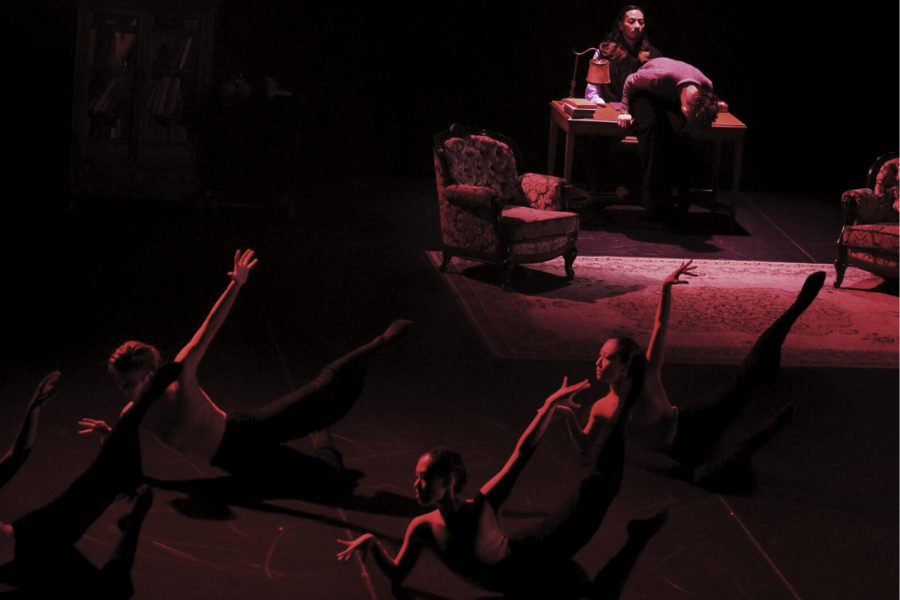
Image Credit: The Coronet Theatre. Photography by Hiroyasu Daido of Naraku.
Horror becomes cultural memory in Naraku
Against this backdrop of butoh’s visceral distortion and the unnerving stillness that courses through J-horror cinema, Naraku continues the long tradition of Japanese horror. It’s a spiritual successor of everything that has come before it, a performance that distils horror into eroticised internal conflict.
Created by choreographer Yoshimitsu Kushida and first performed in 2020, Naraku translates as abyss. This is a fitting title for a show that plunges audiences into a surreal dreamscape where the fragile boundaries of the civilised self are eroded by the dark pull of suppressed desire. Naraku borrows from all of the art forms that have come before it.
From noh, it borrows the slow ritualised cadence of movement, the sense of figures suspended between human and spirit. From kabuki, it recalls the body as spectacle, through stripped costumes and colour, the spectacle being raw flesh. From butoh, it inherits the grotesque vocabulary of contortion and white-painted bodies. From J-horror cinema, it draws on the logic of unease with slowness and uncanny motion, but without relying on jump scares.
The acclaimed Japanese Dance Company Lasta put on a show that features all of these haunting elements. Dancers writhe in tangled embraces that dissolve into spasms of violence, their bodies becoming both the site of yearning and degradation. This interplay echoes butoh’s fascination with the taboo, while overlaying it with the cinematic tension of the most enduring of horror films.
Naraku had its UK run at The Coronet Theatre, London, from 18 to 20 September 2025. Kushida described the work as: ‘Reality and fantasy are like two mirrors, reflecting each other and easily transcending the boundaries between them. The question is how to return from the fictional world to the real world, and how to connect the two.
References
https://www.nationalgeographic.com/travel/article/japanese-theater-noh-kabuki
https://brandonchin.net/blogs/news/why-are-noh-masks-so-scary?
https://folkhorrorrevival.com/2018/11/22/folklore-thursday-theatre-of-dreams-japanese-noh-masks/
https://musubikiln.com/blogs/journal/a-guide-to-traditional-japanese-performing-arts-noh-and-kabuki
https://suigenkyo.com/en/article-japanese-noh-mask/
https://butohmanual.com/death-81817/
https://angelusnews.com/voices/kazuo-ohno-takao-kawaguchi-and-the-art-of-butoh/
https://www.japansociety.org.uk/review?review=917The Japan Society – Naraku奈落 (Abyss)