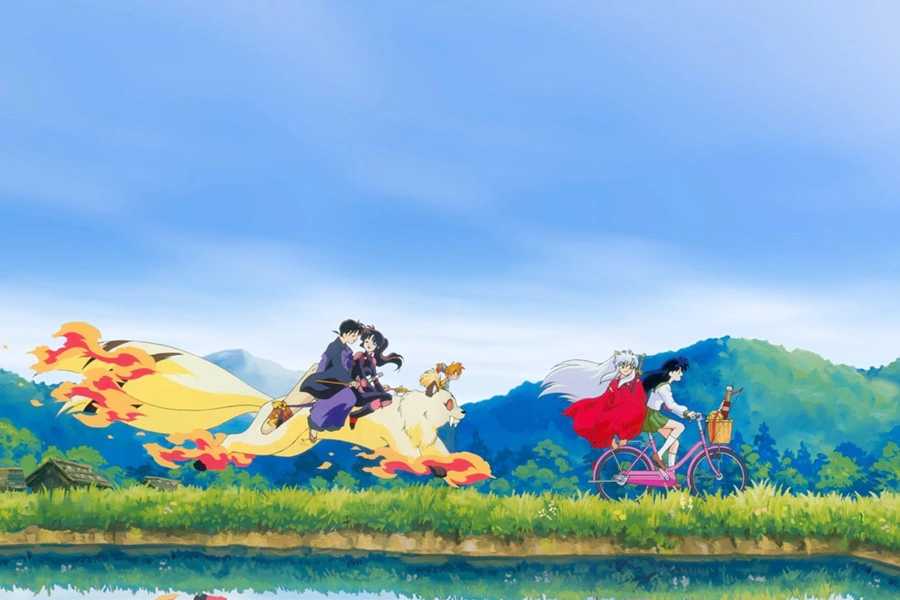
From Kamisama Kiss’ Tomoe to Spirited Away’s No-Face, and even Genshin Impact’s Yae Miko and Kujou Sara, these beloved characters all have one thing in common: they are reimagined portrayals of yōkai. In Japanese folklore, yōkai is a general term used to refer to hundreds of monsters, spirits, and demons. Once fearsome and respected, these yōkai have slowly assimilated into modern pop culture, standing with the likes of Hello Kitty and Pikachu as cute mascots from Japan.
While many Japanese scholars lament the modern portrayal of traditional yōkai, they have now become a staple in anime and manga. How many anime come to mind when I say “young boy fights demons”? In these types of stories, fans are introduced to a variety of yōkai, often without historical context as to what they are or where they come from. Be honest, who wasn’t confused when they first saw a kasa-obake on their screen? Thus, to relieve some of that confusion, today we will discuss yōkai and what they are.
What This Guide to Yōkai Types Covers
What, exactly, counts as a Yōkai?
Yōkai, composed of the kanji for “attractive, bewitching, calamity” and “mystery, wonder, apparition”, are supernatural creatures that originated from traditional Japanese mythology. Through the ages, the number and diversity of yōkai have grown as more authors and storytellers created their own myths and monsters. Today, there is no one English word that can accurately encompass the realm of the yōkai. Monsters, demons, ghosts, spirits, goblins, gods, shapeshifting foxes, talking umbrellas, giant feet from the sky. All these and more are considered yōkai.
In truth, the Japanese themselves have a different understanding of the word. Some may argue over whether gods or ghosts are considered yōkai. Some may believe that benevolent creatures are not, and yōkai can only be evil. Some may think that the vampires and werewolves of the Western world are yōkai too. Thus, a yōkai can really just be any and all of the supernatural entities and phenomena in the world.


Where did stories of Yōkai come from?
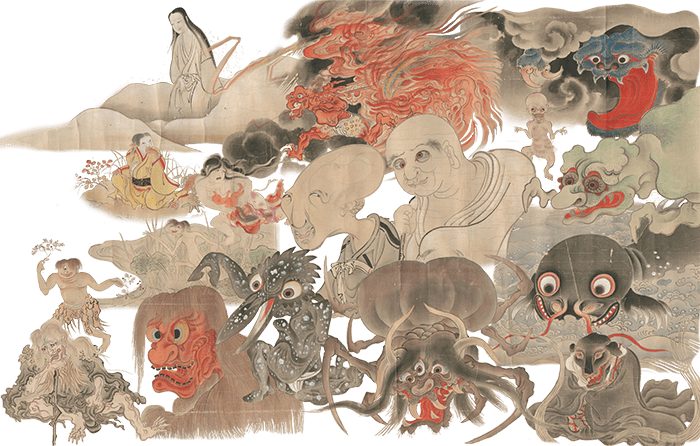
Historically, the earliest records of the supernatural in Japanese mythology can be dated back to the 8th century, within the creation myths and legends of the country. Initially, spirits were believed to be formless and invisible to human eyes. Later, when ancient art developed, these creatures were given shapes and visual representations, first in painted scrolls, and then in encyclopedic compilations.
The first compilation of knowledge on yōkai acknowledged as a database is Toriyama Sekien’s (1712-1788) four catalogues of supernatural creatures. Between 1776-1784, Sekien compiled folk traditions into distinct points of information that later writers can use. He drew information from the oral traditions of rural villages, as well as adding his own creatures into the mix. While he was not the first to write about yōkai, his work is unique in that he identified each creature individually, as free agents rather than as part of a story in Japanese mythology.
In the modern world, Mizuki Shigeru’s works have had a great impact on the contemporary understanding of yōkai. While not as popular overseas, his manga series Gegege no Kitarō (and its various anime adaptations running since 1968) had popularised yōkai, making them more familiar to Japanese children. Mizuki continued Sekien’s encyclopedic database, creating his own codex of yōkai targeted towards younger audiences.
He placed them ethnographically, superimposed on a map to indicate the regional origins of each yōkai, and illustrated them in a manga-style. Aside from this, he also included Western “yōkai” in his work, like vampires, witches, and werewolves. Thus, by drawing inspiration from different sources, Mizuki’s work greatly added to the number and diversity of yōkai in pop culture.
The six types of yōkai: reijū, kami, bakemono, tsukumogami, yūrei and tsukimono
While there is no clear categorisation for yōkai, there are some common characteristics and traits amongst them. In this article, we have identified six major types of yōkai: reijū, kami, bakemono, tsukumogami, yūrei, and tsukimono. Although with the diverse variety out there, it is likely that some fall outside of this range. On the other hand, some creatures may actually be classified into multiple of these categories.
The Reijū

First, there are the reijū, or the sacred beasts. The most sacred of these sacred beasts are the Four Guardians, Seiryuu, Byakko, Suzaku, and Genbu, who appear in traditions and stories all across East Asia. Aside from these guardians, there are also other types of sacred beasts, ranging from dragons to octopi.
The Kami

Related to sacred beasts, kami are the various gods of ancient Japan, including the aforementioned Four Guardians. Aside from the traditional Shintō gods of Japan, many of these deities originated from Chinese, Indian, and Buddhist myths.
The Bakemono

There are also the bakemono. These are shapeshifting monsters, sometimes capable of taking on a human or humanoid shape. Commonly, they gain these powers on their 100th anniversary. Under this category are the ever popular kitsune and tanuki, but any other animal in Japan can be attributed with these shapeshifting powers.
The Tsukumogami
Tsukumogami are household objects that have come to life. Folk belief held that a tool which reached a great age, usually given as its 100th year, gained a spirit and some form of consciousness of its own, and that one thrown away without thanks might come back for revenge. The National Diet Library of Japan holds a copy of the Tsukumogami Emaki, a picture scroll in which discarded tools turn into yōkai to take revenge on the people who threw them out.
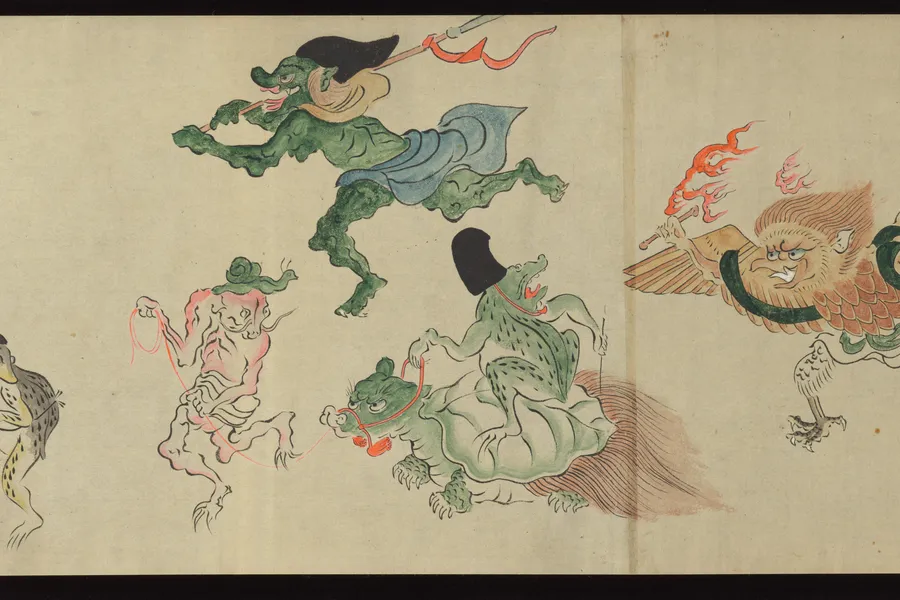
The best known of them is the kasa-obake from the introduction: an old paper umbrella with a single eye and a long tongue, hopping along on one leg. Creatures like these fill the Hyakki Yagyō, or night parade of one hundred demons, a procession of yōkai through the streets after dark. A famous early version is the 16th century handscroll kept at the Shinjuan subtemple of Daitokuji in Kyoto, and Toriyama Sekien’s first catalogue, Gazu Hyakki Yagyō (1776), takes its title from the same idea.
The Yūrei

Yūrei are most closely associated with ghosts, in particular those that were not able to peacefully enter the afterlife. If someone dies in a violent manner, was not given the proper funeral rites customary to Japan, or is overcome with a strong emotion, then their spirit is left on Earth until their purpose is fulfilled.
Lafcadio Hearn noted in In Ghostly Japan (1899) that Japanese folklore has two kinds of ghost proper: shiryō, the spirits of the dead, and ikiryō, the spirits of the living. A house or a person could be haunted by either one, so in Japanese belief you did not have to die to send out a ghost.
The Tsukimono

Similar to spirits, tsukimono possess human bodies. This is usually done as a form of revenge, when a human accidentally kills their child or destroys their home. Of course, these possessions can also be fuelled by simple greed. The most common tsukimono is the kitsune-tsuki, whose symptoms of possession are likened to that of western demons. Traditionally, the usual way to be rid of these spirits was to call in an exorcist, such as the wandering mountain priests called yamabushi. The Meiji government banned the yamabushi’s mountain religion, Shugendō, in 1872, though Lafcadio Hearn noted in 1894 that the Buddhist exorcists still called to cases of fox possession in Izumo were known as yamabushi all the same.
Kitsune, tanuki, tengu, kappa and other famous yōkai from the old stories
Categories only go so far, so here are some of the best-known yōkai by name, with the old stories that made them famous. Several come from the Japanese tales that Lafcadio Hearn and A. B. Mitford retold in English more than a century ago, which is how many of these creatures first reached readers outside Japan.
Kitsune, the fox
The kitsune is the best-known shapeshifter in Japanese folklore. Foxes are the messengers of Inari, the kami of rice, which is why stone foxes guard Inari shrines all over Japan. Folk belief gave them a darker side too. In Glimpses of Unfamiliar Japan (1894), Lafcadio Hearn recorded that in Izumo, today’s Shimane Prefecture, some families were whispered to be kitsune-mochi, or fox-owners, said to keep invisible foxes that brought them wealth and tormented their neighbours. Other families refused to marry into them. The white fox is still a familiar face at Japanese festivals, and the Japan Nakama shop stocks a Japanese festival kitsune mask.
Tanuki and the dancing tea kettle of Morinji
The tanuki is a real animal, the Japanese raccoon dog, and its folklore double is a shapeshifting trickster. Older English books call it a badger. A. B. Mitford’s Tales of Old Japan (1871) tells of an old kettle at Morinji, a temple in what is now Tatebayashi in Gunma Prefecture, that sprouted a badger’s head and tail and later made a poor tinker rich by dancing on a tightrope. Japanese children know the tale as Bunbuku Chagama, and Morinji still tells the legend as part of its own history. Tanuki stories can turn nasty, though. In The Farmer and the Badger, retold by Yei Theodora Ozaki in Japanese Fairy Tales (1908), a captured badger tricks and kills the farmer’s wife before a rabbit takes revenge.
Tengu, the mountain goblins
Tengu are mountain spirits, pictured either as red-faced men with very long noses or as bird-like figures with beaks and wings. Hearn’s In Ghostly Japan (1899) retells a tengu legend from the old Japanese collection Jikkun-shō. An elderly priest from Mount Hiei near Kyoto rescues a kite from some boys, and the kite, really a tengu, repays him with a vision of the Buddha preaching, on the one condition that the priest must not bow. Overcome, he bows anyway, the vision vanishes, and the tengu returns with a broken wing, punished by a guardian of the Buddhist law for deceiving a holy man.
Kappa, the river imps
Kappa are child-sized river creatures with a dish of water on top of their heads, blamed in folklore for dragging swimmers and horses under. In the second series of Glimpses of Unfamiliar Japan (1894), Hearn recorded a local legend from Kawachi-mura, a village about a mile and a half from Matsue. A kappa that had been attacking villagers got caught in a horse’s belly-band and was dragged into a field. It was set free only after it promised never to harm anyone from the village again, signing the oath with an inky handprint. In Izumo, Hearn noted, people called the creature kawako, the child of the river.
Yuki-onna, the snow woman
The yuki-onna appears in snowstorms as a pale, beautiful woman whose breath freezes people to death. The best-known English version is Hearn’s Yuki-Onna in Kwaidan (1904), set in Musashi Province. She kills an old woodcutter but spares his young apprentice, Minokichi, on condition that he never speaks of her. Years later he marries a young woman called O-Yuki, and when he finally tells her the story, she reveals that she was the snow woman and vanishes, sparing him only for the sake of their children.
Rokurokubi, the long-necked women
Rokurokubi look human by day, but at night their necks stretch to impossible lengths. In a related type called nukekubi, the head detaches and flies off on its own. Hearn’s Rokuro-Kubi in Kwaidan uses the flying-head version: a samurai turned travelling priest named Kwairyō shelters with a family of woodcutters in the mountains of Kai, and finds their headless bodies lying in the house in the middle of the night.
Nopperabō and the mujina of Akasaka
The nopperabō is a faceless ghost. Hearn’s Mujina in Kwaidan places one on the Kii-no-kuni-zaka slope in Akasaka, Tokyo, where a merchant finds a young woman weeping by the moat. When she lowers her sleeve, she has no eyes, nose or mouth. He runs to the lantern of a roadside soba seller, who strokes his own face and shows him the same blank. Hearn blames a mujina, a shapeshifting badger, which is why many English readers know the faceless ghost by that name.
Jikininki, the corpse eaters
Jikininki are spirits condemned to eat the bodies of the dead. In Hearn’s Jikininki in Kwaidan, the Zen priest Musō Kokushi loses his way in the mountains of Mino Province and watches a shadowy shape devour a corpse in a village. He learns that the old hermit who refused him shelter was once a priest who thought only of the food and clothing his funeral services earned him, and was reborn as a jikininki as punishment.
Bakeneko and the cat of Nabeshima
Bakeneko are cats with supernatural powers, able to take human form. The most famous is the vampire cat of the Nabeshima family, told in Mitford’s Tales of Old Japan. A huge cat kills O Toyo, the favourite of the Prince of Hizen, takes her shape and drains the prince’s strength night after night. His guards keep falling asleep until a foot soldier named Itō Sōda stays awake by driving a knife into his own thigh, and the creature is finally unmasked and hunted down.
Oni, the ogres of Rashomon and Ōeyama
Oni is the usual Japanese word for a demon or ogre, and oni are among the most familiar figures in Japanese folklore: huge, horned and, in many stories, man-eating. In Buddhist belief they are also the demons of the hells. In Glimpses of Unfamiliar Japan (1894), Hearn describes the oni of the Sai-no-Kawara, the riverbed where the ghosts of children pile up little towers of stones as a penance. The oni knock the towers down as fast as the children build them, until the bodhisattva Jizō hides the children in his sleeves. Hearn explains that every stone laid at the feet of a Jizō statue with a prayer helps one of those children with its penance.
The best-known oni story in English is The Ogre of Rashomon, retold by Yei Theodora Ozaki in Japanese Fairy Tales (1908). Watanabe, one of the knights of the general Raikō, rides alone to the Rashomon gate in Kyoto on a stormy night to prove the rumours of an ogre wrong, and cuts off its arm. He locks the arm in a box, but the ogre comes to his house disguised as his old nurse, begs to see it, snatches it back and escapes through the roof. Ozaki’s story opens with Raikō having already destroyed a band of ogres at Ōeyama, the legend known in Japan as Shuten-dōji after their blood-drinking chief.








Yōkai in the modern world

Overall, it is impossible to quantify the hundreds of yōkai written and documented through the ages. Unlike mythology, it’s impossible to decipher what is right and wrong in folklore. As stories of yōkai get passed down from generation to generation, it becomes harder to define and categorise them.
Yōkai have been studied seriously for well over a century. The philosopher Inoue Enryō, who founded the Tetsugakukan in 1887, the school that became Toyo University, wrote eight volumes of lectures on yōkai with the aim of clearing away superstition. Today Sakaiminato in Tottori Prefecture, the town where Mizuki Shigeru grew up, celebrates them. Mizuki Shigeru Road, an 800 metre stretch of shopping street from Sakaiminato Station, is lined with 177 bronze yōkai statues, and the Mizuki Shigeru Museum stands near the end of it.
Nevertheless, even as time passes, they will surely remain as an important aspect of Japanese culture. In fact, as mentioned earlier, they’re already making quite a splash in the world of anime, film, and video games. This certainly proves the ageless relevance and iconic recognizability of yōkai.
Sources and further reading
- Lafcadio Hearn, Kwaidan: Stories and Studies of Strange Things (1904)
- Lafcadio Hearn, In Ghostly Japan (1899)
- Lafcadio Hearn, Glimpses of Unfamiliar Japan, First Series (1894)
- Lafcadio Hearn, Glimpses of Unfamiliar Japan, Second Series (1894)
- A. B. Mitford, Tales of Old Japan (1871)
- Yei Theodora Ozaki, Japanese Fairy Tales (1908)