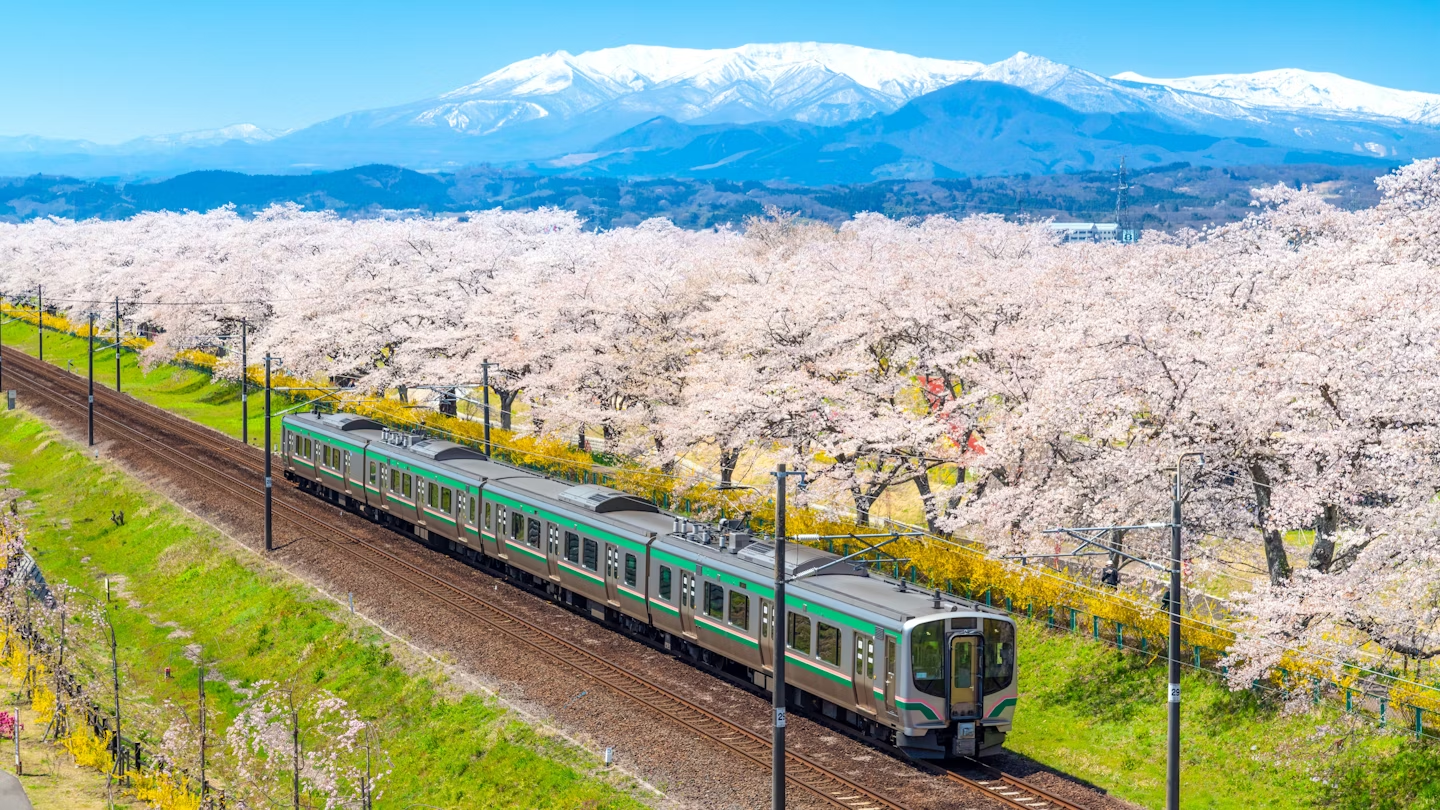
If you think of train travel as just a way to get from one point to another, Japan is about to change your mind. This country’s rail network isn’t just fast and efficient; it’s a ticket to some of the most stunning natural and cultural views you’ll ever see. From snow-covered mountains to sea cliffs, tea fields, and flower valleys, Japan’s railways offer front-row views of jaw-dropping scenery. The best part? You don’t need to hike or rent a car, just pick the right train line, get a window seat, and watch nature come to life.
Whether you’re a first-timer or a seasoned traveller, hopping on one of Japan’s scenic trains is an experience that’s as much about the journey as the destination. Here are some of the most beautiful train journeys you can take for the best experiences.
Tokaidō Shinkansen (Tokyo to Kyoto and Osaka)
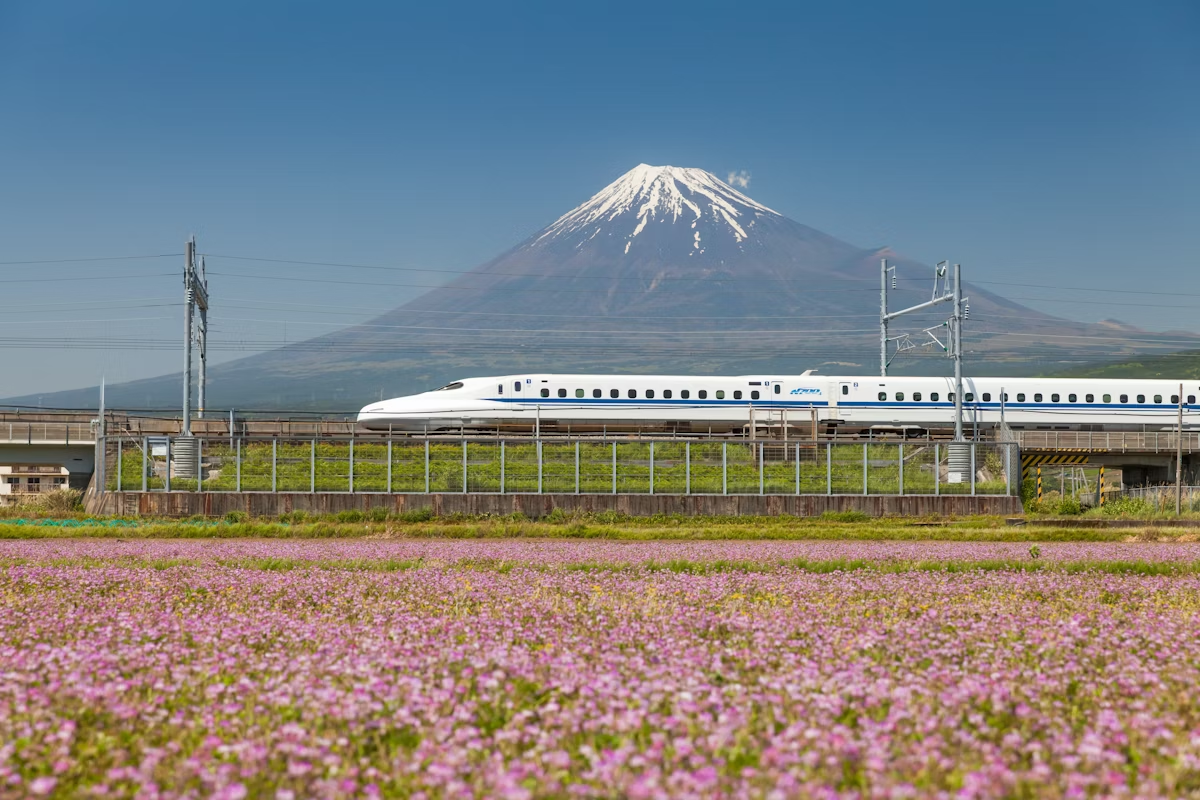
The most famous route is the Tokaidō Shinkansen, which connects Tokyo to Kyoto and Osaka. It’s fast (up to 285 km/h), connecting two of Japan’s major cities with over 350 high-speed trains per day. Around 40 minutes after leaving Tokyo, you can see Mt. Fuji on clear days, which is especially beautiful in winter. For the best views, consider sitting in seat E in standard class or seat D in green class. Fuji can be hidden by clouds, especially in the summer or late in the day, so keep that in mind.
As the train follows the Pacific coast, it passes through Shizuoka, known for green tea plantations, and near Lake Hamana, famous for eel farming. In Nagoya, you might glimpse Nagoya Castle and stop to visit the excellent railway museum, the SCMaglev and Railway Park. Further west, the route skirts Lake Biwa, Japan’s largest lake, before entering the Kansai region and arriving in Osaka, a city known for its food, culture, and nightlife.
The fastest Nozomi takes 2 hours 21 minutes from Tokyo to Shin-Osaka, while the Hikari and the all-stations Kodama take longer. It’s a smooth, scenic alternative to flying, with great views and landmarks along the way.
Sagano Railway (Kyoto)

The Sagano Romantic Train (also called the Sagano Scenic Railway) is a 25-minute scenic ride through the Arashiyama area near Kyoto. It runs between Arashiyama and Kameoka, following the Hozu River through forested mountains and passing near the famous bamboo groves. The train features open-air, vintage-style cars, giving you great views, especially in spring (cherry blossoms) and autumn (colourful foliage).
It’s not covered by the JR Pass, but tickets are inexpensive (¥880 for a one-way adult ticket and ¥440 for children aged 6 to 11). The train runs from 1 March to 29 December and is usually closed on Wednesdays. All seats are reserved, and tickets go on sale one month ahead. Many travellers combine it with a riverboat ride or bike rental for a half-day nature escape just outside the city.


Oigawa Railway Ikawa Line (Shizuoka)

The Oigawa Railway in Shizuoka offers a nostalgic ride on vintage steam trains through tea fields, mountain villages, and the scenic Oigawa River valley. It’s a quieter, more rural experience especially on weekdays, and it is ideal for travellers who enjoy more traditional, slower-paced travel. You can also connect to the Ikawa Line, which includes Japan’s only rack-and-pinion railway. Typhoon damage in 2022 closed part of the Main Line, so trains now run only between Kanaya and Kawane-Onsen Sasamado, with steam trains running between Kanaya and Ieyama. The Kawane-Honchō town bus links the line to Senzu, where the Ikawa Line starts. The route offers occasional views of Mount Fuji, and is especially beautiful in spring and autumn.
This ride isn’t covered by the JR Pass. Steam trains carry a ¥1,500 surcharge for adults (¥750 for children) on top of the ordinary fare, making it a great day trip from Shizuoka or Hamamatsu for those interested in old-school trains and scenic countryside.
Himi Line (Toyama)

The Himi Line in Toyama Prefecture, operated by JR West, is a short local train route known for its rare and stunning combination of coastal and mountain views. The best stretch is between Etchū-Kokubu and Amaharashi Stations, where you can see the Amaharashi Coast and, on clear days, the Tateyama mountain range rising behind Toyama Bay. The view is especially impressive in winter and early spring mornings when the air is clear.
For the best experience, sit on the seaside (right-hand side going north). It’s a peaceful ride and a must-do for anyone who enjoys scenic sea and mountain landscapes in one shot.
San’in Main Line (Kyoto to Shimonoseki)

The San’in Main Line is a long, scenic route running over 600 kilometres from Kyoto to Shimonoseki, mostly along the Sea of Japan coast. It passes through coastal towns, fishing villages, and features highlights like the Amarube Viaduct and the sea-hugging section between Orii and Miho-Misumi Stations, where the train feels like it’s gliding above the water. The line is slow and not modern, but that’s part of its charm.
It’s best enjoyed during warmer months when weather is more stable. Ideal for slow travel and off-the-beaten-path exploring, it’s a great choice for travellers with time who want to see Japan’s quiet coastal side.




San’yō Main Line (Osaka to Fukuoka)

The San’yō Main Line and San’yō Shinkansen both connect Osaka to Fukuoka, offering different ways to explore western Honshu. The San’yō Shinkansen is the faster option, taking about 2.5 hours on the Nozomi service, and it makes key stops in cultural cities like Okayama (home to Koraku-en Garden and Okayama Castle) and Hiroshima (Peace Memorial Park and access to Miyajima’s floating torii gate). It crosses into Kyushu via the Kanmon Strait, ending in Fukuoka, which is known for temples and Hakata Ramen.
The slower San’yō Main Line is ideal for a more relaxed trip, offering beautiful views of the Seto Inland Sea, especially the stretch between Yu Station and Ōbatake Station in Yamaguchi Prefecture, where the train runs directly along the coast, providing stunning views of small islands. It’s also ideal for stopovers in places like Himeji and Miyajimaguchi. If you have time, the Main Line offers a more local experience, while the Shinkansen is ideal for fast and comfortable travel with cultural highlights along the way.
Gonō Line (Aomori to Akita)

The Resort Shirakami on the Gonō Line. Photo: MaedaAkihiko, CC BY-SA 4.0, via Wikimedia Commons
One of the most scenic coastal rides in Japan is the Gonō Line, which runs between Aomori and Akita. The highlight is the Resort Shirakami train which features large panoramic windows, live shamisen performances (three-stringed traditional Japanese musical instrument), and local food sold onboard. The train passes fishing villages, rugged coastlines, and the Shirakami-Sanchi mountains, a UNESCO World Heritage site. Sunset rides are especially popular for the views.
Reservations are required, even with a JR Pass, so book early, especially in spring and summer. It’s a great choice if you want a relaxing, scenic trip far from typical tourist crowds.
Kōmi Line (Nagano and Yamanashi)

The Kōmi Line in Nagano and Yamanashi includes a special train called High Rail 1375, which climbs to 1,375 metres between Kiyosato and Nobeyama, the highest point on any JR line. This means that it’s good for mountain views, especially in autumn. There’s a night version that has a planetarium car, where you can look at stars and constellations. This ride is more about the atmosphere than major landmarks, but it’s a unique experience, especially for astronomy fans.
Kitakami Line (Kitakami to Yokote)

The Kitakami Line, running through Iwate and Akita Prefectures, is best experienced in late October to early November during the autumn foliage season. A highlight of the route is the stretch between Wagasennin Station and Yuda-Kinshūko Station, where the train passes by Lake Kinshū, a reservoir surrounded by red and gold autumn leaves reflected in the still water, with mountains in the background. In winter, the area transforms into a snowy landscape. The line is usually quiet, so getting a window seat without a reservation is easy. Heavy rain on 2 August 2026 damaged the western end of the line, and trains between Hotto Yuda and Yokote are suspended with no reopening date yet, with replacement buses running instead. The Lake Kinshū stretch, between Kitakami and Hotto Yuda, runs as normal.

A fun extra for train fans: Kitakami Station features a rare Platform 0, one of only 36 in Japan.
Tadami Line (Aizu-Wakamatsu to Koide)

The Tadami Line, running between Aizu-Wakamatsu (Fukushima) and Koide (Niigata), is often called one of Japan’s most photogenic train routes. Reopened in 2022 after 11 years of partial closure, it’s best known for its stunning views of bridges crossing the Tadami River, especially the No. 1 Tadami River Bridge between Aizu-Nishikata and Aizu-Hinohara Stations. These bridges are famous for being reflected in the water and surrounded by autumn foliage or heavy winter snow, making them popular photo spots for train fans and arty travellers alike.
Trains on this line are usually just two cars, so it’s a good idea to board early for a window seat. Some windows can even be opened for a better view and fresh mountain air. Another scenic stop is near Aizu-Kawaguchi Station, where a short walk takes you to the Kaneyama Fureai Viewpoint, offering a postcard-worthy shot of the train with a river and mountain backdrop. The Tadami Line is a top pick for anyone who enjoys nature, photography, and peaceful rural scenery.
Hakodate Main Line (Sapporo to Hakodate)

The Limited Express Hokuto is a comfortable and popular train that connects Sapporo to Hakodate in about 3.5 to 4 hours, depending on the service. It runs along the Hakodate, Chitose, and Muroran Main Lines, and is fully covered by the JR Pass and the JR Hokkaido regional passes. All seats on the Hokuto are reserved, so pass holders need to book a seat before boarding.
One of the most scenic parts of the trip is just before arriving in Hakodate, when the train passes through Onuma Quasi-National Park between Akaigawa Station and Ōnuma-Kōen Station. From your seat, you’ll get great views of Lake Onuma, Lake Konuma, and Mount Komagatake, especially on clear days. The scenery looks different every season, with green forests and lakes in summer and snow-covered peaks in winter. If you’re using a JR Pass and heading to Hakodate from Sapporo, this train is one of the easiest and most scenic options.
Senmō Main Line (Hokkaido)

In Hokkaido, the Senmō Main Line between Kushiro and Abashiri gives you a winter landscape with drift ice on the Okhotsk Sea and the chance to spot red-crowned cranes in the marshes. This route gets extremely cold, but if you can handle below-freezing temperatures, the views especially of the drift ice near Abashiri make it one of the most unique winter train rides in Japan.
Hanasaki Line (Hokkaido)

The Hanasaki Line, part of the Nemuro Main Line in Hokkaido, takes you all the way to Nemuro, Japan’s easternmost train station. It’s a quiet, off-the-beaten-path route with limited daily service (just a few rapid and local trains per day) making it feel like a real adventure. The line offers spectacular coastal views, especially if you sit on the right side heading east, where you’ll see cliffs, crashing waves, and endless ocean. If you time it right, you can even catch the sunrise over Cape Nosappu.
Between Akkeshi and Itoizawa Stations, the train passes the Bekanbeushi River and Wetlands, home to red-crowned cranes, Ezo deer, and other wildlife. This stretch is especially beautiful in summer and autumn. For travellers wanting to see Hokkaido’s wild side and visit Japan’s furthest eastern rail stop, the Hanasaki Line is a rewarding, peaceful ride worth adding to your list.
Furano Line and the Norokko Train (Hokkaido)
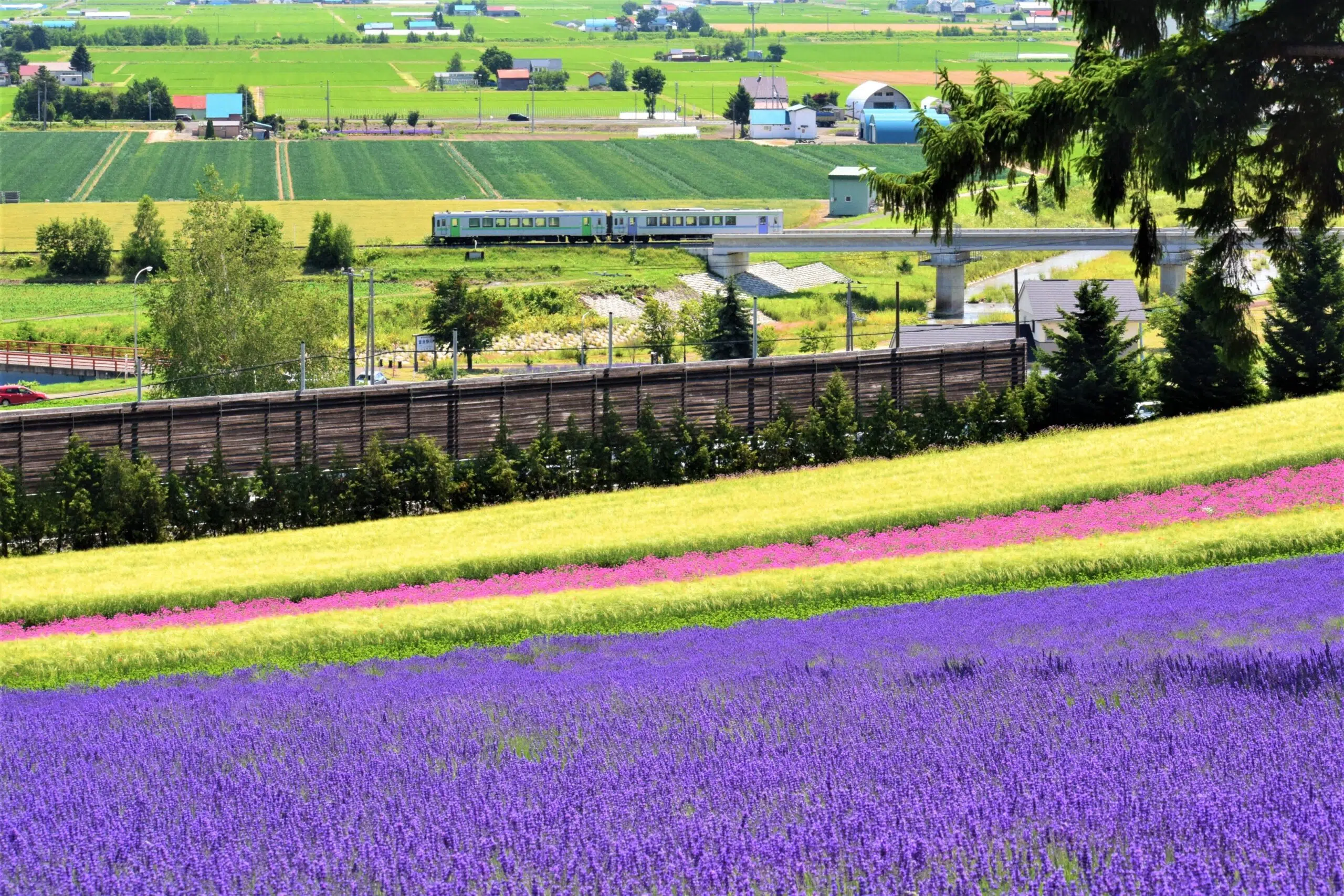
The Furano Biei Norokko Train was a seasonal open-air train on the Furano Line in central Hokkaido, running in summer between Asahikawa, Biei and Furano. It was a favourite for seeing lavender fields, flower farms, and wide-open countryside with distant mountain views. JR Hokkaido retired it after 28 years, and its final run was on 23 September 2026.
The Norokko was slow, with wooden bench seating and windows that opened, letting passengers enjoy the scenery and summer breeze. Regular Furano Line trains still run between Asahikawa, Biei and Furano through the same farmland, and they are covered by the JR Pass and JR Hokkaido passes, so the route is still an easy and scenic addition to a summer trip in Hokkaido’s flower region.
Hisatsu Line (Kumamoto to Kagoshima)

Last but not least, there’s the Hisatsu Line in Kyushu, a mountain route running from Yatsushiro in Kumamoto to Hayato in Kagoshima. Floods in July 2020 closed the whole northern part of the line between Yatsushiro and Yoshimatsu, and it is still closed. In 2025, JR Kyushu and Kumamoto Prefecture agreed to restore the stretch along the Kuma River between Yatsushiro and Hitoyoshi, with trains due back in the 2033 financial year. No decision has yet been made on the mountain section between Hitoyoshi and Yoshimatsu, famous for the loop line and switchback at Ōkoba Station and the switchback at Masaki Station. The southern section between Yoshimatsu and Hayato reopened on 12 July 2026 after separate storm damage. Definitely one to keep on your bucket list.
Best Time to Travel
So when’s the best time to ride? It depends on what you’re after. Winter is best for snow scenes, drift ice, and clear views of Mt. Fuji (perfect on the Tadami, Senmō, or Tokaidō). Spring brings cherry blossoms and new greenery, especially along the Sagano, Hakodate, or High Rail routes. Summer is prime time for flower fields, seaside sunsets, and lush mountain greens, think Oigawa, Furano, or the San’in coast. And if you’re all about autumn foliage, you can’t beat the Kitakami, Tadami, or Kōmi lines in October and November.
JR Pass and Trains
A few tips before you book: the nationwide JR Pass is still great value if you’re riding long-distance or multiple trains often, though regional passes can be even better depending on your plan. If you’re using the Japan Rail Pass, make sure it matches your itinerary. The national pass is pricey (¥50,000 for 7-day, ¥80,000 for 14-day, ¥100,000 for 21-day pass), so regional passes might be better if you’re only covering one area. Those are the prices on the Official Japan Rail Pass Website. Since 1 October 2026, passes bought through overseas travel agents cost ¥53,000, ¥84,000 and ¥105,000, and Green Car passes cost ¥74,000, ¥116,000 and ¥147,000. Some of the scenic trains, like Resort Shirakami, High Rail or the Hokuto, need advance reservations even with a pass, so book as early as one month ahead. They fill up fast, especially on weekends.
If you’re bringing a big suitcase on the Tokaidō Shinkansen, reserve a seat with luggage space. There’s no fee, but it’s required for oversized bags (those measuring 161 to 250 cm in total length + width + height). This reservation guarantees you a seat in the last row of certain cars, where space behind the seat is designated for large luggage, or access to a baggage compartment with lockable racks. You can reserve these seats online, at JR ticket machines, or offices, and failure to do so may result in a ¥1,000 fee or denied boarding for oversized bags.
Finally, try the local ekiben or station bento on long rides. They’re regional, fresh, and way better than airport food. Regional specialities like Aomori apple pie or Kyoto saba sushi make the ride even more memorable.
Stations and Starting Points
Whether you’re arriving via Tokyo’s airports, Kansai (Osaka), or Chitose in Hokkaido, there’s a scenic ride waiting not far away. Major airports like Tokyo’s Narita and Haneda or Osaka’s Kansai International are great starting points. Plan your route so you can hop on scenic trains easily from these hubs. Just pack light (big bags need a seat reservation on some Shinkansen lines), keep your camera ready, and leave room in your schedule to slow down.
Train Apps and Station Signs
Some of the reliable and functional applications you can use on your trip would be: Google Maps, Japan Travel by NAVITIME, JR East and JR West Apps, and Nori-kae Map Navi & Kantan Nori-kae Annai.
Before you head to the station, check your route on NAVITIME or Google Maps, noting the platform numbers and transfer points. When you arrive, look for the platform signs and floor markings that correspond to your train and car number. Use the electronic displays to confirm your train’s arrival time and platform, especially if you’re at a busy station with multiple trains departing. If you need to transfer, apps like Nori-kae Map Navi will guide you to the correct platform quickly, saving you from wandering around. If you have a JR Pass, use the JR East or JR West apps to reserve your seats in advance and keep track of your itinerary. Staying connected is key, so consider using a Jetpac eSIM, a digital SIM card that provides instant mobile data in Japan without needing a physical SIM or pocket Wi-Fi.
In the end, Japan’s scenic train rides are one of the best ways to explore the country beyond the major tourist stops. You don’t need to rent a car, speak perfect Japanese, or plan a complicated trip. Just pick the routes that match your interests, whether that’s mountain views, flower fields, coastal scenery, or snow-covered bridges. Definitely, these train journeys are 100% worth adding to your itinerary. You can fit them into a longer trip, or plan your whole route around a few of them. Either way, they’re a great way to relax, take photos, and experience Japan in a way most travellers miss.