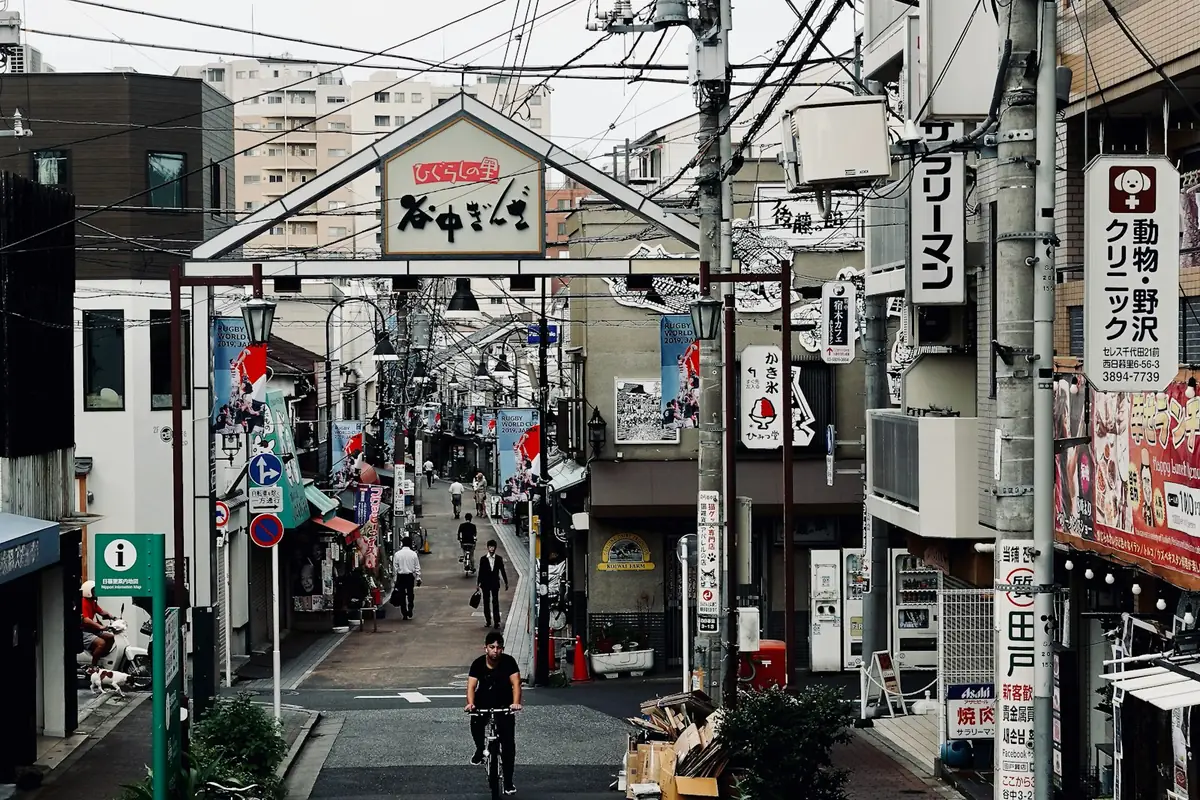
Yanaka Ginza is a 170-metre shopping street of about 60 small, mostly family-run shops in Yanaka, northern Tokyo, five minutes on foot from Nippori Station. People come for menchi katsu (deep-fried minced meat cutlets) from its two butchers, the view from the Yuyake Dandan steps at the Nippori end, and the carved wooden cats placed along the street in 2008.
The streets around it are among the few in Tokyo that largely escaped serious damage in the wars and disasters of the last century, according to GO TOKYO, the city’s official guide. Together with neighbouring Nezu and Sendagi they are known as Yanesen. This guide covers the shops (hours from the shopping street association’s own directory, checked on 31 October 2026), Yanaka Cemetery, the area’s galleries, and a walking route that ends at Nezu Shrine.
Yanaka Ginza Shops, Steps and Side Streets
| Where | Yanaka 3-chome, Taito City, Tokyo. A few shops, such as Goto no Ame, have Nishi-Nippori (Arakawa City) addresses |
| Size | About 60 shops along about 170 metres |
| Hours | Set by each shop, mostly between 10am and 6pm or 7pm |
| Closed | No common closing day. Several food shops close on Mondays |
| Stations | Nippori (JR Yamanote, Keisei and Nippori-Toneri Liner) or Sendagi (Tokyo Metro Chiyoda Line), each 5 minutes on foot |
| From Narita Airport | Keisei Skyliner to Nippori, from 36 minutes |
| Parking | None on the street |
| Best time | Noon to late afternoon for the food shops; around sunset for Yuyake Dandan; April for the Nezu Shrine azaleas |
Yanaka Ginza shopping street: shops and opening hours
Yanaka Ginza grew up on its own around 1945, according to the Yanaka Ginza Shopping Street Association, as a street serving the neighbourhood. When the Yanaka, Nezu and Sendagi area started to be called Yanesen after 1989, in the Heisei era, walkers from across Tokyo and abroad followed. The association’s own count in 2018, in the quiet season, found about 10,000 visitors on a weekday and 14,000 on a weekend day, against about 8,000 a day in 1991.
Most are long-standing family businesses run by specialists: butchers, a fishmonger, a sake shop, tea merchants and sweet makers, alongside newer craft and clothes shops. The association asks visitors to check each shop’s hours directly, because there is no common opening time. These are the hours its shop directory listed for the shops in this guide on 31 October 2026.
| Shop | What it sells | Hours | Closed |
|---|---|---|---|
| Niku no Sato (肉のサトー) | Butcher; Yanaka Menchi and Yanaka Croquette | 10:30am to 7:30pm; fried food from noon | Mondays |
| Niku no Suzuki (肉のすずき) | Deli; Genki Menchi Katsu and roast pork | 10:30am to 6pm | Mondays and Tuesdays (see below) |
| Yanaka Shippoya (やなかしっぽや) | Baked doughnuts shaped like cats’ tails | 10am to 6pm; to 7pm at weekends and on holidays | Irregular |
| Goto no Ame (後藤の飴) | Homemade boiled sweets, since 1922 | 10:30am to 6pm | Wednesdays, plus occasional days |
| Wagriya (和栗や) | Japanese chestnut sweets and café | 11am to 7pm (last orders 6:30pm) | Mondays (Tuesday if Monday is a holiday) |
| Yakiya (やきや) | Grilled squid | 10:30am to 7:30pm on weekends and holidays | Irregular |
| Kinkichien (金吉園) | Green tea and Japanese ceramics | 10am to 6pm | Wednesdays and Thursdays |
| Echigoya (越後屋酒店) | Sake and drinks | 10am to 9pm; to 8pm on Sundays and holidays | Open all year |
A few details from the shops’ own pages: Goto no Ame says its year-round best seller is a fiery nikki (cinnamon) sweet, with yuzu the favourite seasonal flavour; Shippoya keeps 13 or 14 flavours on sale, and its tiger-striped “Tora” (black cocoa with white chocolate chips) is the best seller; Kinkichien, in Yanaka for more than 50 years, pours a cup of tea for everyone who comes in. The two butchers do not take credit cards, so carry cash.
Yanaka Ginza also appears in our guide to Tokyo’s markets and shopping streets, alongside Nakamise in Asakusa and the city’s flea and antique markets.


Map of Yanaka Ginza Shopping Street
Yanaka menchi katsu at Niku no Sato and Niku no Suzuki
Menchi katsu is minced meat shaped into a patty, breaded and deep-fried, and on Yanaka Ginza two butchers a few doors apart make it their signature.
Niku no Sato at 3-13-2 Yanaka calls its Yanaka Menchi the street’s speciality. It is made with Japanese beef, including top-grade A5 wagyu, and a little pork, and fried in soya bean oil with a small amount of lard. The shop recommends it for eating as you stroll; the street is narrow, so step to the side to eat. Fried food goes on sale at noon, so arrive after 12pm. The shop also makes a Yanaka Croquette and roast pork.
Niku no Suzuki at 3-9-15 Yanaka opened in 1933 as a wagyu butcher, and the third-generation owner turned it into a shop for handmade deli food. Its Genki Menchi Katsu is all beef, a blend of Japanese beef shoulder and belly with Australian beef thigh, and the frying oil is changed three times a day. The shop warns that at busy times there can be a wait, because every cutlet is made by hand. The association’s directory lists it as closed on Mondays with some Tuesdays, and the shop’s own page says Mondays and Tuesdays, so plan to go from Wednesday to Sunday.
Yuyake Dandan steps and the Yanaka cats
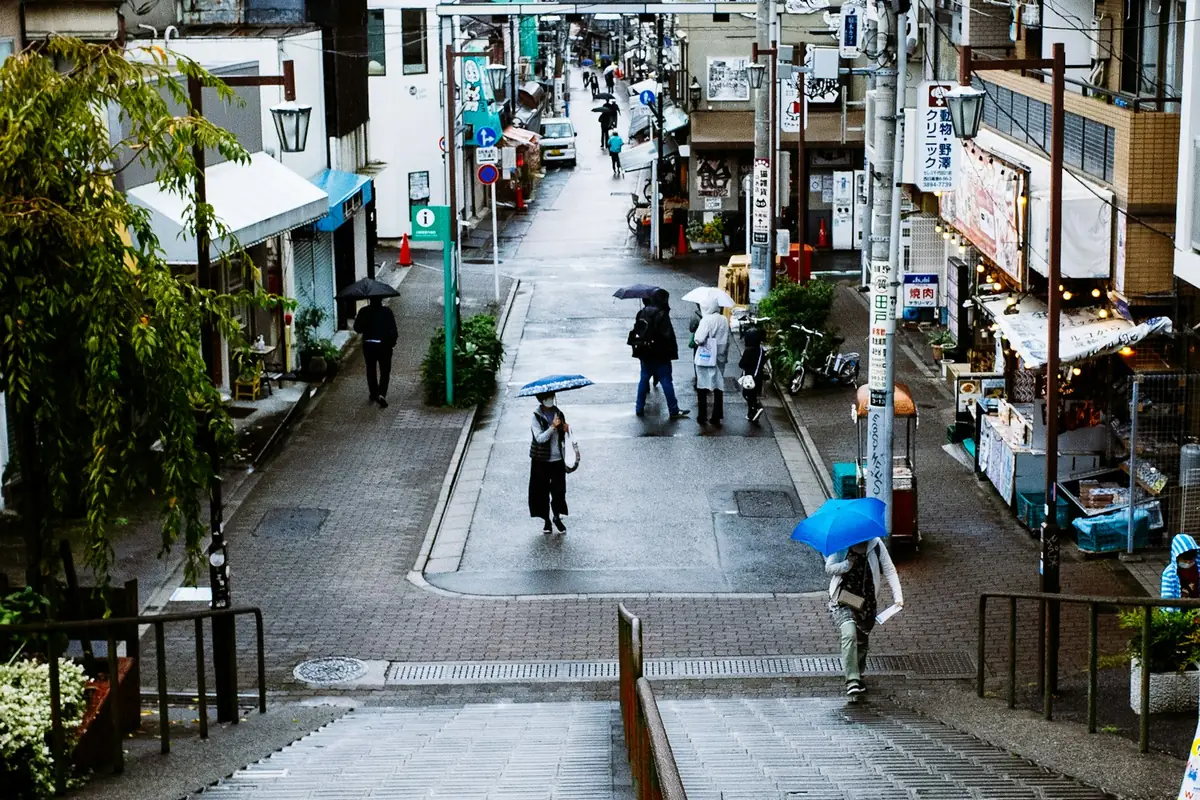
Walking from Nippori, the road passes Yanaka Cemetery and the temple streets before the view suddenly opens out at the top of Yuyake Dandan, the “sunset steps”. The association describes it as a well-known place to watch the sun go down, looking over the low roofs of the old town with Yanaka Ginza at its centre. Late afternoon, before the shops close, is the time to be here.
Yanaka is known for its cats, and the street plays along. In 2008 the association placed carved wooden cats along the street, which GO TOKYO calls the Seven Lucky Cats, and in 2016 it introduced its own mascot, a cat called Sen-chan. Member shops marked with a paw print in the directory take part in the Sen-chan stamp card. Shippoya’s cat-tail doughnuts are the edible version.








Yanaka Cemetery and Tokugawa Yoshinobu’s grave
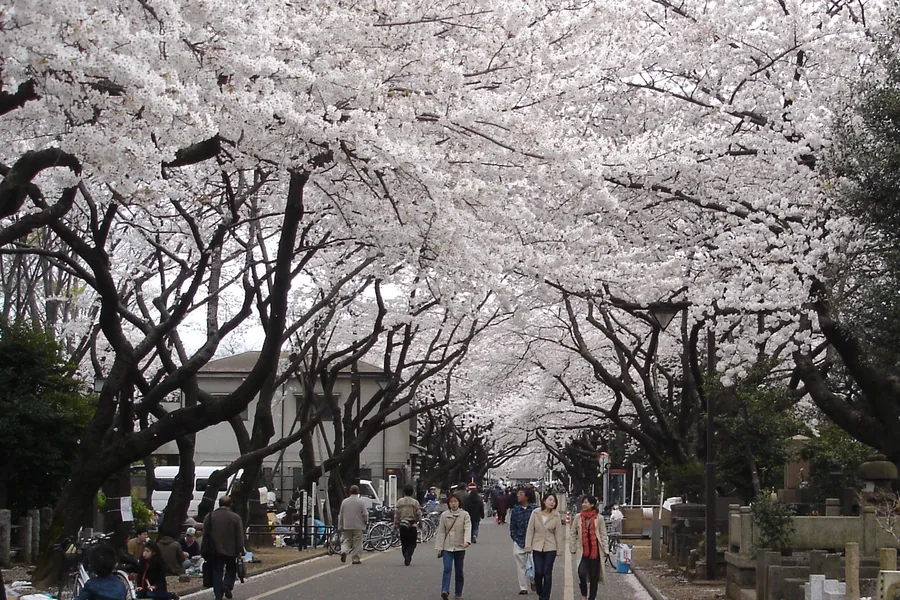
Right beside Nippori Station’s west exit, Yanaka Cemetery opened on 1 September 1874 and covers about 10 hectares. The Tokyo Metropolitan Park Association, which runs it, says much of the land once belonged to the temples Tennoji and Kan’eiji, and that many artists, writers, actors, scholars and statesmen are buried here. Its central avenue, Sakura-dori, is lined with cherry trees and draws crowds in spring.
The best-known grave is that of Tokugawa Yoshinobu, the last Tokugawa shogun, who lies in the Kan’eiji section of the cemetery. His resignation in November 1867 opened the way for the end of shogun rule; our article on the Meiji Restoration and the fall of the shogunate tells how it happened. The park association’s English map marks his grave, along with two other landmarks worth finding:
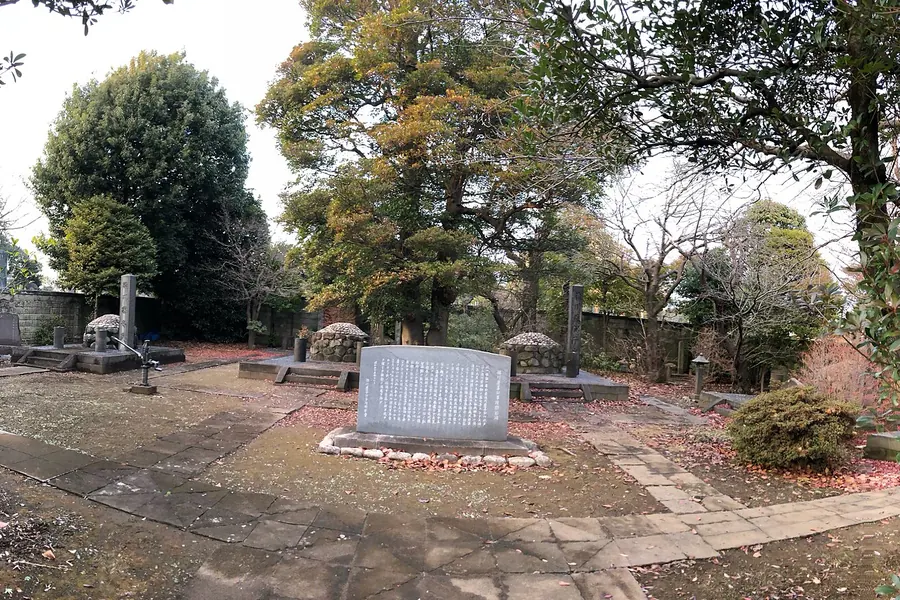
- The five-storey pagoda ruins: a pagoda once stood on Sakura-dori as the symbol of the cemetery. It burned down in 1957 in a double suicide, and its foundation stones are still there. It was the model for Koda Rohan’s novel The Five-Storied Pagoda.
- The grave of St Nicholas of Japan: marked on the map towards the Ueno side of the cemetery.
Yanaka also has a place in Japanese ghost stories. Lafcadio Hearn’s retelling of the Peony Lantern tale, “A Passional Karma” in In Ghostly Japan (1899), has the young samurai Hagiwara Shinzaburo, who lives in the Nezu quarter, go searching for O-Tsuyu’s home in Yanaka-no-Sasaki. The cemetery office at 7-5-24 Yanaka opens from 8:30am to 5:30pm; there is no parking.
SCAI the Bathhouse, Kayaba Coffee and the Asakura Museum
Three stops show how Yanaka reuses its old buildings.
SCAI the Bathhouse is a contemporary art gallery in a public bathhouse that the gallery describes as 200 years old, at 6-1-23 Yanaka. It opened in 1993 and has worked with artists including Mariko Mori, Kohei Nawa and Anish Kapoor. From 4 November to 19 December 2026 it shows Nobuko Tsuchiya’s “Ace of Hearts”, curated by Martin Clark, director of the Camden Arts Centre in London, for Art Week Tokyo. The gallery opens from noon to 6pm, closes on Sundays, Mondays and public holidays, and shuts between exhibitions. From Nippori’s south exit, walk straight along the broad avenue for about five minutes, turn left at the end of the road, and it is a minute further on your right, opposite a police box.
Kayaba Coffee, a wooden building from 1916, served as a coffee shop from 1938 until its original owner died in 2006, and reopened in its Showa-era style in 2009, according to GO TOKYO. Our Ueno guide covers it alongside Yanaka Beer Hall, both a short walk from Ueno Park.
The Asakura Museum of Sculpture is the former studio and home of the sculptor Fumio Asakura (1883 to 1964). The shopping street association puts it 300 metres, about three minutes on foot, from Yanaka Ginza.
Nezu Shrine and the Bunkyo Azalea Festival
Nezu Shrine is about ten minutes’ walk from Yanaka Ginza by way of Sendagi Station. The shrine’s history traces its founding to the legendary prince Yamato Takeru more than 1,900 years ago, and its present buildings to the fifth shogun, Tokugawa Tsunayoshi, who built them in 1706 on the estate where his successor Ienobu was born.
Those buildings survive complete. According to the shrine’s guide to its grounds, seven of them are national Important Cultural Properties, all finished in real lacquer, and its tower gate (romon) is the only one left at any shrine in old Edo. The writers Natsume Soseki and Mori Ogai were both parishioners, and a “writers’ stone” marks where they are said to have sat on walks through the grounds.
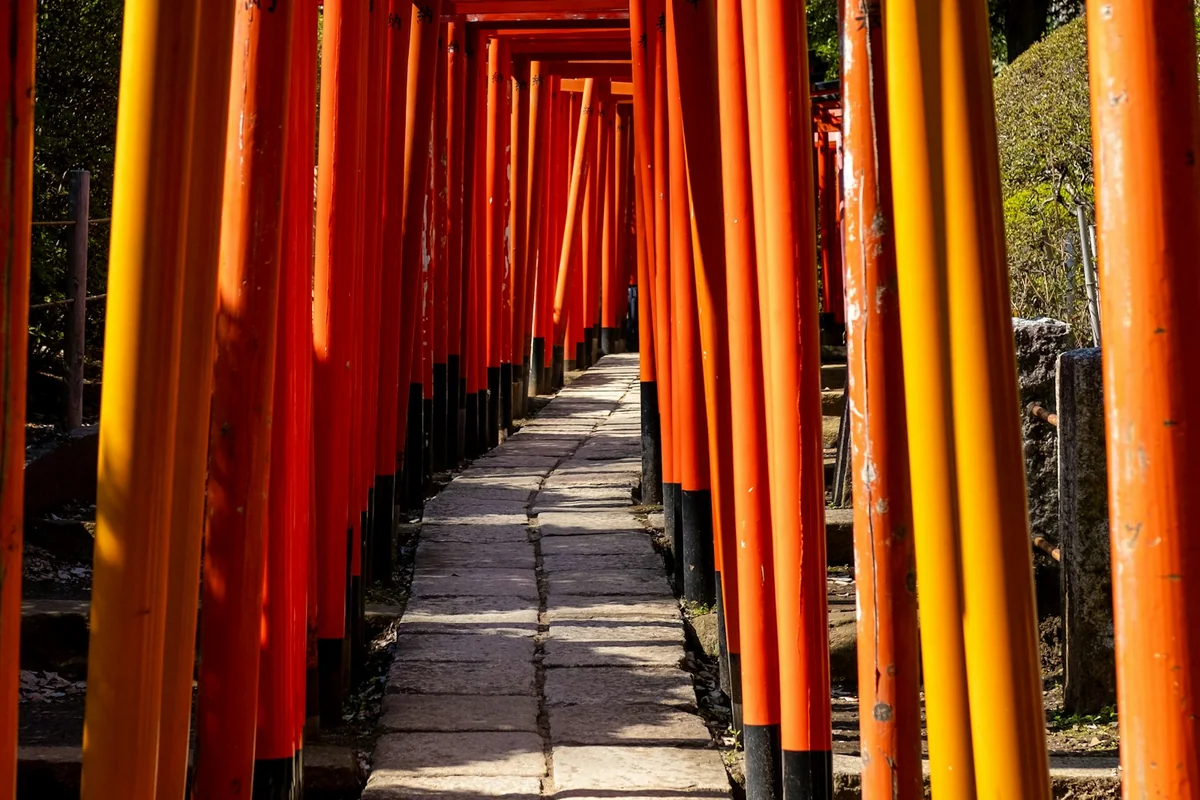
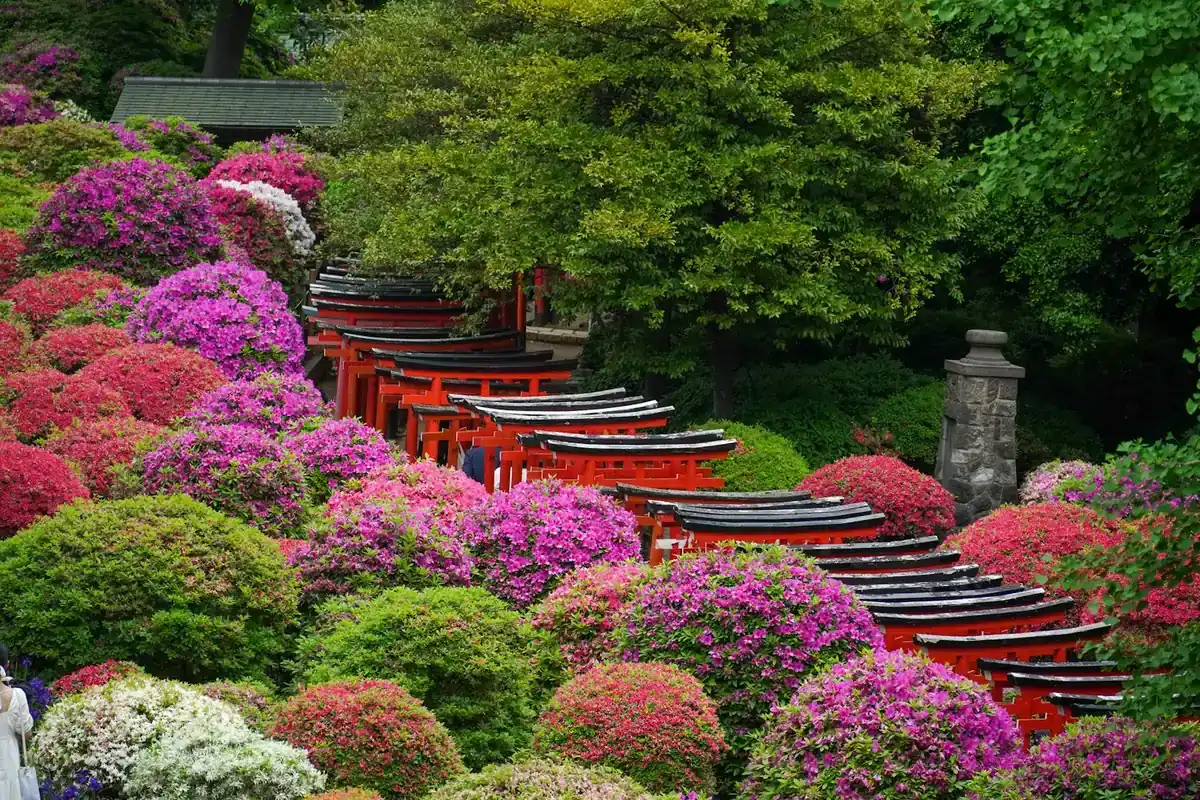
The path of tightly packed torii gates, known as senbon torii, leads to Otome Inari, a small shrine on a platform above the pond. In April the slope beside it becomes the azalea garden. The 55th Bunkyo Azalea Festival ran from 1 to 30 April 2026, and the 2027 dates had not been announced at the time of writing. These were the 2026 arrangements:
- Garden hours: 9am to 5:30pm (11am on the opening day).
- Entry: a donation of 500 to 1,000 yen; free for children aged 12 and under.
- When to go: early, mid and late flowering varieties bloom in turn. The shrine says the most flowers are out by the middle of the month, with the late bloomers carrying on into the last week.
- Rules: no pets, no eating or drinking, no tripods or monopods, and no re-entry. Entry may be limited when it is crowded.
The shrine posts bloom updates on its official Instagram account during the festival.
A Yanesen walk from Nippori to Nezu Shrine
This route links the places above in walking order, using the walking times each site publishes. It works best on a Wednesday to Saturday, when Niku no Suzuki, SCAI the Bathhouse and most food shops are all open.
- Nippori Station, south exit. Yanaka Cemetery’s office is 6 minutes’ walk. Follow Sakura-dori past the pagoda ruins and look for Tokugawa Yoshinobu’s grave in the Kan’eiji section.
- SCAI the Bathhouse. About 6 minutes from Nippori’s south exit, opposite a police box. Open noon to 6pm, Tuesday to Saturday.
- Asakura Museum of Sculpture. 300 metres, about three minutes, from Yanaka Ginza.
- Yuyake Dandan and Yanaka Ginza. Arrive after noon so Niku no Sato is frying, and take the steps in the late afternoon light.
- Sendagi Station. 5 minutes from Yanaka Ginza.
- Nezu Shrine. 5 minutes from Sendagi or Nezu stations on the Tokyo Metro Chiyoda Line. Finish at Nezu Station for the train back.
Map of Nezu Shrine
Getting to Yanaka from central Tokyo and Narita
Nippori Station is the main gateway. GO TOKYO puts it 12 minutes from Tokyo Station and 20 minutes from Shinjuku on the JR Yamanote Line, and the Keisei Skyliner reaches it from Narita Airport in as little as 36 minutes, which makes Yanaka an easy first or last afternoon of a trip. Sendagi and Nezu stations on the Tokyo Metro Chiyoda Line serve the western side.
Yanaka sits in Taito City, the ward that also holds Ueno and Asakusa; our Taito City guide covers the rest of it. For a second shopping street in the same ward, Kappabashi Street, Tokyo’s kitchen town, is a 15-minute walk from JR Ueno.
Yanaka Ginza questions and answers
How do I get to Yanaka Ginza?
Take the JR Yamanote Line or Keisei Line to Nippori Station and walk 5 minutes from the west exit, past Yanaka Cemetery and down the Yuyake Dandan steps. From the Tokyo Metro Chiyoda Line, Sendagi Station is also 5 minutes away. There is no parking on the street, so come by train.
What is Yanaka Ginza famous for?
Its old-style family shops and street snacks, above all menchi katsu from the butchers Niku no Sato and Niku no Suzuki. It is also known for the Yuyake Dandan steps, a sunset viewpoint at the Nippori end, and for the carved wooden cats placed along the street in 2008.
What time do Yanaka Ginza shops open?
Each shop sets its own hours, and the street association asks visitors to check with individual shops. Most open between 10am and 11am and close between 6pm and 7pm. Niku no Sato starts selling fried food at noon, and several food shops close on Mondays, so a Wednesday to Saturday afternoon works best.
Why are there cats in Yanaka?
The neighbourhood is known for its cats, and the shopping street has made them its theme. The association placed carved wooden cats along the street in 2008, which GO TOKYO calls the Seven Lucky Cats, and in 2016 introduced a cat mascot, Sen-chan. Shops sell cat-themed snacks such as Shippoya’s cat-tail doughnuts.
Where is Tokugawa Yoshinobu’s grave?
In the Kan’eiji section of Yanaka Cemetery, about 6 minutes’ walk from the south exit of Nippori Station. Yoshinobu was the last Tokugawa shogun, and his resignation in 1867 opened the way to the Meiji Restoration. The cemetery’s official English map, published by the Tokyo Metropolitan Park Association, marks the grave.
When is the Nezu Shrine azalea festival?
Every April. The 55th Bunkyo Azalea Festival ran from 1 to 30 April 2026, with the azalea garden open from 9am to 5:30pm for a donation of 500 to 1,000 yen. The shrine says the most flowers are out by mid April. The 2027 dates had not been announced by the end of October 2026.
What does Yanesen mean?
Yanesen joins the first sounds of Yanaka, Nezu and Sendagi, three neighbouring districts of old Tokyo. The shopping street association says the name took hold in the Heisei era, which began in 1989, when the area became a popular place for walking. The walk from Nippori to Nezu Shrine in this guide passes through all three.