The Meiji era, which ran from 1868 to 1912, was a transformative period in Japanese history. It marked the end of the Tokugawa shogunate and the return of imperial rule under Emperor Meiji. This era is renowned for its significant political, social, and cultural changes as Japan sought to modernise and compete with Western powers. One of the most intriguing aspects of this transformation was the reconfiguration of the Japanese body’s perception and presentation. This article explores the profound shifts in bodily practices, influenced by the Western gaze and governmental policies, and the tension between modernisation and cultural preservation during the Meiji Era. The westernisation of Japan played a significant role in these changes.
Tattoos, blackened teeth, topknots and public bathing all changed within a generation, pushed by new laws at home and by how Japan wanted to be seen abroad. Here is what changed, who changed first, and what people kept doing in private.
Meiji Era at a Glance
- Dates: 1868 to 1912. The new year name, Meiji, meaning “enlightened government”, was counted from 1 January 1868.
- Emperor: Mutsuhito, known after his death as Emperor Meiji, the 122nd emperor, born on 3 November 1852. He came to the throne in 1867, in his fifteenth year.
- How it began: the last shogun, Tokugawa Yoshinobu, offered to return power to the Emperor in November 1867, and an order restoring imperial rule followed on 3 January 1868.
- Capital: Edo was renamed Tokyo, the “Eastern Capital”, and became the seat of government.
- Government: the Charter Oath of 1868, the end of the feudal domains in 1871, the Constitution of 11 February 1889 and the first Imperial Diet in November 1890.
- Wars: with China in 1894 to 1895 and with Russia in 1904 to 1905.
- How it ended: Emperor Meiji died in July 1912, and the Taishō era began.
- Where to see it today: Meiji Jingu in Tokyo, the shrine built in 1920 for the Emperor and Empress Shōken.
How the Meiji Era Remade the Japanese Body

Meiji Era Timeline, 1868 to 1912
The body changes in this article happened alongside the political ones, often in the same years. The timeline puts both on one page, using the National Diet Library’s chronology for the dates of state, and the sources named in each section below for the changes to daily life.
| Year | What happened |
|---|---|
| 1868 | Imperial rule restored by order on 3 January. The Emperor swears the Charter Oath in the third month. Edo becomes Tokyo. In May, Ernest Satow sees the 15-year-old Emperor with shaved and painted court eyebrows. |
| 1870 | The imperial family and court nobles are ordered to stop blackening their teeth. |
| 1871 | The feudal domains are abolished by an edict of 29 August. Men are allowed to cut off the topknot, and the Ainu women’s tattoos are banned. The Iwakura Mission sails from Yokohama for America and Europe on 23 December. |
| 1872 | Tokyo’s misdemeanour ordinance targets public nudity, mixed bathing, tattooing and women cutting their hair short. |
| 1873 | A conscription law makes every adult man liable for military service. The Emperor cuts his hair and puts on a Western military uniform, and the Empress stops blackening her teeth. |
| 1877 | The Satsuma Rebellion: about 40,000 samurai under Saigō Takamori fight for eight months against a government army of 66,000. |
| 1878 | Isabella Bird travels north, noting tattooed rickshaw runners and village women still blackening their teeth. |
| 1886 | Empress Haruko appears in Western dress for the first time. |
| 1889 | The Meiji Constitution is proclaimed on 11 February, and the Emperor and Empress ride in the same carriage. The statesman Viscount Mori Arinori is stabbed the same day. |
| 1890 | The first general election on 1 July, and the first Imperial Diet opens on 29 November. |
| 1894 to 1895 | The First Sino-Japanese War, from Japan’s declaration on 1 August 1894 to the Treaty of Shimonoseki on 17 April 1895. |
| 1902 | The Anglo-Japanese Alliance is signed on 30 January. |
| 1904 to 1905 | The Russo-Japanese War, from 10 February 1904 to the Treaty of Portsmouth on 5 September 1905. |
| 1910 | The treaty annexing Korea is signed on 22 August. Inouye notes that older Tokyo women still blacken their teeth. |
| 1912 | Emperor Meiji dies in July, ending the era. |
Two details from the period’s own writers show how unsettled those first years were. Brinkley, writing in 1915, argues in chapter XLVI that the men who drafted the Emperor’s oath of 1868 never meant its promise of “deliberative assemblies” as a parliament in the Western sense: it was a check on the great clans’ ambitions, and only later came to be read as a promise of a national assembly. And Satow, who dined with the Satsuma statesman Ōkubo Toshimichi in 1868, wrote in chapter XXXII of A Diplomat in Japan that he had no doubt the decision to make Edo the seat of government and rename it Tokyo was largely Ōkubo’s work.
Transformation of Bodily Practices During the Meiji Era
Before the Meiji Restoration, the Japanese body was a canvas of cultural identity, expressed through practices such as tattooing, blackening teeth, and specific hairstyles. These practices were deeply rooted in Japan’s indigenous culture and carried significant symbolic meanings.

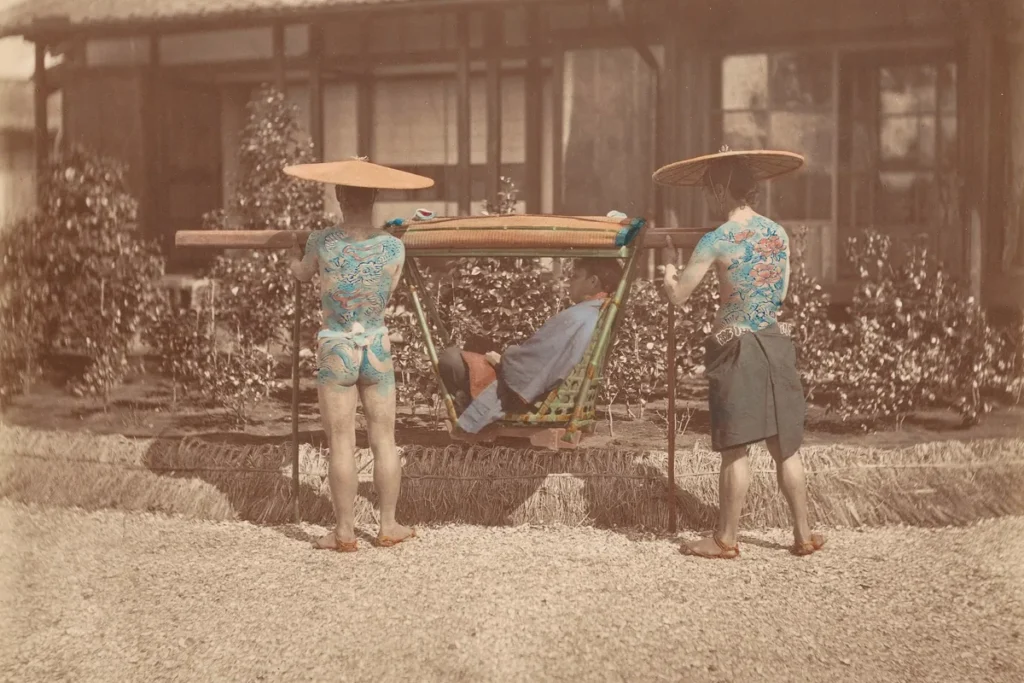
The body being used as a canvas for tattoos. Image Credit: Artsy
Tattoos, for instance, evolved from marks of punishment to intricate designs that symbolised protection, strength, and fashion. Haircuts were laden with social significance, indicating mourning or marital status, while blackened teeth signified a woman’s engagement or marriage.
Sudden Conservativeness?
However, the Meiji Restoration brought about drastic changes. The new government, keen on modernising Japan, viewed these traditional practices as obstacles to progress. Influenced by Western notions of decency and respectability, the government implemented policies that discouraged or outright banned these customs
The traditional nakedness, which was seen as natural and non-sexual in Edo Japan, was now considered indecent. Public nudity, tattoos, and other bodily practices were scrutinized and regulated under new laws.
The Western Gaze and Self-Consciousness

A woodblock print of a Western ship in a Japanese harbour, the kind of scene that followed Commodore Matthew Perry’s black ships, led by the steam frigate USS Susquehanna, into Edo Bay in 1853. Image Credit: The Wandering Historian/ X
Where It All Began
The arrival of Westerners, particularly after Commodore Matthew Perry’s expedition in 1853, introduced a new perspective on Japanese bodily practices. Western visitors were often shocked by the casualness of public nudity and the indigenous customs they deemed “barbaric.” This marked the beginning of the westernization of Japan.
This Western gaze forced Japan to become self-conscious about its traditions. The Japanese leaders, aware of how their country was perceived by the West, felt pressured to adopt Western norms to avoid being seen as uncivilized and to reduce the risk of colonization.
The Fashion Agenda
This self-consciousness was not merely a reaction to Western opinions but a strategic move by the Japanese leaders. By aligning with Western standards, they aimed to gain respect and secure their place in the international community. This alignment was a significant part of the westernization of Japan.
This led to a systematic effort to control and reshape the Japanese body through new laws and regulations. The government’s approach to bodily practices was part of a broader agenda to modernise Japan and prevent foreign domination.

Symbolic Meaning of Traditional Bodily Practices
Traditional Japanese bodily practices were not merely aesthetic choices but carried profound cultural and social meanings. Tattoos, which once marked criminals, evolved into elaborate designs that symbolised protection, strength, and fashion. The shift in the perception of tattoos reflects broader changes in Japanese society, where what was once stigmatized could become a mark of pride.
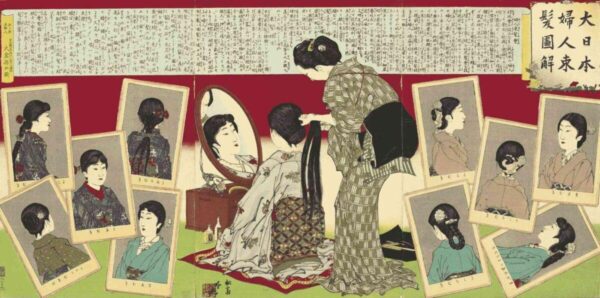
Meiji Daughters: Their Stuff and Fancy in Brocade Pictures. Image Credit: The University of British Columbia
Haircuts, too, had deep social significance. Cutting one’s hair could signify mourning or devotion, while different hairstyles marked social status. The practice of blackening teeth, originally part of coming-of-age ceremonies for young aristocrats, boys and girls alike, became a widespread custom that signified marital status. These practices were integral to Japanese identity, and their gradual disappearance under Western influence marked a profound cultural shift.
The enforcement of new laws regulating these practices was not merely about public decency but about redefining Japanese identity in a modern context. The tension between preserving traditional practices and adopting Western norms was a central theme of the Meiji Era and westernisation of Japan.
Ohaguro: who blackened their teeth, and how teeth blackening ended
Teeth blackening, known as ohaguro, has very old roots and was a mark of the imperial court by the Heian period, when young aristocrats of both sexes blackened their teeth on coming of age, and samurai such as the Taira clan followed the court’s lead. By the Edo period it had narrowed mainly to married women. The Meiji government moved against it from the top down: in 1870 it ordered the imperial family and court nobles to stop, three years before the Empress set her own example. Ordinary women were much slower to follow. Isabella Bird, travelling near Nikkō in June 1878, watched village women blackening their teeth in front of round metal mirrors, as she recorded in Unbeaten Tracks in Japan (1880). As late as 1910, Jukichi Inouye noted in Home Life in Tokyo that middle-aged and older women in the capital still kept up the custom, and by the end of the Taishō period (1912 to 1926) it had all but vanished.
The chonmage topknot and the 1871 haircut edict
Men’s hair changed faster. The Edo period topknot, the chonmage, meant shaving the crown and tying the remaining hair into a waxed queue folded forward over the head, which had to be redone every two or three days, usually with help. In 1871 the government issued an edict allowing men to cut their hair short, and many did so gladly. Inouye recalled that cropped hair caught on partly because it saved time and money, and that the popular short cut was nicknamed the “chestnut burr”. Women who copied the men were another matter: Tokyo’s 1872 misdemeanour ordinance listed a woman cutting her hair without good reason as an offence.
Swords: the last thing the samurai gave up
The two swords at a samurai’s waist were as much a part of how he looked as the topknot, and they went more slowly. Brinkley describes the sequence in chapter XLVI of A History of the Japanese People (1915). First, wearing swords was made optional, and in 1873 the government offered to buy out the samurai’s hereditary pensions. The conscription law that followed opened the army to any adult man, and Brinkley judged that the cut in income hurt the samurai less than “the necessity of laying aside their swords”.
When both measures were later made compulsory, the money caused little protest. “It was to the loss of their swords that a number of samurai objected strenuously,” Brinkley writes. A few score of them, in old-fashioned armour and carrying family weapons, attacked a castle garrison and then took their own lives, and soon afterwards the Satsuma samurai rose in the rebellion of 1877.
Governmental Influence and the Meiji Misdemeanor Law
The Meiji leaders played a pivotal role in transforming Japanese bodily practices through the implementation of the Meiji Misdemeanor Law in 1872. This law enforced new regulations on public decency, targeting customs like public nudity, mixed bathing and tattoos. The authorities imposed fines and, in some cases, used force to ensure compliance. This rigorous enforcement highlighted the government’s commitment to modernising the nation’s image.
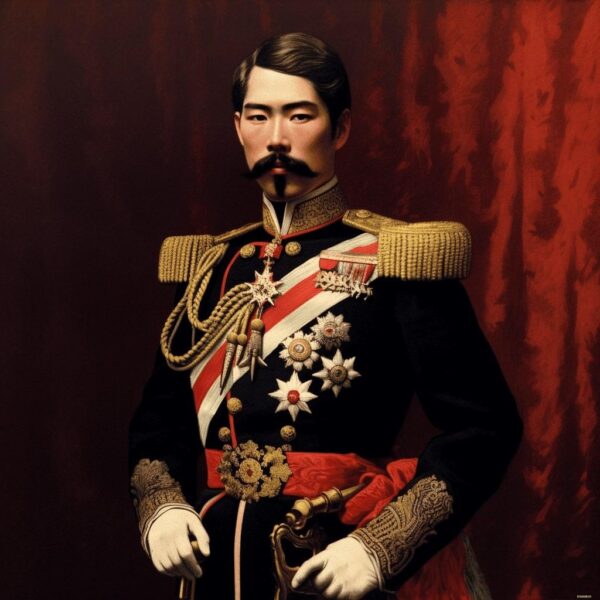
Emperor Mutsuhito. Image Credit: Roppongi
The emperor and empress themselves adopted Western clothing and hairstyles to set an example. In 1873, Emperor Mutsuhito cut his hair and donned a French-style military uniform, while Empress Haruko gave up shaving her eyebrows and blackening her teeth. She first appeared in corseted Western dress in 1886.
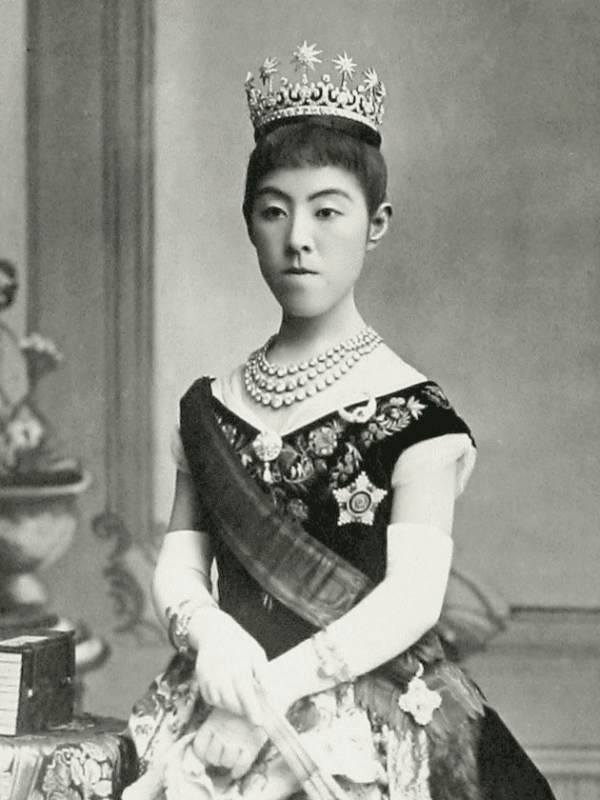
Empress Haruko. Image Credit: Getty Images
This dramatic shift in their appearance was a powerful statement to the Japanese people, signalling the importance of conforming to Western norms.
The adoption of Western styles by the imperial couple was not without controversy. While some viewed it as a necessary step towards modernisation, others saw it as a betrayal of Japanese tradition. This dichotomy reflects the broader societal tension between embracing modernity and preserving cultural identity during the Meiji Era.
Shaved and painted eyebrows in 1868, a shared carriage in 1889
The imperial makeover is easier to appreciate once you know where it started. When the British diplomat Ernest Satow attended the audience in Osaka on 22 May 1868 at which Sir Harry Parkes presented his credentials, he saw the 15-year-old Emperor with his eyebrows shaved off and painted in an inch higher up, in the old court style, as he recorded in A Diplomat in Japan (1921). Two decades later the change was complete. On 11 February 1889, the day the Meiji Constitution was proclaimed, the Emperor and Empress rode together in the same carriage to a military review at Aoyama, a sight that astonished the crowds. Alice Mabel Bacon, in Japanese Girls and Women (1902), called it the first time in Japanese history that an emperor and empress had ridden side by side.
Tattooed rickshaw runners and the Ainu plea: what Isabella Bird saw in 1878
The bans took time to reach the street. On the road north from Tokyo in June 1878, Bird noticed that her rickshaw runners’ loose jackets flew back to show chests and backs tattooed with dragons and fish. Tattooing had recently been prohibited, she wrote, although for these men it had been a favourite adornment and a stand-in for clothing. Our guide to irezumi follows the ban to its end in 1948. In Hokkaido that summer, Ainu women told her how upset they were by the government’s 1871 ban on the tattoos around their mouths and on their arms, which marked a girl’s coming of age and readiness to marry. They said the gods would be angry and that women could not marry without them, and they begged Bird and her travelling companion von Siebold to plead their case with the government.
Cultural Resistance and the “Double Life” Phenomenon
Despite the government’s efforts to enforce Western norms, many Japanese people continued to practice their traditional customs in private, leading to the phenomenon known as “nijuu seikatsu” or “double life.”
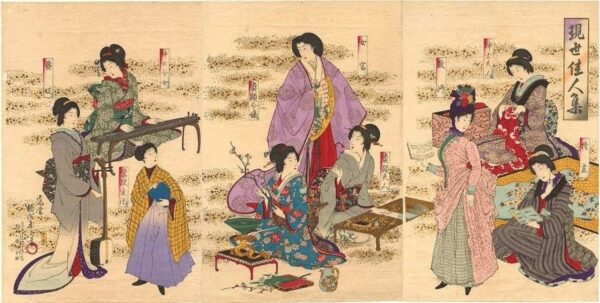
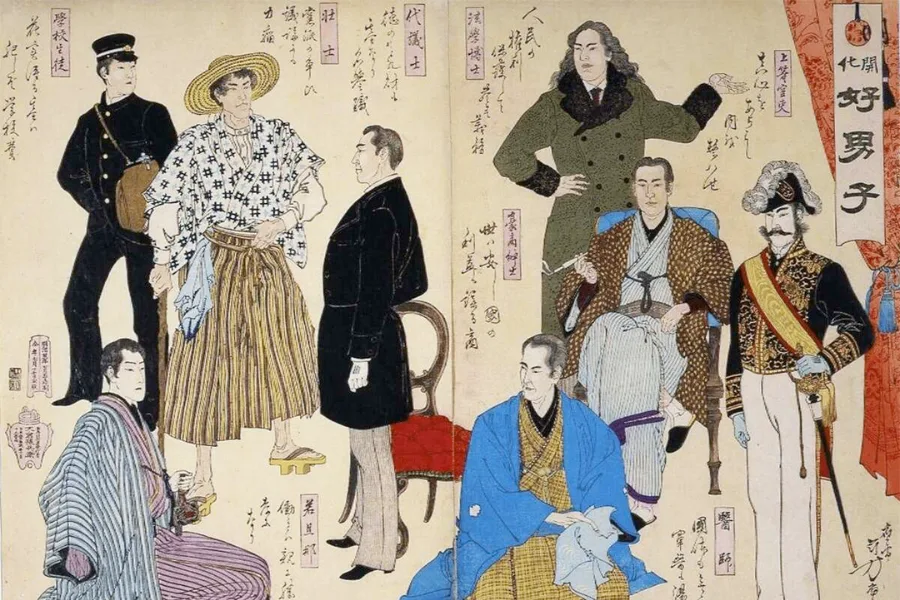
Gensei Kajin Shu by Yoshu Chikanobu (1890). Image Credit: Yoshu Chikanobu/ Wikimedia Commons
In public, individuals conformed to Western dress codes, but in private, they reverted to traditional Japanese attire. This duality underscores the complexity of cultural transformation during the Meiji Era and westernisation of Japan.
Two wardrobes: why tatami floors kept the kimono at home
There was a practical side to the double life too. Inouye explained that European suits suited offices, schools and government buildings furnished with chairs and desks, but were uncomfortable at home, where people sat on tatami mats. The collar pressed on the throat, trousers bagged at the knee, and thin socks were no match for a winter room warmed by a single charcoal brazier. So a middle-class man who wore Western clothes for work still needed a full set of Japanese clothes for home, and paid for both.
The “double life” phenomenon illustrates the resilience of cultural traditions amidst external pressures. It was not merely a matter of practicality but a reflection of deeply ingrained cultural values.
The Japanese people found ways to navigate the demands of modernisation while preserving their heritage. This tension between public conformity and private tradition highlights the nuanced nature of cultural change.
The Meiji Restoration was a period of profound transformation for Japan, particularly in the realm of bodily practices. The traditional customs that once defined Japanese identity were challenged and reshaped under the Western gaze and governmental policies. While the government sought to modernise and align with Western standards, the Japanese people navigated these changes with a “double life,” maintaining their cultural heritage in private.
The story of the Japanese body during the Meiji Era is one of tension and adaptation, reflecting the broader struggle between modernisation and cultural preservation. The reconfiguration of bodily practices was not just about aesthetics but about identity, power, and resistance. As Japan continues to evolve, the legacy of the Meiji Era remains a powerful reminder of the complexities of cultural transformation.
Meiji Era: Questions and Answers
The Meiji era is the period of Japanese history from 1868 to 1912, named for the reign of Emperor Meiji. It began when power passed from the Tokugawa shogunate back to the Emperor. Over the next 44 years Japan rebuilt its government on Western lines, and changed how its people dressed and looked.
It started in 1868, with the year name Meiji counted from 1 January that year, after an order restoring imperial rule on 3 January 1868. It ended with the death of Emperor Meiji in July 1912, when the Taishō era began. The Emperor had come to the throne in 1867, aged 14.
Meiji means “enlightened government”, in the translation Frank Brinkley gives in his 1915 history. The year name was adopted in 1868 and counted from 1 January that year. The Emperor, whose personal name was Mutsuhito, is known by the name of his era after his death, which is why he is called Emperor Meiji.
The feudal domains were abolished in 1871 and replaced by prefectures, the samurai lost their pensions and their swords, and every man became liable for military service. The 1889 constitution created an elected Diet. Daily life changed too: the topknot, teeth blackening, tattooing and mixed public bathing were all discouraged or banned.
Mostly for security and status. After Commodore Perry’s black ships arrived in 1853, Japan’s leaders saw how weak a divided country was against Western navies. Adopting Western law, armies and manners was meant to make Japan strong enough to avoid colonisation, and respectable enough to win revision of the unequal treaties with the Western powers.
The Taishō era, from 1912 to 1926, under Emperor Taishō. The changes to appearance kept spreading in Taishō: Jukichi Inouye found older Tokyo women still blackening their teeth in 1910, and the custom had all but vanished by the end of the Taishō period.
Sources and further reading
- Frank Brinkley with Dairoku Kikuchi, A History of the Japanese People (1915), chapter XLV (the Emperor Mutsuhito and the year name Meiji) and chapter XLVI (the Emperor’s oath, the abolition of the domains, the samurai and their swords, the Satsuma Rebellion and the Constitution)
- National Diet Library, Modern Japan in Archives: chronological table
- Alice Mabel Bacon, Japanese Girls and Women (1902)
- Isabella Bird, Unbeaten Tracks in Japan (1880)
- Jukichi Inouye, Home Life in Tokyo (1910)
- Ernest Satow, A Diplomat in Japan (1921), including chapter XXXII (Ōkubo and the move of the capital to Tokyo)