Elegantly subtle and terrifyingly direct, these are words I would use to describe Yasujirō Ozu’s Tokyo Story. It’s a film that hits you hard when you least expect it and jabs you continuously when you’re paying attention. In many respects, it reminds me of great playwrights like Henrik Ibsen, in that once the idea hits with you, it’s impossible not to see it. And along with Seven Samurai, is one of the greatest Japanese films of all time.
It’s also a film that doesn’t attempt to mislead anybody or send a grandiose message; rather, it tells a simple story with a lot of layers. And as you gradually peel them away, you begin to discover new significance in its simplicity. But, above all, it’s a gorgeous film that will remain with you long after the credits have rolled.
The Premise
The premise is straightforward: an elderly couple visits Tokyo to see their grown children, only to be treated poorly. That’s it. It’s not even that they’re treated that poorly; it’s simply that they’re treated in a dismissive and indifferent manner. But it is in this simplicity that Yasujirō Ozu uncovers so much depth, such as the essence of family, feudal vs. metropolitan life, honour, and so much more.
With that stated, consider the following: “How many times have you seen a genuinely passive protagonist?” Most likely, not many. Protagonists are meant to make choices, open doors to new worlds, take risks, and strive for greater heights. Even characters who are meant to be passive are ultimately compelled to make a choice. This is also why most protagonists are youthful and hungry for adventure. However, Ozu selects these older people on purpose because they suit the narrative he wants to convey, even if it means risking monotony.
The protagonists of Tokyo Story are peaceful elderly folks who want to be led about and avoid problems, and the bulk of their conversation consists of them agreeing and accepting whatever comes their way. Tokyo Story feels like a peaceful meditation that asks the spectator to care for these two seniors as if they’re part of the family. And it works; at the midway mark, you feel as though you’re watching two folks who might be your grandparents.
Family is family, every time
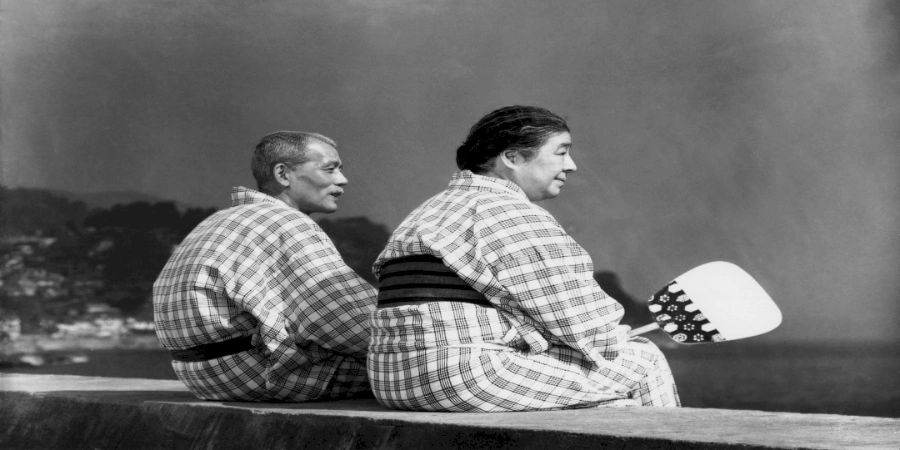
As the viewer, one can only ask, “why?” when their children treat their parents in such a careless manner. Many options are explored throughout the film, which ends up addressing a deeper area than was first intended. Ozu really discovers the general in specific, creating a picture that encompasses Japan’s circumstances at the moment, as well as human nature.
The first cause is due to a change in settings. Going from a tiny village in Japan to the massive urban Tokyo implies a change in cultural norms, which may result in the loss of certain values, such as respect for parents. The children in the film seem to be more concerned with how to handle their finances than with providing a nice experience for their parents. This may be a reflection on how the new quality of life provided by America after the war changes Japan’s culture and brings it to where it is now. The notion itself is not new; many painters of the period addressed the same subject, but I’ve never seen it approached with such calmness. It’s almost as though it rejects it while equally accepting it.
Another possibility is that they are resentful of their father. Tokyo Story emphasises situations when the father drank excessively and frightened them, or where great demands were placed on them. The fact that it is often addressed and even pondered upon leads me to think that it has a significant impact on the children’s conduct, one that is expressed more by actions than words.
Ultimately, the movie’s message is the same: family is always family and should be treated with respect, no matter what. The idea that children can only care for their parents while they are still alive runs under the whole story, as a message to both the characters and the audience. The film’s viewpoint is eventually represented by the character of Noriko, who, although being only a daughter-in-law to a son who went missing in the war eight years ago, treats the couple with enthusiastic affection. She is the real protagonist of the tale in more ways than one. Setsuko Hara also plays a Noriko, a different character, in Ozu’s Late Spring (1949).

Dialogue
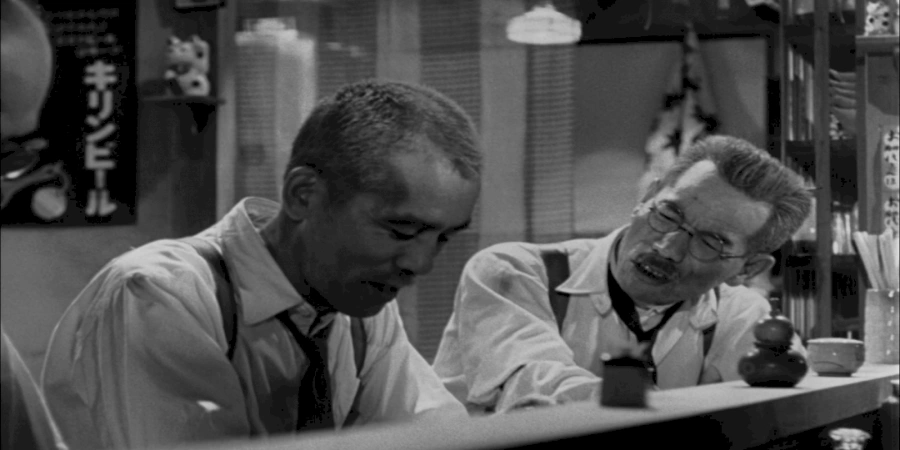
In every sense of the word, the dialogue in the film is simply amazing. It seems to be uttering nothing but filler at points, but then it hits with amazing accuracy. Ozu’s dialogue choices make even the most mundane situations tense. I’m especially frightened by the way the children in Tokyo mention going to their parents’ home, which you’ll recognise if you’ve watched the film.
On the other side, the language can feel so minimalistic at times that it purposefully removes suspense from moments that should be frightening. The elders’ manner of speaking, constantly smiling, humming, and lingering on their response, even if it’s only a simple “yes,” adds a dimension of innocence and purity to the characters. This is so powerful that the impact I stated before (about them feeling like family) is amplified since you really care about them.
There are other moments when the film seems to be directing its words straight at the audience. For example, the closing sentence and the way the character is framed make it seem as though the protagonist and the audience are gazing at one other. I won’t spoil it for you and say the phrase, but it will keep you coming back.
Cinematography
Tokyo Story was shot by Yūharu Atsuta, Ozu’s regular cameraman, and nearly every shot follows the same rules. The camera sits low, at roughly the eye level of someone kneeling on a tatami mat, and it barely moves. That steady view from the floor puts the audience inside each home with the family, which is a large part of why the film feels so intimate.

The film opens on still shots of Onomichi, its rooftops and the hills behind them, before any character appears. Between scenes Ozu cuts to quiet shots like these, a street or a line of washing in place of a fade, and critics call them pillow shots. They give each new scene a moment to settle before anyone speaks.
When people talk, Ozu films them almost head on, so they seem to speak straight to you.
The cinematography’s devotion to its theme is also deserving of attention. Most of the shots are centred on a single figure, whose upper body takes up the majority of the screen, if not all of it. A lot of space above the heads, on the other hand, is utilised to depict a weight in some situations. This is well shown in a moment towards the film’s conclusion.
Conclusion
Rather than grab your attention right away, Tokyo Story is a film that asks you to pause and reflect on what you’re watching. It’s a film that asks for and rewards patience by delivering little parts of a large and beautiful puzzle over the course of the film.
Everything about it is both subtle and straightforward, both exquisite and sincere. Yasujirō Ozu produced a work of art worthy of the title “classic”.


Watch the Tokyo Story trailer
Watch Tokyo Story on BFI Player
Tokyo Story is available on BFI Player, and is updated frequently with new classic and contemporary Japanese films.
Note that BFI Player can also be accessed on Amazon Prime Video, Apple TV, and Roku (US).