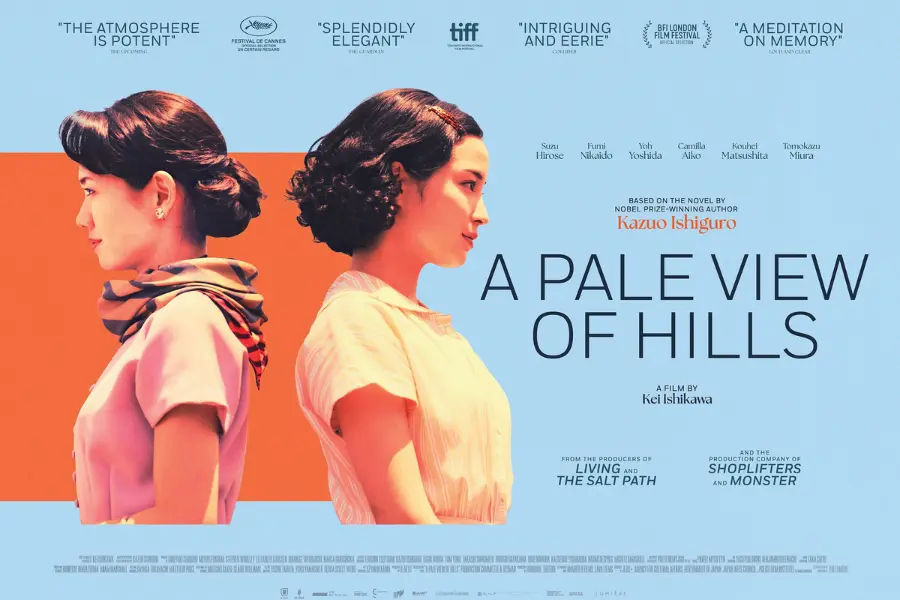
Memory is slippery in A Pale View of Hills, and Kei Ishikawa turns that uncertainty into the film’s greatest strength. Moving between post-war Nagasaki and 1980s England, this adaptation of Kazuo Ishiguro’s debut novel is less interested in tidy answers than in the emotional damage people carry across countries and family lines. Through a nonlinear storytelling, A Pale View of Hills gives a visceral portrayal of post-war grief, familial guilt, and how these never truly leave a person. It’s a film that lingers long after it ends, rewarding viewers who enjoy reflective storytelling and subtle emotional reveals.
What A Pale View of Hills is about (Spoiler-free)

A Pale View of Hills follows the story of Etsuko, a widow who lived through post-war Nagasaki in 1952, as she recalls her past while living through 1980s England with her daughter, Niki. Her recollections of the past are peppered by memories of her friendship with a mysterious woman, Sachiko, who was navigating life at the time with her young daughter. She constantly positions herself vis-a-vis Sachiko, noting how they are very different from each other.
Memory is a central theme in this film. We see this through alternating between two timelines: each with very different visual presentations. We also see this through the influences these memories have over Etsuko’s present life, despite time and geographic distance. It is also these very memories that continue to influence the characters’, especially Etsuko’s, way of life.
A Pale View of Hills is a confrontation of the past and a grappling with the present. But this isn’t presented in a confrontational way. In fact, it’s the opposite. The film is calm and picturesque, albeit intentionally confusing.
Why the dual timeline works

Two very distinct visual styles are present in the film. 1952 Nagasaki is colour-graded to be much warmer, while resembling an idyllic past. In Nagasaki, everything is dreamlike and calm, concealing truths of the time in plain sight. In contrast, 1980s England is presented to be much cooler and harsher, which lends to the grounding of the characters in their present realities. Here, England is an after-effect of everything that was. The way it is framed in the film carries a form of emotional fatigue that permeates through the screen.

This contrast is important because they are used to evoke the same emotions the characters go through from the viewer. It mimics the abrupt switching of emotions that Etsuko goes through as she tells the story of her past.
The film’s use of colour and visual techniques is also a tool for omission, yet another way the film presents the story. For instance, Nagasaki’s warm and dreamlike colouring masks the grisly realities behind truly living in that past. Throughout the film, Etsuko also turns out to be quite unreliable in her recollections of this same past.


The themes that stay with you (Start of spoilers)
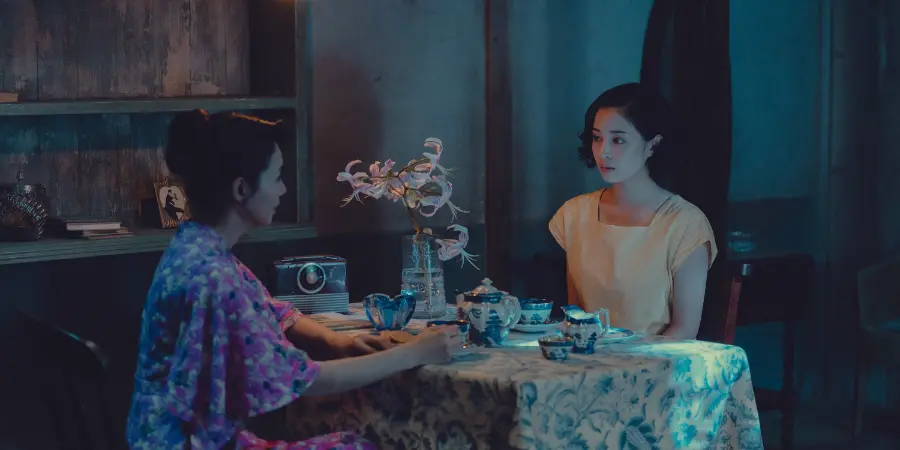
A Pale View of Hills is memorable not only in its visual storytelling, but also through what it leaves to its viewers.
Post-war grief that lingers in ordinary life
One of the film’s most striking ideas is how the aftermath of war quietly seeps into everyday life. Although Nagasaki in 1952 is shown through warm, almost nostalgic visuals, the emotional reality beneath the surface is far more complicated. Conversations about rebuilding, career aspirations, and social expectations carry a subtle weight. No one explicitly talks about trauma, yet it is clearly present in the background of daily routines. Life continues—people marry, work, and socialise—but grief lingers quietly beneath these normal activities.
Cultural dislocation between Japan and England
The contrast between Etsuko’s past in Japan and her present life in England highlights a different kind of displacement. Her move abroad promises a new beginning, but the film implies that migration also creates emotional distance from one’s homeland, from family history, and sometimes from loved ones.
In England, Etsuko’s life appears stable and peaceful, yet the environment feels colder and more detached than her memories of Japan. The geographic shift emphasises the tension between past and present, suggesting that leaving one place does not necessarily mean escaping what happened there. Instead, the past travels with her, shaping how she understands both countries and her own identity.
Family relationships
Throughout the film, the most important relationships are defined by what remains unsaid. Conversations between Etsuko and her daughter Niki are calm and polite, yet they carry an undercurrent of unresolved grief. The absence of open emotional expression becomes a central part of how the characters relate to each other.
This quiet distance echoes in Etsuko’s memories as well. Her observations of Sachiko and Sachiko’s daughter, Mariko, mirror the emotional gaps between parents and children that the film repeatedly explores.
Etsuko’s fractured point of view

At the centre of the film is Etsuko’s perspective, which shapes how the audience experiences the story. Etsuko’s fractured point of view unfolds in fragments, creating a sense that something is concealed.
Part of this disjointed feeling comes from the way Etsuko recounts her past through Sachiko’s story. The events involving Sachiko and her daughter Mariko seem detailed and vivid, yet Etsuko often positions herself as a detached observer. This creates the impression that the memories are slightly displaced, as if they belong to someone else.
What makes Etsuko compelling is that she does not feel like a deliberately deceptive narrator. Instead, she seems almost unreliable, a character who may be subconsciously reshaping her memories in subtle ways to cope with regret. Her recollections feel sincere, but they are slightly rearranged. Like its visual presentation in the film, memory itself has softened or shifted certain details over time.
This ambiguity turns Etsuko into the emotional centre of the film. Her memories go beyond being a story about the past; they are an attempt to understand it.
What doesn’t fully land
While the film’s ambiguity is one of its defining qualities, it can also make the story quite difficult to follow at times. Because Etsuko’s recollections unfold in fragments, some transitions between events feel disorienting. The film’s commitment to ambiguity occasionally distances the audience from the emotional clarity it is trying to achieve.
But this isn’t necessarily entirely negative. For viewers who enjoy interpretive storytelling, this uncertainty can be rewarding.








Final Verdict
Ultimately, A Pale View of Hills is less a conventional drama than a meditation on memory and emotional inheritance. Director Kei Ishikawa approaches the story with restraint, allowing quiet performances and carefully composed imagery to carry much of the film’s emotional weight.
The result is a film that thrives in patience and reflection. It does not present a mystery that needs to be solved. Rather, it asks viewers to sit with uncertainty and consider how people reshape their past in order to live with it.
This makes the film especially well-suited for audiences who enjoy contemplative, character-driven stories. Fans of Kazuo Ishiguro will likely appreciate how faithfully the adaptation captures the tone and ambiguity of his writing. For viewers willing to engage with its subtle storytelling, A Pale View of Hills becomes a haunting exploration of memory, migration, and things left unsaid.
See A Pale View of Hills official trailer:
A Pale View of Hills premiers starting March 13 in cinemas nationwide in the UK. Visit the official site for more information.