In our last film review, we discussed the transcendent efforts of the late Akira Kurosawa to distinguish the intricacies of human fallibility in his seminal crime drama, Rashomon. Dissecting the film’s flurry of diverse character perspectives in order to explore the unreliability of human nature and how, as a prideful species, we conceal aspects of truth that might tarnish our self-perceived notions of grandeur and/or dignity. This week, however, we’re moving on to another of Kurosawa’s masterpieces, the highly-acclaimed and epochal action film, Seven Samurai (1954).
The Classic Journey of Seven Samurai

Seven Samurai (1954) Photo Credit: Original Film Art
The Plot
Arguably the most celebrated and influential piece in Kurosawa’s pioneering repertoire of film wonders, Seven Samurai is famously the film which inspired the likes of myriad western interpretations – i.e. the recent “Sanctuary” episode in Disney’s Star Wars spinoff, The Mandalorian (as well as the animated Clone Wars effort in the episode “Bounty Hunters”) and of course the film’s seminal 60s western remake, The Magnificent Seven, by John Sturges (adapted subsequently in Antoine Fuqua’s 2016 contemporary remake).
As a forebear to the aforementioned slew of western interpretations, it’s no wonder that Vox lauded the film as an elegant, primal cinematic template, where, although differing in location and character, the bare-bones remain intact: a group of villains intend on assaulting a small settlement; the inhabitants of said settlement hire a misfit company of warriors to fight them off; the warriors help fortify the town; some of them die but eventually the good guys win and the settlement is saved. Albeit with varying aspects in motive, plot, and character discrimination, the story is, essentially, always the same – proving time and time again the lingering effect of Kurosawa’s original film and the lasting impact of a tale as universal as it was formative on the world of cinema.

Filming of “The Seven Samurai” from Eiga no Tomo (December 1953) Photo Credit: Wikipedia
Kurosawa’s Seven Samurai begins with an overhead shot of a small village that has been repeatedly assailed by a large group of bandits. After overhearing a conversation between the bandits, an inhabitant farmer discovers that the bandits intend to come back and raid the poor village when the harvest is due, in order to make off with the largest possible bounty. The farmer then runs to tell of this news to the rest of the village, where – after discussing with the village elder and a fellow miller – they decide that enough is enough, and they should entail enlisting a group of samurai to defend them from the oncoming onslaught of bandits.
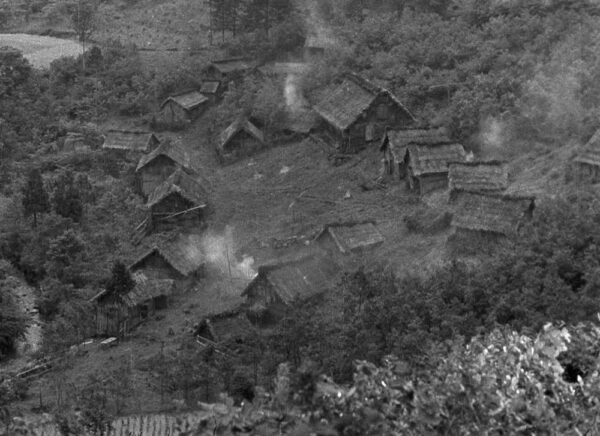
Village in Seven Samurai (1954) Photo Credit: Legendary Trips
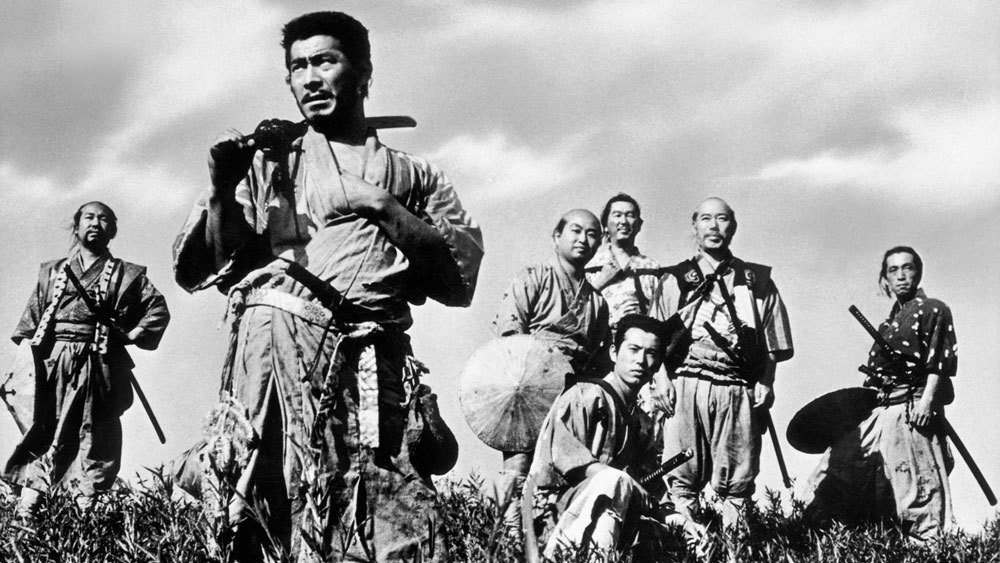
Thus ensues a tale of heroism, gallantry, and sacrifice as the villagers hire a ragtag crew of samurai warriors (some of whom aren’t officially even samurai) to pit and prepare the inhabitants against the villainous bandits. Fortifying the village, training its people, and proving the hailed earnestness – and great skill – of traditional samurai warriors.


The Samurai

The Seven Samurai Photo Credit: WordPress / Titan Passions
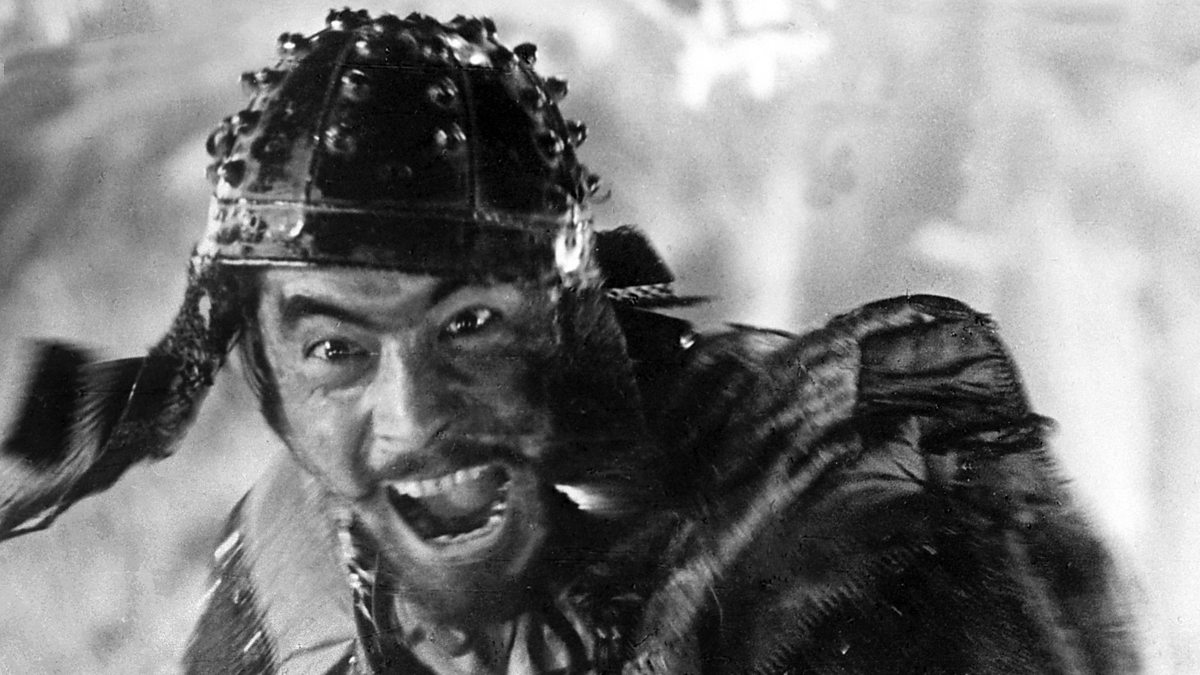
Although largely a grand epithet to the legendary valour of traditional Samurai, Kurosawa simultaneously interweaves an array of unexpected character motives that somewhat deconstruct the withstanding literary perception of the historical warriors. Breaching the otherwise famed notions of samurai – their empathy and skill – to employ more nuanced backgrounds to many of his earnest, and yet, broken heroes. For instance, the character of Kikuchiyo (played by Kurosawa’s go-to flawed hero, Toshiro Mifune) is somewhat of an unskilled, unproven, wannabe samurai, whose narrative orphanage is revealed to be the per result of samurai intervention – his parents, killed as a consequence of samurai raids on his own childhood home. Resulting in his carrying of a familial scroll which Kikuchiyo insists proves his samurai, though most likely was stolen as the scroll implies that the character is in fact only a teenager.
Kikuchiyo is plagued by the unjust notion that samurai are the prophetic warriors of legend and yet is belittled by them at every chance – driven away when he attempts to enlist with them and scolded when he discovers armour scavenged from dead samurai by the lowly villagers. His inclusion within the tale begs the question: are samurai truly heroic? Or rather simply harbingers of death and destruction, only hailed as earnest and good when their master’s intent presumes so.

Toshiro Mifune as Kikuchiyo Photo Credit: BBC UK
Moreover, the end of the film chiefly distorts the heroic nature of the samurai. Our central samurai, Kambei (portrayed soulfully by Takashi Shimura) regrets his survival on the battlefield of the village, claiming pensively that “[we’ve] lost yet again. With their land, the farmers are the victors… not us”. Suggesting thus his acknowledgment that samurai are but weapons in the confines of war and battle, led dutifully to exact some form of justice which, in reality, proves neither their heroism nor their earnestness. It simply makes them pawns in a never-ending struggle for dominance. These samurai, as is true in history, are neither honourable, nor heroic – they are simply permitted by the whims of their masters (in this case, the villagers) to cause more death and destruction. And, although it may seem just and righteous, most of them are only enlisting for a scrap of food and to prove their worth as these legendary soldiers. After Kambei’s iconic final line (mentioned above) the film appropriately closes on the graves of the four warriors who’ve died in the protection of the village – suggesting that, as is the reality of the acclaimed fighters, the masters are the winners, not the samurai.
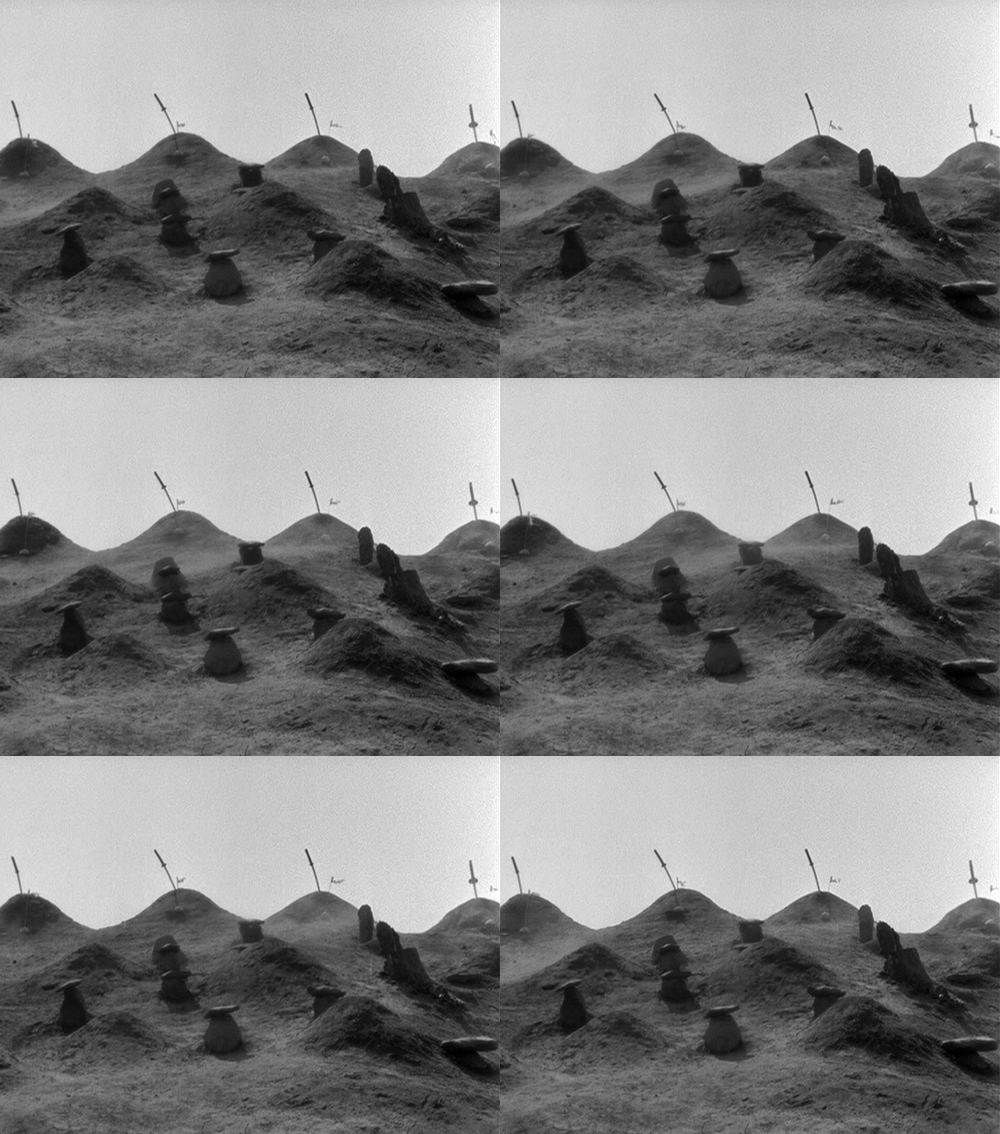
Graves of the Samurai
The Women
Seven Samurai is usually described as a film about men, and in screen time that is fair enough. The anthropologist D. P. Martinez makes the case that the women set almost everything in the plot moving anyway, and once the film has been watched that way it is difficult to unsee.
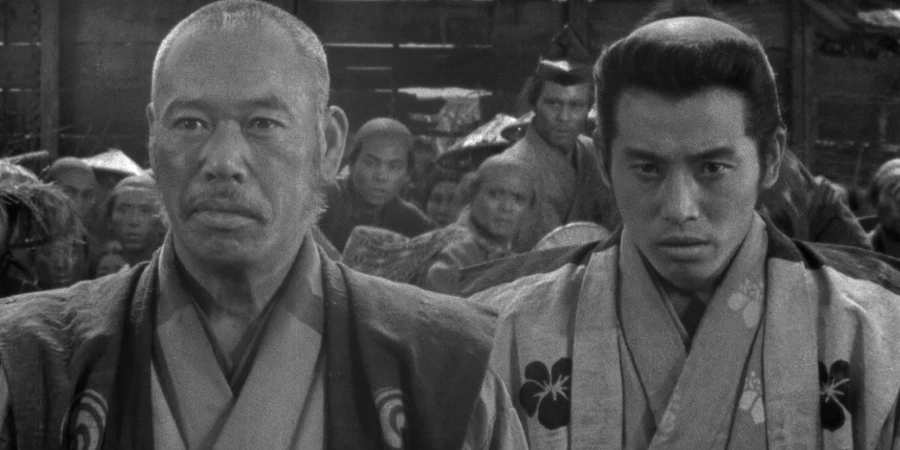
Start with Shino, daughter of the farmer Manzo. The moment the village decides to hire samurai, Manzo takes a blade to his daughter’s hair to disguise her as a boy so that she will not go near them, and beats her while he does it. The other villagers tell him he is being absurd, then quietly hide all their own young women. Shino’s answer is to keep the disguise on and go wandering in the woods, where she meets Katsushiro, the youngest of the seven, and begins something she knows can never end in marriage.
Then there is Rikichi’s wife, who appears in a single scene. When four of the defenders ride out to burn the bandits’ lodge, a woman inside wakes, notices the fire, looks at her sleeping captors and does nothing at all. She walks out of the burning building without hurrying. Rikichi runs to her, she backs away from him, and she goes back into the fire.
Most English-speaking viewers read that as shame. Martinez argues it is something quite different, and that the reason we miss it is a subtitle.
Late on, Manzo is raging about Katsushiro having taken his daughter, and Rikichi rounds on him. The standard English subtitle gives the line as “At least she was taken by a samurai, not a bandit!” What Rikichi actually says runs closer to this: they like each other, so let it alone, this is nothing like handing a girl over to the bandits.
That handing over is not hypothetical. Rikichi’s wife was the bargain the village struck with the bandits, and the bargain failed, because the bandits came back regardless.
It reframes the film. It explains why the village is so frightened for its daughters, why the men are so paralysed until their own women shame them into moving, and why the old woman is berating them in the opening scenes. Martinez reads Rikichi’s wife walking back into the fire as revenge on the people who gave her away.
Kurosawa played down his interest in women, and in his own account of his life presented himself as a man who never much understood them. His films keep suggesting otherwise.
The Guns
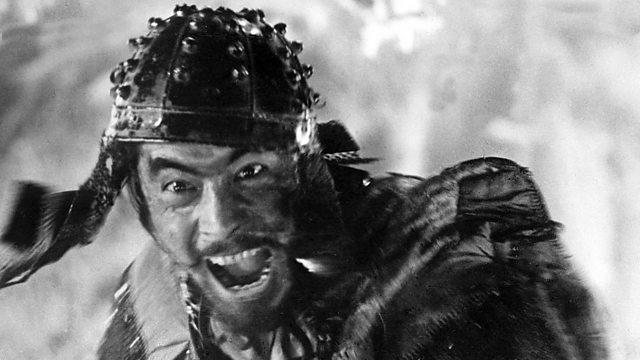
The film never states its bleakest argument out loud. It stages it instead. Not one of the four samurai who die is killed by a sword.
Heihachi is shot as he tries to stop Rikichi following his wife into a burning building. Gorobei is found dead after gunfire during the siege. Kyuzo, the finest swordsman of the group and the one man whose skill is never in question, is shot by the bandit chief. Kikuchiyo is shot by that same chief and kills him before falling. Four deaths, four bullets, and not a duel among them.
The bandits carry three matchlock muskets between them, and a striking amount of the defence is organised around taking those three weapons out of play. Firearms had reached Japan in 1543, when a Portuguese ship was driven ashore at Tanegashima, and Japanese smiths were copying the design within a generation. By 1586, where the film is set, the gun had already started to make a swordsman’s lifetime of training beside the point. An untrained man behind a fence could kill the best blade in the province, and no amount of practice answered that.
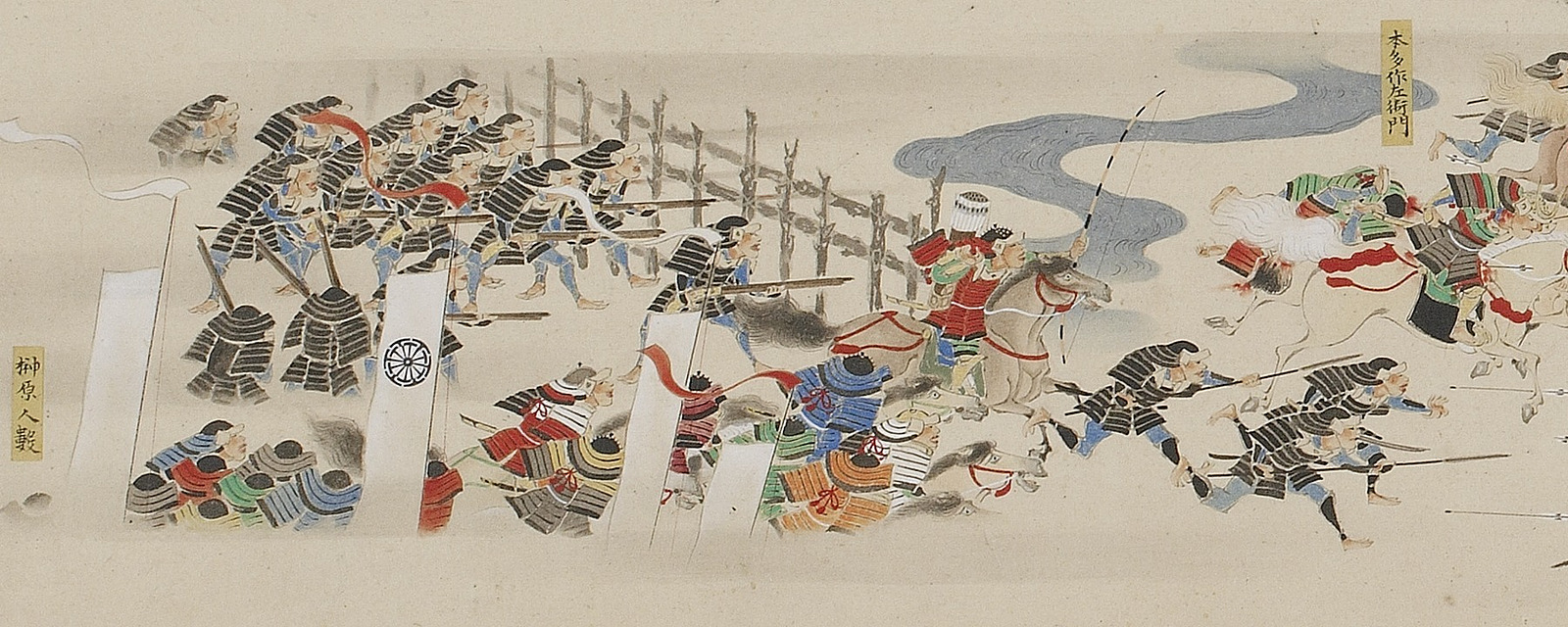
Read that way, Kambei’s closing line stops sounding like modesty. The farmers have won because the future belongs to numbers, powder and land rather than to the individual warrior. Kurosawa returned to the same idea at far greater scale in Kagemusha, where massed matchlock fire destroys the Takeda cavalry and the camera settles on the aftermath rather than the volley.
The banner makes the same point in miniature. Heihachi paints six circles for the six samurai, a triangle for Kikuchiyo, who belongs fully to neither group, and beneath them the character standing for the village and its fields. Kikuchiyo raises it at Heihachi’s funeral. By the closing scene most of the men the circles represent are dead, and the fields are still there. Stephen Prince reads the flag as a picture of new relations between warrior and farmer that ends up revealing which of the two is permanent.








The Technique
Working closely with cinematographer, Asakazu Nakai, Kurosawa made sure to give each and every shot of the film displayed a technical mastery that matched the thematic density of the genius screenplay. Dispersing heroic characters in equal fashion, framed in deep-focus compositions that juxtapose sound and image; utilising Nakai’s pioneering mirror technique (used prior on Rashomon) to reflect the sun’s natural rays into strong beams of heavenly light; illuminating the sets, the locations, and the actors with an ethereal and crisp aesthetic. With Seven Samurai, Kurosawa perfected his sharp and dynamic style of filmmaking by utilising experts from across the filmic spectrum (Nakai, composer Fumio Hayasaka and actors Mifune and Shimura, among others) to create a profound examination of moral issues in a story epic in nature and mindful in approach.

Toshiro Mifune and Akira Kurosawa on the set of “Seven Samurai” Photo Credit: NPR
By Kurosawa’s own account, Seven Samurai was the film on which he began running three or more cameras at once, positioned at different distances and angles and rolling simultaneously. The stated reason was performance rather than coverage. Actors who know where the camera is will play to it, and Kurosawa wanted them unable to tell. The method also handed the cutting room several simultaneous views of the same moment, which is why a muddy and largely unrepeatable battle cuts together with a continuity that single camera coverage could never have delivered.
The second tool is the telephoto lens. Stephen Prince traces its first serious compositional use in Kurosawa to Stray Dog in 1949, and by Seven Samurai it is doing something more aggressive. Long lenses flatten distance, so a charging horse or a running man seems to arrive in the audience’s lap without ever appearing to cross the ground in between. The battle is not staged at a comfortable remove. It is compressed until it is on top of the viewer.
The final battle is then fought in torrential rain, and the choice is structural rather than atmospheric. Mud levels everyone standing in it. Armour, rank and technique stop being legible once every body in the frame is the same colour, and Mitsuhiro Yoshimoto has described the sequence as one in which samurai and farmers are fighting the mud itself rather than performing the choreographed swordplay the genre had trained its audience to expect. Prince reads the resulting classlessness as a vision of horror rather than an achievement. The film finally gets the equality it has argued towards for three hours, and it arrives as filth, exhaustion and drowning.
The monumental impact of Kurosawa’s Seven Samurai lingers far beyond the reach of its successors and arguably beyond the reach of the director’s exceedingly powerful body of work. Proving, immeasurably, his ability to create works of jidaigeki (“period drama”) that transcend setting and resonate globally.
Lauded as one of the greatest films of all time and largely seen as Kurosawa’s opus, Seven Samurai, earning two Oscar nominations at the 1957 Academy Awards, was a seminal influence on a slew of referential works from the 20th Century, inspiring an array of iconic filmmakers (such as George Lucas and Quentin Tarantino). As affirmed by the late, great film critic, Roger Ebert, “Akira Kurosawa’s “Seven Samurai” is not only a great film in its own right, but the source of a genre that would flow through the rest of the century”.

Emitting a thematic resonance which continues to flow into the 21st Century, seemingly unceasing in its impact and affect, Seven Samurai remains a masterwork of technique, skill, vision and artistry. It’s Kurosawa at his best, and that’s no small feat.
Watch Akira Kurosawa’s Seven Samurai now on the BFI Player.
References:
D. P. Martinez, “Seven Samurai and Six Women: Kurosawa Akira’s Seven Samurai”, in Alastair Phillips and Julian Stringer (eds), “Japanese Cinema: Texts and Contexts”, Routledge, 2007.