In the current landscape of media criticism, the phrase “is a love letter to” has been used so much that it has become almost parodic. It is, to its credit, a great sentence: it immediately establishes an anchor point from which a film can be analyzed. However, the phrase is also vague enough to make it all-encompassing: anything can be a love letter to something if you squint hard enough. Therefore, it’s the critic’s job to provide a compelling argument for their case, and this is where the results may vary. Maybe you came out of the theater thinking they were right; maybe you watched the movie and felt misled. So when various outlets started calling Hikari’s (Mitsuyo Miyazaki, 宮崎 光代) newest film, Rental Family (2025), a love letter to Japan, we were as excited as we were skeptical.
After watching the film, however, we’re convinced Rental Family is not merely a love letter to Japan, but a continuous exercise in loving it. Hikari makes the case that, although flawed and incomprehensible to some, Japan has a culture worth exploring, understanding, and embracing. It is a place that, for all its downsides (and, to a point, because of them), is able to make creativity flourish and forge completely unique human relationships. The end result is messy and convoluted, but also heartwarming, tender, and deeply human.
To see how Rental Family is able to achieve this, we first need to look at the story it wants to tell.
Inside the World of Rental Family
What Rental Family Is Doing
In order to understand the message Hikari is sending with Rental Family, we must get a grasp of what the story is about. And, crucially, also what it isn’t.
The Plot of Rental Family
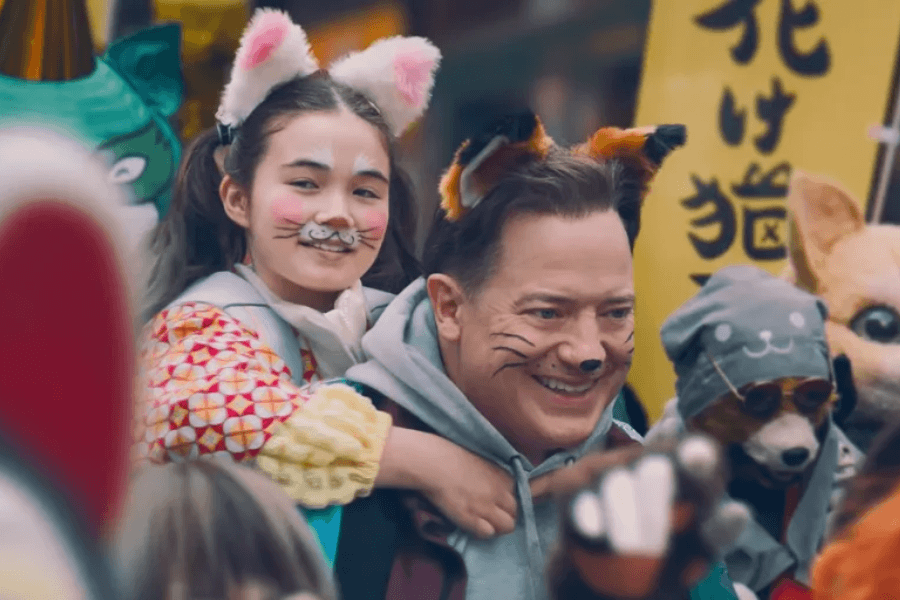
Without getting into spoilers, in the film we follow Philip Vanderploeg (played by Brendan Fraser), an American actor who’s been living in Japan for almost seven years. After a successful toothpaste commercial, he’s been struggling to find work, which has put him in a very precarious situation. On one hand, he is willing to take whatever job he can find; on the other, he is eager for roles with deeper meaning. In this position he meets Shinji (played by Takehiro Hira, 平 岳大), who offers him a role in his company, Rental Family.
What’s the job? To sell emotion, Shinji proudly declares. Or, to be specific, play characters in real people’s lives: a husband, a father, a best friend, etc. While reluctant at first, Philip ends up becoming part of the Rental Family crew, where he is tasked with playing various roles that require “a token white guy.” Most of these are shown in montage form, but two end up becoming the emotional core of the film. The first is as a father to a young girl, Mia (played by Shannon Gorman), and the second is as a journalist writing the memoirs of a long-forgotten actor of the Japanese Cinema Golden Age, Kikou (played by Akira Emoto, 柄本 明).
As one might’ve guessed, Philip develops genuine bonds with the people whose lives he temporarily steps into. This drives the conflict of the film, and Hikari manages to direct it in a fantastic way. Rather than hinge on the aspect of lies, declaring the rental system fundamentally flawed, the film argues that truth can be, and often is, found in fiction. Consequently, it focuses on the relationships this system can create: imperfect, yet beautiful.
But to understand Hikari’s intent more clearly, we could contrast her approach with films that treat the same subject from a different angle.


What Hikari Does Differently
Cinephiles might be aware this isn’t the first time a film has used the Japanese rental family service as the basis for its premise. Perhaps the most well-known example is by none other than legendary German filmmaker Werner Herzog, who used it for his 2019 film, Family Romance, LLC.
A fantastic film in its own right, Family Romance, LLC uses a documentary style to tell the fictional story of an actor hired to play the father of a young girl. As the film progresses, we see the girl is slowly getting attached to her fictional father, while he struggles to keep the distance his work requires. The film, in fact, ends up with the man staging his own funeral in order to get out of the situation and continue with his work in the rental family service. Ultimately, Herzog argues that, while fiction can provide comfort, it’s not necessarily harmless.
This, to be clear, is a valid perspective, and Werner Herzog did a fantastic job portraying it on the silver screen. However, it is by no means what Hikari was going for. She is doing something much more challenging: presenting a system Western audiences already consider alien and arguing for its occasional beauty.
With Rental Family, Hikari aims to present the rental service honestly, with ups and downs, and makes the bold decision to treat it as analogous to understanding Japanese culture. She chose a premise most directors would see as prime material for a drama, and present it in a comedic, lighthearted way, because in its essence she found a way of speaking about Japan itself. Now, let’s examine how she does it.
A Matter of Perspective

One of the main themes of Rental Family has to do with the idea of perspective. Whether fiction can become reality (or whether reality can slip into fiction) depends on who’s looking, why, and for how long. Moreover, the film uses elements of filmmaking itself, such as shot composition and, as alluded to earlier, the montage, to make different perspectives stand out and complement one another. Through this, Rental Family finds the points of view that broaden its statement and deepen its understanding of the mechanisms that allow the premise it’s based on to exist.
It’s not just about the rental family service, but about how that system reflects Japan’s shortcomings and the creative ways people adapt to them.
The Outsider Perspective

At first glance, the inclusion of an American actor such as Brendan Fraser might appear purely strategic: a recognizable face meant to attract general audiences. However, Rental Family immediately establishes his role as an outsider to broaden the scope of its themes. Philip Vanderploeg, despite living in Japan for seven years, is still unable to grasp many of the things the country has to offer, with the rental family system being one of many examples. In fact, one of the most iconic lines in the film is “you could live in this country for a hundred years and there will still be things you won’t understand.”
Fraser’s performance is endearing in this regard, portraying Philip as an awkward, well-meaning, and sensible person, whose narrow mindset prevents him from seeing the bigger picture. When first presented the rental family service, for example, he suggests everyone involved should go to therapy. The film then highlights that, while he is not wrong, mental health is stigmatized in Japan, and social norms make it difficult to access support. The rental service is, therefore, a solution born out of that situation. And if Philip doesn’t engage with it, he’ll never understand why people actually care about it.
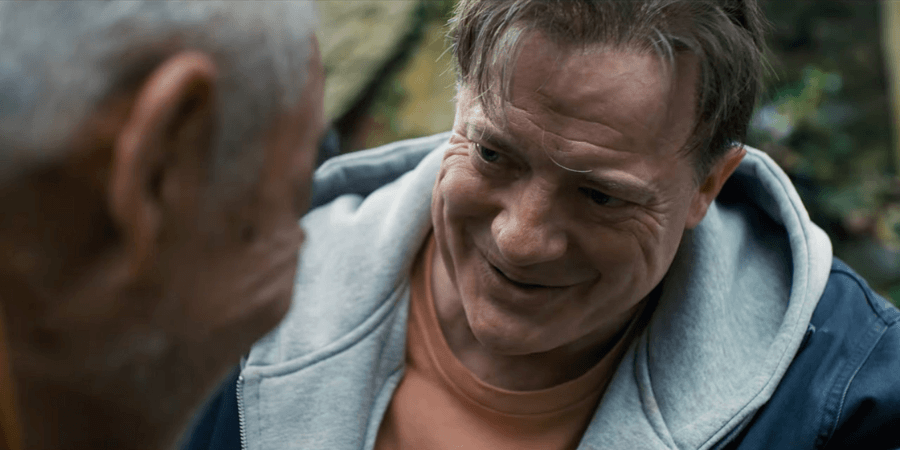
As the film progresses, we see how understanding the rental family system deepens Philip’s understanding of Japanese society. There are, of course, people who exploit the system, such as the adulterers who hire actors for “apology services.” But there are also people who engage in the tacit understanding that this is fiction, and use it as an exercise in becoming healthier, well-adjusted, and socially active citizens. This is expertly shown in Fraser’s performance, with facial expressions that show him quietly battling with Japan’s contradictions and subtle beauties. And we, as audience members, most likely also outsiders, come to understand Japan alongside him.
The Cinematography of Rental Family
The theme of perspective is one that doesn’t remain only at the script level, it’s carried through the film’s cinematography. This is especially noticeable with the use of pillow shots, a technique pioneered by one of Japan’s greatest directors, Yasujiro Ozu (Director of Tokyo Story). For the uninitiated, pillow shots are still and calm shots of landscapes, rooms, or everyday objects that serve as reflective pauses between scenes. While they can be used to lazily extend a film’s runtime, great films use them to echo or contrast a story’s themes. This is, of course, the case with many of Ozu’s films, and it’s also true with Rental Family.
Hikari uses the meditative nature of pillow shots to contrast with Philip’s reflections on his role as a rental actor. Moreover, the still shots of Japan establish a clear connection in the audience’s minds: Philip’s thoughts extend beyond his job; they reflect his feeling of the country as a whole.
Following that thread, the calm shots are often contrasted with exhilarating montages of Japanese life: crowded streets, subways, and bars. These montages don’t just show Japan; they show Philip’s contradictory feelings: for every beautiful scene of people playing in a park, there’s a shot of an overworked salaryman sleeping on the metro.
The film’s cinematography, in short, thrives in contrast, the same one that makes Philip’s reflections nuanced and intriguing. And just like before, we audience members are able to understand that through the visual cues. In doing so, Rental Family guides our emotions through Philip’s overloads and moments of calm, letting us feel Japan as he does: messy, loud, overwhelming, but also beautiful, resilient, and full of potential.








The Argument Some Viewers Won’t Buy

As stated earlier, Hikari is doing something very difficult in defending the occasional beauty of the rental family service, especially for a western audience. Her argument, as a whole, hinges on the idea that the system is not fundamentally bad, and this is something some critics will undoubtedly be skeptical of.
If a media critic approaches Hikari’s statement with negative preconceptions about the rental family service, the film could be read as manipulative: a way of sanitizing a concept that we should all be highly critical of. This criticism can then extend to the cinematic techniques the film uses, not doubting their effectiveness, on the contrary, highlighting that their proper execution can be of service to its manipulative message.
That said, this is, like the film itself, a matter of perspective. As far as Hikari is concerned, she is within her right to artistically explore a concept such as this and add her point of view. Moreover, Rental Family doesn’t exist in a vacuum. Other films critical of the rental family service, like Herzog’s Family Romance, LLC, do exist, so audience members can reach their own conclusions regarding the topic.
Hikari, if anything, contributes her honest perspective to an ongoing conversation. That openness makes her vulnerable to criticism, but it also reveals bravery and commitment to her artistic integrity. Recognizing that and remaining thoughtful, critical observers of the media we consume, is how art continues to progress.
Who Will Love it (And Who Might Not)

If you’re looking for a lighthearted, character-driven comedy-drama that uses its premise to explore Japanese society, Rental Family will likely be your kind of film. With its use of montage and pillow shots, the film leans into the small moments, offering gentle, comforting scenes rather than sustained tension. Moreover, if you enjoy stories where found families and unlikely connections slowly reshape a character’s inner world, Hikari’s approach should resonate.
On the other hand, you might want to avoid Rental Family if you’re looking for a tight, plot-driven narrative. Its reliance on awkward humour may feel too gentle for viewers who expect a more severe treatment of the subject matter. Additionally, if you want the film to take a clear moral stance and outright condemn the rental family system, its more ambivalent, exploratory approach may prove frustrating.
Final Words

Hikari’s Rental Family is, overall, a remarkable film that takes a unique, highly debated premise, and uses it to make a broader statement about understanding and loving Japan. With great cinematography, performances, and heartwarming scenes, audience members of all ages will come out with something to appreciate about the film. That said, those who already have a basic understanding of Japanese culture and are looking to broaden it will get the most out of it.
As for us, Japanese culture lovers, Rental Family feels like a love letter to Japan in the best way imaginable: honest, thoughtful, and not blind to the country’s flaws. Through this, the film uniquely positions itself to celebrate the people who make the country possible, those who endure its shortcomings and are able to find happiness where others can’t. And that’s a statement we not only agree with, but wholeheartedly celebrate.