Yasujiro Ozu (1903 to 1963) was a Japanese director who made 54 films, almost all of them about ordinary families, and Tokyo Story (1953) is the one to start with. His films are known for a camera placed low, close to the eye line of someone kneeling on a tatami mat, and for quiet cutaways to empty rooms and washing lines between scenes. In the UK, 15 of his films stream on BFI Player’s subscription service, including Tokyo Story and Late Spring.
| Born | 12 December 1903, Fukagawa, Tokyo |
| Died | 12 December 1963, his 60th birthday, of throat cancer |
| Films | 54 as director, 1927 to 1962; 17 silent films are lost |
| Studio | Shochiku for almost his whole career |
| Best known for | Late Spring (1949), Tokyo Story (1953), An Autumn Afternoon (1962) |
| Sight and Sound 2022 | Tokyo Story 4th in both the critics’ and the directors’ polls |
| Watch in the UK | BFI Player: 15 films on subscription, 11 more to rent (checked 31 October 2026) |
Who Yasujiro Ozu was
Ozu was born in Fukagawa, in eastern Tokyo, the second son of a fertiliser merchant. At nine he was sent with his siblings to his father’s home town of Matsusaka in Mie Prefecture, where he skipped school to watch American films and decided, after seeing Civilization in 1917, that he wanted to direct. He failed university entrance exams, worked for a year as a substitute teacher in the mountains of Mie, and joined the Shochiku studio as a camera assistant on 1 August 1923.
Yasujiro Ozu's Films, Style and Life in Brief
His first film as director, Sword of Penitence (1927), was a period drama, the only one he made, and it is lost. It was written with Kogo Noda, who would co-write with him for the rest of his career. Through the late 1920s and early 1930s he turned out short comedies about students and office workers, and in 1932 I Was Born, But…, a comedy about two boys who discover their father bows to his boss, was named the year’s best Japanese film by Kinema Junpo.
The war took him away twice. He was conscripted in 1937 and spent two years with an infantry unit in China, then was sent to Singapore in 1943 to make a propaganda documentary. He spent most of that posting reading and watching American films, and at the surrender he destroyed the script and footage. He returned to Japan in February 1946 and to the Shochiku studio at Ofuna.
The films he made after the war are the ones the world knows. He never married, lived with his mother until her death in 1961, and wrote his scripts with Noda over many bottles of sake, first at the Chigasakikan inn and later at a mountain house in Tateshina. He died on his 60th birthday in 1963. He also looked out for younger directors: in 1943 he helped talk the wartime censors into passing Akira Kurosawa’s first film, Sanshiro Sugata.
Most of his films are shomin-geki, the Japanese term for dramas about the everyday lives of ordinary working and middle class families. In a 2017 study, Erin Schoneveld of Haverford College notes how he kept returning to the same events: a daughter’s marriage, a parent’s death, and the distance that grows between the generation raised before the war and the one that came after it.

The Ozu style: the tatami shot, pillow shots and no fades
Ozu’s films look like nobody else’s, and once you know what to watch for, you see it in every scene. The film scholar David Bordwell, in his book Ozu and the Poetics of Cinema (1988), put it this way: the style looks plain at first and turns out to be very strange on a closer look, yet it never makes the story hard to follow.
The low camera
Ozu set his camera low, roughly at the eye level of someone kneeling on a tatami mat, which is why it is often called the tatami shot. In practice it was often lower still, which meant special tripods and raised sets, and he kept that height even in corridors where nobody sits. His first film with the low position was Body Beautiful in 1928, now lost. Throughout his career he used a 50mm lens, the focal length closest to normal human vision, and in his colour films he stopped using tracking shots altogether.
Actors who speak to the lens
Most films shoot a conversation over each actor’s shoulder. Ozu filmed people almost head on, so they seem to talk straight to you. He also ignored the convention that two speakers’ eyelines must match. Roger Ebert recounted that when an assistant suggested shooting a scene both ways, Ozu agreed, compared the results and said there was no difference. The 180 degree rule, the convention that keeps the camera on one side of a conversation, meant as little to him. Ozu moved his camera all the way round a room, which is why critics describe his staging as 360 degree space.
Pillow shots
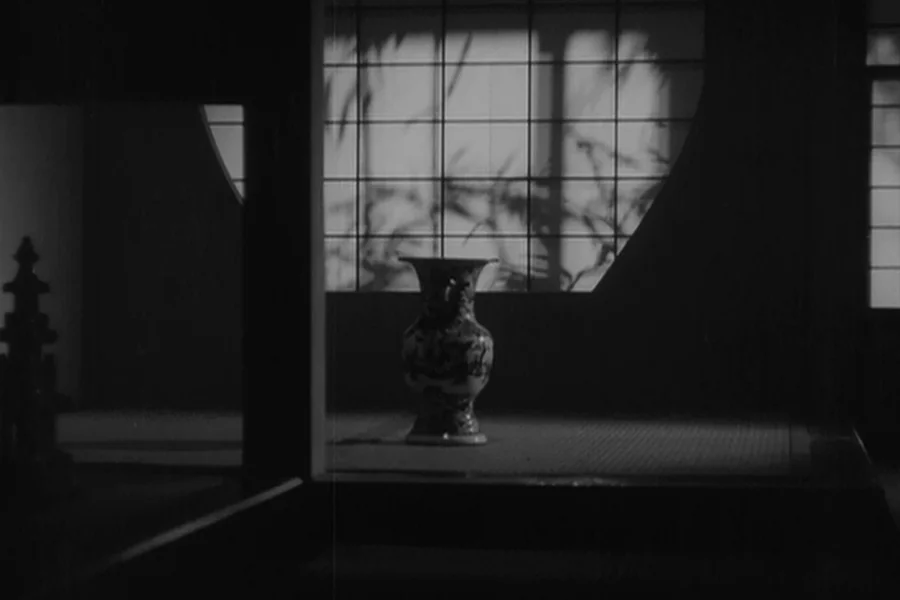
Between scenes, Ozu cut to brief shots of things: a vase, a row of washing, a factory chimney, an empty room. The critic Noel Burch called these pillow shots, after the pillow words of classical Japanese poetry, short phrases that sit beside a line and colour what follows. The most discussed is the vase above, from Late Spring, which appears near the film’s heartbreaking climax as a daughter lies awake on the last trip she will take with her father.
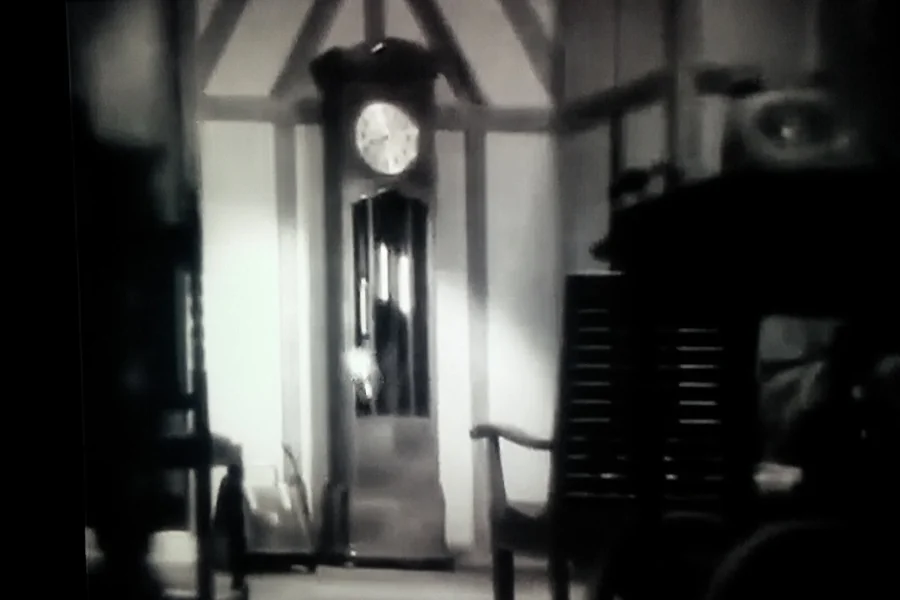
The habit goes back to his silent films. The clock above is from A Mother Should Be Loved (1934), one of his silent dramas that survives only in incomplete form.
Cuts, never fades
Ozu moved between scenes with straight cuts and those still shots of objects. He left the fades and dissolves of other directors’ films alone. Music usually played only across those transitions. He also left big events off screen: in An Autumn Afternoon, the daughter’s wedding is never shown, only the evening after it. There is more on the stillness and silence in his films in our feature on Noh’s presence in Japanese cinema.
Tokyo Story and the Noriko trilogy

Between 1949 and 1953 Ozu made three films in which Setsuko Hara plays a young woman called Noriko. The three stories are separate, and Noriko is a different person in each. Together they are known as the Noriko trilogy.
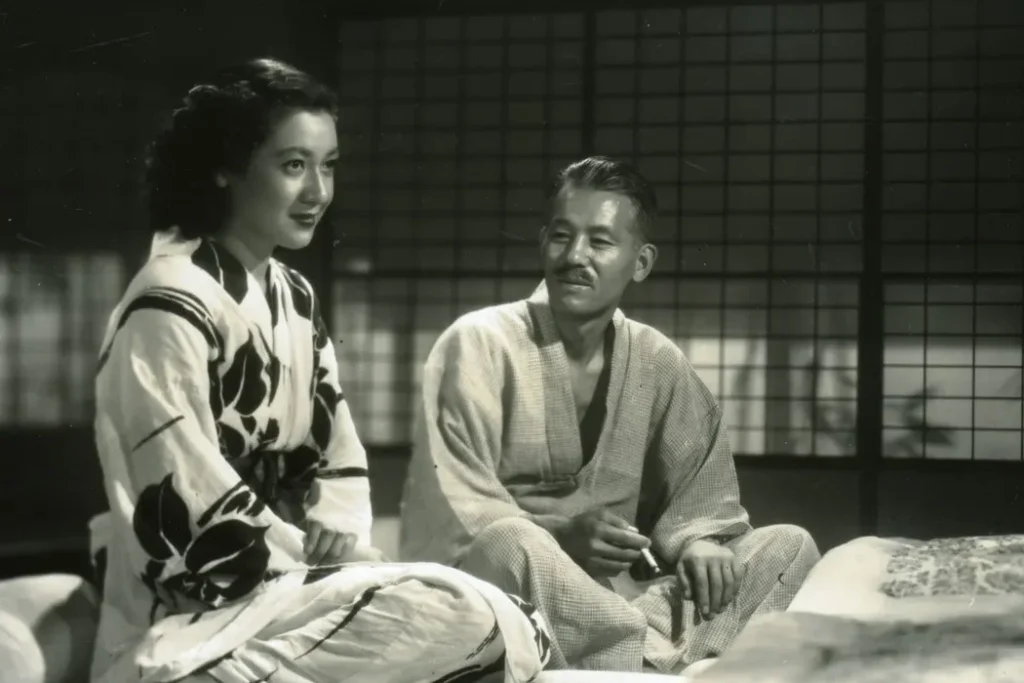
In Late Spring (1949), Noriko lives contentedly with her widowed father, played by Chishu Ryu, until her family decides she must marry. It was Ozu’s first film with Hara and placed joint 21st in the 2022 Sight and Sound critics’ poll. In Early Summer (1951), a different Noriko makes her own choice of husband and surprises everyone.
Tokyo Story (1953) follows an elderly couple from Onomichi who travel to Tokyo to see their grown children, who are too busy for them. Only their widowed daughter in law, Noriko, makes time. In 1958 it won the Sutherland Trophy at the London Film Festival, the start of its fame in the West. In the 2012 Sight and Sound poll, directors voted it the greatest film ever made, and in 2022 it was fourth in both polls. Our Tokyo Story review goes through the dialogue and the cinematography scene by scene.
The colour films, from Equinox Flower to An Autumn Afternoon
Ozu’s first colour film was Equinox Flower (1958). He chose the German Agfacolor process because he felt it rendered reds better than any other. The colour films are among his most relaxed and funny.
Good Morning (1959) remakes his silent I Was Born, But… as a comedy about two brothers who go on strike, refusing to speak until their parents buy a television. Floating Weeds (1959) remakes his 1934 A Story of Floating Weeds about a travelling theatre troupe, and was made away from Shochiku, at Daiei, with Kazuo Miyagawa, the cameraman who shot Rashomon. Late Autumn (1960) gives Setsuko Hara the mother’s role, and The End of Summer (1961) was her last film with him. His final film, An Autumn Afternoon (1962), returns to a father, played by Chishu Ryu, preparing to let his daughter go.


Every Yasujiro Ozu film in order
Ozu directed 54 films. The 17 marked lost survive in no form. “Subscription” and “rental” refer to BFI Player in the UK, checked on 31 October 2026.
| Year | English title | Japanese title | Notes and UK availability |
|---|---|---|---|
| 1927 | Sword of Penitence | 懺悔の刃 | Lost. His only period film |
| 1928 | Dreams of Youth | 若人の夢 | Lost |
| 1928 | Wife Lost | 女房紛失 | Lost |
| 1928 | Pumpkin | カボチャ | Lost |
| 1928 | A Couple on the Move | 引越し夫婦 | Lost |
| 1928 | Body Beautiful | 肉体美 | Lost. First use of the low camera |
| 1929 | Treasure Mountain | 宝の山 | Lost |
| 1929 | Days of Youth | 学生ロマンス 若き日 | His earliest surviving film. Rental |
| 1929 | Fighting Friends Japanese Style | 和製喧嘩友達 | 14 minutes survive |
| 1929 | I Graduated, But… | 大学は出たけれど | 10 minutes survive |
| 1929 | The Life of an Office Worker | 会社員生活 | Lost |
| 1929 | A Straightforward Boy | 突貫小僧 | Short film |
| 1930 | An Introduction to Marriage | 結婚学入門 | Lost |
| 1930 | Walk Cheerfully | 朗かに歩め | Rental |
| 1930 | I Flunked, But… | 落第はしたけれど | Subscription |
| 1930 | That Night’s Wife | その夜の妻 | Rental |
| 1930 | The Revengeful Spirit of Eros | エロ神の怨霊 | Lost |
| 1930 | The Luck Which Touched the Leg | 足に触った幸運 | Lost |
| 1930 | Young Miss | お嬢さん | Lost |
| 1931 | The Lady and the Beard | 淑女と髯 | Rental |
| 1931 | Beauty’s Sorrows | 美人哀愁 | Lost |
| 1931 | Tokyo Chorus | 東京の合唱 | Silent drama about a salaryman who loses his job |
| 1932 | Spring Comes from the Ladies | 春は御婦人から | Lost |
| 1932 | I Was Born, But… | 大人の見る繪本 生れてはみたけれど | Kinema Junpo best film of 1932. Subscription |
| 1932 | Where Now Are the Dreams of Youth? | 靑春の夢いまいづこ | Subscription |
| 1932 | Until the Day We Meet Again | また逢ふ日まで | Lost |
| 1933 | Woman of Tokyo | 東京の女 | Subscription |
| 1933 | Dragnet Girl | 非常線の女 | His gangster film. Subscription |
| 1933 | Passing Fancy | 出来ごころ | Kinema Junpo best film of 1933 |
| 1934 | A Mother Should Be Loved | 母を恋はずや | Incomplete. Rental |
| 1934 | A Story of Floating Weeds | 浮草物語 | Kinema Junpo best film of 1934 |
| 1935 | An Innocent Maid | 箱入娘 | Lost |
| 1935 | An Inn in Tokyo | 東京の宿 | Late silent drama |
| 1936 | College Is a Nice Place | 大学よいとこ | Lost |
| 1936 | Lion in the Mirror | 菊五郎の鏡獅子 | Short documentary of a kabuki dance |
| 1936 | The Only Son | 一人息子 | His first sound film. Rental |
| 1937 | What Did the Lady Forget? | 淑女は何を忘れたか | Rental |
| 1941 | Brothers and Sisters of the Toda Family | 戸田家の兄妹 | Rental |
| 1942 | There Was a Father | 父ありき | Rental |
| 1947 | Record of a Tenement Gentleman | 長屋紳士録 | His first postwar film |
| 1948 | A Hen in the Wind | 風の中の牝鶏 | Subscription |
| 1949 | Late Spring | 晩春 | First film with Setsuko Hara. Subscription |
| 1950 | The Munekata Sisters | 宗方姉妹 | |
| 1951 | Early Summer | 麥秋 | Subscription |
| 1952 | The Flavour of Green Tea over Rice | お茶漬けの味 | From a 1939 script the censors blocked. Rental |
| 1953 | Tokyo Story | 東京物語 | Subscription and rental |
| 1956 | Early Spring | 早春 | Subscription |
| 1957 | Tokyo Twilight | 東京暮色 | Rental |
| 1958 | Equinox Flower | 彼岸花 | First colour film. Subscription |
| 1959 | Good Morning | お早よう | Remake of I Was Born, But… Subscription |
| 1959 | Floating Weeds | 浮草 | Remake of A Story of Floating Weeds. Subscription |
| 1960 | Late Autumn | 秋日和 | Subscription |
| 1961 | The End of Summer | 小早川家の秋 | Last film with Setsuko Hara |
| 1962 | An Autumn Afternoon | 秋刀魚の味 | His final film. Subscription |
Where to start with Ozu
These five work well in this order, and all of them stream on BFI Player.
- Tokyo Story (1953). The one everyone means. Two hours, and it rewards patience.
- Good Morning (1959). The lightest of his films, in colour, about two boys and a television. A good one to watch with family.
- Late Spring (1949). The first Noriko film, and the vase.
- Floating Weeds (1959). The only Ozu film shot by Kazuo Miyagawa, set in a small port town in summer.
- I Was Born, But… (1932). A silent comedy that shows where it all began.
Where to watch Ozu films in the UK
BFI Player is the main place to stream Ozu legally in the UK. As of 31 October 2026, 15 of his films are on its subscription service (£6.99 a month or £65 a year after a 14 day free trial), and 11 more can be rented. Tokyo Story is on both.
The BFI has also released most of his surviving films on disc. Its shop sells Tokyo Story on Blu-ray, paired editions such as Late Spring with The Only Son and An Autumn Afternoon with A Hen in the Wind, a two disc set called Three Films by Yasujiro Ozu (which includes Dragnet Girl) and Two Films by Yasujiro Ozu, released in April 2024. In 2023, the 120th anniversary of his birth, the BFI re-released Tokyo Story in UK cinemas on 1 September and ran a season called A Family Affair: The Films of Yasujiro Ozu.
| How you want to watch | Where |
|---|---|
| Stream Tokyo Story and 14 other films | BFI Player subscription |
| Rent the early and wartime films | BFI Player rentals |
| Buy on Blu-ray | BFI shop, Yasujiro Ozu range |
Ozu’s influence, from Wim Wenders to Perfect Days
Ozu’s films were rarely shown outside Japan until well after his death, partly because distributors thought them too Japanese. The directors who found them never let go. Wim Wenders went to Tokyo in 1983 to look for what was left of Ozu’s city and made the documentary Tokyo-Ga (1985), interviewing the actor Chishu Ryu and the cameraman Yuharu Atsuta. Forty years later he made Perfect Days (2023), whose hero is called Hirayama, the family name of the parents in Tokyo Story. Our feature on Wim Wenders’ Japan follows that thread.
In Japan the next generation pushed the other way. The young directors of the New Wave, some of them hired by Ozu’s own studio, Shochiku, set out to make angrier, more political films than his. Our guide to the Japanese New Wave explains how. In 2025 Daniel Raim’s documentary The Ozu Diaries premiered at the Venice Film Festival.
Ozu’s grave at Engaku-ji, Kamakura
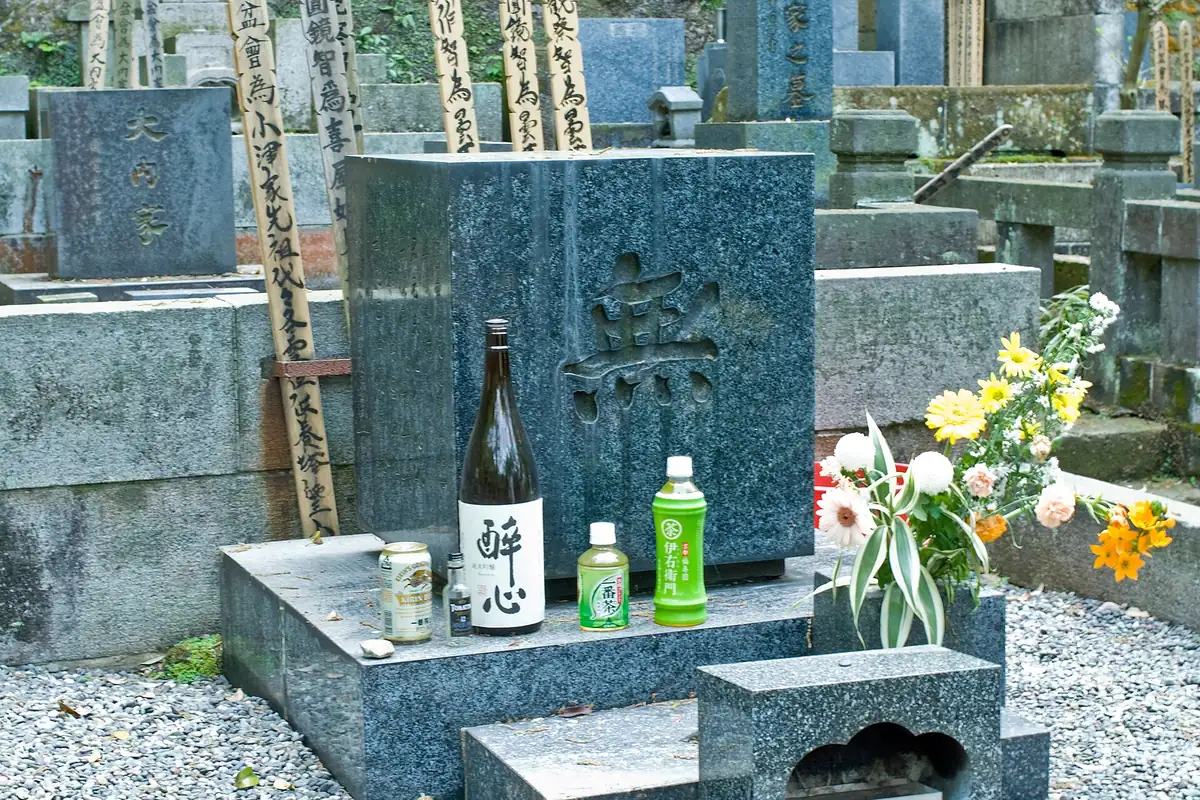
Ozu is buried with his mother at Engaku-ji, a Zen temple in Kita-Kamakura, a short walk from Kita-Kamakura station. Our Kamakura day trip guide suggests arriving soon after it opens. The stone carries no name, only the character mu (無), meaning nothingness. Visitors still leave bottles of sake on the step.
Questions about Yasujiro Ozu
Tokyo Story (1953). An elderly couple travel from Onomichi to Tokyo to visit their grown children, who have little time for them. In the 2012 Sight and Sound poll, 358 directors voted it the greatest film ever made, and in the 2022 poll it placed fourth with both critics and directors. It streams on BFI Player in the UK.
A pillow shot is a brief cutaway to an object or empty place between scenes, such as a vase, a washing line or a chimney. The critic Noel Burch coined the term after the pillow words of classical Japanese poetry. Ozu used them in place of fades, and they set the mood for the scene that follows. The vase in Late Spring is the best known.
Ozu placed his camera roughly at the eye level of someone kneeling on a tatami mat, and often lower, which is why it is called the tatami shot. He first used it in Body Beautiful (1928) and kept it even in scenes where nobody sits. It puts the viewer inside the family’s home, at their level, looking straight at them.
Three Ozu films in which Setsuko Hara plays a young woman named Noriko: Late Spring (1949), Early Summer (1951) and Tokyo Story (1953). The stories are separate and each Noriko is a different character. Hara also appeared in Ozu’s Tokyo Twilight, Late Autumn and The End of Summer.
BFI Player streams 15 Ozu films on its subscription service, including Tokyo Story, Late Spring, Good Morning and An Autumn Afternoon, and rents 11 more (checked 31 October 2026). The BFI shop sells Blu-ray editions of most of his surviving films.
At Engaku-ji, a Zen temple in Kita-Kamakura, south of Tokyo. He shares the grave with his mother. The headstone has no name, only the character mu, meaning nothingness. Akira Kurosawa is buried in the same city, at An’yo-in temple.