As the year’s conclusion approaches, award season comes forth to celebrate the art that made it special. And with that, we’re reminded of 1996, a year when Japan was culturally dominated by Masayuki Suo’s (周防正行) Shall We Dance?. The film released to massive critical and commercial success, becoming both a box office hit and the most awarded movie in the Japanese Academy Awards. To this day it holds the award record of the ceremony, having won 13 out of its 14 nominations, including Best Picture, Best Director, Best Actor, and Best Actress. A record we don’t think will be taken away from it any time soon. It was so successful, in fact, it even inspired a 2004 American remake of the same name. So what made it so special?
Shall We Dance? is, like many great films, deceptively complex. It’s a movie that draws the viewers in with a simple-to-understand plot and an even simpler story structure, to then leave them wondering what is it really about. To anyone who’s watched the film, the answer to this question is as straightforward as a good poem: with layers of known and unknown meanings to words one can recite out of memory.
Indeed, Shall We Dance? will feel familiar to those who consider themselves a little more than the average movie-goer. Each sequence in the film seems to follow typical screenwriting formulas, with ups, downs and thresholds to overcome. And yet, the movie is never formulaic. The film, like the dances it’s passionately portraying, knows each step along the way and executes them masterfully. Moreover, it does it in a way that reflects the time and place that birthed it: 1990s Japan.
Today, we revisit this classic film and analyse what made it such a successful and enduring piece of art. So, what do you say, dear reader, shall we dance?
The Plot
The movie begins with a Shakespeare quote, “Bid me discourse, I will enchant thine ear,” (from Venus and Adonis) that slowly pans out to reveal the Blackpool ballroom. As we see couples dancing, a voice-over explains the stigmas that exist in Japan around dancing, simply put, “it’s beyond embarrassing.” However, the narrator inquires, even Japanese people know dancing can bring secret joys.
After this, we’re introduced to Shohei Sugiyama, played by Kōji Yakusho (役所広司). He is a forty-year-old successful salaryman (サラリーマン) with a wife, a daughter and a recently bought house. In other words, in society’s eyes, he has everything. And yet, Sugiyama has been depressed lately, always looking outside the windows in his office, the metro, his house. Something is missing in his life, but he isn’t sure what it is exactly. Finally, he gets a hunch when he spots a similar melancholic face looking outside the window of a dance academy. This turns out to be Mai Kishikawa, played by Tamiyo Kusakari (草刈 民代), a successful competitive dancer turned teacher that has lost the enjoyment for her once passion. Wanting to get close to her, he enrols in the class.
What follows is a comedy film in every sense of the words, with endearing character plot lines and hilarious scenes. The dance school, for example, is full of colourful and wholesome characters that make the film a blast to watch. Sugiyama’s wife, suspecting an affair, hires a private investigator that progressively falls for dancing himself, making for some of the funniest scenes in the movie. Sugiyama himself acknowledges he never wanted something romantic with Kishikawa, and discovers the joy dancing can bring to his life. And Kishikawa, through teaching Sugiyama, rekindles the passion for dancing that was once lost.
Beyond the Surface
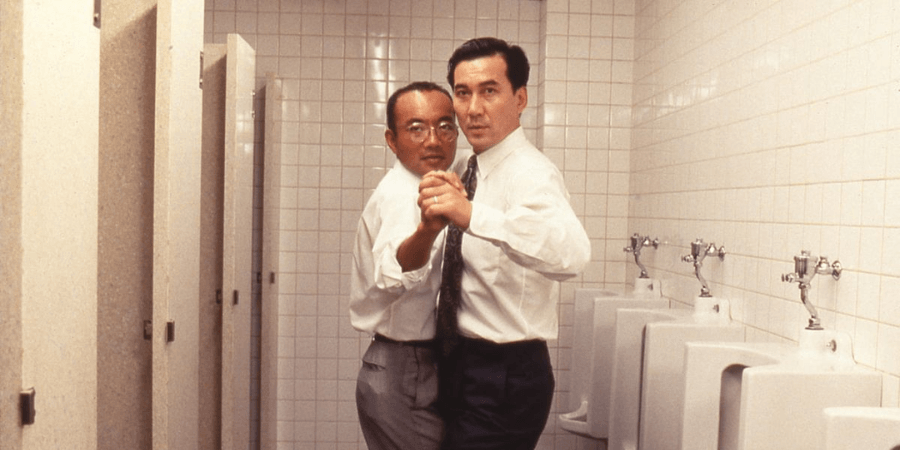
Protagonist Shohei Sugiyama dancing with coworker Tomio Aoki in the bathroom
Now that we’ve addressed the movie’s plot, you can start to see why the film would feel familiar to any cinema enthusiast. At its core, Shall We Dance? is a classic outsider tale, with the protagonist getting into something he doesn’t understand, for reasons he doesn’t fully know, and discovering what he truly needs. And that idea, what a character wants vs. what it needs, is something any cinephile would recognize as the making of a cohesive film.
But, as stated before, this movie is not merely “competent,” it’s a great piece of art with much to dig into. For starters, we can look at what caused Sugiyama’s depression in the first place: buying a house. Even without addressing the nuances of its Japanese setting (we’ll get to that later), we can see why this being the catalyst is so thematically profound. Sugiyama, by buying the house, believed to beat the system, but in reality he has finally fallen victim to it. When he didn’t have a house, this was his goal to look forward to, but now that he has it, he realises these goals bring him no happiness. And, to be clear, there are goals to be obtained: he can pay the mortgage, get promotions, ascend the corporate ladders, have more kids, etc. But the movie argues that life needs to have more than whatever the system presents. It needs something outside of it.
In life, it says, we should embrace the different, what’s beyond our comfort zone and discover new horizons. We should escape monotony and look at what’s past our windows.
The Sight Past Our Windows
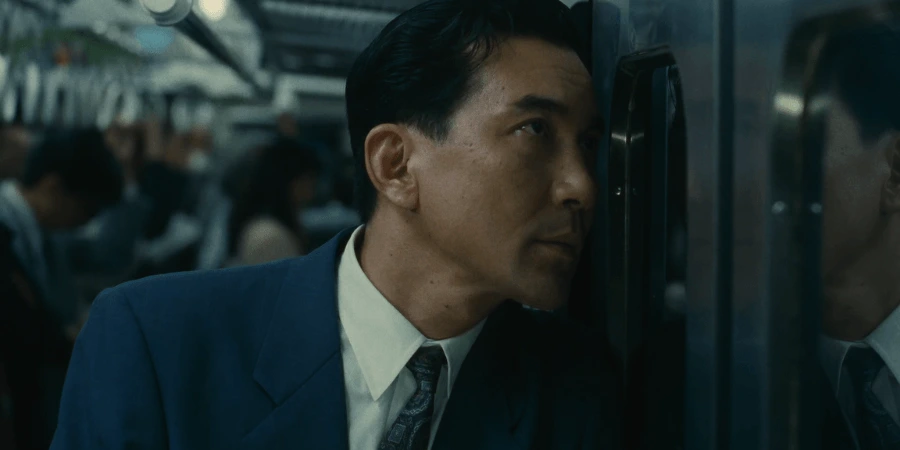
Sugiyama looking outside the metro’s window
As you might’ve guessed, this “joy outside the system” theme is expressed masterfully through the leitmotif of the windows. Sugiyama is constantly looking outside precisely because he is trapped, and he subconsciously knows he needs to get out, even if briefly, to rejuvenate his joy. And dancing, from the very beginning of the film, is established as stigmatized in Japanese society. This is to say, the act of dancing is both literally and metaphorically a thing for outsiders. And while it might make him less manly or even less Japanese to his peers, it is what he needed to feel alive again.
This being said, perhaps the most interesting use of the window leitmotif comes in Mai Kishikawa’s plot line. She, like Sugiyama, also melancholically looks at the horizon, but the thing she is trapped in is dancing itself. This is because, when she became a competitive dancer, she made the act of dancing into a rigid institution. What once was joyful movement became restrictive, set in stone, and the happiness it brought, disappeared. She is also trapped in a system, as no activity, for as cheerful as it may seem, is immune to institutionalization.
The movie isn’t arguing that competition or following rules is inherently bad. As a matter of fact, the act of mastering the different dance steps is presented as progress. No, the movie argues that, whatever activity brings us joy (dancing being one of many), we should keep it grounded, so as to not miss the forest for the trees. Or, as Paul Tatara said in his CNN review “it’s about the healing powers (and poetry) of simple self-expression.”

The Mastery of Form
So far, what we’ve covered is the story, and while this is an important aspect of Shall We Dance?, is not the only one. Film, as an art form, it’s a collaborative effort, one that requires many different pieces to work in tandem in service of something bigger. And this film doesn’t just know that, it excels at it.
So now, it’s only fitting that this section acknowledges the immense work that Masayuki Suo and his team put into making Shall We Dance? go above and beyond expectation. They are, by all accounts, masters of their craft, and this film is a great showcase for it.
The Acting Performances
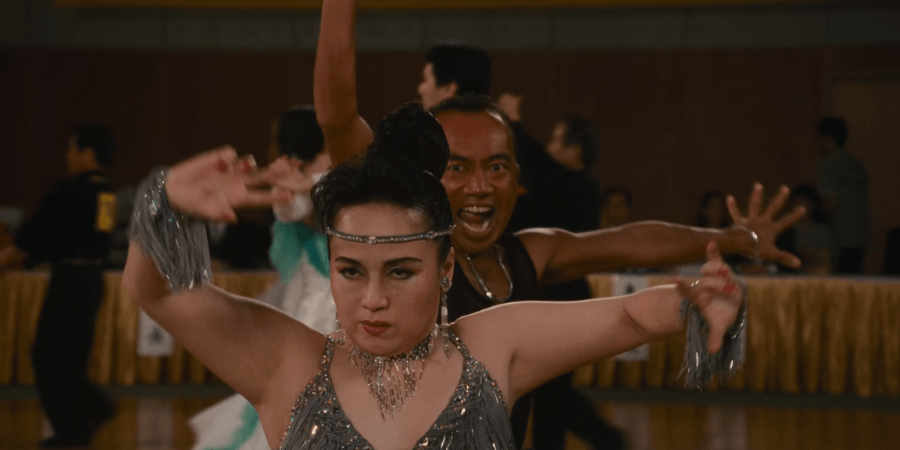
Tomio Aoki and his dance partner in Latin dance competition
The first and most obvious example of Masayuki Suo’s superb direction is in how he directed the actors, which is not to take credit away from them. As we’ve said, film is a collaborative art form, and both director and actors worked in tandem to give us some fantastic character performances. Kōji Yakusho as Sugiyama did an amazing job, being one of the first times he showed that calm, shy style of acting that he would go on to master in Wim Wender’s Perfect Days. Then there’s Tamiyo Kusakari, with a cold, yet somewhat endearing attitude, that makes her characters grow progressively welcoming, both for the characters and the viewer.
The supporting cast also did an amazing job, with some great standout performances. One of them is Naoto Takenaka (竹中 直人) as Tomio Aoki, a self-proclaimed Donnie Burns disciple and Latin King, that is constantly hilarious to watch. He moves with a fierce demeanour that I (as a Peruvian reviewer) found immensely entertaining. Another one is Hideko Hara’s (原日 出子) performance as Sugiyama’s wife. She begins as a care-free housewife that grows increasingly worried and, consequently, silent in a disheartening way. Her performance becomes one of the emotional backbones of the film, and it adds a needed human touch of despair to the story.
The Editing and Choreography
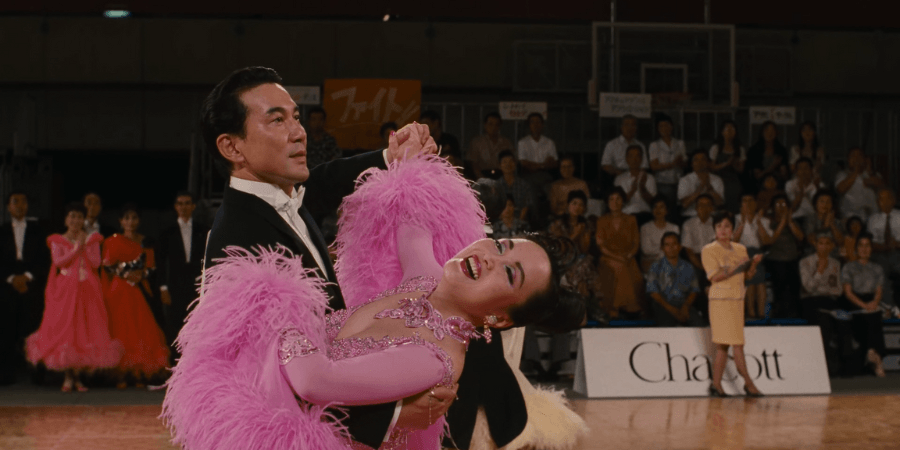
Shohei Sugiyama and his dance partner in a dancing competition
The choreography of the dances is also a thing worth celebrating in the film. Masayuki Suo and his team really studied what makes these dance styles so entertaining to practice and watch. And it appears that idea, learning to love dancing, was given a lot of effort, with them wanting the audience to leave the theatre with it. Even if the first steps can be a little rough, they eventually lead to movement so liberating it feels triumphant. This is why the beginning of the film is slow but not sluggish, as it is always leading somewhere, it just needs your time first. Before we can dance in the ballroom, you must learn to move your feet without stepping on them.
Additionally, the editing substantially adds to this feeling. The camera is always cutting to peoples faces, their feet and movement, creating a path for the viewer to follow. This path is, crucially, both physical and emotional, as one bad step can ruin the dance. The characters know it, and the editing makes sure you do too. Moreover, Masayuki Suo’s team managed to capture the essence of each dancing style, making all of them unique on screen. Not once will you get lost watching Shall We Dance?, nor will you ask yourself “what style are they dancing now?” It’s all so beautifully and expertly communicated.
The Sound and its Absence
Finally, the film’s sound is something worth noting. Being a movie about dancing, one would guess it has a great soundtrack to accompany it. And for much of the film’s runtime, that is the case. The music, made by Yoshikazu Suo (周防 義和), perfectly captured the loose yet sophisticated style the movie was going for. The use of Latin instrumentation and arrangements was particularly genius, with trumpets, saxophone, and castanets accompanying the dancers on their joyful journey into the unknown. If one had to recommend a song, “Golden Rumba”, most prominently featured with Naoto Takenaka’s character, perfectly captures the seductive persona he desperately wants to project.
However, one of the things that makes the movie special is, ironically, when it lacks sound. Many scenes are done in complete silence, and given how good the soundtrack is, this immediately captures the viewer’s attention. To be clear, this was a deliberate stylistic choice. Silence in the film is often used to express melancholy and emotional distance, which is especially noticeable in scenes with Mai Kishikawa. She, as we’ve discussed, is trapped in her own rigid discipline, and this is something that silence perfectly conveys.
To give an example of this duality at play, there’s a scene where Kishikawa is retelling how she fell in love with dancing. The film then shows a flashback that is not only warmer, with a pastel colour palette, but it’s also accompanied with some great music. However, once the flashback ends and we’re back in the present, we are faced with Kishikawa looking at the window in complete silence. Or, for a different character example, there’s Sugiyama’s wife. In the scene when she finally confronts her husband’s dancing, she is met with a wall of silence, as to symbolize how alone and weary she has grown over the course of the film.
1990s Japan on Screen
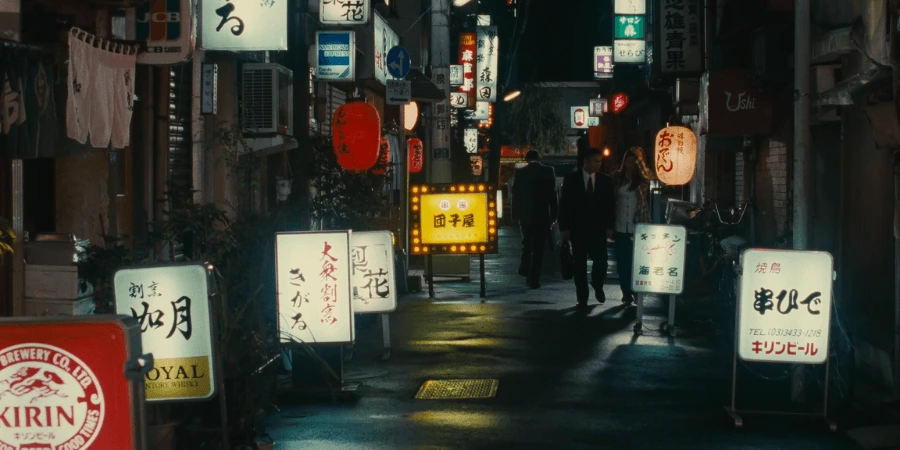
Shohei Sugiyama walking the streets of Tokyo after refusing to drink with coworkers.
What we’ve discussed so far is the making of a great film, and while it might be able to explain the awards and box office success, it isn’t enough to address the lasting cultural impact of Shall We Dance?. So what’s beyond that? How do you make a film endlessly replayable? That’s a question Hollywood executives have tried to ask for a long time, and film history, to their dismay, has many possible answers. The one Masayuki Suo appears to have taken with Shall We Dance? was to make the movie inseparable from the time and place that made it possible.
Because yes, a good foundation is key, and it’s partly the reason the film could so easily be made into an American remake. But what makes it everlasting is how it reflects the time period of 1990s Japan, with its anxieties, stigmas, and even policies. Shall We Dance? gets to be a classic by way of a time capsule, being a piece of art that so masterfully and unapologetically displays the psyche of the moment. Moreover, it does it in a comedic and lighthearted way, one only able to be found in Japanese media. Shall We Dance? decided from the beginning that, for as universal as the outsider tale might be, it wanted to be a Japanese film first. So let’s see how they did it.
The Cultural Stigma of Dancing
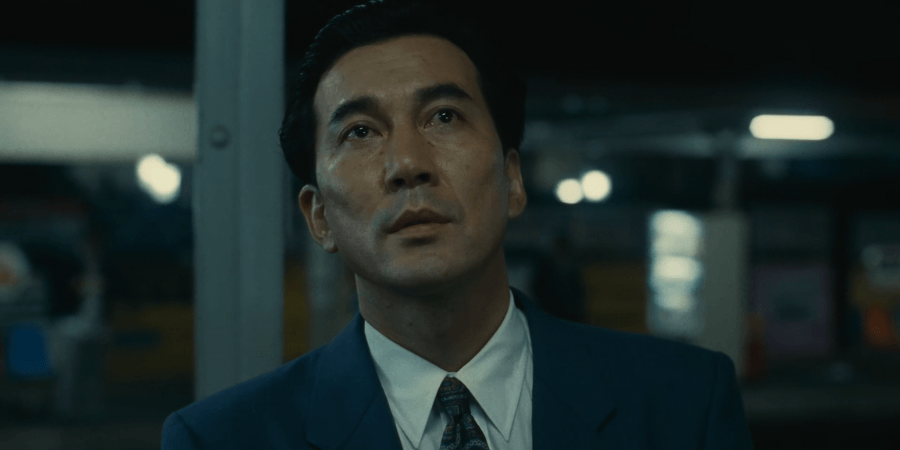
Shohei Sugiyama looking adoringly at the dance school.
The first and most obvious way Shall We Dance? reflects 1990s Japan is with the premise itself. Dancing, especially ballroom dancing, was seen for many years as taboo in Japanese society. In fact, in 1948, a law was passed that prohibited dancing after midnight altogether. The film doesn’t create a problem from scratch, it relies on real-life Japanese experiences to make its point. Some characters state that “the Japanese body wasn’t made for dancing,” hence this movie being the most effective counterpoint.
But why was dancing taboo in Japanese society? Well, a part of it, as the movie itself showcases, has to do with societal norms around masculinity. Sugiyama keeps it a secret because for him, as a man, it’s embarrassing. The more complex reason has to do with broader social norms about public affection in Japanese society. As Kristina Veemees said in a study on social dance in Japan, “is hard to accept in a culture where “skinship‟ (body contact) is only important during childhood.” Indeed, ballroom dancing is a public display of affection, and even with one’s spouse, this was seen as too much.
Moreover, dancing in Japan was also seen as a sign of western degeneracy making its way into Japanese society. Japanese dance traditions are, for the most part, theatrical. Take Butoh for example, which has a collective message, but the dance itself is always solitary. Ballroom dancing, on the other hand, requires close physical contact, which to many Japanese citizens was evidence of decaying morals. Going back to the 1948 law, this was itself the remnant of anti-prostitution law, which goes to show their perception on the topic.
It’s only now, thanks to globalization and movies like Shall We Dance? that Japanese society has become more accepting of ballroom dancing. It’s still a far way to go, but at least the 1948 law was finally repealed in 2015.
The Salaryman and the Lost Decade

Friends take Sugiyama’s briefcase so he can dance with Mai Kishikawa.
The other way Shall We Dance? reflects 1990s Japanese society is with its protagonist and the turmoils he is up against. Sugiyama is a typical salaryman, a white collar salaried worker, which is itself an enduring Japanese cultural figure. Salaryman are people that dedicate their time to work, often to a single company for their entire life. This is something that extends to their social circles, as most of the time they have close relationships with coworkers and even bosses. Drinking out or singing karaoke after work are, for example, staples in salaryman culture.
The figure of the salaryman has changed significantly throughout Japanese history. While it technically began in the 1920s with the early economic success of the country, it really took off with the Japanese post-war economic miracle. Here, thanks to a series of government reforms, the system of Shūshin koyō (permanent employment) was established. This made salaryman the norm in Japanese society, giving people permanent and secure employment until retirement. However, when the 1980s Japanese economic bubble burst, the system of Shūshin koyō lost its prominence. And the salaryman, consequently, changed significantly in the public eye.
By the 1990s, where Shall we Dance? is set, Japan was facing the economic turmoils of the Lost Decade. Moreover, salaryman gained a reputation for overworking, with karōshi (過労死) (death from overwork) becoming increasingly prominent. Sugiyama, at forty years of age, was someone who lived as a salaryman since his twenties. He un-botherly grew in the business world since the 1970s, but by the 1990s, he, like most of Japan, was anxious. Maybe this isn’t sustainable. Maybe what will bring me joy lies outside this system. For many real salaryman, the answer was golf, for Sugiyama, it was dancing. And if you watch the film knowing this, the golf analogies some characters use make perfect thematic sense.
Yutori and The Need For it
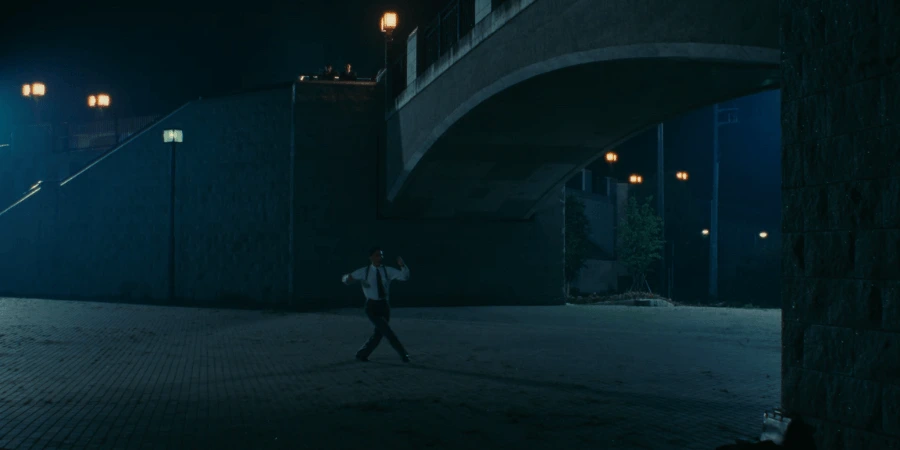
Sugiyama practicing in a secluded spot while the Private Investigator looks at him.
The final thing we should address regarding the film’s connection to 1990s Japan is the term Yutori (ゆとり). Yutori is not a term that can be easily translated, as it means both a physical place and a state of mind. In many ways, it is similar to Virginia Woolf’s famous “a room of one’s own,” being a sort of sanctuary: a physical space that allows someone to conjure a mental space, where they can breathe deeply and live a more balanced, less stressful life. It’s a place for self-expression, away from the claws of an oppressive system, letting its inhabitants enjoy the simple moments. This place, in the film, was dancing and the ballrooms.
But why is Yutori significant to 1990s Japan specifically? Well, dear reader, it’s significant because this societal need for breathing room became so pronounced that, in the late 1980s and early 1990s, even the Japanese government recognized it. This is where Yutori Education was born, a new school curriculum aimed to reduce academic pressure and foster creativity. Of course, this makes sense given what we’ve previously discussed, especially the salaryman’s new gained perception. They wanted children to be creative again, and not throw their entire life at a company without a goal in mind. Shall We Dance?, consequently, was perfectly positioned to show the transition period of this new way of thinking.
It should be noted that Yutori Education is nowadays a controversial topic, with many citizens claiming it has made the children less disciplined. This is beyond this article’s scope, but what we can do is point at Shall We Dance? and see how the 1990s were, in many ways, a turning point.
Where to Watch?
Shall We Dance? is now more available than ever in the western hemisphere, in no small part thanks to Film Movement’s purchase of its distribution rights. On May 30, 2025, they released a 4k restoration of the film which aired at the Film Forum of New York City. This restoration is the uncut, 137-minute original film, being the first time it is available in North America. Moreover, the Blu-ray version of this restoration is coming to stores across the US and Canada on the 25th of November, 2025.
As for the UK, the film is available for purchase and rent in many services. Some of these include Apple TV (iTunes), Amazon Video, Sky Store and Rakuten TV. The price may vary between streaming services, but most of them allow rentals for as low as 3.49 pounds.




Frequently Asked Questions (FAQ)
1. What is the biggest difference between the original 1996 Japanese film and the 2004 American remake?
The biggest difference lies in the cultural stakes and tone of the films. The 2004 American remake, starring Richard Gere, treats dancing like a typical midlife crisis. The 1996 film, as we’ve discussed, uses the anxieties of the 1990s Japanese salaryman and Japan’s stigmas on dancing to make its case.
2. Is Shall We Dance? based on a true story?
No, the film is not based on a true story. It is, however, inspired by the real-life Japanese experience of the 1990s, with public dancing being a genuine social taboo, one that had historical Japanese laws that regulated dance halls.
3. What happened to the lead actress, Tamiyo Kusakari, after the film?
Shall we Dance? was Tamiyo Kusakari acting debut; she was a professional ballerina beforehand. She continued her career as dancer and choreographer, maintaining a selective acting career. For the most part, she collaborates with Masayuki Suo, who she married shortly after the film’s release.
Last Words
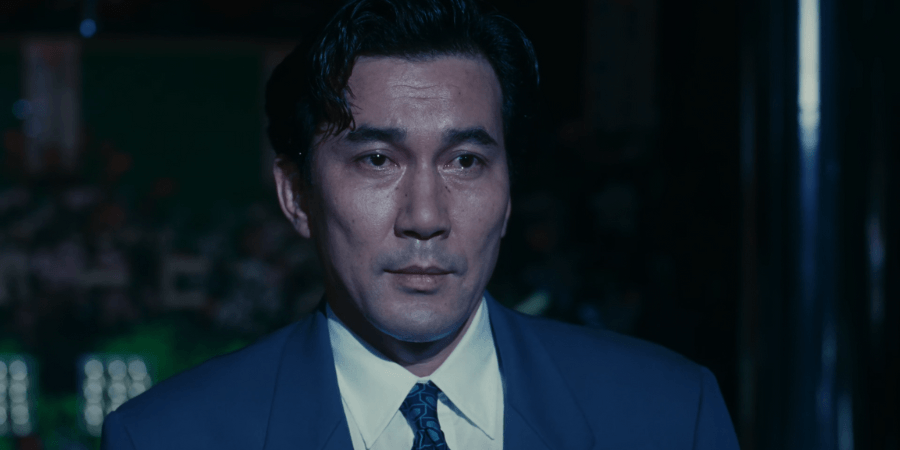
Mai Kishikawa using a spotlight to select Shohei Sugiyama as her partner for the next dance.
In conclusion, Shall We Dance? is way more than meets the eye. It presents itself as a lighthearted comedy, with a silly premise and a classic outsider tale anyone can recognize and empathize with. But, as the film progresses, it reveals hidden layers of meaning, sparks of filmmaking poetry, and a sociopolitical commentary that, at the time, was strikingly poignant. Moreover, as it does it, it never ceases to be that lighthearted comedy you came to see in the first place. Shall We Dance? is complex not because it pretends to be a comedy while actually being a commentary of 1990s Japan. Instead, its complexity stems from its success in accurately and poignantly commenting on 1990s Japan, while remaining a genuinely entertaining comedy.
This was possible thanks to the collaborative efforts of Masayuki Suo along with his team of editors, actors, sound designers, and choreographers. The film is, in short, a classic, and watching it will transport you to the time period like only classics are able to do. Times may be different, but when a film has good artistic direction, a compelling story, and a human core, it simply never ages. Shall We Dance? may not be for everyone, but we hope with this article we’ve explained why it is important for so many.
Source: Japan Academy Film Prize archives.