“Life is but a dream, a vision, an illusion,” sings warlord Oda Nobunaga (Daisuke Ryu) as he commemorates the death of his rival Takeda Shingen (Tatsuya Nakadai) in Akira Kurosawa’s Kagemusha (1980); “Life, once given, cannot last forever.” Taken from the Noh play by Zeami Motokiyo, the Song of Atsumori invokes the themes of Kurosawa’s epic jidaigeki masterpiece: that in this crazy world, those at the top may end up at the bottom, and that the significance we place on symbols of power is as illusionary as life itself.

Kagemusha is the 27th film from Akira Kurosawa, the legendary Japanese filmmaker whose masterpieces such as Seven Samurai (1954) and Yojimbo (1961) secure his mantle as one of the greatest directors of all time. Written by Kurosawa and Masato Ide during a time when the former was suffering a period of depression and inactivity, Kagemusha is as much a journey into the mind of a struggling artist, as it is an exploration into the hollowness of symbols.
Kurosawa's Kagemusha
The Double
Set during the Sengoku period, an era of Japanese history plagued with civil war and social upheaval, the film begins with a meeting between Shingen and his brother, Nobukado (Tsutomu Yamazaki), who has spared a thief from crucifixion due to his uncanny resemblance to Shingen. The brothers agree that the thief could be used as a political decoy in the event of Shingen’s death. This sets up the plot of the film, with the double brought in to rule when Shingen dies of a sniper wound early on.

The way Kurosawa composes his shots is akin to an artist with a paintbrush, drawing viewers in with deep colours and delicate lighting. In the opening shot, the brothers are positioned to one side of the frame, mimicking each other’s movements while the thief sits by himself, lit by a single candle above him. The shadow of Shingen that sits between him and Nobukado personifies the kagemusha himself, literally meaning “shadow warrior,” while the candle draws our attention to the thief with his uncouth behaviour, pointing and laughing, dramatically juxtaposed to the refinement of the brothers. Once an aspiring painter, Kurosawa had dropped his dream of being an artist when he became a director, explaining in his autobiography: “When I changed career, I burned all the paintings I had done up until that point. I intended to forget painting once and for all.” It could be argued that Shingen represents the medium Kurosawa left behind, with his high-class mannerisms and the statuesque blocking of Nakadai’s performance invoking the stillness of traditional Japanese paintings.
Why do we place so much importance on people in power? This is the dramatic question established in Kagemusha’s opening scene as Shingen, who admits to killing his own son and banishing his father to maintain his rule, sits calmly while the double, appears uncontrollable, throwing his petty thievery back at the lord as a nothing compared to the amount of death and defilement caused by his wars. Shingen is a murderer of thousands, killing endlessly to maintain his position, while the double is a mere thief. The thief and Shingen are the same, literally played by the same actor (Nakadai), and yet one holds power, while the other barely holds his own life.

Kurosawa questions the legitimacy of power with the shadow between the brothers invoking the emptiness of power, of symbols, while the double directly points this out, positioned exactly opposite the shadow as he calls out Shingen’s hypocrisy. Foreshadowing the film’s plot as well as setting up the themes, the pointlessness of war and the mountains of death caused by it, Kurosawa establishes the double as merely a shadow to Shingen; a hollow vessel to do his violent bidding. Even when Shingen explains that he intends to rule to unify the country and prevent any more death, the scene leaves us with one final hollowness: that even in peace, leaders are just symbols; empty vassals of ideology used to glue society together, immovable like a mountain.


The Struggle to Get it Made
Prior to the production of Kagemusha, Kurosawa had been in a state of depression. Burned by the production of Tora! Tora! Tora! (1970) in which Kurosawa was meant to direct the Japanese language sequences, only to be fired due after two years of work. After this, despite his iconic filmography, he struggled to secure finance for his own films, which was made worse by the financial failure of Dodes’ka-den (1970), his first colour film. In the period between Dodes’ka-den and Kagemusha, the Japanese film industry suffered a crisis with audiences dropping dramatically due to the spread of television.
At the same time, Kurosawa was suffering from ailments of ageing – from gallstones and failing eyesight. Yet, more greatly, he was suffering from his lapse in cultural relevance. The film industry had been pulling away from Kurosawa since the 1960s, allowing room for new filmmakers and the emergence of colour film in the mainstream. Kurosawa struggled to keep up. On 22 December 1971, at the age of sixty one and shortly after moving his family to a smaller home in Tokyo, he attempted to take his own life, burdened by the possibility that his work was never good enough.

“Movie directors, or should I say, people who create things, are very greedy and they can never be satisfied… That’s why they can keep on working. I’ve been able to work for so long because I think next time, I’ll make something good”
– Kurosawa
It wasn’t until 1975 when a Soviet invitation to direct a film version of Dersu Uzala, a memoir by Russian explorer Vladimir Arsenye, that Kurosawa’s career enjoyed a renaissance. Five years on, he would convince Japanese film studio Toho to finance his next feature, Kagemusha. Yet, even then, the company couldn’t complete the film’s ¥2.3 billion ($6 million) budget.

The Paintings
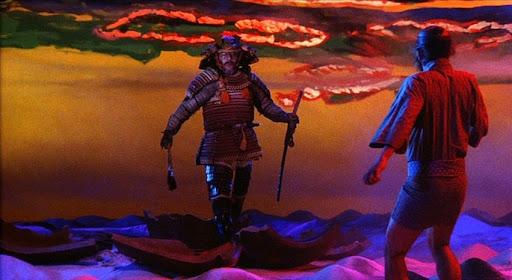
The storyboard reproduced further up this page is not a production document in the ordinary sense. It is a painting, and it exists because the film did not.
For close to four years while the money refused to appear, Kurosawa directed Kagemusha in his head and then set the results down on paper. Not thumbnail sketches for a crew to work from, but full scale, finished pictures in saturated colour, produced daily and in quantity. He was a man with no film to make, so he made the film the only way still available to him.
The detail that gives this its weight is the one already noted above. Kurosawa had wanted to be a painter, and on becoming a director he burned everything he had produced. In his own words he intended to forget painting once and for all. Almost forty years later, at the lowest point of his working life, painting is what he went back to, and it is what kept the film alive through the years when nobody would fund it.
That history is visible on screen. The dream sequence is the clearest case, with its hallucinatory reds and blues owing more to a canvas than to any photographic reference, but the habit runs through the whole film. Colour arrives in flat, deliberate blocks. Armies are arranged as shapes and masses before they are arranged as armies. Figures are frequently held still and centred in a way that has more in common with a painted panel than with the restless, multi camera coverage of Seven Samurai.
Kurosawa worked the same way again on Ran, painting it years before he could shoot it. Both films were pictures long before they were productions, which is worth holding on to when watching Kagemusha. Much of what looks like grand historical spectacle began as one unemployed man at a desk, refusing to stop working on something he had no reason to believe would ever be filmed.
New Hollywood Support
Overseas, however, the rise of New Hollywood filmmakers, Francis Ford Coppola, Steven Spielberg, George Lucas and others, had caused a resurgence in the American film industry. Defying studio conventions with films such as Bonnie and Clyde (1967), The Godfather (1972) and Easy Rider (1969), the movement sought to break free of the status quo, presenting films with more nudity, more violence, more creativity in line with what they were seeing in international cinema. In an interview with Criterion for the 2005 rerelease of Kagemusha, Coppola suggests that “at the time […] there were three giants [in the international cinema space]: [Frederico] Fellini, Kurosawa, and [Imgmar] Bergman.” Emerging out of film schools such as The University of Southern California, the so-called “movie brats” were exposed to much more international cinema than filmmakers had been prior, attending screenings and learning about the practices of their foreign predecessors. “You gotta remember that in those days there was no VHS, there was no DVD, and if you wanted to see a particular movie, it either had to come from some art house, you had to see it at two o’clock in the morning on television, or you could see it at film school” (Lucas, Criterion 2005).
Enamoured by Kurosawa’s films, Lucas and Coppola were astounded to find out about Kurosawa’s struggle to make Kagemusha; how the director of The Hidden Fortress (1958), the film which literally inspired Star Wars (1977) was unable to continue working. They had encountered this ten years before when Citizen Kane (1941) director, Orson Wells had struggled to finance a picture. He wasn’t trusted by studios, and despite support from the movie brats, failed to get it off the ground. “Of course, we didn’t have any prestige, really at that time but […] 12 years later we did” (Coppola, Criterion 2005). Using their newfound clout with American studios, they decided to help Kurosawa, convincing 20th Century Fox to make up the shortfall in Kagamusha’s budget, about $1.5 million dollars. Coppola suggests that it was “George who was the instrumental one […] because, at that point, Star Wars had saved them, had greatly … embellished Fox’s prestige” (Criterion, 2005).

The uphill struggle to get Kagemusha made coincides with its themes. As the double is ripped from the cusp of crucifixion to act as a decoy to a lord only to be discarded when he fails to keep up his guise, so is Kurosawa, brought in to direct the Japanese language sequences in Tora! Tora! Tora! only to be discarded when his own film, Dodes’ka-den makes no money. As the Song of Atsumori suggests, “Life, once given, cannot last forever” and Kurosawa’s successes did not sustain his career.








The Battle Within
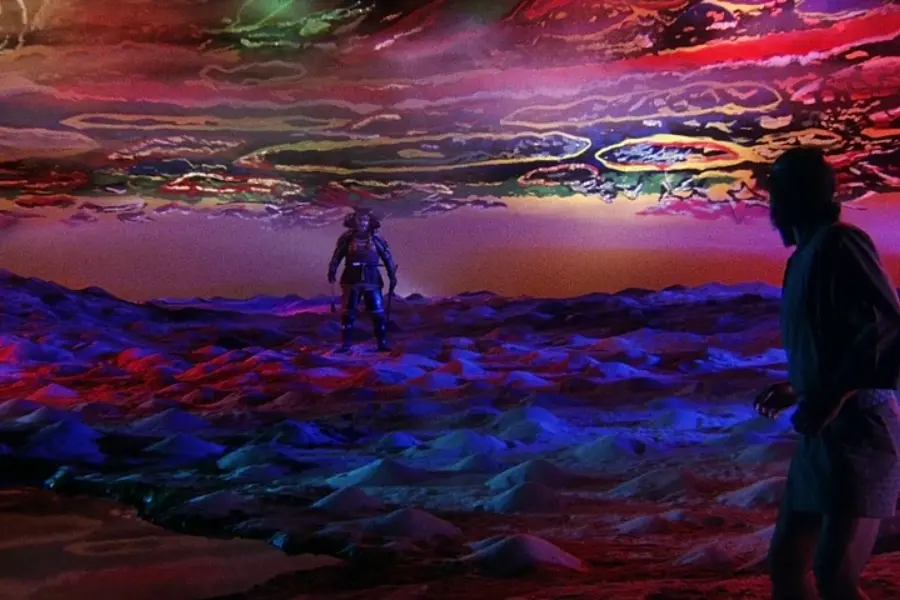
There is a dream sequence in the film which feels ripped out of Kurosawa’s psyche. At a moment of crisis, after Shingen has died and the double agrees to act in his stead, he finds himself struck by the difficulties of pretending to be someone he isn’t. He dreams of a tumultuous sea, decorated in vibrant colours, hallucinatory blues and passionate reds that speak of a man in conflict with himself. Chased by the ghost of the dead Shingen, the double tries to escape, only to find himself lost when the Lord disappears. The double wanders, unable to find the man he is pretending to be, waking sweaty and frenzied, speaking of “a million enemies” that surrounded him.
The dream foreshadows the eventual downfall of the double, with the film’s climax presenting a tragic battle in which Shingen’s army, now under the control of his ambitious son, is laid to waste by the muskets of Nobunaga. It personifies Kurosawa’s inner conflict at this point in his career; depressed and paranoid, believing that enemies surround him: the studio executives, and the struggle to finance his film. A more pressing enemy, however, could be Kurosawa himself and his internal struggle to maintain cultural relevance in an industry obsessed with new technologies: cinemascope and technicolour.
“Modern technology and I do not get along,” said Kurosawa in an interview for The New York Times. “My son tells me I look like a chimpanzee when I try to dial the telephone, and it would be hopeless for me to try to drive a car.”
Like the double, Kurosawa is living in the shadow of a Lord: his iconography and past successes as a director. Despite being the originator of that shadow, he cannot outrun it, nor live without it. He can only try and emulate what has come before. As one of Shingen’s generals states in the film, “The shadow of a man can never stand up and be himself.” Kurosawa is held back by his shadow: his former successes and his refusal to be governed by studios or producers (as is the case with Tora! Tora! Tora!). Ultimately, he is discarded, left to wander the battlefield as the Nobunaga’s new generation, with their new technologies (personified by guns) lay waste to his traditional army of swords and arrows (Kurosawa’s career).

The nightmare and the climactic battle invoke the rampant rise in film technologies, with colour film representing the new wave in filmmakers. Considering the detrimental effect that Dodes’ka-den had on Kurosawa’s life and career, it’s unsurprising that the dream is filled with nightmarish reds, and blues while the grey double wanders aimlessly.
The Sixteenth Century
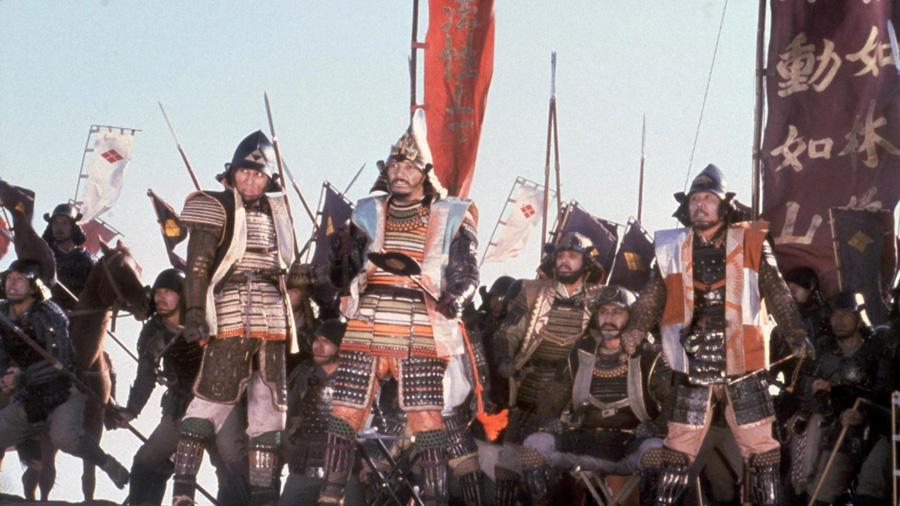
There is a claim Kurosawa made about his own work that is worth taking seriously here. He said he thought he was the only director who had ever made films about the sixteenth century civil wars. It sounds like vanity until the rest of the genre is laid alongside it.
The overwhelming majority of samurai films are set in the Tokugawa period, which began in 1603 and ran for two and a half centuries of enforced peace. The samurai of those films are a warrior class with almost no war to fight. They are administrators, retainers and bureaucrats, bound by an elaborate code and dying for points of honour rather than territory. Kagemusha is set decades earlier, in a country that is genuinely at war, and the difference is not cosmetic.
The code itself is part of the confusion. The bushido most people picture, with its formal duties and its readiness for death, was systematised in the Tokugawa era by scholars such as Yamaga Soko, long after the wars it claims to describe had ended and at a point when the men it governed were pushing paper. Applying it to 1575 is applying a peacetime ideal backwards onto people who were simply trying to win.
Stephen Prince draws a useful line through Kurosawa’s own work on this point. The samurai of Throne of Blood and Ran embody the greed of the real historical past. The heroes of Seven Samurai embody the ideals of the imagined one. Kagemusha belongs firmly with the first group. Nobody in it is honourable. Shingen admits to killing his own son and exiling his father to hold his position, the clan lies about his death for three years, and the plan at the centre of the film is to prop up a corpse’s authority using a thief.
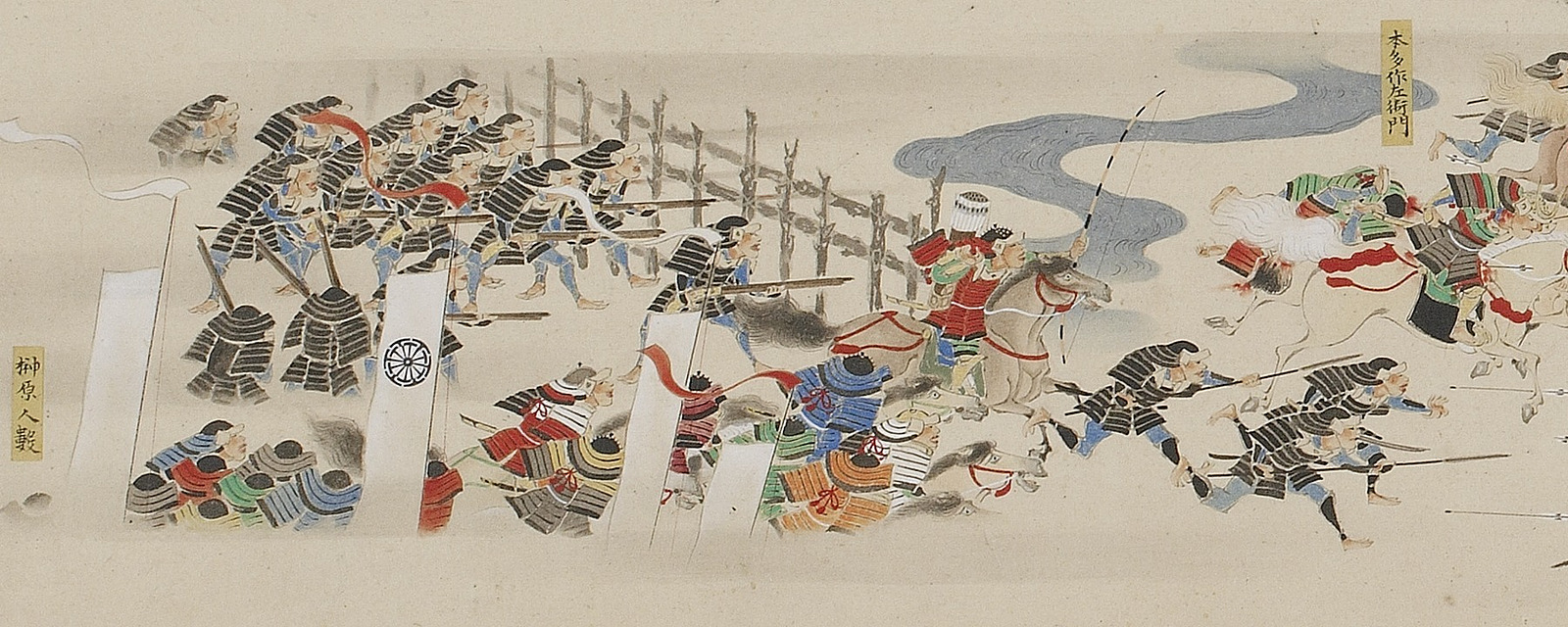
The battle that ends the film is the Battle of Nagashino, fought in 1575, and it is the moment the period turns. Oda Nobunaga’s massed arquebusiers cut down the Takeda cavalry, and the most feared mounted force in Japan is destroyed by ranks of men with guns who need no particular skill and no particular breeding. Kurosawa refuses to show the charge as spectacle. He shows the horses afterwards. The sixteenth century is where the samurai were still fighting real wars, and Nagashino is where the wars stopped needing them.
“A Shadow Cannot Exist Without a Person”
Kagemusha is an exploration into the mind of a director in crisis, brought back due to his past successes only to struggle with the weight of modernisation. Winning the Palme d’Or at the 1980 Cannes Film Festival, the film proved that you can teach an old dog new tricks, with Kurosawa’s later technicolour masterpieces, Ran (1985) and Dreams (1990), bolstering his indomitable filmography. Saved by the new generation, Lucas and Coppola, who act as executive producers on the film, Kagemusha acts as a personification of the difficulties for an artist to maintain relevance in an ever-changing world. It speaks of idols, fathers and leaders, and yet undercuts it all by showing the truth of these symbols: that they are just that, illusions of grandiosity, hollow and easily uprooted.
In the last moments of the film, we witness the double perish in the sea that has been terrorising his dreams, floating past one of Shingen’s standards: “As swift as the wind, as gentle as the forest, as fierce as fire, as unshakable as the mountain.” Shingen was that mountain, and yet he has been removed in place of the double. Then, once his guise is up, the double is replaced by Shingen’s son only to be defeated at the hands of Nobunaga. Power in Kagemusha is the ultimate symbol, and even then, it changes hands so easily.