Late Spring (Banshun) is a 1949 Japanese film by Yasujiro Ozu about Noriko, a 27 year old woman who is happy keeping house for her widowed father and has no wish to marry. To set her free, her father lets her believe that he is about to remarry himself. It was the first of three films in which Setsuko Hara plays a woman called Noriko for Ozu, and Japanese critics voted it the best Japanese film of 1949.
Critics often date the start of Ozu’s great postwar run to this film. Its story of a parent quietly letting a grown child go returns, in different forms, in many of the films he made afterwards.
Inside Ozu's Late Spring, From the Noh Play to the Vase
| Japanese title | 晩春 (Banshun), meaning late spring |
| Released in Japan | 19 September 1949, after previews from 13 September |
| Studio | Shochiku |
| Running time | 108 minutes, black and white |
| Written by | Yasujiro Ozu and Kogo Noda, from Kazuo Hirotsu’s short story Father and Daughter |
| Main cast | Setsuko Hara (Noriko), Chishu Ryu (her father Shukichi), Haruko Sugimura (Aunt Masa), Yumeji Tsukioka (Aya), Jun Usami (Hattori) |
| Recognition | Kinema Junpo best Japanese film of 1949; 15th in the 2012 Sight and Sound critics’ poll and joint 21st in 2022 |
| Watch in the UK | BFI Player subscription, or free on Plex (checked 12 November 2026) |
Noriko, her widowed father and the lie about remarrying
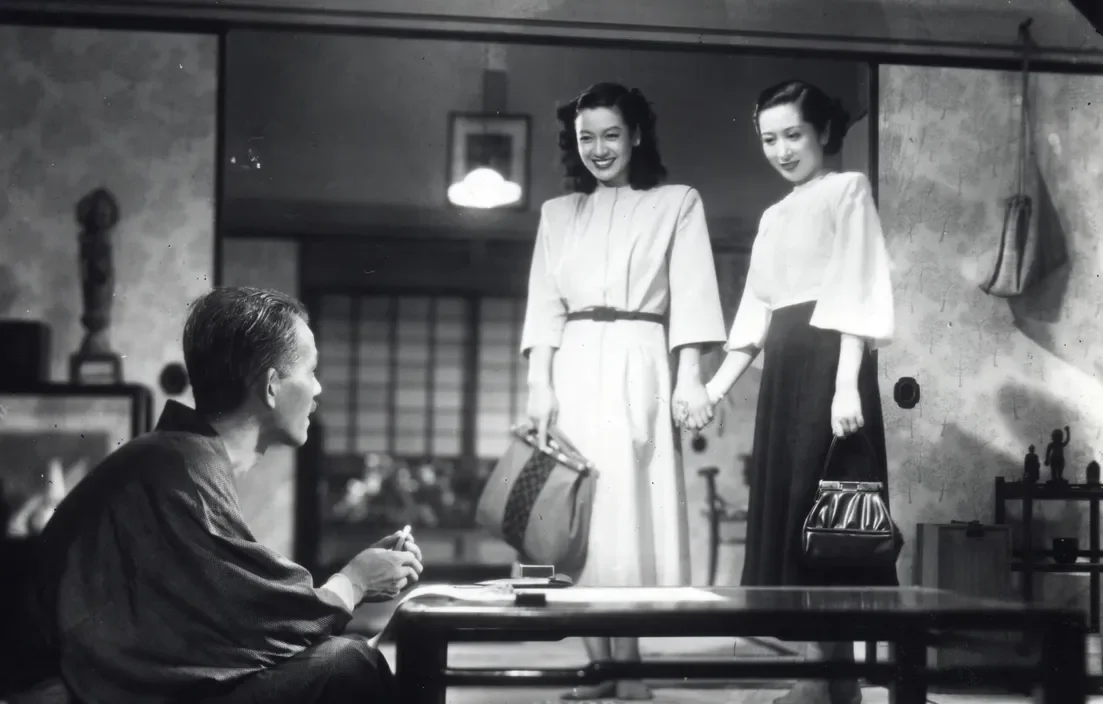
Noriko Somiya lives with her father Shukichi, a widowed professor, in Kamakura, the old temple town on the coast south of Tokyo. She was ill for a time in the hard years after the war. Now she runs the house and sees no reason for anything to change.
Her aunt Masa thinks otherwise, and warns Shukichi that unless Noriko marries soon she may end up alone. Shukichi wonders about his assistant, Hattori, and Noriko does spend a carefree afternoon cycling to the beach with him. Hattori, it turns out, is already engaged to someone else.
So Masa finds a suitable man, and Shukichi does something out of character. He lets Noriko believe that he intends to marry Mrs Miwa, a widow. Noriko is hurt and angry, and agrees to meet the man her aunt has chosen.
Before the wedding, father and daughter take one last trip together, to Kyoto. Then Noriko marries, though the audience never sees the groom. Afterwards Shukichi goes for a drink with Aya and admits the remarriage was never real: he invented it so that his daughter would leave.


Ozu’s style, shot by shot in Late Spring
Watch Late Spring beside a Hollywood film of the same year and it looks unusual, yet the story is never hard to follow. The film historian Erin Schoneveld of Haverford College in Pennsylvania built a course assignment around exactly that. Her 2017 study uses scenes from Late Spring to illustrate each of the techniques below, and describes asking students who had never made a film to copy them.
The camera at floor height
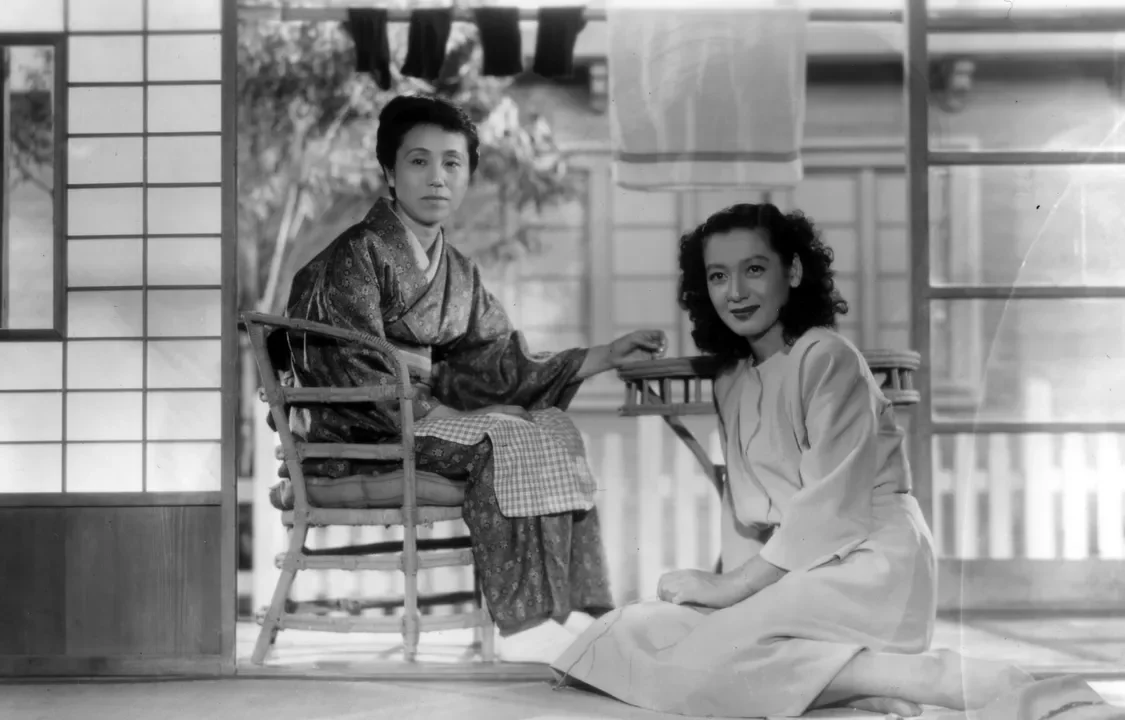
Ozu sets the camera low, at about the eye level of someone kneeling on a tatami mat, and keeps it there even in streets and on temple steps. It rarely moves. A conversation plays out inside a fixed frame, and the actors move within it.
One room, seen from every side
Most directors keep the camera on one side of a conversation, so each speaker stays on the same side of the screen. Ozu placed his camera all the way round a room instead, which critics call his 360 degree use of space. From one shot to the next, the wall behind a speaker can switch to the opposite side of the room.
Pillow shots
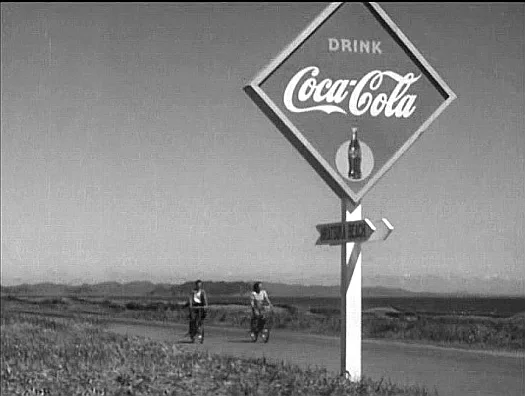
Between scenes, Ozu cuts to places without people in them: a corridor, a vase, two bicycles standing on the sand. The critic Noël Burch named these pillow shots, after the pillow words of classical Japanese poetry that sit beside a line and colour what follows.
Faces turned to the lens
Characters often speak almost straight into the camera, so the viewer sits where the other person would be. In one shot a woman in a kimono leans towards the lens and asks, in the English subtitles, “Isn’t it time you got married?” The question seems aimed at the audience as much as anyone on screen.
Dim rooms and black and white
Many interiors are lit sparingly, with faces half in shadow, as when Shukichi sits reading at his desk late at night with a cigarette.
Schoneveld’s students, none of whom had made a film before, produced short films of seven to ten minutes using these devices and screened them for the whole college. She found that making the shots, however rough, taught them why Ozu framed a scene the way he did.
Kakitsubata, the Noh play at the heart of the film
Midway through the film, Noriko and her father go to a Noh performance. The play is Kakitsubata, The Water Iris. Ozu asked the Noh drummer Komparu Soemon, the 22nd head of his family line, to suggest a piece, and Komparu chose Kakitsubata because Late Spring is a love story. The lead role is danced by the Noh actor Umewaka Manzaburo. The opening credits list the play with its love dance, but that dance was cut in the edit.
During the performance Shukichi exchanges a polite nod with Mrs Miwa across the audience. Noriko sees it, and her mood darkens. For the rest of the scene the camera keeps returning to her face while the dancer moves slowly on stage.
The play suits the film. Kakitsubata draws on The Tales of Ise, the tenth century collection of poems and stories linked to the poet Ariwara no Narihira, and its heroine is the spirit of an iris. Irises flower in late spring, and some critics read the play as a second meaning behind the film’s title.
Kyoto, Ryoanji and the vase at the inn
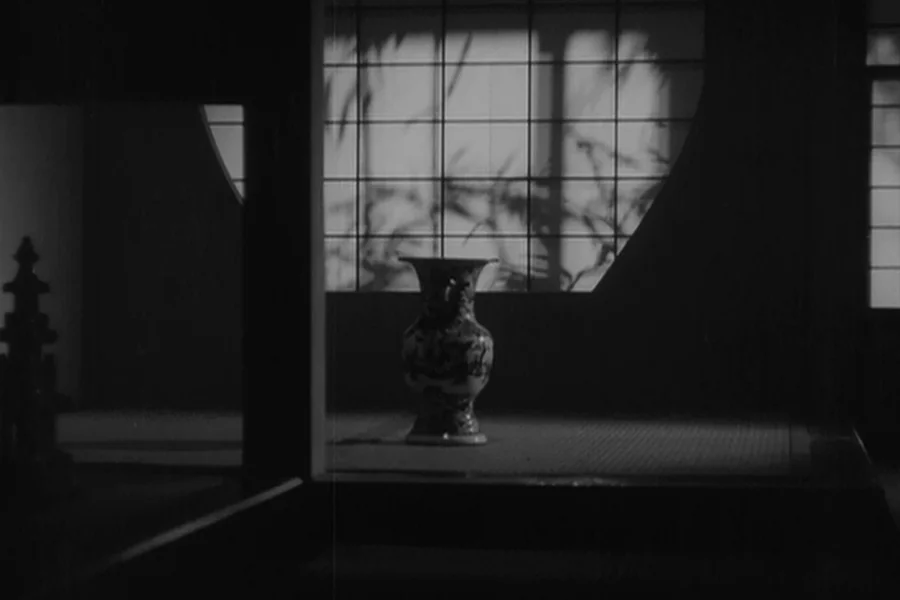
The Kyoto trip is the last holiday father and daughter take together. They spend the day with Shukichi’s old friend Onodera, who has remarried, and Noriko, who disapproved of his remarriage back home, changes her mind about it.
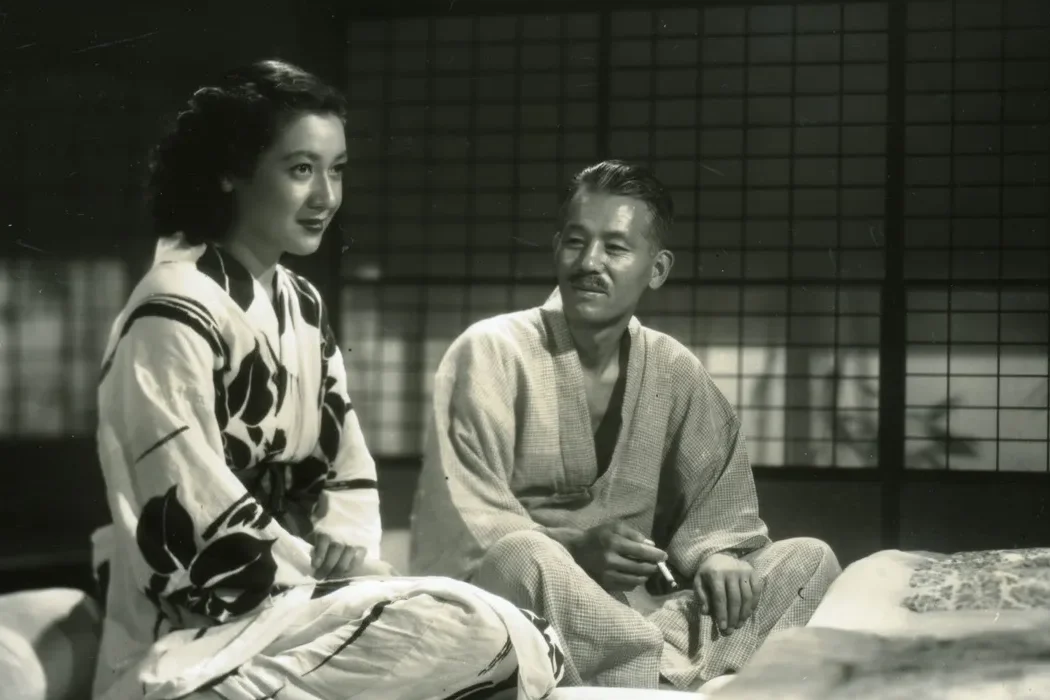
That night, at the inn, comes the most argued over minute in Ozu’s work. Lying on her futon beside her father’s, Noriko looks up towards the ceiling and seems to smile. Ozu cuts to a vase in the darkened room, standing before a paper window lit from outside, for about six seconds. When the camera returns, Noriko looks sad and close to tears. Then comes the vase again, held for about ten seconds as the music rises.
In an essay called The Riddle of the Vase, the film scholar Abé Mark Nornes says nothing in all of Ozu’s films has sparked such conflicting explanations. Some see the vase as a symbol of the traditional Japan that Noriko is about to leave behind. The French philosopher Gilles Deleuze saw it as an image of time itself, unchanged while Noriko moves from a half smile to tears.
The next day, Shukichi and Onodera sit at the Ryoanji rock garden and talk about how daughters grow up and leave their fathers.








The apple and the waves at the end of Late Spring
On her wedding day Noriko thanks her father and leaves in a hired car. After his drink with Aya, Shukichi comes home to the empty house, sits down and begins to peel an apple in one long strip. The peel breaks, and his hands go still. The film then cuts to waves breaking on a beach, and ends.
There are no tears and no speech. Shukichi has got what he wanted for Noriko and lost the life they shared, and Ozu leaves the audience to feel that through one unfinished task and the sea.
What the American censors changed in Late Spring
Late Spring was made under the Allied Occupation of Japan, when scripts had to pass American censors. The historian Kyoko Hirano, in her 1992 book Mr Smith Goes to Tokyo, records that they objected to the custom of arranged marriage meetings as feudal. A reference to bomb ruins in Tokyo was taken out, and the city became merely “dusty”.
Signs of the Occupation still made it on screen. On the bicycle ride, Noriko and Hattori pass a Coca-Cola sign and a road sign giving a 30 ton weight limit for a bridge, which the film historian Lars-Martin Sorensen reads as pointed reminders of the occupying army. Our feature on the American Occupation and Japanese cinema covers the censorship system in more detail.
Late Spring and the Noriko trilogy
Late Spring came first, followed by Early Summer (1951) and Tokyo Story (1953). In all three, Setsuko Hara plays a young woman named Noriko, and in each she is a different person in a different family. Chishu Ryu appears in all three as well, as her father, her brother and then her father in law.
The three are known together as the Noriko trilogy. Each turns on the same question of what a family owes its members once the children are grown, and watching them in order shows how far Ozu could stretch one situation.
Where to watch Late Spring in the UK
All checked on 12 November 2026.
- BFI Player: on the subscription service, £6.99 a month or £65 a year after a 14 day free trial.
- Plex: free to stream.
- Apple TV: to rent or buy.
- Blu-ray: the BFI release pairs Late Spring with Ozu’s first sound film, The Only Son (1936).
Late Spring is not currently on Netflix or MUBI in the UK.
Questions about Late Spring
A widowed professor in Kamakura and his 27 year old daughter Noriko, who is content to look after him and does not want to marry. To make her go, he pretends that he is about to remarry. She marries, and he returns to an empty house.
No. Late Spring (1949) came four years before Tokyo Story (1953). Both feature Setsuko Hara as a woman called Noriko, but the characters and families are unrelated. With Early Summer (1951) they make up the Noriko trilogy.
Nobody knows for certain, and Ozu’s critics disagree. The two shots come as Noriko lies awake at the Kyoto inn, between a half smile and tears. Readings range from the old Japan she is leaving to the passing of time itself.
No. After the wedding he tells Noriko’s friend Aya that the plan to marry Mrs Miwa was invented to persuade his daughter to marry.
Kakitsubata (The Water Iris), with Umewaka Manzaburo in the lead role. A Noh drummer, Komparu Soemon, suggested it to Ozu because the film is a love story.
On BFI Player’s subscription service, free on Plex, or to rent from Apple TV (checked 12 November 2026). The BFI also sells it on Blu-ray with The Only Son.