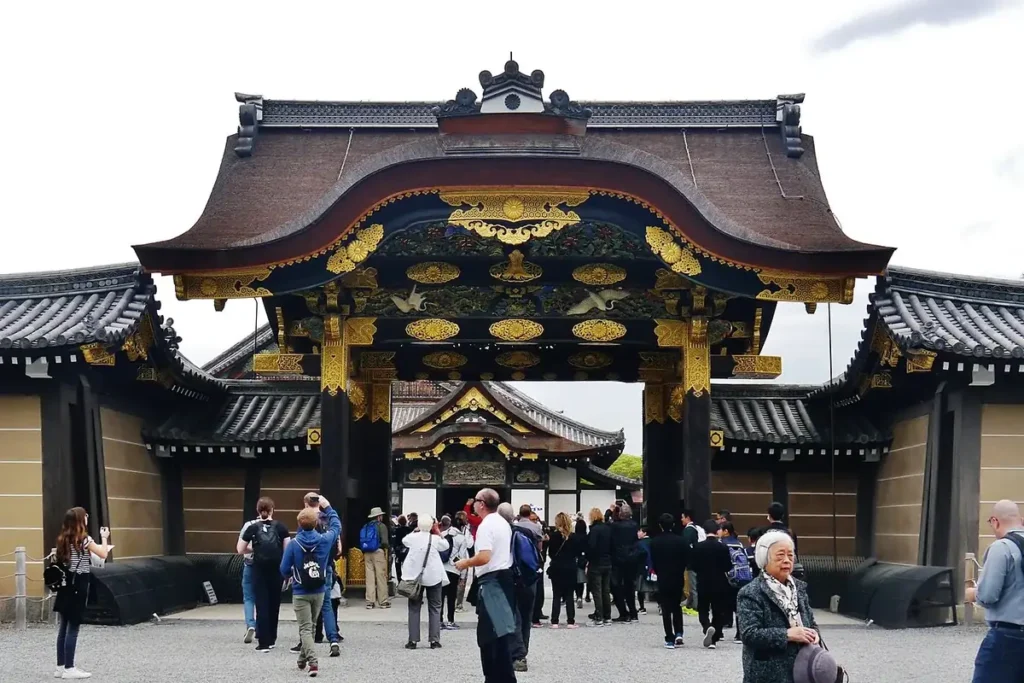
Kiyomizu-dera is the hillside temple in eastern Kyoto with the huge wooden stage built out over the trees, founded in 778 and rebuilt in its present form in 1633. The gates open at 6am every day of the year and adult entry costs ¥500. Closing time moves with the season, from 6pm for most of the year to 9:30pm on special night viewing evenings.
The early opening is the single most useful fact about the place. By 10am the slopes below the gate are some of the busiest streets in Japan, so everything below is arranged around getting you up the hill at the right time, on the right bus, with the right expectations about what is open.
Visiting Kiyomizu-dera: Hours, Stage, Waterfall and Slopes
| Address | 1-294 Kiyomizu, Higashiyama-ku, Kyoto |
| Opens | 6am every day, all year |
| Closes | 6pm most of the year, 6:30pm in July and August, 9:30pm on night viewing evenings (last entry 9pm) |
| Tickets | ¥500 adults, ¥200 primary and junior high school pupils |
| Nearest bus stop | Gojo-zaka (buses 206, 100 and the weekend EX101), then about 10 minutes uphill on foot |
| Time needed | About an hour inside the temple, plus as long as you like on the slopes below |
| Best time | 6am to 8am, before the coaches and school groups |
Kiyomizu-dera opening hours for 2026, month by month
The temple publishes its hours as a table, and the pattern is simple once you see it laid out. These are the temple’s own opening hours for 2026:
| Dates in 2026 | Opens | Closes |
|---|---|---|
| 1 January to 26 March | 6am | 6pm |
| 27 March to 5 April (spring night viewing) | 6am | 9:30pm, last entry 9pm |
| 6 April to 30 June | 6am | 6pm |
| 1 July to 13 August | 6am | 6:30pm |
| 14 to 16 August (summer night viewing) | 6am | 9:30pm, last entry 9pm |
| 17 to 31 August | 6am | 6:30pm |
| 1 September to 20 November | 6am | 6pm |
| 21 to 30 November (autumn night viewing) | 6am | 9:30pm, last entry 9pm |
| 1 to 31 December | 6am | 6pm |
The temple has no closing day. The charm and amulet counters and the desk that writes goshuin (temple seals) start work at about 8am, so an early visitor can walk the grounds two hours before they can buy anything. If you are planning a whole day in the east of the city, the Kyoto travel guide sets out which sights close earliest, and most of them close long before Kiyomizu-dera does.


Tickets and the ¥500 entrance fee
Entry to the paid area, which includes the Main Hall and its stage, costs ¥500 for adults and ¥200 for primary and junior high school pupils, the rates Kyoto City’s tourism association has listed since 1 April 2024. The gate, the three-storey pagoda and the approach are outside the paid area and free to walk. The temple offers no group discount, and a visitor with a Japanese disability handbook can enter free with one companion.
Two extras cost more. The Zuigudo hall near the entrance runs tainai-meguri, a walk through a pitch-dark basement that stands for the womb of a bodhisattva, for a separate fee. And twice a year the temple opens the garden of Jojuin, one of its sub-temples, known as the “Moon Garden”. In autumn 2026 that runs from 21 to 30 November, from 9am to 4pm and again from 6pm to 8:30pm (last entry), at ¥600 for adults and ¥300 for children on top of the normal ticket.
The wooden stage, 13 metres above the hillside
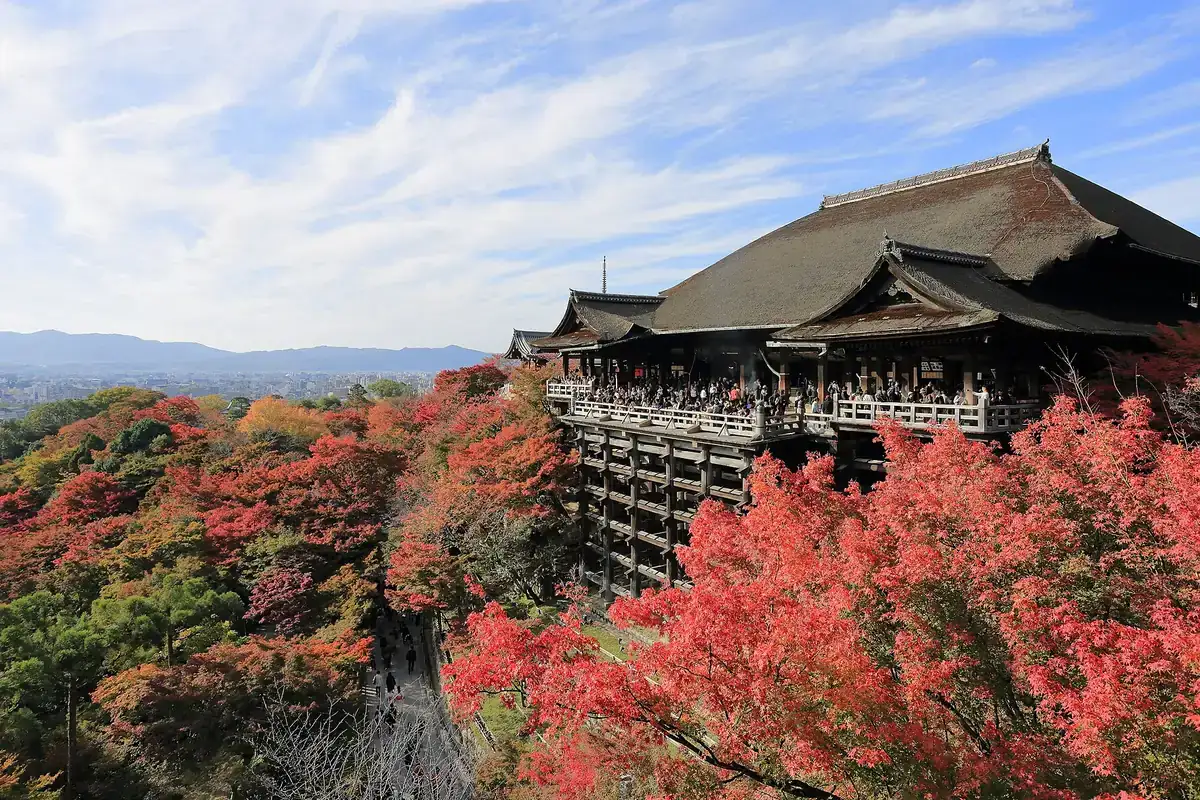
The stage is the veranda of the Main Hall, a National Treasure rebuilt in 1633 on the steep face of Mt Otowa in the Higashiyama hills. The temple says its floor covers about 200 square metres and rests on pillars more than 13 metres tall, about the height of a four-storey building, on a frame of pillars and rails that the temple says works like scaffolding and keeps the hall standing firm through earthquakes. During a 12-year restoration that began in 2008, the floor was relaid with 166 boards of hinoki cypress.
The stage was built for worship. Court music, Noh, kyogen and kabuki have all been performed on it as offerings to the temple’s Kannon, the bodhisattva of compassion. It also gave Japanese a phrase: “to jump off the stage at Kiyomizu” means to take the plunge on a big decision.
For the classic photograph of the stage, walk on past the Main Hall to the Okunoin, the smaller hall that stands directly above the waterfall and has a stage of its own. It was restored in 2017. Looking back from its stage across the trees gives the classic view of the Main Hall, and the photograph at the top of this page was taken from there.
The Otowa Waterfall and what its three streams mean
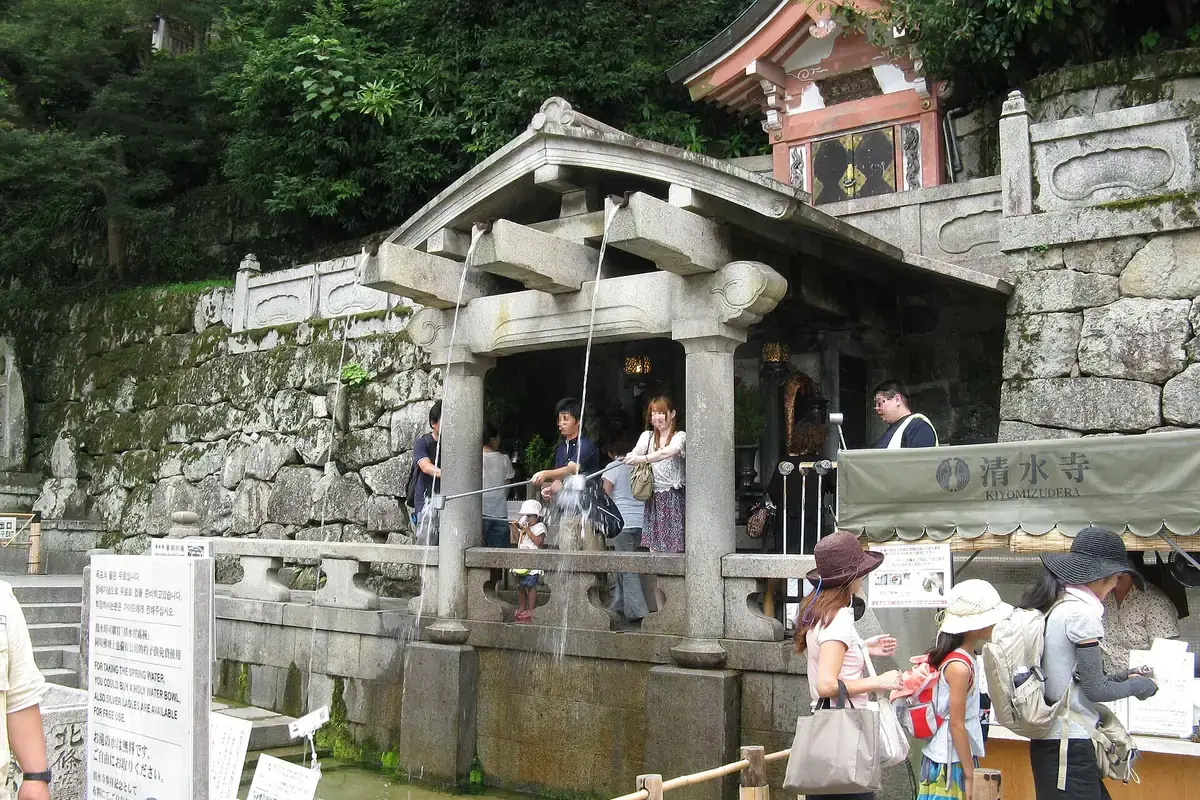
Below the Okunoin, the spring that gave the temple its name falls from a stone channel in three thin streams. Kiyomizu means “pure water”, and the temple’s history says the monk Kenshin found this waterfall on Mt Otowa before the temple existed. Visitors queue to catch the water in long-handled cups.
Most guides, Kyoto City’s official one included, say each stream brings a different blessing: health, long life and success in study. The temple’s own description is simpler. It calls the water golden water and life-extending water, and says visitors catch it in the ladles to purify the six senses and pray for their wishes to come true.
The water has been tied to finding a partner for centuries. In the eighth act of Chushingura, the 18th-century puppet play about the 47 ronin, the women of a roadside inn call out to travellers: “If you would seek a mate, go to the Temple of Kiyomizu, plunge into the Falls of Otowa, and pray for one every day” (Chushingura, translated by Jukichi Inouye, 1917, Act VIII).








Jishu Shrine: closed for restoration, with no reopening date
Jishu Shrine, the matchmaking shrine behind the Main Hall with its pair of “love fortune-telling stones”, is closed. Its own website says the gates are shut for work on its buildings and grounds, and that neither the length of the work nor a reopening date has been set. The shrine still accepts prayer requests by post. Many guides and booking sites still describe it as open, so do not plan your visit around it.
The love tradition has not disappeared from the temple. Zuigudo, the hall with the dark basement walk, enshrines deities of good relationships, safe childbirth and child-raising alongside its main figure.
Night viewings in spring, summer and autumn
Three times a year the temple stays open until 9:30pm, lights the Main Hall from below and sends a single blue beam into the sky, which it says stands for Kannon’s compassion. No booking is needed. In autumn 2026 the night viewing runs from 21 to 30 November, with the evening entry from 5:30pm and the last entry at 9pm.
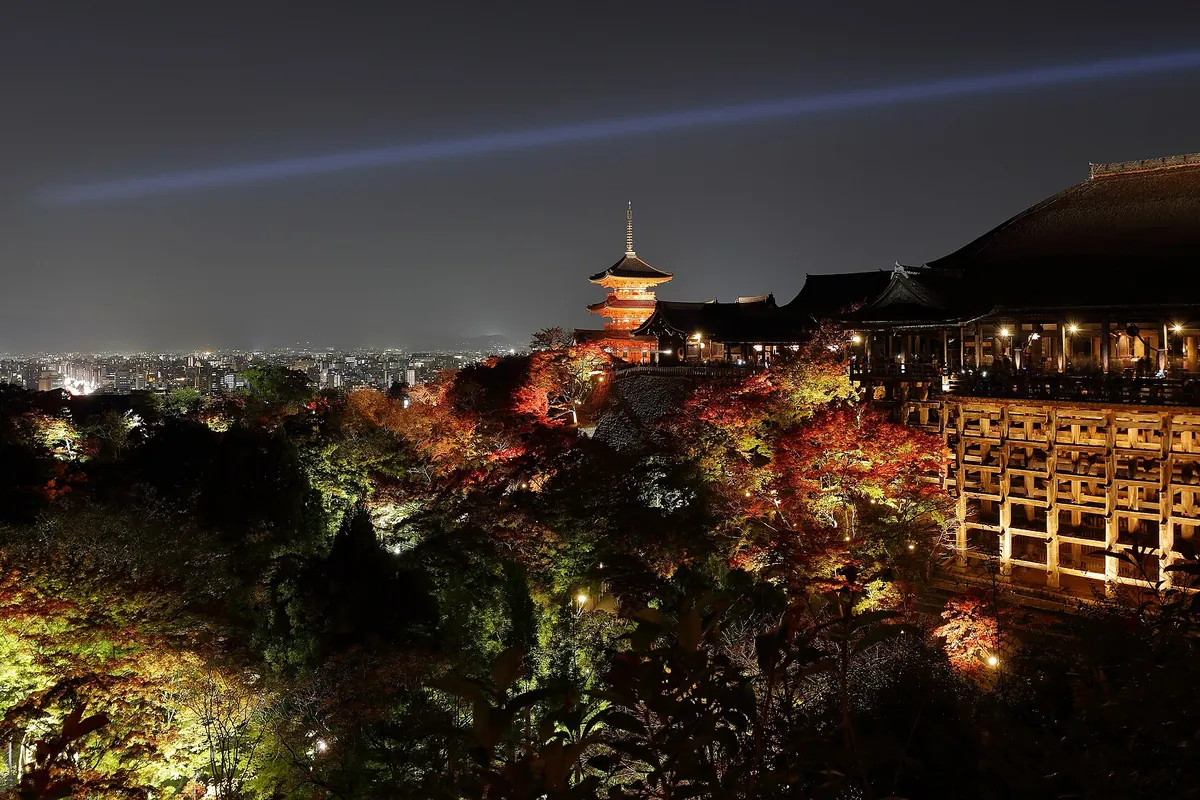
The temple says the dates change every year. Comparing the last two years shows how they move:
| Night viewing | 2025 | 2026 |
|---|---|---|
| Spring (cherry blossom) | 25 March to 3 April | 27 March to 5 April |
| Summer (Sennichi Mairi, the Thousand-day Prayer) | 14 to 16 August | 14 to 16 August |
| Autumn (maple leaves) | 22 November to 7 December | 21 to 30 November |
The temple had not published its 2027 hours by 31 October 2026. On that pattern, expect spring dates in the last week of March and first days of April, the summer dates on 14 to 16 August, and the autumn dates in the second half of November. Kyoto City has arranged extra buses back to Kyoto Station for the autumn 2026 light-up, which tells you how busy these evenings get.
Sannenzaka, Ninenzaka and the slopes below the gate
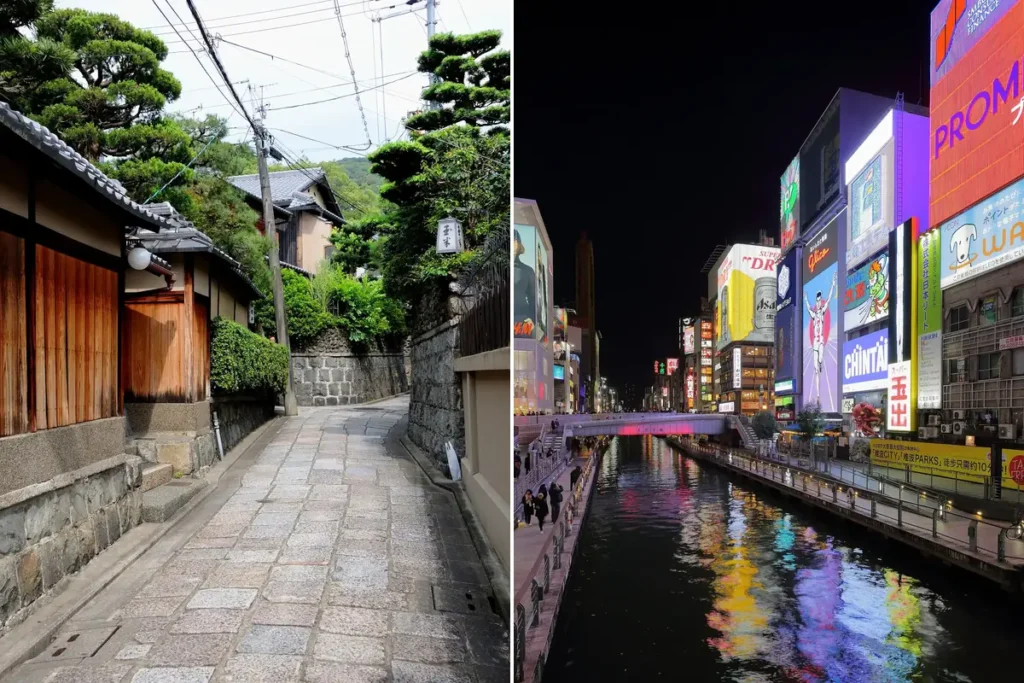
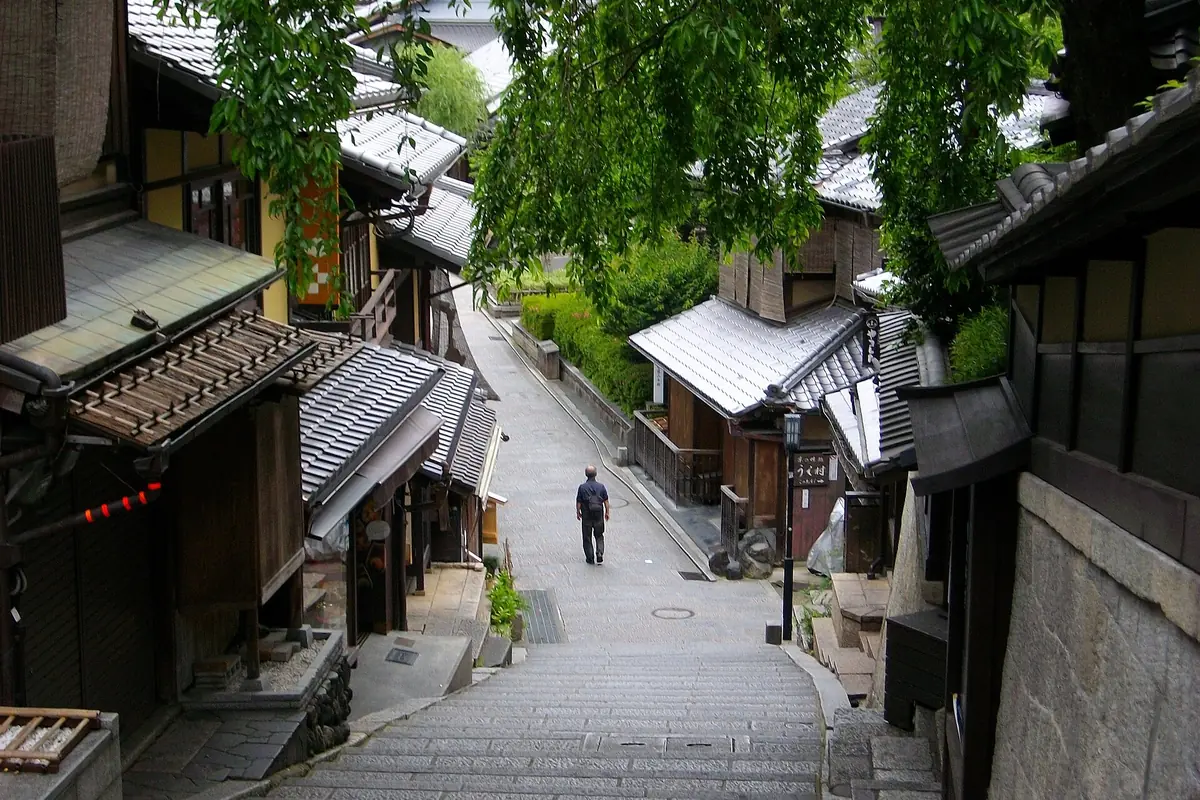
The stone-paved lanes below the temple are part of the Sannenzaka district, one of the first areas in Japan to be protected as a preservation district for groups of traditional buildings, selected on 4 September 1976. Kyoto City’s own description of the district says it began as a gate town serving Kiyomizu-dera, the Yasaka pagoda at Hokan-ji and the Gion shrine, and filled with houses along the paths between them from the middle of the Edo period. It covers about 8.2 hectares.
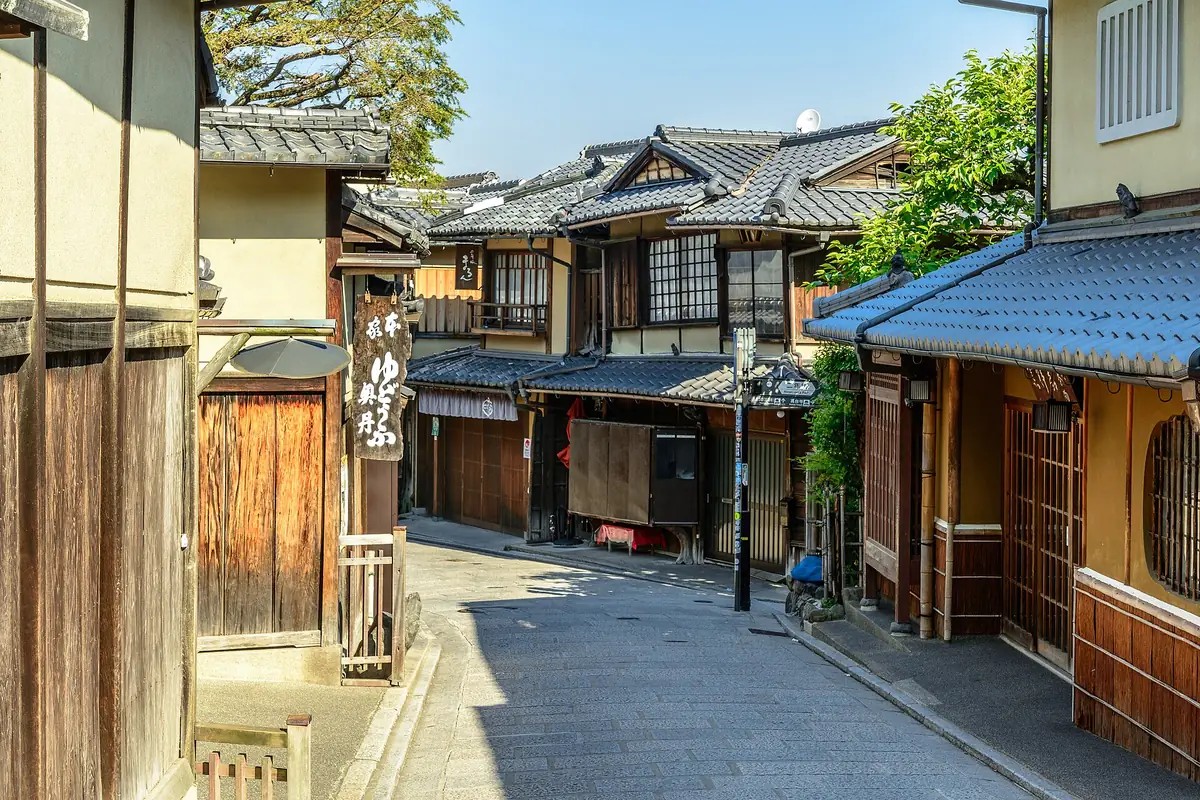
Kiyomizu-zaka, the steepest and most crowded of the slopes, runs straight up to the Nio-mon gate. The travel writer Eliza Scidmore walked it in the 1880s and knew the hill as Teapot Hill, its street “lined on either side of its hilly half-mile with china shops”, where “one may collect his three hundred and sixty-five teapots in an hour” (Jinrikisha Days in Japan, 1891, chapter 23, “Kioto Temples”). Kiyomizu-yaki, one of the Kyoto styles of pottery, grew up here, and Kyoto’s official guide notes that the lanes are still full of ceramics shops.
Sannenzaka (also written Sanneizaka) and Ninenzaka branch off to the north, down a flight of steps, towards the Yasaka pagoda and Kodai-ji. Kyoto’s official tourism site asks visitors not to smoke on these streets, to take litter home and not to stop for long photographs in the way of traffic. Our walking guide to Gion and Higashiyama follows these slopes north through the district, gate by gate.
Getting to Kiyomizu-dera: bus 206, the EX101 and the walk from Higashiyama
The temple warns that there are only two ways onto its grounds: up Kiyomizu-zaka to the Nio-mon gate, or up Chawan-zaka to the emergency road entrance. Its access page says map apps, Google Maps included, sometimes plot a route that does not reach the temple at all, so follow the signs for those two slopes.
- City Bus 206 or 100 from Kyoto Station: get off at Gojo-zaka and walk east for about 10 minutes. The flat city bus fare is ¥230.
- EX101 Sightseeing Limited Express (Saturdays, Sundays and holidays): from stop D1 at Kyoto Station straight to Gojo-zaka in about 10 minutes, every 7 to 8 minutes in the morning. It costs ¥500 for adults, ¥250 for children, and is free with the ¥1,100 Subway and Bus One-Day Pass. The EX100 does the same run and continues to Gion, Heian Shrine and Ginkaku-ji (Kyoto City Bus timetable).
- Okoshi Bus Kiyomizu-dera Line (weekdays): a seated sightseeing shuttle run by Keihan Bus from Kyoto Station and Keihan Shichijo to Gojo-zaka, on weekdays from 1 July 2026 to 29 January 2027, at ¥500 for adults and ¥250 for children. A ¥1,500 ticket adds a guided walk to the stage and the temple entry (Kyoto City official guide).
- Kyoto Bus 18 (Saturdays and holidays): from Kyoto Station towards Ohara, getting off at Gojo-zaka.
- On foot from Kiyomizu-Gojo Station (Keihan Line): about 25 minutes, uphill for the second half.
- The walk in from the north: Kyoto City recommends taking the subway to Higashiyama Station (about 15 minutes and ¥260 from Kyoto Station, changing at Karasuma Oike) and walking south past Shoren-in, Chion-in, Maruyama Park, Kodai-ji, Ninenzaka and Sannenzaka. The whole walk takes 40 to 45 minutes and avoids the bus queues entirely.
Wheelchair users and families with pushchairs should use Chawan-zaka, where vehicles may enter by the emergency road and every public area is reachable by step-free routes. The street in front of the main gate is closed to traffic from 8am to 7pm, and the temple has no car park.
Kyoto City Bus fares are about to change for visitors. The city has announced a “citizen priority” fare for the 2027 financial year (April 2027 to March 2028), with the proposed adult fare for non-residents at around ¥350 to ¥400 and Kyoto residents paying ¥200. The details still need national approval, so check before you travel in 2027.
Map of Kiyomizu-dera
When to go: 6am starts, cherry blossom and autumn maples
The temple’s grounds hold about 1,500 cherry trees and 1,000 maples. Cherry blossom usually peaks from late March to early April and the maples from mid-November to early December, the temple says, though both shift from year to year.
- Go at 6am. Kyoto City’s own tourism guide recommends visiting at opening time, when there are few people about.
- Avoid late morning to mid-afternoon in spring and autumn, when school groups and tours fill the stage.
- Check the crowds live. Kyoto City runs a sightseeing comfort map with hour-by-hour forecasts and a live camera on the Kiyomizu slopes.
- Leave the tripod at your hotel. Drones, monopods and tripods are banned in the grounds, and the temple asks you not to eat or drink while walking around (sealed drinks are fine).
The second day of our 7-day Kyoto itinerary is built around exactly this kind of early start: the Yasaka pagoda at 6am, the slopes before breakfast and Kiyomizu-dera before the coaches.
Pairing Kiyomizu-dera with Gion, Kennin-ji and the Philosopher’s Path
From the Nio-mon gate, Kyoto City’s walking times put Maruyama Park and Yasaka Shrine, at the top of Gion, about 25 minutes away on foot by Sannenzaka, Ninenzaka and Kodai-ji. If you would rather have a guide, a tea ceremony walking tour of Gion starts at Gion-Shijo Station and passes Kennin-ji, the oldest Zen temple in Kyoto.
On a weekend, the EX100 bus carries on from Gojo-zaka to Ginkaku-ji, the northern end of the Philosopher’s Path, in about 20 minutes, which makes a Kiyomizu morning and a canal walk in the afternoon an easy pair.
Kiyomizu-dera questions answered
What time does Kiyomizu-dera open and close?
It opens at 6am every day of the year. In 2026 it closes at 6pm for most of the year, at 6:30pm in July and August, and at 9:30pm (last entry 9pm) during the spring, summer and autumn night viewings. The autumn 2026 night viewing runs from 21 to 30 November. There is no closing day.
How much is the Kiyomizu-dera entrance fee?
Entry to the paid area, including the Main Hall and its stage, is ¥500 for adults and ¥200 for primary and junior high school pupils. The gate, the pagoda and the slopes outside are free. The Jojuin garden opening in late November costs a further ¥600 for adults, and tainai-meguri at Zuigudo has its own small fee.
Is Jishu Shrine open?
No. Jishu Shrine, the matchmaking shrine behind the Main Hall, is closed for work on its buildings and grounds. Its own website says no completion date or reopening date has been set, though it still takes prayer requests by post. You can still visit the rest of Kiyomizu-dera as normal.
How long do you need at Kiyomizu-dera?
Allow about an hour for the paid area: the stage, the Okunoin viewpoint, the Otowa Waterfall and the walk back past the Koyasu pagoda. Add one to two hours for the slopes of Kiyomizu-zaka, Sannenzaka and Ninenzaka below, and longer if you walk on to Gion.
What is the best way to get to Kiyomizu-dera from Kyoto Station?
On Saturdays, Sundays and holidays, take the EX101 bus from stop D1 to Gojo-zaka in about 10 minutes for ¥500. On weekdays, take City Bus 206 or 100, or the Okoshi Bus Kiyomizu-dera Line until 29 January 2027. Then walk about 10 minutes uphill.
What do the three streams of the Otowa Waterfall mean?
Popular belief, repeated in Kyoto City’s official guide, says the three streams bring health, long life and success in study. The temple itself does not split them up: it says visitors catch the water to purify the six senses and pray for their wishes to come true. Expect a queue at busy times.