Obon is Japan’s Buddhist festival for the ancestors, when families welcome the spirits of the dead home for a few days and then send them back. Most of Japan keeps it from 13 to 16 August, which in 2027 runs from Friday 13 to Monday 16 August; Tokyo and some other areas keep it a month earlier, from 13 to 16 July, and Okinawa follows the old lunar calendar.
This guide explains where Obon comes from, what families do on each day, and the public festivals that grew out of it, from bon odori to Kyoto’s five mountain fires, then what it means for travel and where Obon is marked in the UK.
Obon 2027 at a glance
August Obon: Friday 13 to Monday 16 August 2027, in most of Japan.
July Obon: Tuesday 13 to Friday 16 July 2027, in Tokyo and some other areas.
Kyoto’s Gozan no Okuribi: Monday 16 August 2027, from 8pm.
Public holiday: no. Obon is not a national holiday, but many businesses close and the trains are at their busiest. Mountain Day, Wednesday 11 August, is a holiday.
Obon Dates, Customs and Festivals
Ullambana and Mokuren’s Mother: What Obon Is
Obon, or simply Bon, is short for urabon, the Japanese form of the Sanskrit word ullambana. Its Buddhist origin story is told in the Urabon Sutra. Mokuren, one of the Buddha’s disciples, saw his dead mother suffering among the hungry ghosts, where every mouthful of food she lifted turned to fire. The Buddha told him to make offerings to the monks on the fifteenth day of the seventh month, and when he did, his mother was released. Lafcadio Hearn, who heard the story from a young Buddhist student, added the detail that Mokuren saw her “dancing for joy”, and that this was the origin of the bon odori dances (Glimpses of Unfamiliar Japan, First Series, 1894, chapter five, “At the Market of the Dead”).
Japan’s earliest record of the rite dates from 606, and it was held at court in the seventh century. Over time it merged with older Japanese beliefs that the spirits of the ancestors return in the middle of the year, as they do at New Year. That is why Obon is above all a family reunion: people travel back to their home towns, clean the family grave and spend the days with their relatives.


Obon Dates in 2027: 13 to 16 August, or July in Tokyo
Obon was held from the 13th to the 15th or 16th of the seventh month of the old lunisolar calendar. When Japan adopted the Western calendar in 1873, regions chose different answers, and three Obon dates survive. The Heibonsha World Encyclopedia records July Obon as concentrated around Tokyo and parts of Tohoku, and August Obon as the norm in Hokkaido and across the country west of a line through Niigata, Gunma, Saitama and Chiba. Okinawa keeps the lunar date, with eisa drum dances through the streets; in 2026 its last day, Ukui, fell on 27 August, according to the Ryukyu Shimpo. August is now what most people mean by Obon.
| Obon | Where | 2027 dates |
|---|---|---|
| August Obon (tsuki-okure, a month late) | Most of Japan | Friday 13 to Monday 16 August |
| July Obon (new calendar) | Tokyo and some other areas | Tuesday 13 to Friday 16 July |
| Lunar Obon (old calendar) | Okinawa and some other areas | Moves each year with the lunar calendar; 25 to 27 August in 2026 |
| Gozan no Okuribi, Kyoto | Five mountains around Kyoto | Monday 16 August, fires lit from 8pm |
| Mountain Day (national holiday) | Japan | Wednesday 11 August |
Mukaebi, Shōryōuma and Okuribi: Obon Customs Day by Day
Customs vary by town and Buddhist school, but the order of the days is much the same. Jukichi Inouye described a Tokyo family’s Obon in Home Life in Tokyo (1910, chapter 21), and most of it is still recognisable.
The 13th: welcome. The family visits and washes the grave, and at home builds a shōryōdana, a small altar for the spirits, usually on the morning of the 13th. In the evening they burn hemp reeds, ogara, in a shallow clay dish at the gate or the front door. This is mukaebi, the welcome fire, and its light guides the ancestors home. Hearn recorded that some towns lit exactly 108 welcome fires along the shore of their sea, lake or river.
Shōryōuma, the spirit animals. On or beside the altar, many families set a cucumber and an aubergine on legs made of hemp reed or wooden sticks. The cucumber is a horse and the aubergine is a cow: the ancestors ride home quickly on the horse and are carried back slowly on the cow, so that they stay a little longer. Another explanation is that the ancestors ride the horse while the cow carries their luggage.

The 14th and 15th: feeding the guests. Offerings are set out as if for living visitors. Hearn listed sōmen noodles, boiled rice, small dumplings, aubergine and seasonal fruit such as melon, watermelon, plums and peaches, with tea poured for the unseen guests every hour and never fish, meat or wine. A priest often visits to read sutras. Many temples also hold a segaki service, which feeds the spirits who have no family left to remember them.
The 15th or 16th: farewell. The fire is lit again at the gate, this time as okuribi, the send-off fire. Inouye’s Tokyo family lit it on the evening of the 15th, when people lit their pipes from it as a charm against illness of the mouth and stepped over the embers to guard against ailments in the lower half of the body.
Tōrō Nagashi: Lanterns and Spirit Boats on the Water
In many places the spirits are sent off by water. Hearn described small boats of woven barley straw, seldom more than two feet long, loaded with food, a tiny lantern at the prow and incense at the stern, and launched on canals, rivers and the sea until “all the sea sparkles to the horizon with the lights of the dead”. Even then, he noted, the custom had been banned in the big ports, and Eliza Scidmore recorded the same ban in Nagasaki in 1891, after junks and bridges caught fire on festival nights (Jinrikisha Days in Japan, 1891, chapter 36).
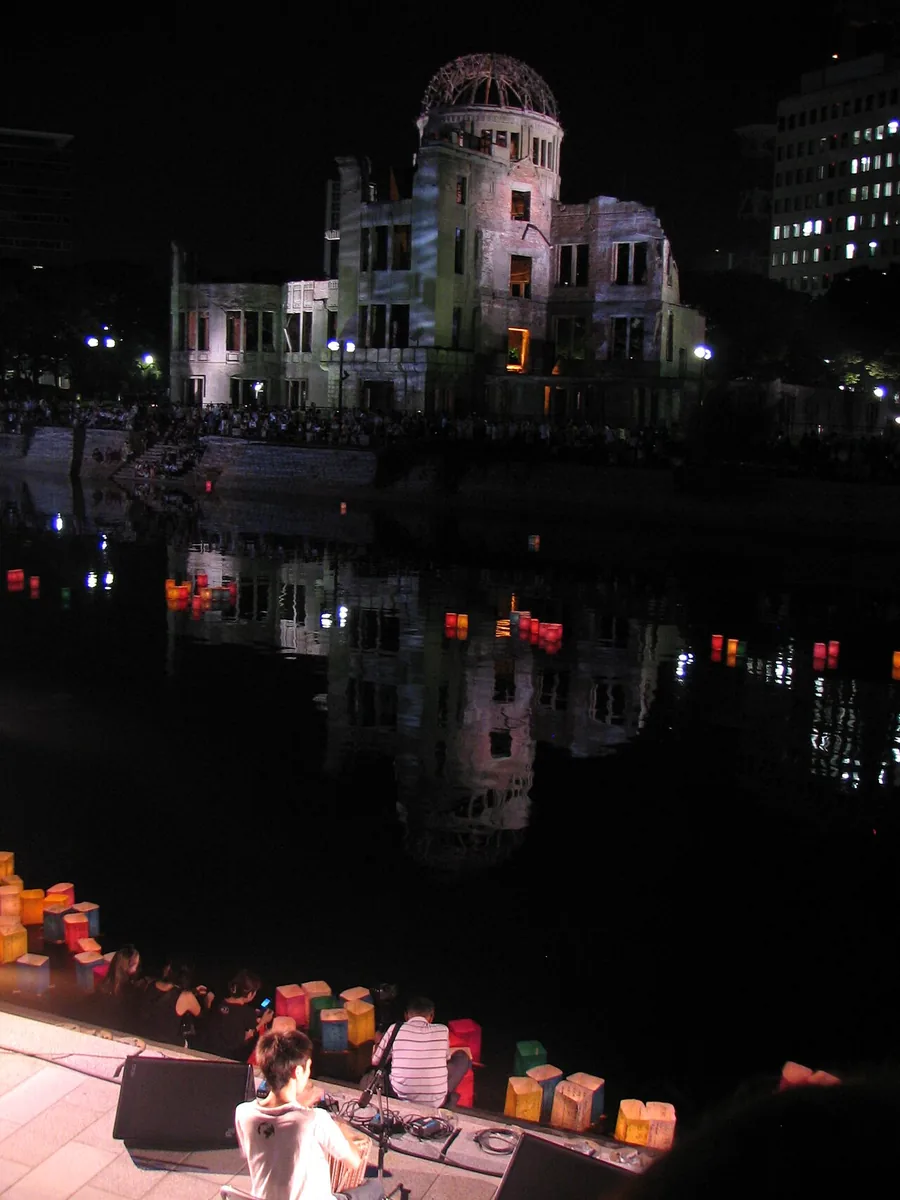
Floating paper lanterns, tōrō nagashi, remains one of the most moving sights of the season. The best known takes place in Hiroshima on 6 August, the anniversary of the atomic bombing, a week or so before Obon. It began in 1947, and about 8,000 lanterns carrying handwritten prayers for peace drift down the Motoyasu River past the Atomic Bomb Dome between 6pm and 9pm, according to Japan’s Tourism Agency.
Bon Odori: The Dance That Sends the Spirits Home
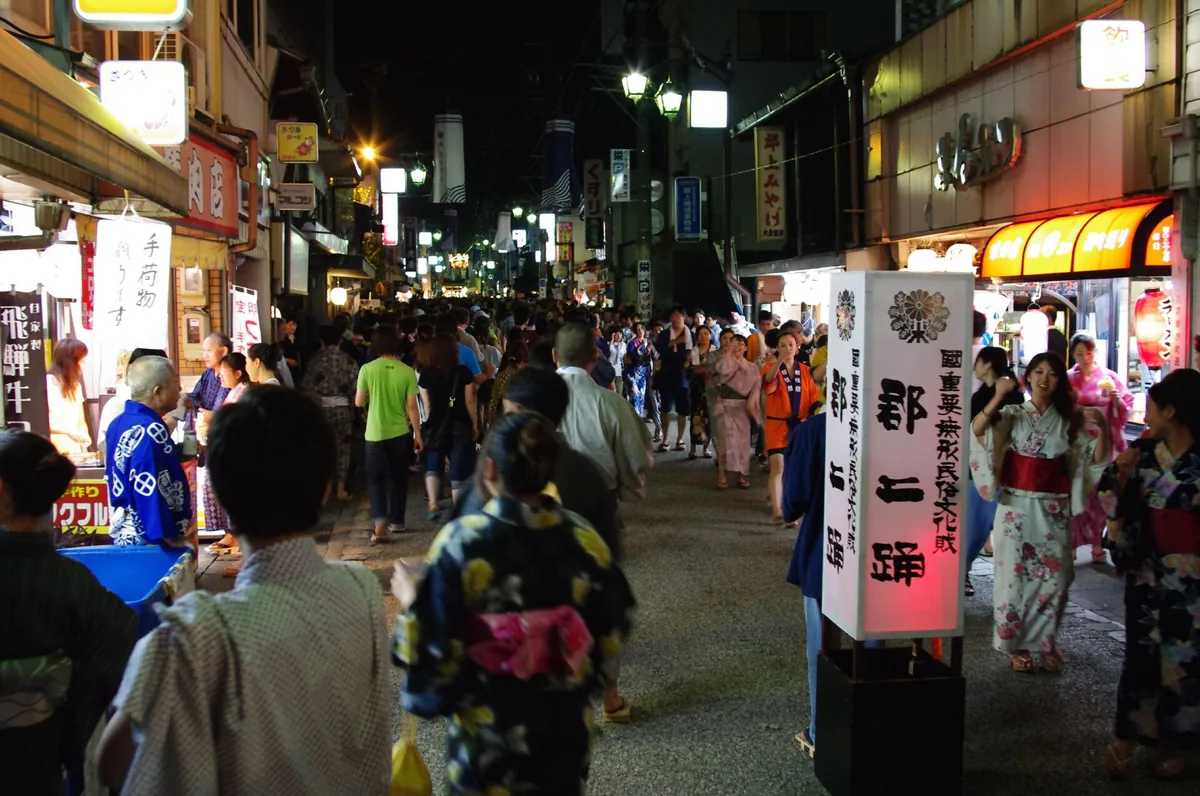
Bon odori is the dance of Obon. People gather in a temple yard, a park or a town square, usually around a raised stand for the drummers and singers, and dance in a circle to local songs. It was first danced to entertain the returning spirits and send them back cheerfully, and from the medieval period it spread with the popular nenbutsu dances, so every region developed its own steps and songs.
Two bon odori festivals are famous across Japan. In Gujō Hachiman, in Gifu Prefecture, the Gujō Odori is danced on more than 30 nights between mid July and early September, and from 13 to 16 August the dancing goes on all night, from evening until dawn. Its origins go back to the 1580s, it is protected by the national government as an Important Intangible Folk Cultural Property, and the local tourism association runs dance lessons during the season, open to people coming on their own. In Tokushima, on the island of Shikoku, the Awa Odori fills the streets from 11 to 15 August; one of its origin stories is that it grew out of the city’s bon odori, and Tokyo has its own version at the Koenji Awa Odori on the last weekend of August.





Gozan no Okuribi: Kyoto’s Five Fires on 16 August
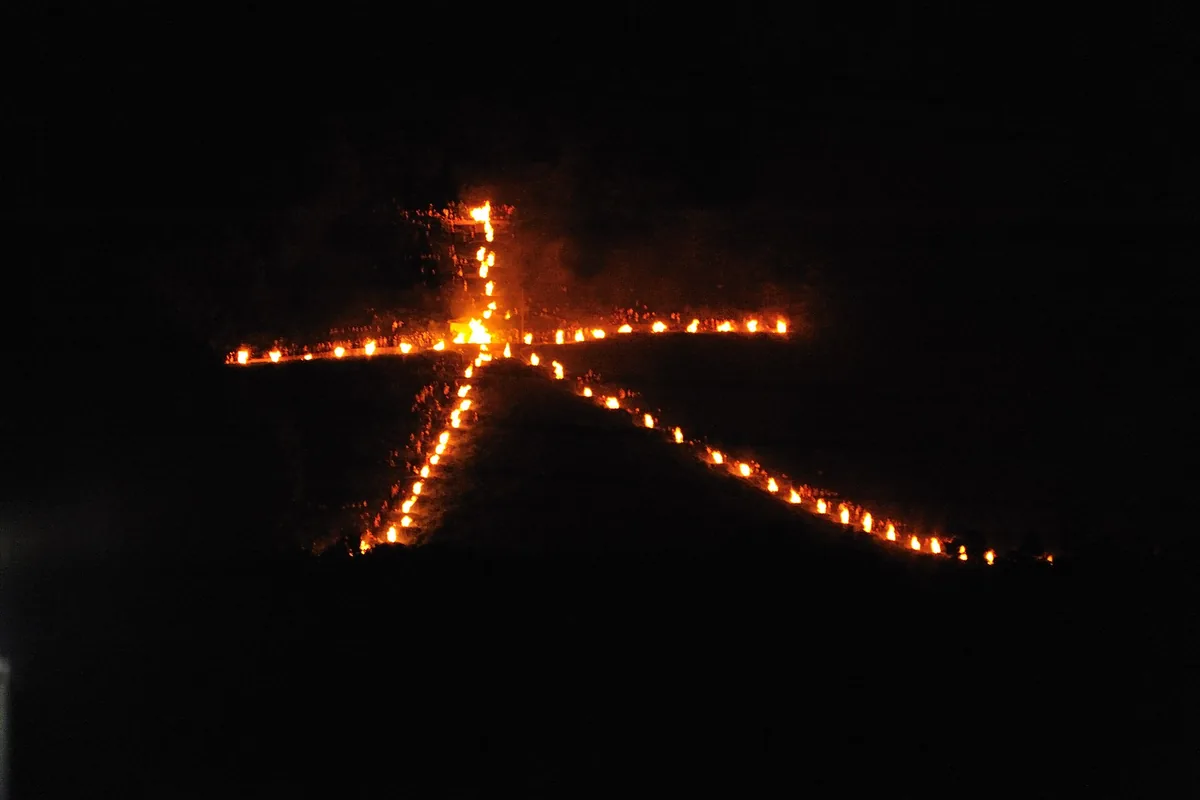
On the last night of Obon, Kyoto sends its ancestors off with five giant fires lit on the mountains around the city. Each fire is the work of a local preservation society, and they are lit one after another from 8pm and burn for about 30 minutes. In 2027, 16 August is a Monday.
| Fire | Mountain | Lit at | Where to watch |
|---|---|---|---|
| Daimonji, the character 大 (great) | Nyoigatake, Higashiyama | 8pm | Kamo River embankment |
| Myōhō, the characters 妙 and 法 | Nishiyama and Higashiyama, Matsugasaki | 8.05pm | Kitayama-dōri |
| Funagata, a ship | Funayama, Nishigamo | 8.10pm | Kitayama-dōri |
| Hidari Daimonji, a second 大 | Ōkitayama | 8.15pm | Nishiōji-dōri |
| Toriigata, a shrine gate | Mandarayama, Saga Toriimoto | 8.20pm | Matsuo Bridge and around Hirosawa Pond |
Eliza Scidmore watched the fires from the upper storey of a Kyoto school in 1891, with 200 children chattering below her. She saw a glimmer “like a waving torch” on the mountainside, then lines of fire running together until the character Dai blazed out, “in outline not unlike a capital A”, followed by the ship, the second Dai and, in the west, a gateway of fire (Jinrikisha Days in Japan, 1891, chapter 24). The five groups have been coordinated since 1956 by the Kyoto Gozan Okuribi Association, which became a public interest foundation in June 2026. The association describes the fires as a religious rite that sends the ancestors welcomed at Obon back to the Pure Land. Our Kyoto guide covers where to stay and what else to see in the city.
Travelling in Japan During Obon 2027
Obon is not on Japan’s list of national holidays, but JNTO counts it among the times when domestic travel peaks and many businesses close or shorten their hours. In 2027 the August Obon days run from Friday 13 to Monday 16 August, and Mountain Day falls on Wednesday 11 August, so the rush is likely to start midweek and run into the weekend.
Shinkansen are the pinch point. During the major peak periods, Obon included, JR Central and JR West make every seat on Nozomi trains on the Tokaido and Sanyo Shinkansen reserved. Holders of an unreserved ticket may stand in the aisles of ordinary cars, and Japan Rail Pass holders cannot use Nozomi at all without an extra ticket; they can take the slower Hikari and Kodama, whose unreserved cars get very full. Book seats early; JR Central publishes the 2027 peak dates on its Nozomi page. Our guide to Japan in August sets Obon against the month’s weather, fireworks and dance festivals.
Obon in the UK: Bon Services at Three Wheels and Brookwood
In London, Obon is kept by Three Wheels, a Shin Buddhist temple with a Zen garden in Acton, whose priest, Rev. Kemmyo Taira Sato, came to Britain in 1993. In 2026 it held Bon memorial services on three days: at Brookwood Cemetery in Surrey on Thursday 13 August, at Hendon Cemetery on Friday 14 August and at the temple itself on Saturday 15 August, with private Bon services available on request.
The Brookwood service has a story of its own. Four young Japanese students who came to study in Britain in the 1860s died of tuberculosis before they could finish their studies, and were buried at Brookwood between 1866 and 1873. Members of the temple have visited their graves since the 1990s. A monument from the Anglo-Japanese Friendship Society of Kagoshima has stood beside them since 1998, and in 2013 a second was unveiled to Professor Alexander Williamson of University College London and his wife Catherine, who welcomed the first Japanese students to Britain and nursed one of the four in their home.
Three Wheels is at 55 Carbery Avenue, London W3 9AB. The nearest Underground station is Acton Town, on the District and Piccadilly lines. The temple opens for its scheduled events, so check its upcoming events page before you go; the 2027 Bon dates will appear there. In October 2026, two Japanese professors spoke about bon odori at a free forum at Goldsmiths in New Cross.
Map of Three Wheels Shin Buddhist Temple
Obon: Questions and Answers
Obon is the Buddhist festival when Japanese families welcome the spirits of their ancestors home and then send them back. Families clean the family grave, light a welcome fire called mukaebi, set out food offerings at a small altar and dance bon odori, then light a send-off fire called okuribi. The name comes from urabon, from the Sanskrit ullambana.
In most of Japan, Obon runs from Friday 13 to Monday 16 August 2027. Tokyo and some other areas keep the July Obon, from Tuesday 13 to Friday 16 July 2027. Okinawa follows the old lunar calendar, so its date moves each year; in 2026 it ended on 27 August. Kyoto’s Gozan no Okuribi fires are lit on Monday 16 August 2027.
No. Obon is not on the Cabinet Office list of Japan’s national holidays. In practice it is the summer holiday for many families: JNTO notes that many businesses close or shorten their hours and domestic travel peaks. Mountain Day, on 11 August, is the nearest national holiday, and in 2027 it falls on a Wednesday.
They are shōryōuma, spirit animals for the ancestors. The cucumber, on legs of hemp reed or sticks, is a horse so the spirits can hurry home, and the aubergine is a cow so they return slowly and stay a little longer. Another explanation is that the ancestors ride the horse while the cow carries their luggage.
Bon odori is the circle dance of Obon, danced to local folk songs in temple yards, parks and town squares. It began as a way to entertain the returning spirits and send them off cheerfully. Famous examples include the Gujō Odori in Gifu, danced all night from 13 to 16 August, and the Awa Odori in Tokushima from 11 to 15 August.
Gozan no Okuribi is the send-off for the spirits in Kyoto on 16 August, when five giant fires are lit on the mountains around the city: the character 大 on Nyoigatake at 8pm, then 妙 and 法, a ship, a second 大 and a shrine gate at five-minute intervals. Each burns for about 30 minutes. In 2027, 16 August is a Monday.
It is a rewarding time for festivals, with bon odori, lantern floating and Kyoto’s fires, but it is one of the busiest travel periods of the year. Shinkansen are crowded, every seat on Nozomi trains is reserved at the peak, and some shops and restaurants close. Book trains and rooms early, and keep the 13th to the 16th flexible.
Three Wheels, the Shin Buddhist temple at 55 Carbery Avenue in Acton, holds Bon memorial services each August. In 2026 they took place at Brookwood Cemetery on 13 August, Hendon Cemetery on 14 August and the temple on 15 August, with private services on request. The nearest Underground station is Acton Town. Check the temple’s events page for 2027.