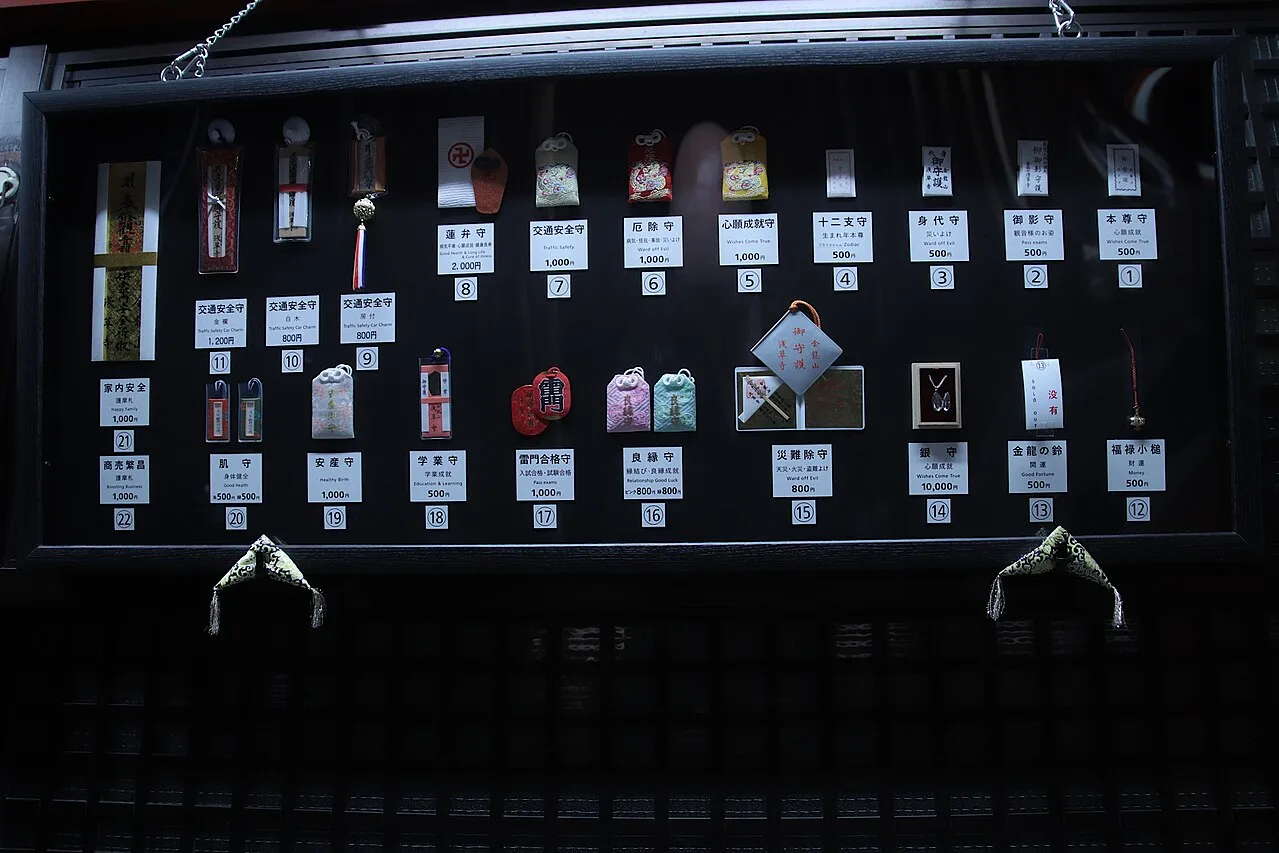
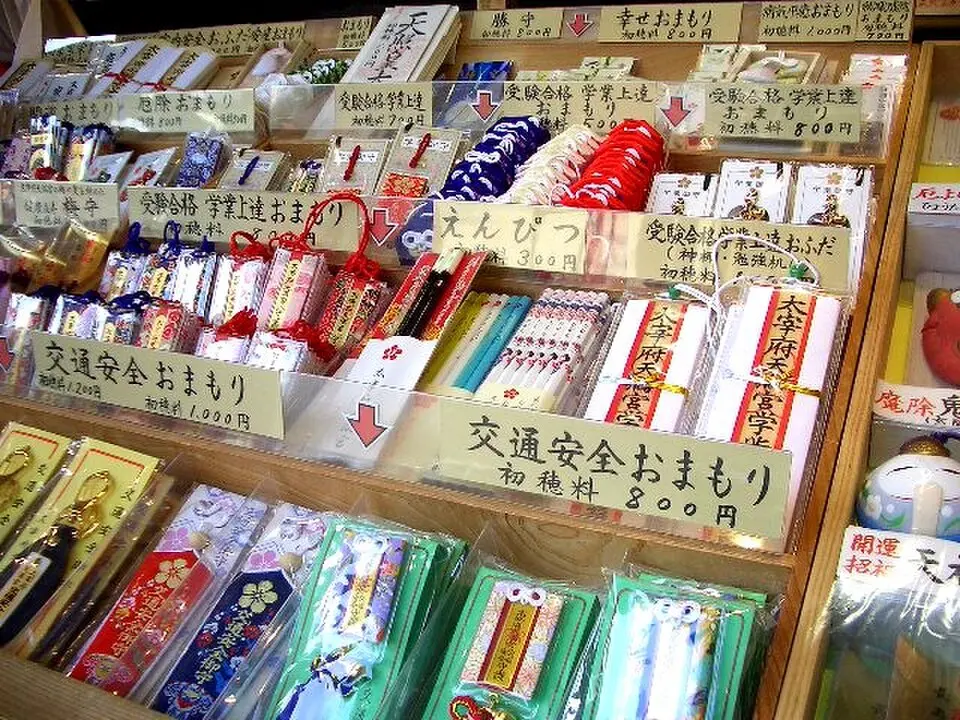
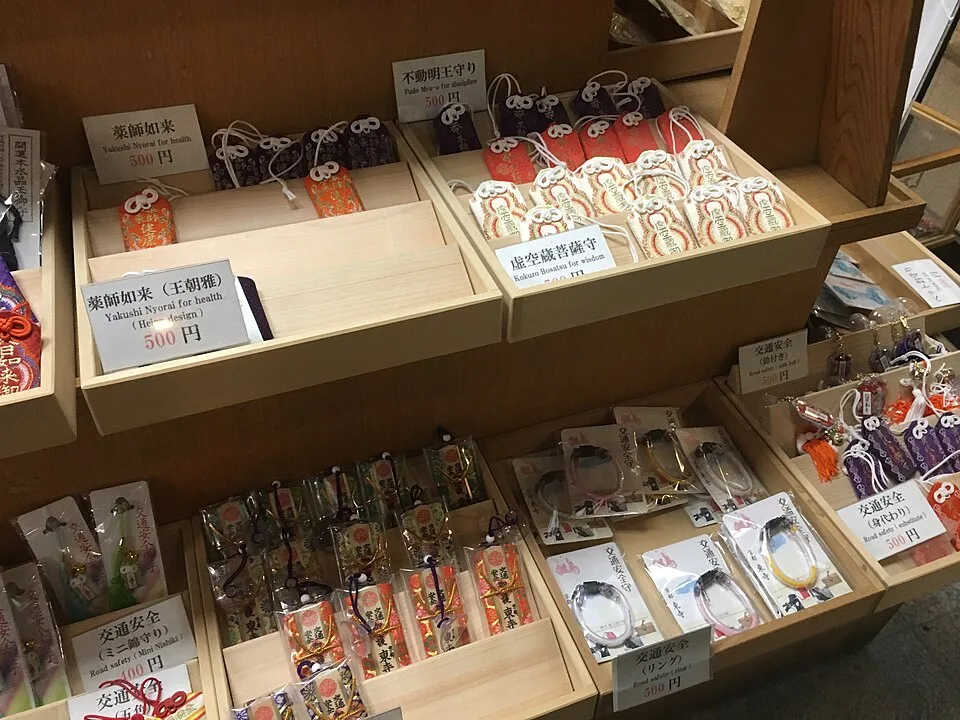
Omamori are small charms, usually a brocade pouch on a cord, that Shinto shrines and Buddhist temples in Japan give out to protect the holder or help with one particular wish, such as safe driving or passing an exam. Most cost ¥500 to ¥1,500. You carry one closed, and after about a year it goes back to a shrine or temple to be burned.
Below are the main types with real examples and prices from shrine and temple price lists checked on 1 November 2026, how to carry and return a charm, which shrines are known for which omamori, and what you can buy in the UK.
Omamori at a glance
Name: お守り, from mamoru, to protect.
Where: the charm counter (juyosho) of a shrine or temple; shrines list the price as hatsuhoryō, an offering.
Typical price: ¥500 to ¥1,500, with car charms and special designs higher.
How long: about a year; Fushimi Inari Taisha asks visitors to renew charms once a year.
Afterwards: return it to a shrine’s box for old charms, where it is burned in a sacred fire.
Omamori Types, Shrines and How to Return Them
Omamori and Ofuda: The Pocket Charm and the House Talisman
An omamori is the charm you carry. Its larger relative, the ofuda, is a paper or wooden talisman bearing the shrine’s name that stays at home, usually on a kamidana, the household shrine shelf described in our guide to Shinto in daily life in Japan. Many shrines sell both side by side; Yushima Tenmangu in Tokyo even offers sets that pair an omamori with an ofuda.
The word has always covered a lot of ground. Writing in 1899, Lafcadio Hearn noted that mamori had as many meanings as the English word amulet, and described being shown a tiny figure of Kannon in an iron case that an officer had carried through the Satsuma war of 1877; it had stopped a bullet, and the dent was still visible. In the fishing town of Yaizu, Hearn saw boats with Shinto or Buddhist charms fixed to their high prows, including written charms from what he called the temple of the Goddess of Fuji.
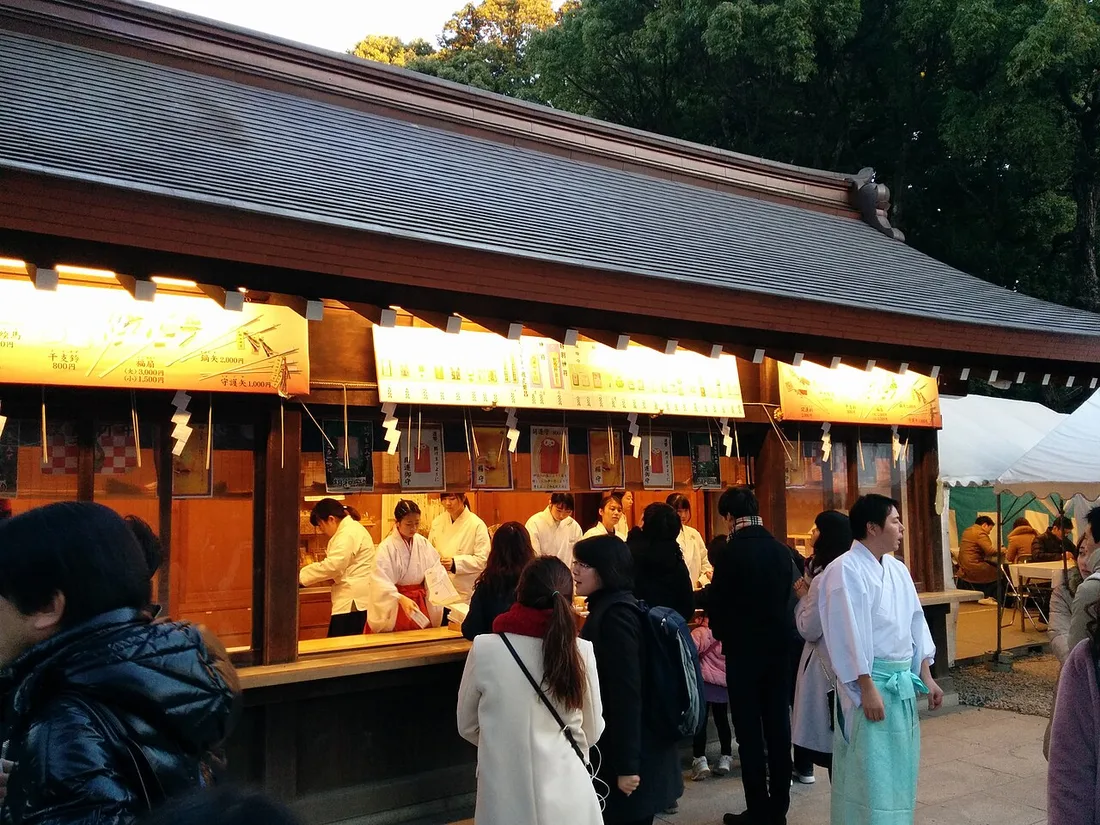
Shrines and temples both give out omamori. At Meiji Jingu in January, shrine staff in white robes hand charms across a long wooden counter to a queue of visitors.


Omamori Types and What Each One Protects
Most omamori name their purpose on the front, so learning a few words tells you what you are looking at. The examples below come from each shrine’s or temple’s own price list, read on 1 November 2026.
| Type | Japanese | Protects or helps | Example, with price |
|---|---|---|---|
| Kōtsū anzen | 交通安全 | Traffic safety, for drivers and travellers | Fushimi Inari Taisha car charm (shatai mamori), ¥1,500; Yushima Tenmangu traffic safety charm, ¥1,000 |
| Kenkō and byōki heiyu | 健康 / 病気平癒 | Good health, and recovery from illness | Yushima Tenmangu health charm, ¥1,000, and recovery charm, ¥1,500; Tokyo Daijingu silk health charm, ¥1,000 |
| Gakugyō jōju and gōkaku | 学業成就 / 合格 | Study, and passing exams | Yushima Tenmangu academic charm, ¥1,000; Fushimi Inari Taisha study charm, ¥800 |
| En-musubi and ren’ai jōju | 縁結び / 恋愛成就 | Finding a partner, and love | Tokyo Daijingu lily of the valley charm, ¥800; Yushima Tenmangu matchmaking charm, ¥1,000 |
| Kin’un and shōbai hanjō | 金運 / 商売繁昌 | Money, and a thriving business | Fushimi Inari Taisha business charm, ¥1,000; Yushima Tenmangu money luck charm, ¥1,000 |
| Anzan | 安産 | A safe birth | Tokyo Daijingu, ¥800; Yushima Tenmangu, ¥1,500 |
| Yakuyoke | 厄除 | Warding off misfortune | Yushima Tenmangu omamori and ofuda set, ¥1,500 |
| Kaiun | 開運 | General good fortune | Yushima Tenmangu, ¥1,000, or a shell charm for ¥500 |
Some charms are newer than they look. Kanda Myojin in Tokyo, a short walk from the electronics shops of Akihabara, sells an IT charm (¥1,000) to protect computers and guard against information leaks, and Yushima Tenmangu’s range includes a Hello Kitty good fortune charm at ¥800.
Choosing an Omamori: Match the Wish to the Shrine’s Deity
Most shrines sell charms for many purposes, but each is known for what its deity looks after, and visitors go to the shrine whose deity matches their wish. Tenmangu shrines enshrine Sugawara no Michizane, the scholar and statesman revered as the god of learning, so students head there before exams. Inari shrines are linked with business and the household: Fushimi Inari Taisha describes its blessings as prosperity in business and safety at home. Kanda Myojin’s business talisman names Daikoku and Ebisu, gods of good fortune and trade, and Tokyo Daijingu enshrines the musubi deities, who preside over the binding together of all things, which is why so many of its charms are for love.
For a gift, choose the purpose for the person: a study charm for a student, or a traffic safety charm for a new driver. Omamori sit in the same family as the daruma doll, which is also bought for a goal and handed back to a temple at the end of the year.
How to Carry an Omamori, and Why It Stays Closed
Keep it close to whatever it protects. Meiji Jingu’s guidance, published in the Japan Tourism Agency’s multilingual explanation database, says an omamori can be attached to a bag, purse or pocket, or kept inside one, until it has fulfilled its purpose, and that it should not be opened. Car charms belong in the car: Naritasan Shinshoji asks drivers to place the talisman from its car blessing somewhere in the vehicle where it will not get in the way of driving.





Returning an Omamori After a Year: The Old Charm Box and Otakiage
An omamori has a working life of about a year. Fushimi Inari Taisha asks visitors to receive new ofuda and omamori once a year, and the Meiji Jingu text explains that charms are usually returned once they have done their job or after more than a year, often around New Year before new ones are bought. Because omamori are sacred, throwing one in the bin is discouraged. Shrines keep a box for old charms, house talismans and the decorative hamaya arrows of New Year, and everything collected is burned in a sacred fire, the ceremony known as otakiage. The box is for these items only, never for rubbish.
The burning is an old custom. Helen Gunsaulus, describing the New Year festival in 1923, wrote that it closed with the burning of the kadomatsu pine decorations and other New Year ornaments on the 14th or 15th day of the first month, and many shrines still hold their fire rituals in mid January. When a wish comes true, Yushima Tenmangu and Naritasan Shinshoji both invite a thank-you visit, called orei mairi, and that is a natural moment to hand the charm back.
If you are back in the UK when the year is up, keep the charm safe until your next trip to Japan and return it then. If you are unsure whether a shrine will take a charm from somewhere else, ask at its charm counter.
Famous Shrines and Temples for Particular Omamori
Yushima Tenmangu, Tokyo: study and exams
Yushima Tenmangu, in Bunkyo near Ueno, enshrines Sugawara no Michizane and offers prayers for exam success. Its price list runs from the ¥1,000 academic charm to study pencils, a headband for academic success and a charm for children’s school bags. The charm counter to the right of the main hall opens from 9am to 5pm and the shrine office to the left from 9am to 7.30pm, every day. See Yushima Tenmangu’s charm list.
Dazaifu Tenmangu, Fukuoka: the head Tenmangu shrine
Dazaifu Tenmangu calls itself the head shrine of all Tenmangu shrines in Japan, and its study charms and study pencils are aimed at students before entrance exams. It holds a special prayer festival for exam success every October, with prayers offered through the month.
Tokyo Daijingu: lily of the valley charms for love
Tokyo Daijingu, near Iidabashi, is closely linked with Ise Jingu and is known for love charms. Its most popular is the en-musubi lily of the valley charm (¥800), shaped like the white flower whose meaning in Japanese flower language is that happiness will come. Others include a pair of interlocking charms whose lids fit together (¥1,000) and a key-shaped charm (¥1,200).
Meiji Jingu, Tokyo: the camphor-scented love charm
Alongside its traffic safety and study charms, Meiji Jingu’s counter offers one of its own: the sowa mamori, a love charm scented with camphor from the shrine grounds and linked to the Meoto Kusu, the pair of husband and wife camphor trees in the inner precinct.
Kanda Myojin, Tokyo: business and an IT charm
Kanda Myojin, the guardian shrine of old Edo, sells business success charms (¥1,000, or ¥1,500 with a business card case) and its IT charm for computers. It also runs an online charm office. See Kanda Myojin’s charm list.
Fushimi Inari Taisha, Kyoto: business and car charms
The head shrine of Inari, famous for its tunnels of torii gates, offers business prosperity charms (¥1,000), a charm for the car body (¥1,500), a charm for cyclists and the person (¥1,000) and a study charm (¥800). It is also the shrine that spells out the once-a-year rule. See Fushimi Inari Taisha’s omamori page.
Naritasan Shinshoji, Chiba: car blessings
Naritasan Shinshoji is a Buddhist temple near Narita Airport with its own hall for car blessings. The hall blesses the car and then the driver, for an offering of ¥5,000 or ¥10,000, with no booking needed, from 8am to 4pm on weekdays and 8am to 5pm at weekends and on holidays. Its signature charm (¥500) is said to take misfortune on itself in place of the person who carries it. See Naritasan Shinshoji’s car blessing page.
Osaka has its own favourites: our guide to Namba Yasaka Shrine covers the lion-head stage and its lion-themed charms.
Can You Buy Omamori in the UK?
A shrine’s own omamori can only be received at that shrine or through its own postal service, and the postal services we checked are for addresses in Japan. Tokyo Daijingu states that it posts charms within Japan only, and Yushima Tenmangu and Fushimi Inari Taisha take payment by cash registered post, a Japanese domestic service. We could not find a shrine or temple in the UK that gives out omamori.
What you can buy in the UK are omamori-style charms made as gifts. The Japan Nakama shop sells omamori lucky charms in seven designs, from Success in your Studies to Love and Health and Safety, at £24.99 with free shipping. For a lucky charm that lives on a shelf, the beckoning cat in our guide to maneki neko is the classic lucky charm for a shop or business.
Omamori: Questions and Answers
An omamori is a small charm, usually a brocade pouch on a cord, given out by Shinto shrines and Buddhist temples in Japan to protect the holder or help with one wish, such as traffic safety, health, study or love. The word comes from mamoru, to protect. Most cost ¥500 to ¥1,500; Yushima Tenmangu’s academic charm, for example, is ¥1,000.
About a year. Fushimi Inari Taisha asks visitors to receive new ofuda and omamori once a year, and Meiji Jingu’s guidance says charms are usually returned once they have done their job or after more than a year, often around New Year before new ones are bought. Old charms go into the shrine’s box for old charms and are burned.
No. Meiji Jingu’s guidance, published in the Japan Tourism Agency’s multilingual database, says omamori should not be opened. Keep it closed and attached to a bag, purse or pocket, or inside one, until it has fulfilled its purpose. When the year is up, return it to a shrine, where it will be burned.
Take it back to a shrine or temple and put it in the box for old charms, where it is burned in a sacred fire known as otakiage, often in January. The Meiji Jingu text says omamori are sacred, so throwing one in the bin is discouraged, and the box is for charms, house talismans and hamaya arrows only, never for rubbish.
Look for gakugyō jōju (学業成就, study) or gōkaku (合格, passing) charms, ideally from a Tenmangu shrine, which enshrines Sugawara no Michizane, revered as the god of learning. Yushima Tenmangu in Tokyo sells its academic charm for ¥1,000, and Dazaifu Tenmangu in Fukuoka, the head Tenmangu shrine, holds a special prayer festival for exam success every October.
Not from a shrine. A shrine’s omamori can only be received there or through its own postal service, and the services we checked serve Japanese addresses only. We found no UK shrine or temple that gives them out. UK shops sell omamori-style gift charms, including the Japan Nakama shop’s seven designs at £24.99 with free shipping.