Hinamatsuri (雛祭り), the Doll Festival or Girls’ Day, is held in Japan on 3 March, when families with daughters set out tiered displays of hina dolls dressed as the Heian imperial court and pray for their girls’ health and happiness. In 2027 it falls on a Wednesday; it is not a public holiday, and it is also known as Momo no Sekku, the Peach Festival.
This guide explains where the custom came from, which doll sits on which tier, the food served on the day, and when the dolls go up and come down. It ends with where to see displays in Japan and the one place in London where a hina-matsuri palace is on show.
Hinamatsuri 2027 at a glance
Date: Wednesday 3 March 2027 (not a public holiday). Other names: Momo no Sekku (the Peach Festival) and Jōshi no Sekku. Dolls go up: from mid January to February. Dolls come down: on a fine day between 4 March and mid April. Festival food: chirashi-zushi, clam soup, hishi-mochi, hina-arare and shirozake. In London: a 19th century hina-matsuri palace model at the Young V&A, free.
Hinamatsuri Dolls, Food and Displays
Hinamatsuri 2027: Wednesday 3 March, the Peach Festival
Hinamatsuri began as Jōshi, a spring festival from ancient China when people bathed in rivers to wash away bad luck. In Japan it took the name Momo no Sekku because peach trees blossomed around that time under the old calendar, and in China the peach was believed to ward off evil. Florence Du Cane, writing in 1908, said no Girls’ Festival was complete without a branch of peach blossom in the vase in the alcove.
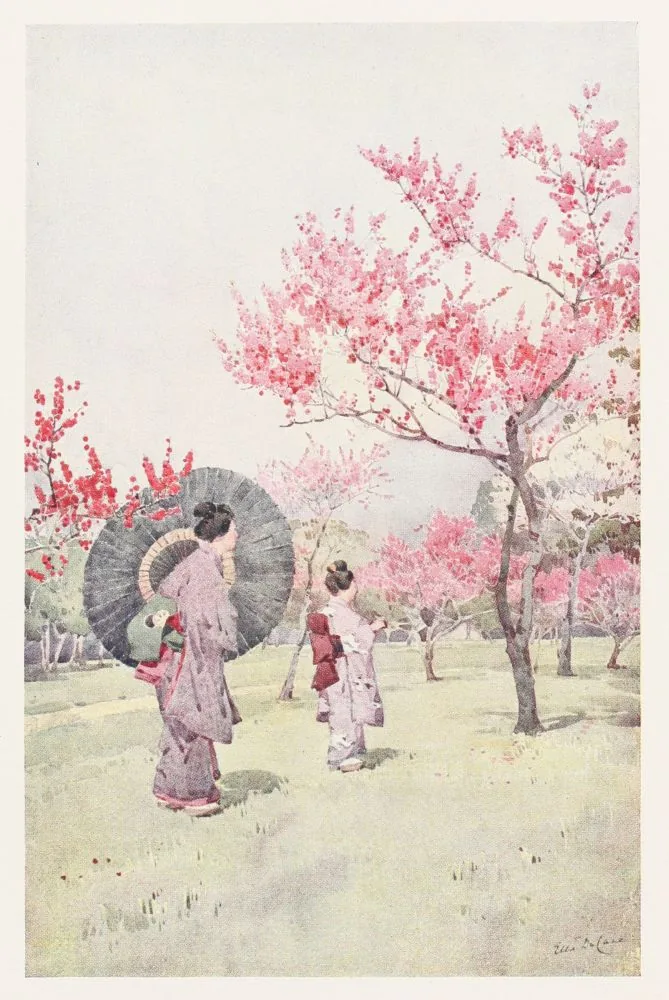
Today the festival is on 3 March in most of Japan. Hinamatsuri is absent from the Cabinet Office’s list of 2027 national holidays, so schools and offices are open and the celebration happens mainly at home. Some towns, such as Gujō Hachiman in Gifu, keep the old calendar and display their dolls around 3 April instead.


From Paper Kamibina to Tiers of Court Dolls
The dolls began as stand-ins. Etsu Inagaki Sugimoto, who grew up in a samurai family in snowy Echigo, explained in A Daughter of the Samurai (1925) that in early Shinto belief a person seeking purification bathed in a stream, then sent a substitute, and finally used a pair of figures, male and female, standing for the whole family. They were cut from paper and called kamibina, paper dolls. Her mother’s family kept a pair of them that could never be sold or given away, and Sugimoto wrote that no doll set, however grand, was complete without them.
Children of the Heian aristocracy also played house with small dolls, a game called hiina asobi, and the two strands merged. The doll maker Yoshitoku describes how the custom reached Japan in the Nara period and took its present form between the Heian and Edo periods, and how over time the dolls became charms that celebrate a daughter’s birth, ward off misfortune and protect her. By 1902 the American teacher Alice Mabel Bacon could call it the feast most loved in the whole year, and she described a Tokugawa lord’s house where five or six red-covered shelves, perhaps 20 feet long, were filled with dolls collected over hundreds of years.
Who Sits Where on a Seven-Tier Hina Display
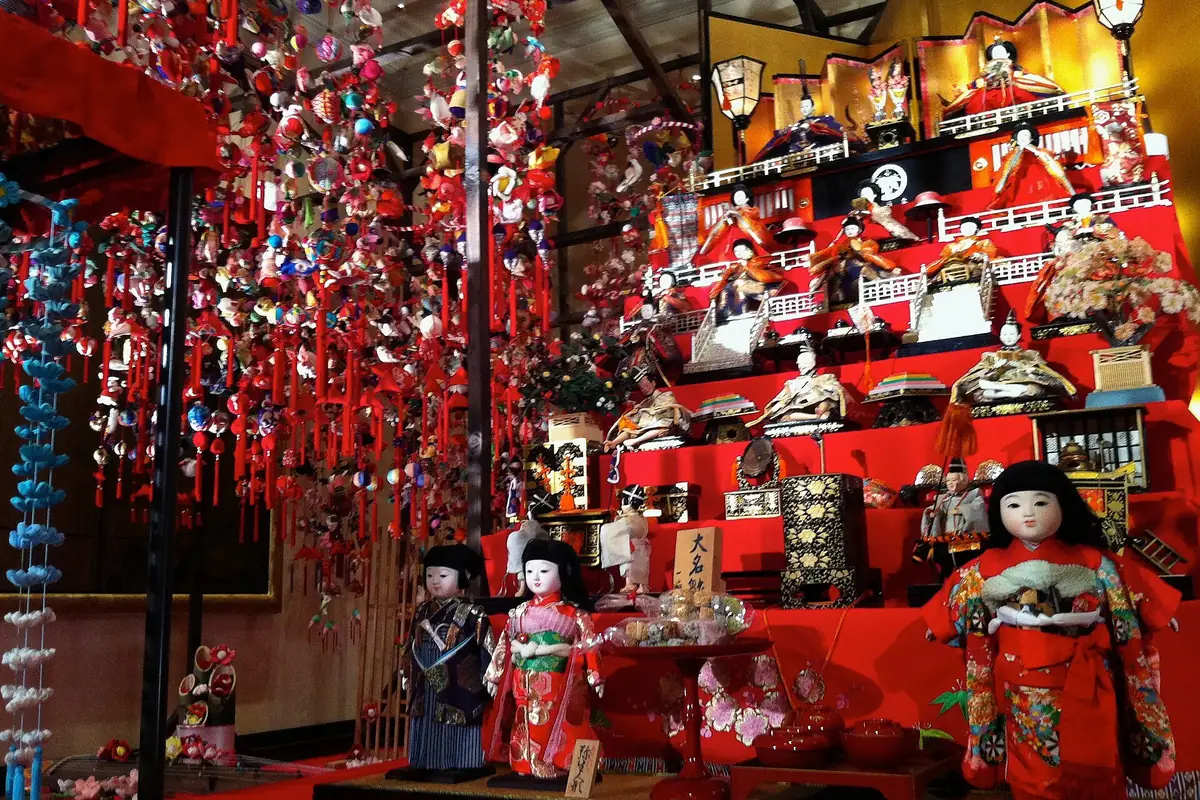
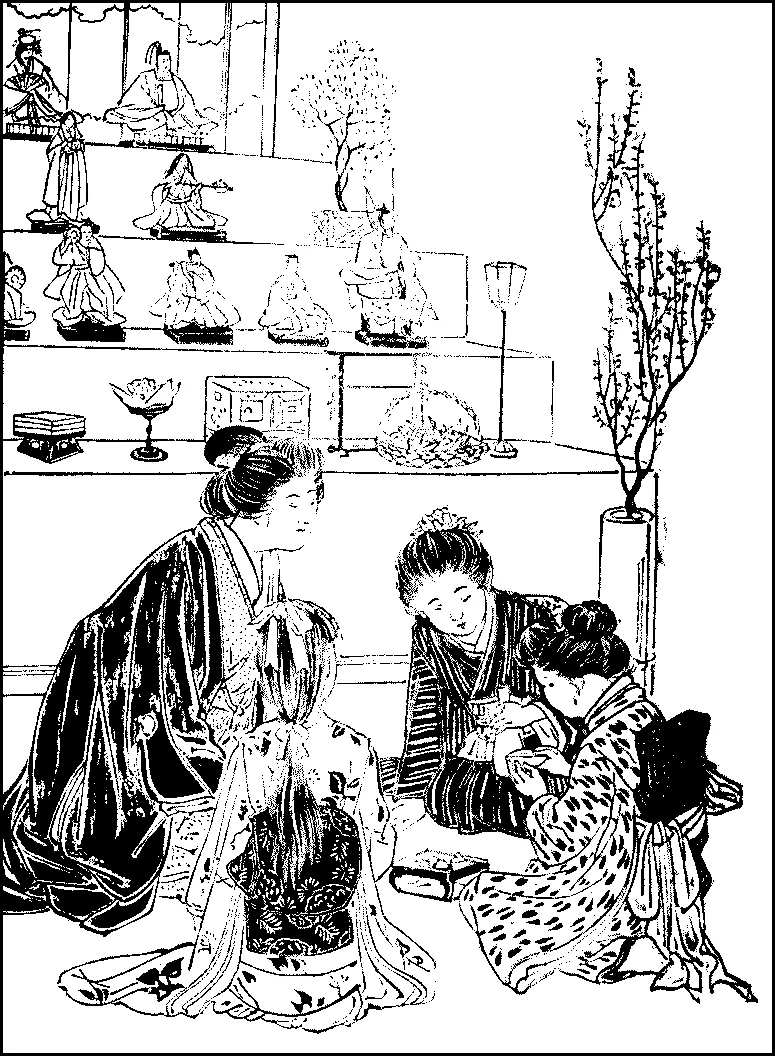
A full display, called nanadan kazari, has seven tiers covered in red cloth, with a folding screen behind the top step. Smaller homes often set out only the imperial couple (shinnō kazari) or a five-doll set on two or three steps. The table shows the full arrangement as the doll retailer Prifua Ningyo lays it out, reading left to right as you face the display.
| Tier | Dolls or objects | What to look for |
|---|---|---|
| 1 (top) | The imperial couple: obina (male) and mebina (female) | Male on the left and female on the right in the usual modern layout; Kyoto-style sets reverse them |
| 2 | Sannin kanjo, three court ladies | The middle lady is seated, has no eyebrows and blackened teeth, and holds a tall stand |
| 3 | Gonin bayashi, five musicians | From left: a drum, a large hand drum, a small hand drum, a flute and a singer |
| 4 | Zuishin, two ministers | A young Minister of the Right on the left and an old Minister of the Left on the right, with a tray table and a diamond-shaped stand for hishi-mochi |
| 5 | Shichō, three attendants | An angry face, a crying face and a laughing face, with a mandarin tree on the left and a cherry tree on the right |
| 6 | Bridal furniture | Chests of drawers, a long chest, a mirror stand, a sewing box, a brazier and tea utensils |
| 7 (bottom) | Carriages | A palanquin, stacked food boxes and an ox-drawn court carriage |
Map of Young V&A
Jukichi Inouye described much the same order in Tokyo homes in 1910: the emperor and empress on the highest shelf with a screen behind them, the court ladies below, then the five musicians and two armed guards, then food on miniature trays and “lilliputian household goods”. The furniture is a bride’s trousseau in miniature, which is why the V&A describes such sets as modelled on the wedding sets in an elite woman’s dowry. The dolls themselves are a specialist craft, and the Edo kimekomi and Edo ishō doll makers are among Tokyo’s traditional craftsmen still at work today.








When Hina Dolls Go Up and Come Down
Families usually set the dolls out from mid January through February; in Kyoto many wait for risshun, the first day of spring, which falls on 4 February in 2027. They come down on a fine day between 4 March and mid April. In 1910 Inouye recorded that Tokyo families put the dolls away on the 6th or 7th of March. Sugimoto wrote that every girl has a doll set and takes it with her when she marries, and Bacon saw sets in old families that were hundreds of years old.
Chirashi-zushi, Clam Soup, Hishi-mochi and Shirozake
Each dish on the Hinamatsuri table carries a wish for the girls of the house.
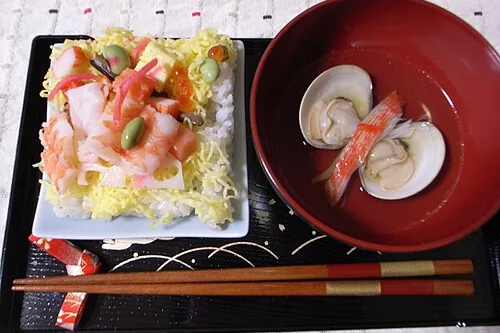
Chirashi-zushi is “scattered sushi”: seasoned rice topped with colourful ingredients. For Hinamatsuri cooks choose toppings with lucky meanings, such as prawns, lotus root and beans. Clear clam soup (hamaguri no osuimono) follows, because a clam shell only fits its own partner, so the pair stands for a happy marriage.
Hishi-mochi are diamond-shaped rice cakes stacked in layers of green, white and pink from the bottom up. The white stands for snow, the green for plants rooting under the snow, and the pink for life. Hina-arare are small puffed rice crackers in pastel colours, which the guides explain as the seasons or as snow, new buds and life; our guide to Japanese sweets and wagashi covers the wider family they belong to.
Shirozake, white sake, is the festival drink. Inouye described it in 1910 as sake lees dissolved in mirin, offered to the dolls and drunk by the family, and Bacon compared it to sweet cider set beside hard cider.
Nagashi-bina: Paper Dolls on the River at Shimogamo Shrine
The oldest form of the festival survives as nagashi-bina, floating dolls. At Shimogamo Shrine in Kyoto, every year on 3 March, simple paper figures of a married couple, called hitogata, take on the bad luck of the children and are set on round straw mats and floated down the Mitarashi stream to pray for their health. Visitors can float a pair for a fee, and the ceremony draws large crowds each year. It is the same idea Sugimoto described: a doll carries the impurity away on the child’s behalf.
Where to See Hina Doll Displays in Japan
Many towns stage public displays, and some use dolls that families have given up, which keeps old sets on show. The calendar below lists displays confirmed by the Kyoto City Tourism Association and by JAL’s seasonal guide; check each one’s dates before you travel. For the rest of the month, see our guide to festivals and things to do in Japan in March.
| Where | When | What you see |
|---|---|---|
| Hōkyō-ji, Kyoto | Hinamatsuri ceremony on 1 March; doll exhibition each spring (March) and autumn (November) | The temple’s own doll collection |
| Shimogamo Shrine, Kyoto | 3 March every year | Nagashi-bina: paper dolls floated on the Mitarashi stream |
| Sanjūsangendō, Kyoto | 3 March | The Shuntō-e Buddhist service, with free admission on the day |
| Echizen Ōno, Fukui | Spring | About 1,000 donated dolls chosen and displayed by a citizens’ committee |
| Chōfu, Shimonoseki, Yamaguchi | Spring | Hanging decorations, and a shrine display of dolls donated since the 1950s stacked to the ceiling |
| Bitchū Takahashi, Okayama | Early April | Dolls including Edo period sets, along Honmachi-dōri, a street of old merchant houses on the former Matsuyama road |
| Gujō Hachiman, Gifu | Around 3 April (old calendar) | Fukuyose-bina: dolls given a second life after their families could no longer display them |
Hina Dolls in London: the Young V&A’s Palace Model
London’s best place to see a piece of a hina display is the Young V&A in Bethnal Green. Its Imagine gallery shows a model palace (goten) made in Japan in the 1800s, which the V&A catalogues as a hina-matsuri stage: hinoki cypress with a gabled roof, painted paper walls, a railed veranda and a flight of five steps. The V&A’s collections database listed it on display in the gallery’s Living Together section, case 3, when we checked on 1 November 2026. The V&A also owns a set of miniature hina furniture of about 1870, catalogued in 118 parts from lacquered chests to tiny kitchen pans, which is in store.
Address: Young V&A, Cambridge Heath Road, London E2 9PA. Nearest Tube: Bethnal Green (Central line). Open: daily 10am to 5.45pm, galleries close from 5pm. Entry: free. Check the object record before you go, since museum displays change.
Hinamatsuri: Questions and Answers
Hinamatsuri falls on Wednesday 3 March 2027. It is not a national holiday, so schools and offices are open and families celebrate at home in the evening. Most of Japan keeps 3 March, but some towns that follow the old calendar, such as Gujō Hachiman in Gifu, display their dolls around 3 April instead.
Hinamatsuri, the Doll Festival or Girls’ Day, is the day families with daughters display hina dolls dressed as the Heian imperial court and pray for the girls’ health and happiness. It is also called Momo no Sekku, the Peach Festival. It grew from an ancient Chinese spring purification and paper dolls that carried away bad luck.
JAL’s seasonal guide gives a fine day between 4 March and mid April. In 1910 Jukichi Inouye recorded that Tokyo families put the dolls away on the 6th or 7th of March. The dolls usually go up from mid January to February, and many Kyoto families wait for risshun, the first day of spring, which is 4 February in 2027.
Chirashi-zushi, sushi rice scattered with lucky toppings such as prawns, lotus root and beans; clear clam soup, because a clam shell only fits its own partner; hishi-mochi, diamond-shaped rice cakes layered green, white and pink; pastel hina-arare rice crackers; and shirozake, a sweet white sake that Inouye described in 1910 as sake lees dissolved in mirin.
On a full seven-tier display the imperial couple sit at the top, with the court ladies on the second tier and the musicians on the third. Ministers and attendants come next, and the bottom two tiers hold miniature bridal furniture and carriages. In the usual layout the male doll sits on the left as you face the display; Kyoto-style sets put him on the right.
The Young V&A in Bethnal Green shows a 19th century hina-matsuri palace model in its Imagine gallery, listed on display in the V&A’s collections database on 1 November 2026. Entry is free and the museum opens daily from 10am to 5.45pm. The nearest Tube station is Bethnal Green on the Central line.
It is also the name of Masao Ōtake’s comedy manga, which began in Enterbrain’s magazine Fellows!, and of its anime, about a yakuza member whose life changes when a strange girl falls onto his head. The title borrows the festival’s name. This guide is about the festival itself, held in Japan every 3 March.