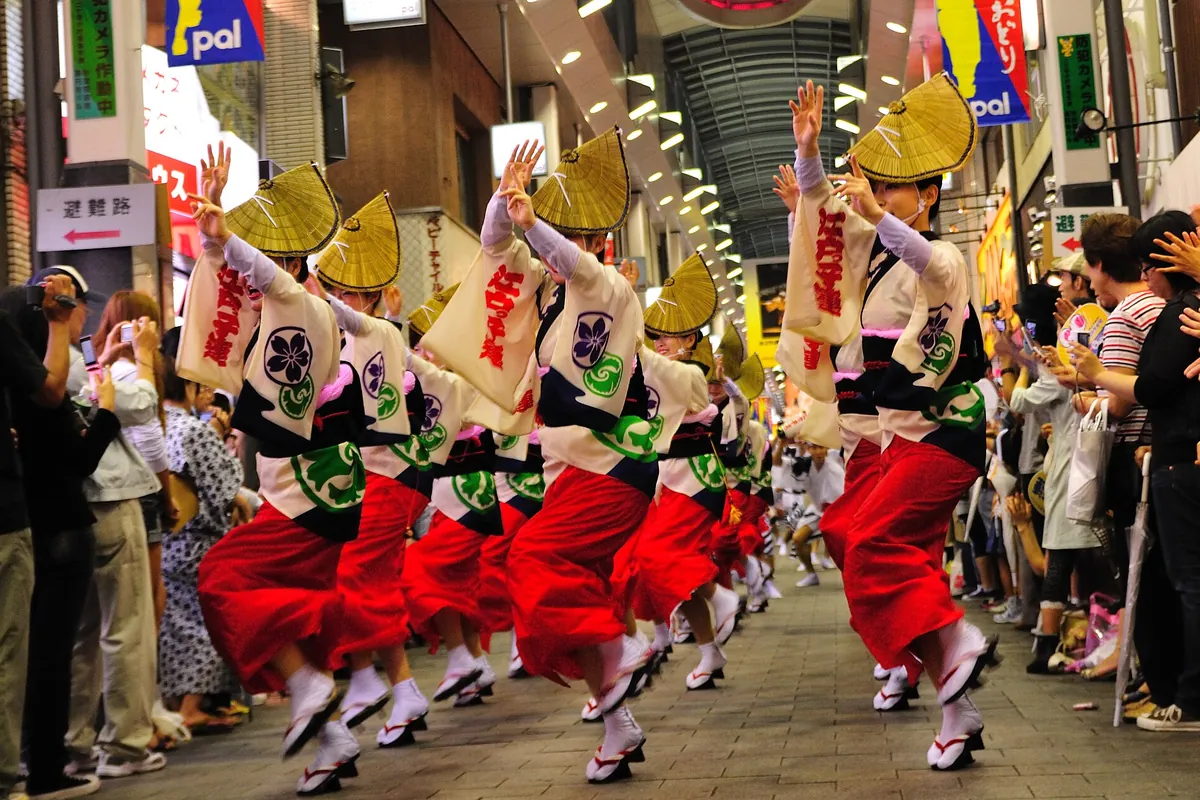
The Tokyo Koenji Awa Odori is a two-evening street dance festival held on the last weekend of August in Koenji, west Tokyo. The 67th edition ran on Saturday 29 and Sunday 30 August 2026 from 5pm to 8pm. On the same pattern, 2027 falls on Saturday 28 and Sunday 29 August, though the organisers had not confirmed it by the end of October 2026. Watching from the pavement costs nothing.
The dance itself comes from Tokushima on the island of Shikoku, where the original Awa Odori has been danced for more than 400 years. Koenji borrowed it in 1957 to bring shoppers back to its high streets, and its organisers now call it the face of Tokyo’s summer: 950,000 people came to watch in 2026.
Koenji Awa Odori Dates, Dance Areas and Tips
| When | Last weekend of August, 5pm to 8pm both days. 2026: 29 and 30 August. 2027: expected 28 and 29 August |
| Where | Shopping streets around JR Koenji and Shin-Koenji stations, plus Konan-dori, in Suginami City |
| Cost | Free from the street. Sponsorship seats ¥10,000 or ¥15,000 per unit |
| Scale in 2026 | 166 ren (troupe) appearances across nine dance areas, 950,000 spectators |
| Stations | JR Koenji (Chuo-Sobu local line) or Shin-Koenji (Marunouchi Line), each about 5 minutes’ walk |
| Organiser | Tokyo Koenji Awa Odori Promotion Association (NPO) |
Koenji Awa Odori dates for 2026 and 2027
The festival always takes the last Saturday and Sunday of August. According to the organisers’ report on the 2026 festival, the 67th Tokyo Koenji Awa Odori ran on 29 and 30 August 2026, from 5pm to 8pm each evening, in light rain on the Saturday and under cloud on the Sunday. It counted 166 ren appearances over the two nights and 950,000 spectators. Suginami City co-hosted, with Tokushima Prefecture and Tokushima City among the supporters.
For 2027, the last weekend of August is Saturday 28 and Sunday 29. The organisers announced the 2026 dates with a short video on their YouTube channel, and that channel and the official site are where the 2027 dates will appear first. Book a room early: two hotels sit right by JR Koenji Station, Hotel Mets Koenji and Koenji Ark Tower, and the organisers suggest looking along the JR and Tokyo Metro lines if both are full.
The Japan in August guide lists the other big dance and fireworks festivals of the month, including the original Awa Odori in Tokushima from 11 to 15 August.

Nine dance areas around Koenji and Shin-Koenji stations
The festival does not happen on one stage. Dancers move through the neighbourhood along routes the English site describes as a giant figure of eight, performing on nine marked stretches of street called enbujo, dance areas. In 2026 they were:
- Chuo (central)
- Higashi (east)
- Junjo, on the Junjo shopping street north of the station
- Pal, on the PAL shopping street south of the station
- Momozono
- Minami (south)
- Look No. 1 and Look No. 2, on Look Street towards Shin-Koenji
- Koen-mae (in front of the park)
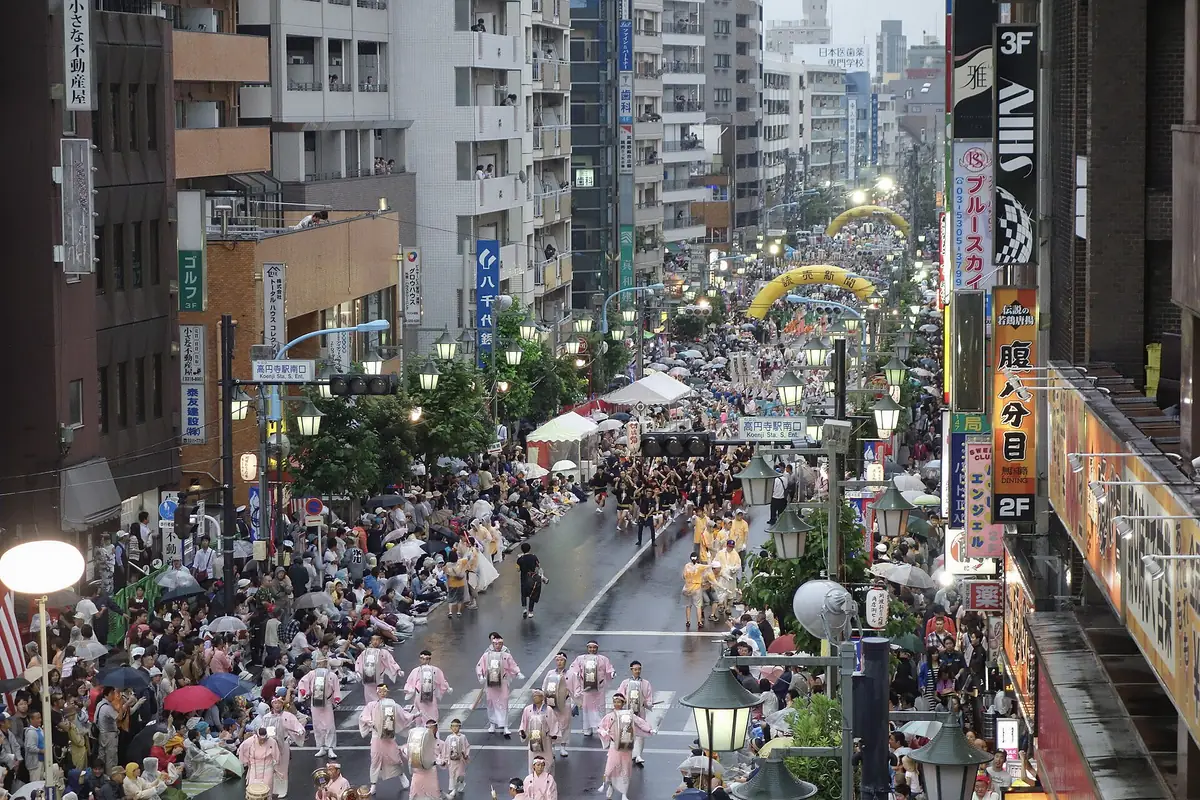
On the narrow shopping streets the dancers pass close by; on wider roads such as Konan-dori you see each ren coming from further away. The organisers’ own tip for children is to stand where the Junjo and Pal dance areas start, or at Look No. 2, where the view is relatively easy, though they point out this is based on past years and not guaranteed.
Every ren is given a starting dance area for each night, published on the official troupe list. If you want to see a particular group, check it before you go and wait there for 5pm. Our Koenji guide maps out the PAL arcade, Junjo Street and Look Street, along with the record shops and izakaya you will want after 8pm.
Ren, the Awa Odori dance troupes of Koenji
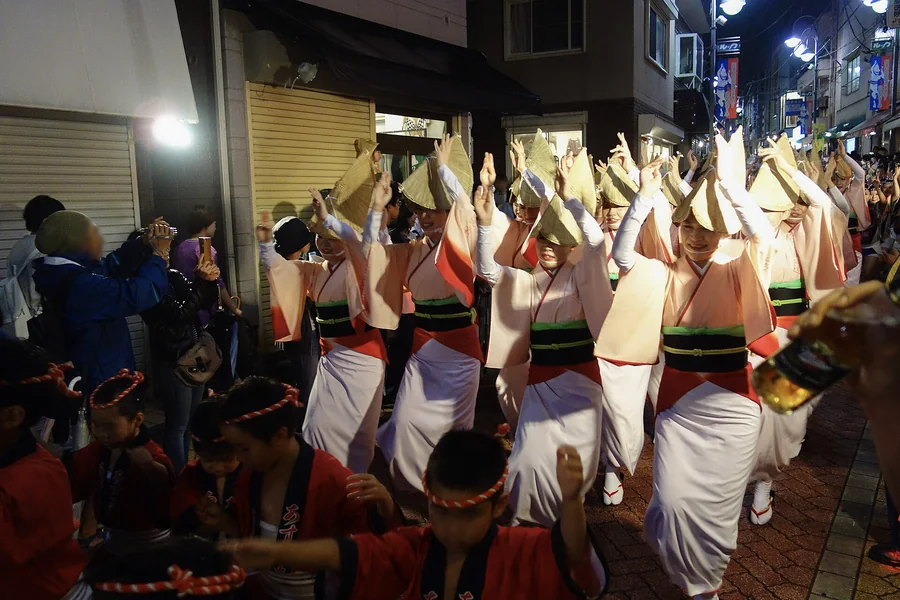
Awa Odori is danced by ren, troupes that each develop their own costumes, music and performance. There are two basic dances. The men’s dance is low and bent at the waist, though plenty of women dance it too. The women’s dance is performed on raised geta sandals in braided straw hats. The organisers sum up the steps simply: raise your hands, and step forward leading with the hand and foot on the same side.
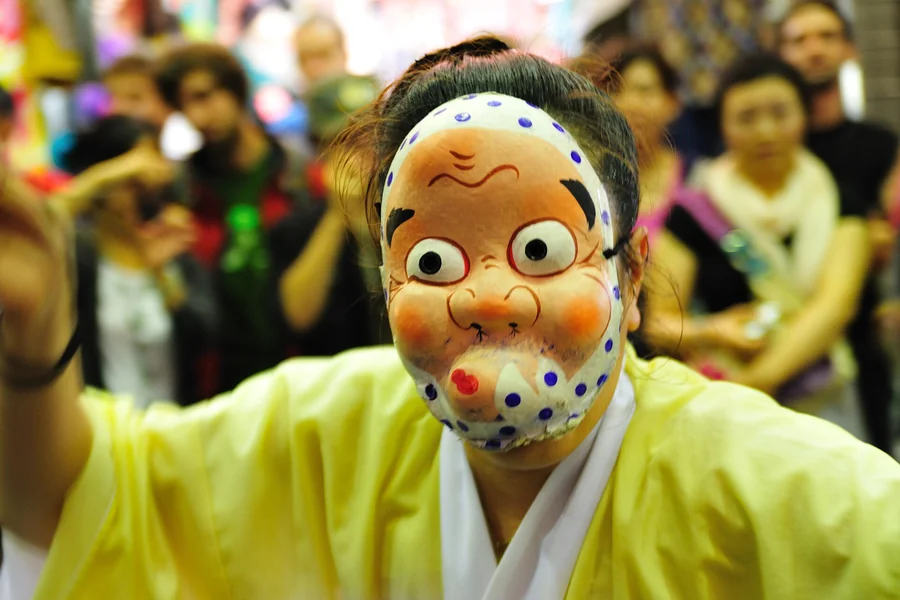
The music is played on the move by each ren’s own band of flutes, shamisen, chimes and large and small taiko. Tokushima’s organisers call the rhythm yoshikono.
Koenji’s own troupes are organised through the Koenji Awa Odori Ren Association, founded in 1981 by 15 local ren and now 31 strong. Among them are Tokyo Tensui-ren (東京天水連), Edokko-ren (江戸っ子連), Aoi Shin-ren (葵新連), Tokyo Shin Nonki-ren (東京新のんき連), Tengu-ren (天狗連) and Hyottoko-ren (ひょっとこ連). Alongside them dance guest ren from across Japan, company ren and ward office ren, and in 2026 a joint troupe from the Tokushima Prefecture Awa Odori Preservation Association together with Tokushima’s Hachisuka-ren (蜂須賀連) and Bushu-ren (武秀連) on the Saturday.
From the PAL shopping street in 1957 to 950,000 spectators
The first Koenji Awa Odori was danced in 1957 in what is now the PAL shopping street, as a way to bring life back to the local high streets. It survived several crises in its early years. By the 1960s the route had reached the north exit of the station, and once the new Koenji Station was finished in 1969 the dancing spilled onto the wider roads around it, according to the organisers’ English history page.
Koenji’s dancers performed for the world when Tokyo hosted the 1991 World Championships in Athletics, with more than 300 of them performing, and today over 250 of them dance at the Hometown Festival Tokyo at Tokyo Dome every January. The festival also has friendship ties with towns including Ojiya in Niigata and Nayoro in Hokkaido, each with its own ren.
One of the three origin stories Tokushima’s organisers give for Awa Odori is that it grew out of the city’s bon odori, the dances of the summer Obon season. Lafcadio Hearn, watching bon odori across western Japan in the 1890s, noticed that no two provinces danced it the same way, with “the motions and gestures” and even the tunes changing from place to place (Glimpses of Unfamiliar Japan, First Series, 1894, chapter six, “Bon-Odori”). Awa Odori is Tokushima’s version, and Koenji is where it took root in Tokyo.


Koenji Awa Odori and Tokushima’s Awa Odori compared
| Tokyo Koenji Awa Odori | Tokushima Awa Odori | |
|---|---|---|
| Where | Koenji, Suginami City, Tokyo | Central Tokushima City, Shikoku |
| When | Last weekend of August, two evenings, 5pm to 8pm | 11 to 15 August every year, five days |
| Since | 1957 | More than 400 years, by every origin theory |
| Visitors | 950,000 in 2026 | More than 1 million a year |
| Seats | Free street viewing, plus sponsorship seats at four dance areas | Free street viewing plus paid stands |
Tokushima’s organisers give three origin theories for the dance on their official site. The best known says it began in 1586, when the lord Hachisuka Iemasa let townspeople celebrate the completion of Tokushima Castle without the usual rules of rank. The others trace it to the city’s bon odori, and to furyu odori, a medieval performing art of the Muromachi period that was danced in Tokushima in the Tensho era (1573 to 1592). They agree it took off after Iemasa arrived in 1585 and the province grew rich on indigo and salt.
Tokyo has other Awa Odori evenings too. In July, Kagurazaka Matsuri ends with two nights of dancing in the narrow streets of Kagurazaka, covered in our guide to Japan in July.
Getting there: JR Koenji, Shin-Koenji and the rapid trains that skip the station
On festival days, Chuo Line rapid trains do not stop at Koenji, which also applies on every weekend of the year. Take the yellow Chuo-Sobu local line instead:
- From Shinjuku: Chuo Line rapid to Nakano, then one stop on the Chuo-Sobu local line to Koenji. Or take the Marunouchi Line from Shinjuku to Shin-Koenji.
- From Tachikawa and the west: change at Mitaka for the local line to Koenji, or at Ogikubo for the Marunouchi Line to Shin-Koenji.
- Walking times quoted by the organisers: Koenji and Shin-Koenji 5 minutes, Higashi-Koenji 12 minutes, Asagaya and Nakano 15 minutes, Minami-Asagaya 20 minutes.
Roads in the area bounded by Ome-kaido, Kan-nana, Waseda-dori and Mabashi-dori are under traffic restrictions from 4:10pm to 8:30pm on both days, and the bus and taxi stands at JR Koenji’s south exit move to temporary stops at the north exit. Leave the car, the bicycle and, if you can, the pushchair at home.
Map of Koenji Station
Rules for watching: no tape, no tripods and no joining in
The organisers’ FAQ sets out the rules, and the stewards do enforce them:
- No saving spaces. Taping off pavement or kerb is banned, and tape put down before the start is removed by police, staff and dancers.
- No stepping into the dance areas, and no joining a ren mid-performance. There is no walk-up troupe for visitors on the day.
- No tripods, monopods, stepladders, chairs, selfie sticks or drones, and no filming from inside the dance areas.
- No smoking on the street. Use the fixed smoking areas on the north and south station plazas or the temporary ones on the Momozono-gawa green path and Konan-dori.
- Take your rubbish home or back to the shop it came from. Each information point has large bins.
- Do your shopping before 5pm. Once the dancing starts the shopping streets are too packed to browse.
- Rain does not stop it unless it is very heavy.
If a child goes missing, the police boxes handle it: north of the Momozono-gawa green path, the box by Koenji Station; south of it, the box by Shin-Koenji Station. There are first aid posts too, and staff will point you to the nearest.
Reserved seats at the Chuo, Junjo, Momozono and Minami dance areas
There are no ordinary tickets. Instead, seats in the stands are given as a thank-you to people who sponsor the festival, and the organisers are clear the money is a donation: there is no refund if rain cancels it. In 2026 the sponsorship seats worked like this:
| Sponsorship per unit | Seat at |
|---|---|
| ¥15,000 | Chuo dance area |
| ¥10,000 | Junjo, Momozono or Minami dance area |
Each unit buys one seat, up to five per person, for the Saturday or Sunday. Applications opened online at 9am on 1 July through the Koenji Matsuri ticket centre and by postcard from 1 to 15 July, first come first served. Tickets are printed at 7-Eleven or FamilyMart, with a ¥150 system fee and ¥100 printing fee per ticket, plus ¥200 per order if you pay at a convenience store (all before consumption tax). Expect the same pattern for 2027.
Koenji Awa Odori questions answered
When is the Koenji Awa Odori in 2027?
The festival is held on the last weekend of August, so 2027 should fall on Saturday 28 and Sunday 29 August, from 5pm to 8pm. The organisers had not confirmed the 2027 dates by the end of October 2026. In 2026 the 67th edition ran on 29 and 30 August.
Is the Koenji Awa Odori free?
Yes. Watching from the street is free, and you can stand anywhere outside the marked dance areas. The only seats are thank-you tickets for sponsors: in 2026, ¥15,000 per unit at the Chuo dance area or ¥10,000 at Junjo, Momozono or Minami, booked from 1 July.
Can visitors join in the dancing at Koenji?
Not on the day. The organisers say there is no walk-up troupe at the Tokyo Koenji Awa Odori, and jumping into a performing ren is banned. To dance, you would need to join one of the local ren, which rehearse through the year. Spectators are expected to stay outside the dance areas.
How many people go to the Koenji Awa Odori?
The organisers counted 950,000 spectators over the two evenings in 2026, with 166 ren appearances across nine dance areas. Their English page gives a general figure of more than 10,000 dancers and over a million spectators. Either way, expect packed trains and pavements from late afternoon.
What is the difference between Koenji and Tokushima Awa Odori?
Tokushima’s festival is the original, more than 400 years old, held from 11 to 15 August with more than a million visitors. Koenji’s began in 1957, runs for two evenings on the last weekend of August, and invites Tokushima troupes as guests. The dances and music are the same tradition.
Does the Koenji Awa Odori go ahead in the rain?
Yes, unless the rain is very heavy, according to the organisers. The 2026 Saturday went ahead in light rain. A light rain jacket is the better choice, since an open umbrella blocks the view for everyone behind you.