Kyoto has older shrines, but few feel as grand, or as calm, as Heian Shrine (平安神宮, Heian Jingū) in Okazaki. Built in 1895 to honour the city’s imperial past, it greets you with a colossal vermilion torii, palace-style halls laid out in perfect symmetry, and the seasonal hush of Shin-en Garden just behind. This guide helps you plan a focused visit: when to come for blossom or foliage, how to pair the free shrine grounds with the paid garden, and the simplest routes from Higashiyama Station or the Kyoto Station buses. If you want one stop that captures Kyoto’s elegance without the crush, start here, then wander the nearby canal, museums, and temple paths while the atmosphere lingers.
Heian Shrine at a Glance
- Name: Heian Shrine (平安神宮, Heian Jingu)
- Location: Okazaki District, Kyoto
- Founded: 1895 (commemorating 1,100 years since Kyoto’s founding)
- Main Features: Giant vermilion torii gate, palace-style architecture, Shin-en Garden
- Hours:
- Shrine Grounds: from 6:00 am, closing between 5:00 pm and 6:00 pm depending on the season (free)
- Shin-en Garden: opens at 8:30 am. Closes 6:00 pm from March to September, 5:30 pm in October and 5:00 pm from November to February, with last entry 30 minutes before (paid entry)
- Admission:
- Shrine: Free
- Garden: 600 JPY (adults), 300 JPY (children)
- Access:
- Subway: 10 min walk from Higashiyama Station (Tozai Line)
- Bus: From Kyoto Station (routes 5, 100, or 110), ~30 min
- Best Seasons: Spring (cherry blossoms) & Autumn (foliage)
- Nearby Attractions: Kyoto Municipal Museum of Art, Okazaki Canal, Nanzen-ji Temple, Philosopher’s Path

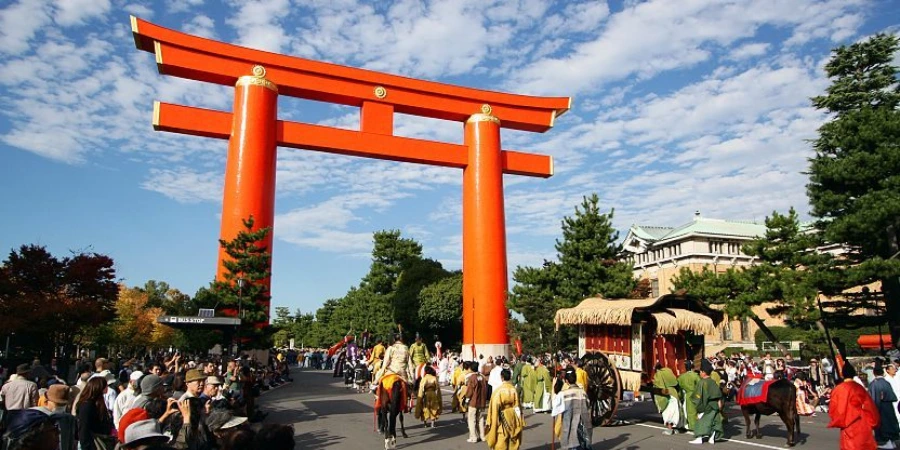
The towering, vermilion red Ōtenmon Gate of Heian-jingū Shrine, the main entrance to the sprawling temple complex. Kyoto Travel
Overview
Kyoto is a city steeped in history, where shrines and temples line the streets like pages in a living storybook. Among its many treasures, the Heian Shrine (Heian Jingu) stands out for both its cultural significance and striking design.
The Heian Shrine may not be as old as many of Kyoto’s historic landmarks, but it carries a significance that goes beyond age. With its towering torii gate, palace-inspired architecture, and seasonal gardens, the shrine embodies Kyoto’s legacy as Japan’s imperial capital.
It is more than a site of worship: it is a cultural symbol, a reminder of Kyoto’s resilience, and a showcase of timeless beauty. For travellers seeking to experience the essence of the city, Heian Shrine offers both grandeur and tranquillity, leaving a lasting impression that endures well beyond the visit.


History
Although many of Kyoto’s shrines trace their roots back centuries, the Heian Shrine is relatively young, built in 1895 to commemorate the 1,100th anniversary of the founding of Kyoto as Japan’s capital, then called Heian-kyo.
The shrine is dedicated to two emperors: Emperor Kammu, who established Heian-kyo as the imperial capital in 794, and Emperor Komei, the last emperor to reign there before the capital moved to Tokyo in 1869.
Together, these figures symbolise both the beginning and the end of Kyoto’s era as the nation’s political and cultural centre.
The Heian Shrine is not only a place of worship but also a monument to the city’s history. It holds the rank of Beppyo Jinja, reserved for shrines of particular standing, and six of its buildings were designated Important Cultural Properties in December 2010: the Daigokuden, the Otenmon gate, the east and west corridors, and the Soryuro and Byakkoro towers.
Its story also speaks of resilience. On 6 January 1976 an arson attack burned nine buildings, including the main hall and the inner worship hall. The sacred objects were carried out in time, and the shrine was rebuilt through public donations by April 1979. That collective effort is why Kyoto regards it as a symbol of the city rather than simply a monument in it.
Architectural Highlights
Approaching the shrine, visitors are welcomed by a giant vermilion torii gate standing 24.4 metres high. It was put up in 1929 and is a Registered Tangible Cultural Property in its own right. Passing beneath it creates the sense of entering a space set apart from the everyday world.
Beyond the gate lies a wide courtyard framed by vivid orange and green structures. The main hall, inspired by the Imperial Palace of the Heian Period (794 to 1185 C.E.), is an elegant 5/8-scale reproduction of the original. Its symmetrical design, bold colours, and sweeping open spaces create a scene that is both grand and serene.
The Garden
Behind the shrine lies the Shin-en Garden, a masterpiece of landscape design and one of the finest examples of a Meiji-period Japanese garden. Admission requires a modest fee, but the experience more than justifies the cost.
The garden is divided into four sections, Higashi (East), Naka (Middle), Nishi (West), and Minami (South), each showcasing a distinct character and design. Together, they represent centuries of refinement in Japanese garden artistry. It covers 33,000 square metres and was laid out by Ogawa Jihei VII, the gardener behind much of Meiji-era Kyoto, and in 1975 it was declared a national Place of Scenic Beauty.
What sets the Shin-en Garden apart is how it encapsulates 1,000 years of gardening techniques developed during Kyoto’s reign as Japan’s capital. From winding paths to reflective ponds and carefully arranged plantings, every element has been crafted to evoke harmony and contemplation.

The tranquil Shin’en Garden at Heian-jingū Shrine, showcasing classic Japanese landscaping around a central pond. Heian-jingū Official Website








Seasonal Beauty
The Shin-en Garden offers a new experience with every season, making it a destination worth revisiting:
Spring: Cascading weeping cherry blossoms create a dreamlike pink canopy.
Early Summer: The garden comes alive with the elegant blooms of Japanese irises.
Autumn: A blaze of red, orange, and gold foliage reflects across the ponds.

Brilliant red autumn foliage (momiji) surrounding the Taishō-Kan Bridge and pond in the gardens of Heian-jingū Shrine Kyoto Travel
Winter: Snow dusts the bridges and evergreens, transforming the garden into a quiet landscape of stillness and light.
Photography Tips
For photographers, some of the most striking images can be captured in spring, when cherry blossoms are reflected in the South Garden pond, or in autumn, when the bridges frame fiery foliage. Early mornings often offer softer light and fewer crowds.
Events & Festival
Heian Shrine is best known as the starting point of the Jidai Matsuri (Festival of the Ages), held every October 22nd. This spectacular procession brings to life more than 1,000 years of Kyoto’s history, with participants dressed in elaborate costumes representing every era of the city’s past.
The shrine also hosts seasonal rituals and smaller festivals, offering visitors a chance to experience living traditions within its grounds.
Best Times to Visit
- Arrive early: The shrine opens at 6:00 am, ideal for exploring before larger crowds arrive.
- Prioritise the garden: The Shin-en Garden is the highlight of the site and should not be missed.
- Allow time: Plan for at least 1 to 2 hours to fully enjoy both the shrine and garden.
- Seasonal visits: Spring blossoms and autumn foliage are especially magical.
Getting There
Heian Shrine is located in Kyoto’s Okazaki district, a cultural hub filled with museums, canals, and gardens.
- By Train: The nearest station is Higashiyama Station (Kyoto Subway Tozai Line), about a 10-minute walk.
- By Bus: City buses from Kyoto Station stop nearby (routes 5, 100, or 110). Travel time is around 30 minutes depending on traffic.
- By Foot/Bike: The shrine is a pleasant walk or short bike ride from Nanzen-ji Temple or the Philosopher’s Path.
Cultural Etiquette
- Purify hands and mouth at the temizuya (water basin) before entering.
- Bow once before passing through the torii gate.
- Refrain from loud conversation in prayer areas.
- Photography is allowed in most areas, but avoid taking photos of worshippers without permission.
Comparisons with Other Shrines
While Fushimi Inari Taisha is famous for its endless red torii tunnels and Yasaka Shrine for its lively Gion district setting, Heian Shrine offers a different appeal: open courtyards, grand palace-style architecture, and one of Kyoto’s most beautiful gardens. It may lack the ancient origins of other shrines, but it provides a serene balance of history, artistry, and seasonal beauty.
Nearby Attractions & Suggested Itineraries
Heian Shrine sits in Kyoto’s cultural heart. Nearby highlights include:
- Kyoto Municipal Museum of Art
- Kyoto City Zoo
- Okazaki Canal (especially beautiful during cherry blossom season)
- Nanzen-ji Temple and the Philosopher’s Path
A half-day itinerary could combine a morning at Heian Shrine with an afternoon stroll along the canal and Philosopher’s Path, ending with a visit to Nanzen-ji.
Why Visit
The Heian Shrine may not be Kyoto’s oldest landmark, but it embodies the city’s spirit: rooted in tradition, shaped by resilience, and alive with beauty in every season. From its towering torii to its ever-changing gardens, the shrine offers both grandeur and tranquillity.
For travellers hoping to capture the essence of Kyoto in a single destination, Heian Shrine deserves a place on every itinerary.