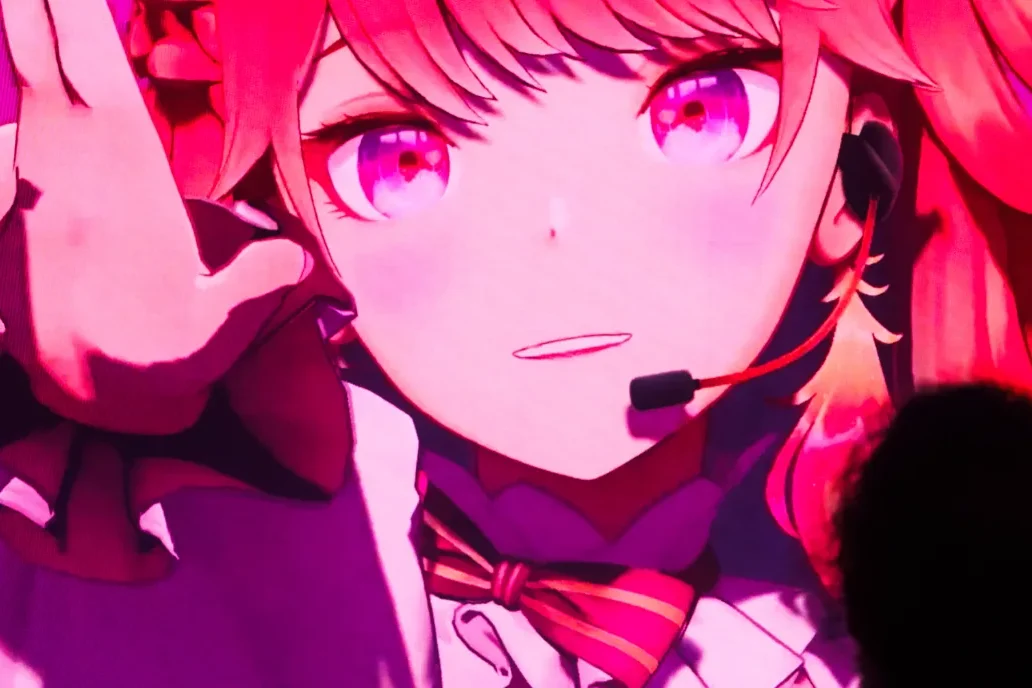
A VTuber, short for virtual YouTuber, is a live streamer who performs as an animated character instead of appearing on camera. A real person sits behind it, talking and reacting in real time, while software maps their face and body onto a drawn or modelled avatar. The performer’s own face is almost never shown.
The idea started in Japan in the mid 2010s and is now a global industry with listed companies, arena concerts and its own conventions. In September 2026 nine hololive talents appeared at a VTuber convention at the National Exhibition Centre in Birmingham, and a cinema next door screened one of their concerts. This guide explains where VTubers came from, how the technology and the agencies work, what actually happens at a show, and how to start watching.
What This VTuber Guide Covers
Kizuna AI and the word that appeared in late 2016
Animated presenters existed before the word did. The UK based vlogger Ami Yamato posted her first video as an animated avatar in June 2011, and the Japanese forecasting company Weathernews gave its virtual presenter Weatheroid Type A Airi a weekly live slot with motion capture from 2014.
The term itself arrived with Kizuna AI, who began posting on YouTube in late 2016 and called herself a virtual YouTuber. She was created by the production company Activ8 and voiced by Nozomi Kasuga. Within ten months she had more than two million subscribers, and she was later made a culture ambassador by the Japan National Tourism Organization.
Part of the appeal was the gap between how she looked and how she behaved. The avatar was cute and juvenile. The person inside swore at video games. That distance between design and personality is still much of the draw.
Growth after that was fast. Between May and mid July 2018 the number of active VTubers doubled from about 2,000 to about 4,000. By January 2020 there were more than 10,000.


Live2D rigs, webcams and models costing up to $2,000

The technology is less exotic than it looks. A webcam and software track the streamer’s head, expressions and mouth, and map them onto a model. Two families of model do most of the work:
- 2D models, rigged in Live2D from artwork drawn in layers. The character stays flat but the layers move independently, which is why a 2D VTuber can blink, turn slightly and lean without ever being a 3D object. This is the standard for everyday streaming.
- 3D models, built in tools such as VRoid Studio and driven by fuller body tracking. These are what agencies use for concerts, where the character has to walk a stage and dance.
A commissioned model is a real commission, paid to a named artist and a rigger, and a detailed one can cost as much as US$2,000. At the other end, some streamers use a single still image with a few swapped expressions and are known, affectionately, as PNGTubers.
Motion capture can also be offloaded to a phone. The depth camera on an iPhone tracks a face well enough that agencies have run auditions with it, which is part of why the field opened up so quickly after 2018.
Cover Corporation, Nijisanji and the idol agency model
Most of the best known VTubers are not independent. They are signed to agencies, and those agencies borrowed their shape from Japanese idol management: the company designs the character, auditions a performer for it, then earns from streams, viewer donations, merchandise, music and live shows.
Two companies dominate. Hololive Production is owned by Cover Corporation, which was founded on 13 June 2016 by Motoaki Tanigo and Ikko Fukuda and began life making augmented and virtual reality software before turning to virtual talent. It debuted its first VTuber, Tokino Sora, in September 2017, launched the hololive agency the following year and opened an English language branch in September 2020. Cover is now listed on the Tokyo Stock Exchange and reported revenue of ¥43.4 billion for the financial year ending March 2025, with 679 staff. As of June 2026 its channels had a combined 95.2 million YouTube subscribers.
Nijisanji, founded at the start of 2018 by the company now called Anycolor, took a different route. It pushed Live2D models and long live streams rather than the edited videos Kizuna AI had made, and that format is the one the whole field settled on. It now manages over 160 talents to hololive’s 90 or so.
The money is not incidental. VTuber channels have repeatedly topped YouTube’s Super Chat earnings tables, and Twitch added a dedicated VTuber tag in May 2021 after the category grew 467 per cent in a year.
Generations, branches and how hololive members are organised
If you have seen a phrase like hololive English -Justice- and wondered what it meant, this is the answer. hololive debuts its talents in groups called generations, and a generation keeps its name for good. It works the way an idol group intake does, and it is how fans navigate a roster of around ninety people.
- The Japanese branch runs from Generation 0, which includes Tokino Sora, through to Generation 5 and Secret Society holoX, alongside the hololive GAMERS unit and a set of smaller sub-units.
- hololive English launched in September 2020 and now has four generations: Myth, Promise, Advent and Justice, plus the VSinger IRyS.
- hololive Indonesia debuted in April 2020 and has three generations of its own.
- Holostars is the male agency under the same Hololive Production umbrella, with Japanese and English branches.
The four talents of hololive English -Justice-, Elizabeth Rose Bloodflame, Gigi Murin, Cecilia Immergreen and Raora Panthera, were the generation that brought a panel to Birmingham this September.
Graduation, nakanohito and who owns the character
Three pieces of vocabulary explain most of what happens when a VTuber’s career changes.
- Nakanohito (中の人), literally the person inside. It is the polite way to refer to the performer without breaking the character, and it is borrowed from the people who wear mascot suits.
- Graduation (卒業, sotsugyō), borrowed straight from idol groups. When a VTuber retires a character or leaves an agency on good terms, they graduate, and fans usually get a final stream to say goodbye.
- IP ownership. In an agency the character and its artwork normally belong to the company. A performer who leaves without those rights cannot take the avatar with them, so they debut again as a new character. Everyone usually knows, and nobody says so directly.
That arrangement has caused real friction. Agencies have been criticised over their treatment of talent, and the industry has had to take the harassment of performers seriously enough to build legal machinery around it. Japanese courts have started to accept that abuse aimed at an avatar can count as an attack on the person behind it, which matters when the whole job depends on the two staying separate.
Plenty of the biggest names are unsigned. Ironmouse, one of the largest in English language VTubing, streams independently these days, and she was on the guest list for the Birmingham convention below.





The face behind the avatar, and why it stays hidden
This is the question newcomers ask first, so here is the plain answer. Agency VTubers do not do face reveals. They are not photographed out of character, they are not interviewed on camera as themselves, and the performer’s real name is not published. When talents appear at a convention, the avatar appears and the performer stays out of sight.
There are three reasons, and only one of them is showmanship.
- The character is the product. The avatar is the agency’s intellectual property and the thing an audience has formed an attachment to. Putting a different face next to it breaks the thing people came for.
- It is a genuine safety measure. Streaming attracts harassment, and a performer whose real identity stays private has a layer of protection that a face-on streamer does not.
- It lets the performer stop. Because the two identities are separate, someone can leave the job and return to an ordinary life, which is far harder for a conventional influencer.
Fans respect the line, and it is considered poor form to dig for a performer’s real identity or to bring it up in a stream’s chat. The polite term for the person inside, nakanohito, exists precisely so the subject can be discussed without crossing it.
Independent VTubers set their own rules and a few do appear as themselves, but within the agencies the separation is close to absolute.
Penlights under 20cm and a room that is meant to be loud

This is the part almost nothing online explains, so here is what a VTuber concert or screening actually involves, taken from the rules of the hololive European tour that opened in Birmingham this September.
- You are supposed to make noise. These are run as cheer friendly events, with calls and chants at set points in each song, the same as an idol concert in Japan.
- Penlights are welcome, up to 20cm. Fans light the colour of the talent they are there for. Staff can ask you to dim one that is bright enough to spoil the view for others.
- Cosplay is encouraged, and so is wearing official hololive clothing.
- Seating is unreserved. Two queues go in, VIP first, then general admission.
- Filming the show is not allowed. Photos and video for personal use are confined to designated photo zones, and nothing from the screening itself goes online.
- Merchandise is sold in the room only. There is no online order for it, and VIP tickets include some.
Ruicheng Lei, whose company Virtual Stage Productions licensed and staged the European tour, told us the hardest part is not the technology at all:
We run our shows as chant-friendly events, reflecting the atmosphere audiences would experience in Japan. The greatest challenge is often encouraging people to feel comfortable enough to open up, join the crowd and participate.
His team helped write some of the community’s early English call books so newcomers would know when to shout. There is more from him on the production side in our interview about staging hololive’s concerts in Europe.
Lighting a particular colour for a particular performer is not a quirk of this scene alone. It is standard oshi fan culture, where your oshi is the one you actively back and oshi-iro is their assigned colour.
hololive at the NEC: Birmingham, September 2026
If you want to see how far this has travelled from a YouTube channel in 2016, September 2026 in Birmingham is the clearest example the UK has produced.
On Thursday 17 September, Cineworld Birmingham NEC screened hololive English 4th Concert -Serendipity-, recorded at the Shrine Auditorium in Los Angeles on 3 and 4 July 2026 with all fifteen hololive English members and four guest performers from the agency’s Japanese and Indonesian branches. The original ran over two nights with two setlists. European audiences get both in one sitting. General admission in Birmingham started at £55.
From Friday 18 to Sunday 20 September, VeXpo took over Halls 9 and 10 at the NEC. It is the UK’s VTuber convention, founded in 2023 and run by a non-profit company, and it grew from 78 guests in its first year to 120 guests and 2,200 attendees in 2025 on its own published figures. Tickets this year ran from £25 to £200.
hololive’s appearance was billed as its first at a UK convention, and it ran under hololive Meet, the brand COVER uses for its stage events worldwide. The programme included a screening of the agency’s third English concert on the Friday, a panel with the hololive English -Justice- generation on the Saturday, and a karaoke relay on the Sunday. Our guide to VeXpo 2026 at the NEC has the ticket tiers, the stage times and the rest of the European screening dates.
Where to start watching
Almost all of it is free, and almost all of it is on YouTube or Twitch. A few practical notes for a first look:
- Start with an English language branch if you do not speak Japanese. Hololive English and Nijisanji EN are the obvious entry points, and both agency sites list every talent with their channels.
- Clip channels do the sorting for you. Streams often run for hours. Fan run clip channels cut them into a few minutes, which is how most people find someone they like.
- Music is a separate door in. Agency talents release original singles and covers, and those are produced properly. If concerts are what interest you, start there.
- Independents are a large part of the field. Several of the biggest names in English language VTubing are unsigned.
For live dates, the Serendipity screening tour continues through Europe until 18 October 2026, finishing in Milan, Barcelona, Paris, Düsseldorf and Berlin.
VTubers: Frequently Asked Questions
What does VTuber stand for?
Virtual YouTuber. Kizuna AI coined the term for herself in late 2016. Most VTubers now stream on Twitch as well as YouTube, so the name has outgrown the platform it came from.
Is there a real person behind a VTuber?
Yes. A VTuber is a live performer, talking and reacting in real time, with software mapping their expressions onto an avatar. Fans call the performer the nakanohito, the person inside.
Is Hatsune Miku a VTuber?
No. Hatsune Miku is a Vocaloid, a singing voice synthesiser sold as software with a character attached to it. Her songs are written and produced by other people, and nobody performs as her in real time. Behind a VTuber there is always somebody in a chair, reading the chat and answering it. The two get confused because both fill concert halls with a character on a screen and a crowd holding penlights.
Do VTubers ever show their faces?
Agency VTubers do not do face reveals, and the performer’s real name is not published. A few independents appear as themselves. The reasons are set out above.
What is hololive?
Hololive Production is a VTuber agency owned by Cover Corporation of Tokyo, a company listed on the Tokyo Stock Exchange. It manages around 90 talents across Japanese, English and Indonesian branches and runs its own concerts, music label and merchandise.
How many hololive members are there?
Around ninety across all branches, organised into generations that keep their names permanently. The Japanese branch runs from Generation 0 to Secret Society holoX, hololive English has Myth, Promise, Advent and Justice, and there is a separate Indonesian branch and a male agency, Holostars.
What does it mean when a VTuber graduates?
Graduation means retiring the character or leaving the agency, usually amicably. The word comes from Japanese idol groups. Because the agency normally owns the character, a graduating performer cannot take the avatar with them.
Can you see VTubers live in the UK?
Yes. VeXpo at the NEC in Birmingham is the UK’s dedicated VTuber convention, and hololive concerts are screened in UK cinemas as part of European tours. Both happened in Birmingham in September 2026.