Washoku (和食) is the Japanese word for Japanese food, and since December 2013 it has also been the name of Japan’s traditional food culture on UNESCO’s list of intangible cultural heritage. In everyday terms it is a meal of rice with a soup made from dashi stock and a few small side dishes, cooked with ingredients at their seasonal best and arranged so the tray shows a spread of colours.
This guide explains the four features Japan’s Ministry of Agriculture, Forestry and Fisheries uses to describe washoku, the rule of five that Japanese cooks are taught and where it comes from, and the one soup, three sides pattern behind a home meal. It also covers the chemistry of umami, where to eat washoku in London and how to put a simple tray together at home.
Washoku at a glance
UNESCO listing: “Washoku, traditional dietary cultures of the Japanese, notably for the celebration of New Year”, inscribed in December 2013.
The basic meal: ichiju sansai, rice with one soup and three dishes.
The five colour rule: red, yellow, green, white and black on the table.
The stock: dashi, usually from kombu kelp and katsuobushi bonito flakes.
Washoku Day: 24 November.
Washoku Explained, From the Rule of Five to Dashi
Washoku Meaning: Japan’s Food Culture on UNESCO’s List Since 2013
UNESCO’s intergovernmental committee added washoku to its Representative List of the Intangible Cultural Heritage of Humanity at its meeting in Baku, Azerbaijan, in December 2013. The listing describes washoku as “a social practice based on a set of skills, knowledge, practice and traditions” covering food from how it is produced to how it is eaten. It links the practice to respect for nature and favours natural, locally sourced ingredients such as rice, fish, vegetables and edible wild plants.
That makes washoku bigger than any single dish. The Washoku Association of Japan, the national body for washoku culture, describes it as a set of customs around food that grows from the Japanese habit of respecting nature. Sushi belongs to it, and so does the way a family lays the breakfast tray.


Four Features of Washoku, From Fresh Ingredients to New Year
When washoku was listed, Japan’s Ministry of Agriculture, Forestry and Fisheries summed it up in four features. They appear on the ministry’s own washoku pages and on the Washoku Association of Japan’s site.
| Feature | What it means at the table |
|---|---|
| Diverse, fresh ingredients and respect for their own flavour | Each region cooks with the ingredients of its own seas, mountains and farms in season, using techniques and tools that bring out the natural taste of the food. |
| Nutritional balance that supports a healthy diet | The ichiju sansai meal pattern and the careful use of umami keep meals balanced and low in animal fat. |
| Showing the beauty of nature and the changing seasons | Dishes are decorated with seasonal flowers and leaves, and served on tableware chosen for the time of year. |
| Close links with annual events such as New Year | Families and communities share food carrying wishes for the year at New Year and at festivals, which strengthens their ties. |
Red, Yellow, Green, White and Black: The Rule of Five in Japanese Food
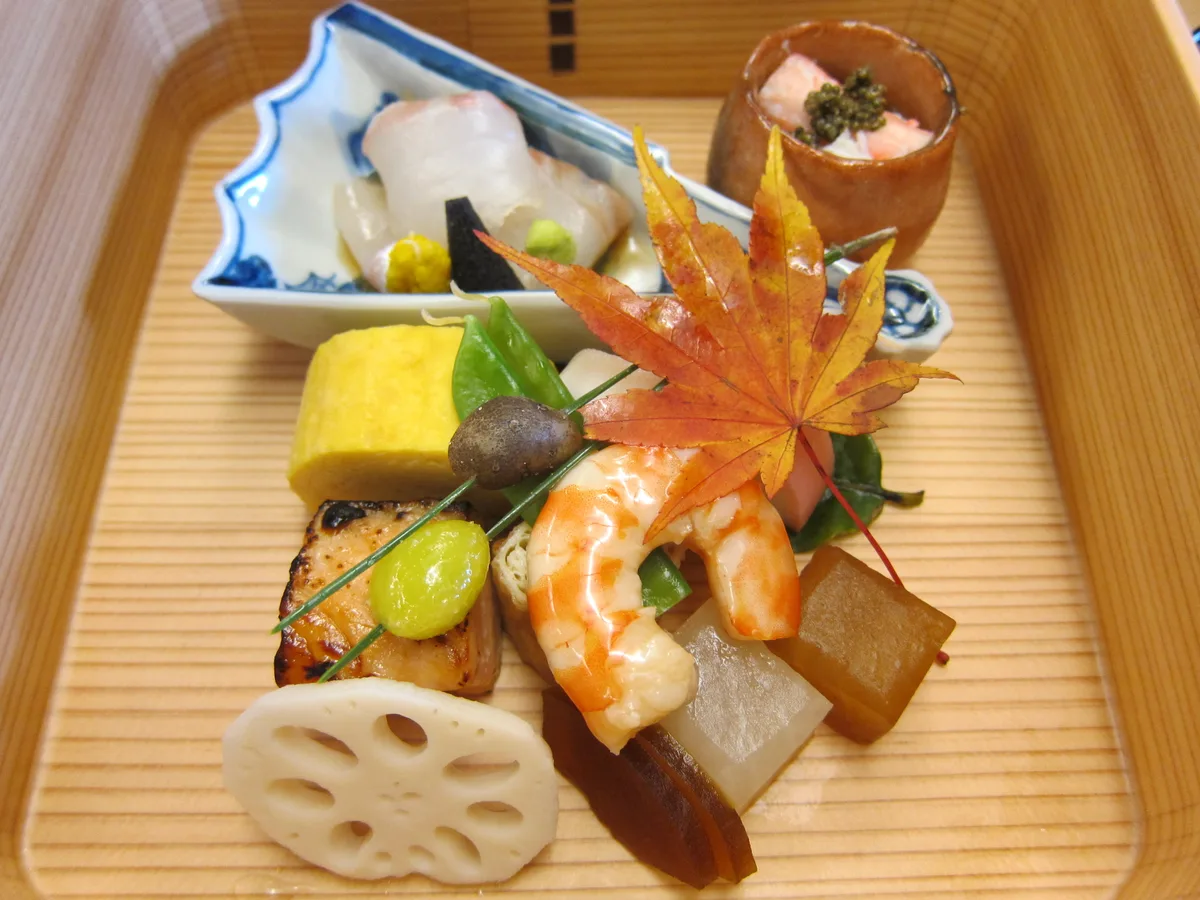
The five colour rule says a Japanese meal should show red, yellow, green, white and black. The ministry calls this goshiki (五色) and teaches it alongside three other sets of five that a Japanese cook keeps in mind: gomi (五味), the tastes, gohō (五法), the cooking methods, and gokan (五感), the senses. Its Washoku World Challenge lesson on the rule says the cook’s job is to combine them with the season and the guest’s tastes so that the guest leaves satisfied.
| Set | Japanese | The five | How the ministry explains it |
|---|---|---|---|
| Colours | 五色, goshiki | Red, yellow, blue-green (ao), white, black | Red and yellow stir the appetite, green looks fresh, white looks clean and black pulls the whole plate together. The colour of the bowl and the garnish count too. |
| Tastes | 五味, gomi | Sweet, sour, salty, bitter, umami | Umami comes from kombu and katsuobushi and is the base of dashi. |
| Methods | 五法, gohō | Raw (cutting), simmering, grilling, steaming, deep-frying | Raw dishes such as sashimi depend on knife work; simmering cooks food gently in dashi or a seasoned liquid. |
| Senses | 五感, gokan | Sight, hearing, smell, touch, taste | A meal is enjoyed with every sense, and the cook should read what the diner wants. |
Chinese Five Phases, Dōgen’s Six Tastes and Umami in 1908
None of the official sources we checked dates the rule of five or names the person who first set it out. Its parts are much older than the rule itself. Sets of colours and tastes go back to Chinese five phases theory, which arose in the Warring States period and later merged with yin and yang thinking, according to the encyclopedias collected on Kotobank. Chinese thinkers applied its five elements to the planets, colours, tastes and musical notes. The chef Minoru Okawara, interviewed in 2017 by Kōsei Rōdō, the magazine of Japan’s Ministry of Health, Labour and Welfare, traced the rule to the same theory.
The tastes have changed along the way. Japanese dictionaries record the classical five tastes as sweet, sour, pungent, bitter and salty, a list Japan shared with China. In the thirteenth century the Zen master Dōgen asked temple cooks, in his Instructions for the Zen Cook (Tenzo Kyōkun), to balance six flavours: bitter, sour, sweet, salty, mild and spicy. The list the ministry teaches today swaps the pungent taste for umami, a taste that was only named in Tokyo in 1908.
So the rule of five in its current form is a modern teaching framework built on ancient ideas. It is what Japanese cookery students learn: the Tokyo Metropolitan Government’s sample exam for its cookery vocational training asks candidates to explain gomi, gokan and goshiki, and to pick out the basic cooking methods.
Ichiju Sansai: One Soup and Three Dishes Around a Bowl of Rice
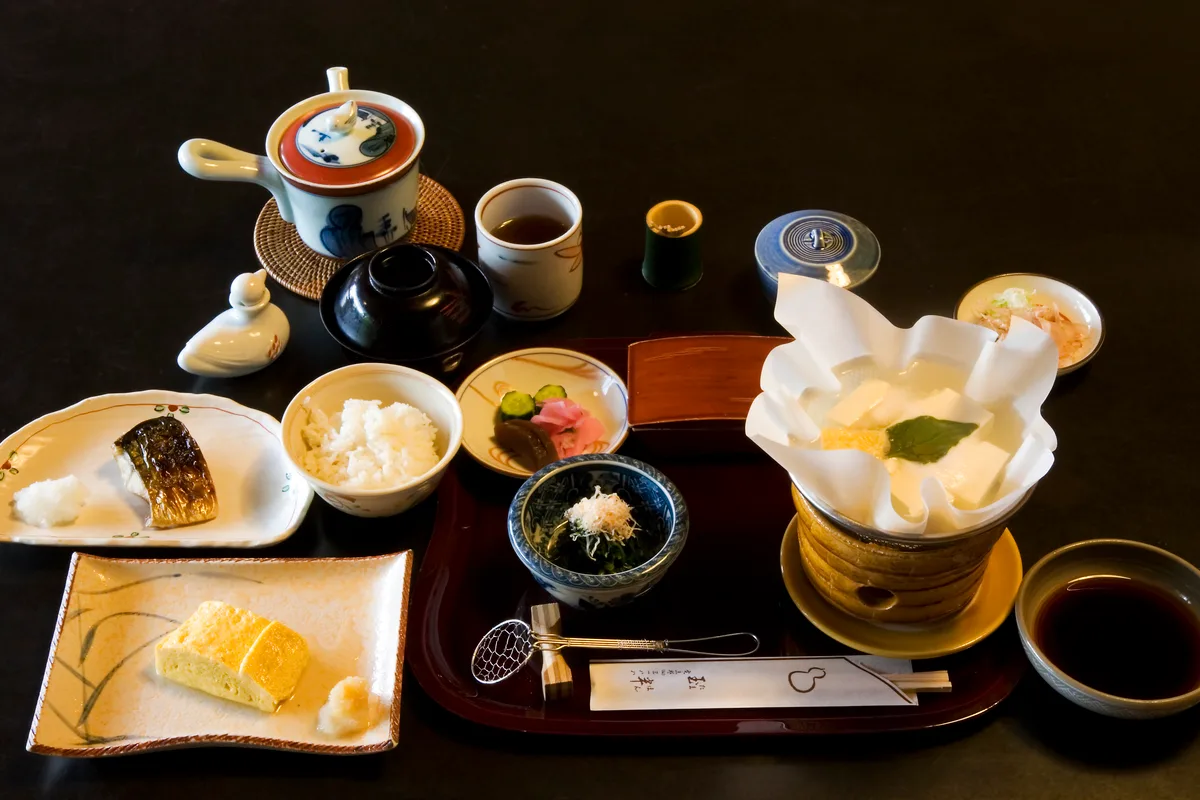
Ichiju sansai (一汁三菜) means one soup, three dishes, and the ministry calls it the basic form of washoku. Alongside rice and a soup, the tray carries one main dish of fish or meat and one or two side dishes of vegetables, mushrooms or seaweed. Rice and pickles are always there and are not counted among the three.
The layout is fixed by custom. The Nihon Kokugo Daijiten dictionary places the soup on the right nearest the diner, the rice on the left, a vinegared dish at the back right, a simmered dish at the back left and the pickles in the middle. Jukichi Inouye described the same order on a Tokyo family’s breakfast trays in 1910: “In the left corner of the tray near the person before whom it is set, is a small china bowl of rice, while on the right is a wooden bowl of miso-soup” (Home Life in Tokyo, chapter five).
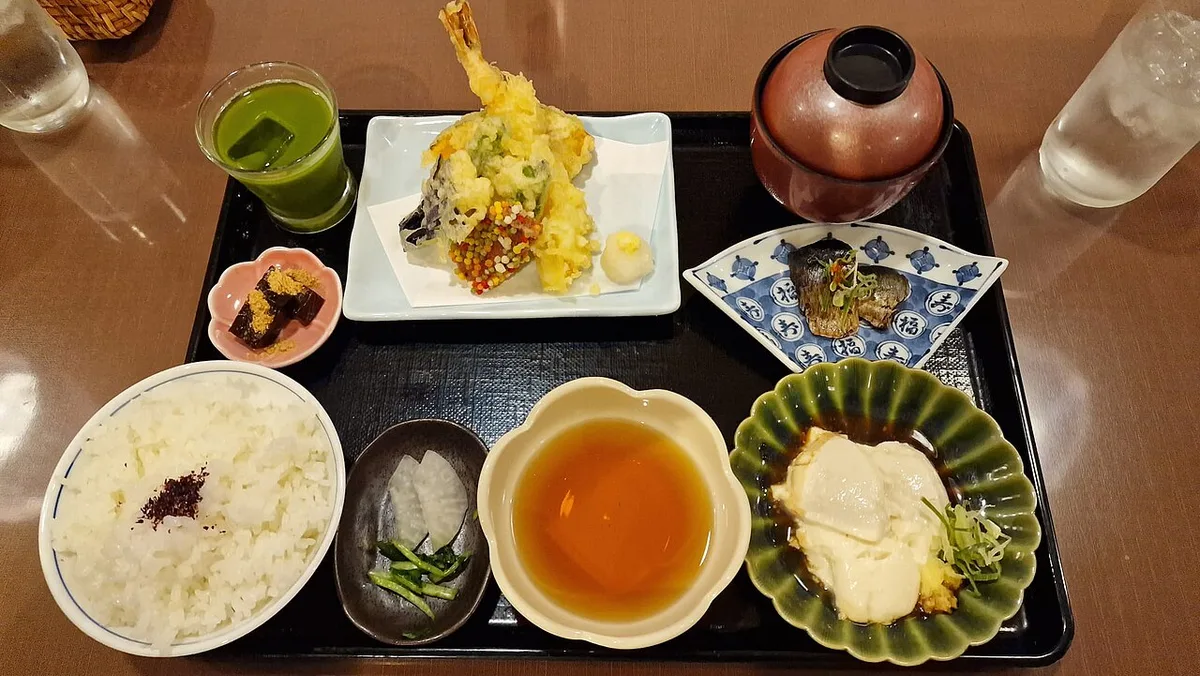
The phrase is old. The same dictionary’s earliest example of the phrase comes from the Rokuon Nichiroku, in an entry dated 1544. The meal served at a tea gathering, cha kaiseki, was ichiju sansai and deliberately plain, according to the Heibonsha World Encyclopedia. The Nihon Daihyakka Zensho calls ichiju sansai the ordinary form, with ichiju issai, a single side dish, as the plainest meal possible. Counting dishes once marked rank. A. B. Mitford’s translation of a Japanese book of ceremonies records that the highest families served wedding dinners in several courses, the largest of seven dishes, and that other families scaled this down “according to the means of the family” (Tales of Old Japan, 1871, appendix B).
In restaurants the pattern survives as teishoku, the set meal of rice, soup, pickles and a main dish that fills lunch menus across Japan. Edo period townspeople started the day with rice, soup and pickles, as our guide to Edo period Japanese food culture describes.








Dashi and Umami: Kombu, Katsuobushi and Kikunae Ikeda’s 1908 Patent
Dashi is the stock behind miso soup, simmered dishes and dipping sauces. The Umami Information Center explains that its ingredients are only soaked in water or heated briefly. Most dashi combines kombu, a dried kelp grown mainly off Hokkaido, with katsuobushi, bonito that is dried and fermented with a mould over several months and then shaved into flakes. Small dried fish called niboshi and dried shiitake mushrooms are also used, and shiitake and kombu make the vegetarian dashi of Buddhist temple cooking.
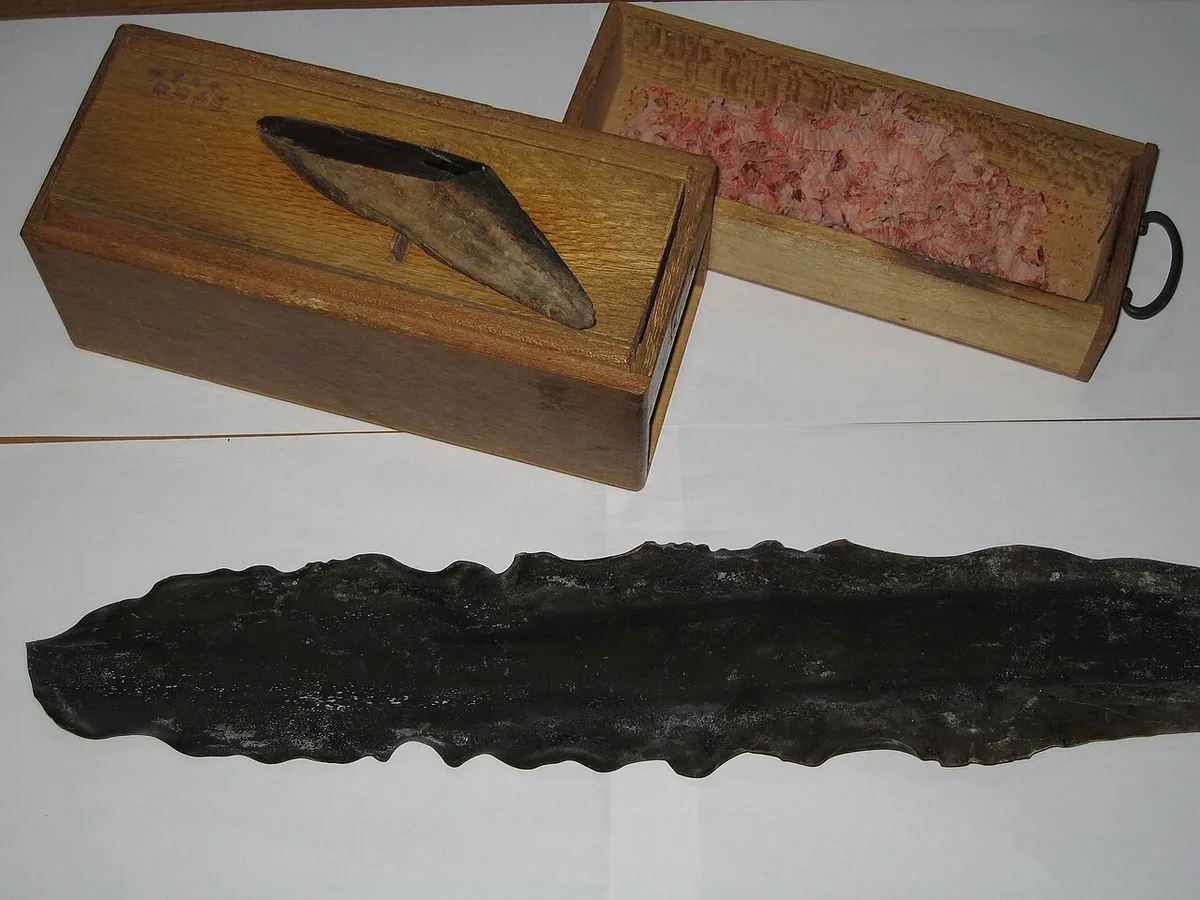
Umami was named by Kikunae Ikeda, a professor of chemistry at the Imperial University in Tokyo, now the University of Tokyo. He started with kelp his wife had brought home to make dashi, traced its savoury taste to glutamic acid and called that taste umami. He applied in April 1908 for a patent on a seasoning based on glutamate, which was granted on 25 July 1908, according to the Umami Information Center’s page on Ikeda.
The two classic dashi ingredients work as a pair. Kombu supplies glutamate and katsuobushi supplies inosinate, and the Umami Information Center says umami is at its strongest when the two are present in almost equal amounts, as they are in ichiban dashi, the first extraction from the two. Its tasting notes put the effect at about eight times the umami of kombu dashi alone. The Washoku Association of Japan credits this skilful use of umami with keeping washoku low in animal fat.
The Umami Information Center’s ichiban dashi uses 20g of kombu and 80g of bonito flakes for every 3 litres of soft water. A third of that makes about a litre:
- Soak the kombu in cold water, 20 to 30 minutes in summer and about an hour and a half in winter.
- Heat it slowly and lift the kombu out just before the water boils.
- Add a splash of cold water to take the pan just off the boil, turn off the heat and add the bonito flakes.
- When the flakes sink, skim the surface and strain the dashi straight away through a cloth.
Dashi was part of daily life long before the chemistry. Inouye noted in 1910 that soups made without miso “are usually flavoured by boiling shavings of sun-dried bonito and straining them off”.
Shun, Hashiri and Nagori: Cooking at the Peak of the Season
Shun (旬) is the stretch of the year when a fish or vegetable tastes best and is most nutritious. The ministry’s lesson on seasonal cooking adds two finer stages. Hashiri is the first of a crop, eaten to get ahead of the season, and nagori is the last of it, eaten with a little regret as it goes.
The stage changes the cooking. Early vegetables are tender enough to eat raw, while late ones such as autumn aubergines are richer and sweeter, so they suit dishes that make the most of that depth. Paying for the first of the season has a long history: in Edo, the old name for Tokyo, people spent heavily on the first bonito of the year.
Osechi and the New Year Meal in the UNESCO Listing
Japan put New Year at the centre of its UNESCO nomination. The listing describes families preparing to welcome the deities of the new year by pounding rice for mochi and cooking special meals, with “beautifully decorated dishes using fresh ingredients, each of which has a symbolic meaning”. The Embassy of Japan in the UK names the dishes: osechi, the New Year food packed in lacquer boxes, ozōni soup with mochi, and toso, a spiced sake.
Our guide to Japanese New Year traditions explains what each osechi dish wishes for, from black beans for good health to prawns, curled like an old person’s back, for a long life.
Washoku has a day of its own in late autumn as well. The Washoku Association of Japan set 24 November as Washoku Day, reading the date as ii nihonshoku, “good Japanese food”, and some Japanese schools serve washoku lunches on the day.
Where to Eat Washoku in London: Umu, Koya Soho and Cooking Classes
For the formal end of washoku, Umu on Bruton Place in Mayfair says it preserves the philosophy of Kyoto kaiseki, the formal seasonal meal served course by course. Its sample kaiseki menu runs from mukozuke and a simmered soup through sashimi, sushi, steamed and fried courses to dessert, at £260 a person. Lunch costs less, and every set comes with salad, rice, miso soup and pickles, from the vegetarian shojin bento at £50. Umu is one of three Japanese restaurants in London with Michelin stars in 2026, as our guide to the best Japanese restaurants in London sets out. It serves dinner from Monday to Saturday and lunch from Tuesday to Saturday, and is closed on Sundays.
Koya on Frith Street in Soho is best known for udon, and its breakfast menu follows the rice, soup and pickles pattern. The Japanese Breakfast brings grilled fish, rice, miso soup and pickles for £16.90, and the Full Japanese Breakfast Set adds rice topped with egg and bonito flakes, vinegared seaweed and a pot of hojicha tea for £21.90. Koya Soho opens at 10am every day and takes walk-ins only.
| Where | What to book or order | Price | Address |
|---|---|---|---|
| Umu | Kyoto kaiseki menu (sample) | £260 a person | 14 to 16 Bruton Place, W1J 6LX |
| Umu | Lunch sets with rice, miso soup and pickles | From £50 (shojin bento) | 14 to 16 Bruton Place, W1J 6LX |
| Koya Soho | Japanese Breakfast: grilled fish, rice, miso soup, pickles | £16.90 | 50 Frith Street, W1D 4SQ |
| Yuki’s Kitchen | Miso and Umami Koji workshop, 4 hours, miso to take home | £160 | 21 Harold Road, SE19 3PU |
| Le Cordon Bleu London | Japanese Cooking Course, including dashi and miso soup | Not published; fully booked, waiting list open | 15 Bloomsbury Square, WC1A 2LS |
To learn the basics with your hands, Yuki Gomi teaches a four-hour Miso and Umami Koji workshop from her home kitchen in south east London, and Le Cordon Bleu’s one-day Japanese course starts with traditional dashi and miso soup. Our round-up of Japanese cooking classes in London lists more schools. Japan House London on Kensington High Street had no food events in its programme on 2 November 2026; its restaurant, AKIRA, serves sushi and robata-grilled skewers.
Map of Koya Soho
A Weeknight Ichiju Sansai Tray: Miso Soup, Salmon and Two Sides
An ichiju sansai dinner takes a little planning. Make the dashi first, since it flavours the soup and the simmered side. Japan Centre’s flagship on Panton Street carries imported Japanese groceries, and the Rice Wine Shop on Brewer Street stocks rice and miso; more shops are in our guide to Japanese markets and supermarkets in London.
| Place on the tray | Dish | Role | Colour it adds | Method |
|---|---|---|---|---|
| Front left | Japanese rice | Rice (not counted) | White | Cooked in a rice cooker or pan |
| Front right | Miso soup with tofu and spring onion | The one soup | White and green | Simmering |
| Back right | Cucumber and wakame seaweed in rice vinegar | Vinegared side dish | Green | Raw (cutting) |
| Back left | Hijiki seaweed simmered with carrot in dashi, soy and mirin | Simmered side dish | Black | Simmering |
| Back centre | Salt-grilled salmon with a little grated daikon | Main dish | Red | Grilling |
| Centre | Yellow pickled daikon (takuan) | Pickles (not counted) | Yellow | Ready-made |
Put the rice on to cook, then simmer the hijiki while the dashi is still warm. Grill the salmon last so it reaches the table hot, and add the miso to the soup at the end, over a low heat. Change the main dish and the sides through the year, using whichever fish and vegetables the fishmonger and greengrocer have at their best.
Washoku: Questions and Answers
Washoku (和食) is the Japanese word for Japanese food and the name of Japan’s traditional food culture on UNESCO’s intangible cultural heritage list since December 2013. It is built on fresh seasonal ingredients, a balanced meal of rice, soup and side dishes, dishes that show the seasons, and food shared at events such as New Year.
The five colour rule, goshiki, says a Japanese meal should include red, yellow, green, white and black. Japan’s Ministry of Agriculture, Forestry and Fisheries explains that red and yellow stir the appetite, green looks fresh, white looks clean and black brings the plate together, and that the colour of the bowl and the garnish count as well.
The rule of five groups the things a Japanese cook balances into sets of five: colours (red, yellow, green, white, black), tastes (sweet, sour, salty, bitter, umami), methods (raw, simmered, grilled, steamed, deep-fried) and the senses. Its parts come from Chinese five phases theory, but the version taught today includes umami, which was named in 1908.
Ichiju sansai (一汁三菜) means one soup, three dishes. It is the basic washoku meal: rice and a soup, usually miso soup, with a main dish of fish or meat and one or two side dishes of vegetables, mushrooms or seaweed. Rice and pickles are not counted among the three. The earliest recorded use of the phrase dates from 1544.
Washoku is the whole of Japan’s traditional food culture, from home breakfasts to festival food. Kaiseki is one formal part of it, a seasonal meal served course by course. The name is shared with cha kaiseki, the meal served at a tea gathering, which was traditionally one soup and three dishes. In London, Umu in Mayfair serves a Kyoto-style kaiseki menu.
Kikunae Ikeda, a chemistry professor at the Imperial University in Tokyo, identified umami in 1908. Working from kombu dashi, he traced its savoury taste to glutamic acid, named the taste umami and patented a glutamate seasoning, granted on 25 July 1908. In dashi, glutamate from kombu and inosinate from katsuobushi strengthen each other.
Umu at 14 to 16 Bruton Place in Mayfair serves a Kyoto kaiseki menu (£260 on its sample menu) and lunch sets with rice, miso soup and pickles from £50. For a simpler meal, Koya Soho at 50 Frith Street serves a Japanese breakfast of grilled fish, rice, miso soup and pickles for £16.90. Prices checked on 2 November 2026.