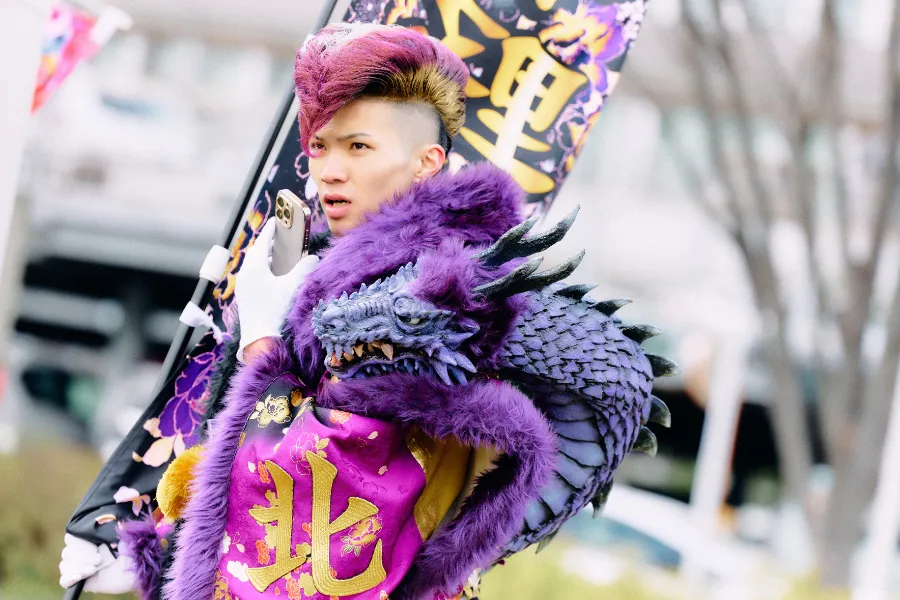
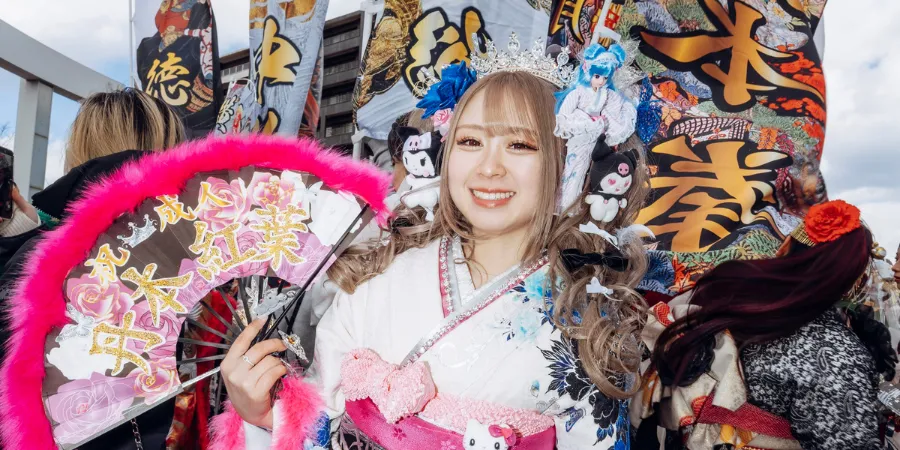
Glittering parasols, fur-trimmed hand fans and gravity-defying hairstyles are just some of the sights awaiting visitors to Tradition/Rebellion, Japan House London’s new exhibition, opening 11 November 2026. The exhibition celebrates one city’s fashion for the Coming-of-Age Ceremony held annually across Japan for those who have turned 20 that year, but which has become particularly famous in Kitakyushu for its eccentric and bold costumes.
It runs until 18 April 2027, entry is free, and Japan House London describes it as the first exhibition anywhere to present the fashion of Kitakyushu’s Coming-of-Age Ceremony. Platform sandals, purple hair dye and kimono trimmed with multicoloured fur are all part of what is going on display on Kensington High Street.
Five months of Kitakyushu's most extravagant coming-of-age outfits, on Kensington High Street.
Coming-of-Age Day and the ceremony Kitakyushu holds on 10 January 2027
Taking place every January, Coming-of-Age Day is a national holiday marking the occasion of each new cohort of 20-year-olds crossing into adulthood. In Japanese the holiday is Seijin no Hi (成人の日), and the ceremonies held for it are called seijinshiki. Throughout Japan, local governments host ceremonies which feature speeches and participants wearing formal dress, typically brightly coloured long-sleeved kimono for women and suits or haorihakama (a type of formal kimono ensemble) for men. In Kitakyushu, the fashion culture of the annual ceremony has evolved into something far more theatrical to demonstrate each young person’s individuality.
The national holiday falls on the second Monday of January, which in 2027 is 11 January. Kitakyushu runs its own event the day before. The city has published the details: its ceremony, officially the Twenty-Year-Old Commemorative Ceremony, takes place on Sunday 10 January 2027, doors at 10am and the ceremony at 11am, at Kitakyushu Messe in Kokurakita ward, a short walk from Kokura Station, and it lasts about an hour. Anyone planning a January trip to Japan should know that this is the one morning of the year when the whole thing spills out onto the street.


Miyabi, the Kokura rental shop behind the look
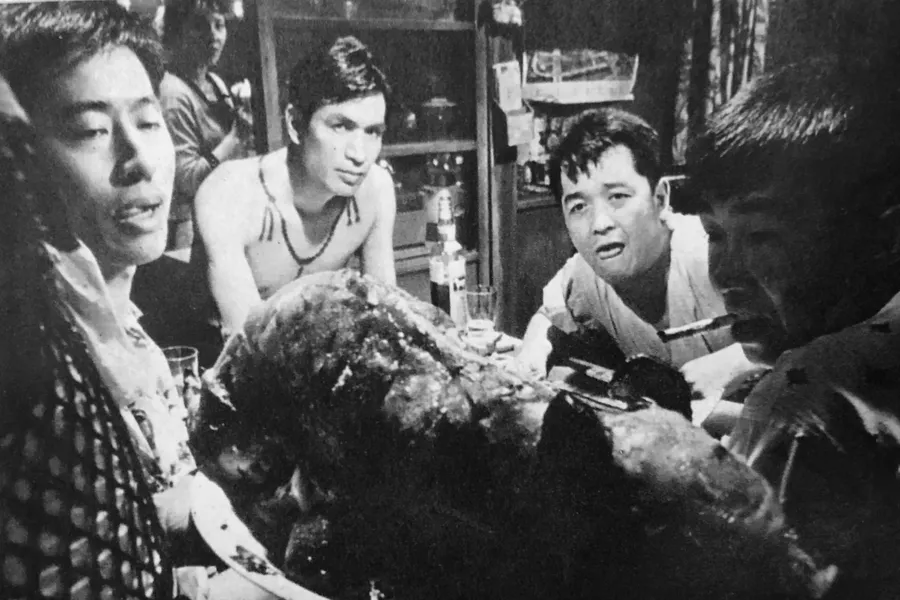
Most of the outfits worn at the Kitakyushu ceremony come from a single shop. Miyabi, a rental costume business in Kokura, dates its run of deliberately flamboyant designs to around 2003, when customers began asking for kimono nobody else would make. It now lists roughly 2,000 coming-of-age kimono and 2,000 men’s hakama in stock, alongside about 800 party dresses, plus its own photo studio and hair and make-up team. Each year’s group sees what the year above wore and asks for something bigger, which is how a local habit turned into an event photographers now travel for.
The region has now also become famous for its particularly flamboyant coming-of-age fashion, often combining more orthodox elements with contemporary and street fashion. It is common to see huge hairstyles, kimono adorned with multicoloured fur and tall personalised banners waving over the vibrant crowds, alongside the more customary kimono. The flamboyance and rejection of convention invite comparisons with basara, a 14th-century aesthetic built on luxury, spectacle and a defiance of social norms to express one’s individuality. Kitakyushu’s custom took shape in the late 20th century, rooted in close school friendships and a strong sense of local belonging. Alongside gregarious one-upmanship and the desire to stand out sits something more heartfelt too: a chance for each new adult to thank their parents or guardians.

Kitakyushu, Kokura Castle and the first modern steel mill in Japan
Kitakyushu is an industrial port city on Japan’s southerly island of Kyushu. A city centred around Kokura Castle, Kitakyushu’s more recent identity was forged in the 20th century as home to one of Japan’s great industries: steel manufacturing. The Yahata Steel Works, the nation’s first modern steel mill, was named a UNESCO World Heritage Site in 2015, as one of the sites of Japan’s Meiji Industrial Revolution.
Tradition/Rebellion: Coming-of-Age Style in Kitakyushu, Japan
The exhibition at Japan House London highlights the stories of eight ‘new adults’ including their preparation for the ceremony, their participation and their thoughts on reaching the age of maturity. One of the defining characteristics of this ceremony is the diversity of attire among participants. While some attendees choose formal dress, others express their individuality and creativity through more distinctive and personalised styles. Each participant celebrates this important milestone in a manner that reflects their own identity and values.
Stories behind their sartorial choices range from wanting to be the ‘best in Japan’, to honouring their mother by wearing the kimono she wore on her own Coming-of-Age Day. Some of the young people featured save for years to pay for a single morning’s outfit.
Tradition/Rebellion also gives context to what makes Kitakyushu’s ceremony distinct, and to the industries that bring it to life. From kimono rental and extraordinary fashion design to specialist hairdressers and commemorative photography, a whole network of local businesses works around the clock in the weeks before the ceremony to make Kitakyushu’s new adults’ dreams come true.
In the Gallery you will find outfits actually worn to the ceremony, the fabrics and materials behind them, tactile displays and video of the preparations and the day itself, with interviews with the city’s residents. The displays also introduce the people who make the morning happen, from kimono makers and embroiderers to stylists, hair and make-up artists and the makers of the personalised banners carried through the crowds.
Tradition/Rebellion is co-curated by fashion director Yamaguchi Souta and Simon Wright, Director of Programming at Japan House London, in collaboration with the people of Kitakyushu.
Simon Wright, Director of Programming at Japan House, said:
There are so many aspects of Japanese cultures and countercultures that people are yet to discover, so I’m excited to be introducing London audiences to the extravagance found at this celebration that takes place in Kitakyushu every year. I can’t wait for visitors to discover the riot of colour, imagination and joy of this one special day for Kitakyushu’s 20-year-olds, and the imaginative local industries that bring it to life.

Yamaguchi Souta, from Kansai Yamamoto to the Tokyo 2020 podium
Born in 1982 in Tokoname City, Aichi Prefecture, Yamaguchi Souta graduated from Bunka Fashion College, where he received the principal’s award, and has worked as a stylist and fashion director since 2006. He served as creative director for KANSAI YAMAMOTO, the label of the designer who dressed David Bowie as Ziggy Stardust, and curated a retrospective exhibition of Kenzo Takada. He also designed the attire worn at the Tokyo 2020 Olympic and Paralympic Games medal ceremonies, unveiled in June 2021. His wider body of work is on his own site.
Simon Wright and the Japan House London programme
Simon Wright has over 30 years’ experience of either working in, or with, Japan, notably his work with the Embassy of Japan in London curating exhibitions and programming events with an emphasis on innovation and emerging Japanese talent. He has been with the Japan House project from the beginning, bringing insight and innovation. He works closely with a wide variety of content holders from Japan on a daily basis and is passionate about allowing activities to form through co-creation and co-production. For Simon, Japan House London is a place to discover and explore how Japanese tradition informs the present and the future.
Japan House London is the cultural home of Japan in the UK. Located on Kensington High Street, it presents the very best in art, design, gastronomy, innovation and technology from the length and breadth of Japan. Since opening in 2018, Japan House London has welcomed over 3 million visitors, with audiences across the UK and beyond connecting with Japan through its digital content as well as a comprehensive programme of rolling exhibitions and events, Shop, café stand, travel information area and restaurant. Recent programming includes Kyotographie, which brought the photography of Kawada Kikuji and Iwane Ai to Kensington. Watch the Year in Review for highlights from 2025 to 2026. Japan House London is part of a global initiative, with sister locations in Los Angeles and São Paulo.
Free tickets, opening hours and getting to the Japan House London exhibition
Japan House London is at 101-111 Kensington High Street, W8 5SA. High Street Kensington station, on the District and Circle lines, is less than 100 metres from the door, and both Notting Hill Gate and Gloucester Road are around a fifteen to twenty minute walk away. The building is open Monday to Saturday from 10am to 8pm, and on Sundays and bank holidays from 12pm to 6pm.
Admission is free. Tradition/Rebellion: Coming-of-Age Style in Kitakyushu, Japan opens on 11 November 2026 and closes on 18 April 2027, in the Gallery downstairs. Japan House London plans each visit at around 40 minutes and asks groups of 15 or more to book ahead. The shop and the Stand on the ground floor need no ticket, and the Japan House London what’s on listings carry everything else on the programme.
Booking a free ticket on the Tradition/Rebellion exhibition page guarantees entry at busy times. Arrive within your booked time slot, as late arrivals may not get in straight away.