Taiko drumming is the Japanese art of playing large barrel drums, called taiko, with thick wooden sticks called bachi. The drums have been used at shrines, temples, festivals and on battlefields for well over a thousand years, but the powerful stage ensembles most people now picture began in 1951, when a jazz drummer in Nagano gave each player in a group a different drum.
This guide explains the main drums, how taiko went from the festival ground to the concert hall, the story of Ondekoza and Kodo, and where to hear or learn taiko in the UK.
Taiko drumming: key facts
- Meaning: taiko (太鼓) means “great drum”; wadaiko means Japanese drum
- Sticks: bachi, made from woods such as white oak, Japanese magnolia or bamboo
- Earliest evidence: 6th century clay haniwa figures of drummers from Gunma Prefecture
- Ensemble taiko (kumi-daiko): created in 1951 by Daihachi Oguchi with Osuwa Daiko
- Best-known group: Kodo, formed on Sado Island, debut in Berlin in 1981
- Try it in London: beginners’ classes with Taiko Meantime and the Tamashii School of Wadaiko-Dō
Taiko Drumming, from Bon Dance to Kodo
No headings found.
Types of Taiko Drum: Ōdaiko, Nagadō, Shime and Okedō
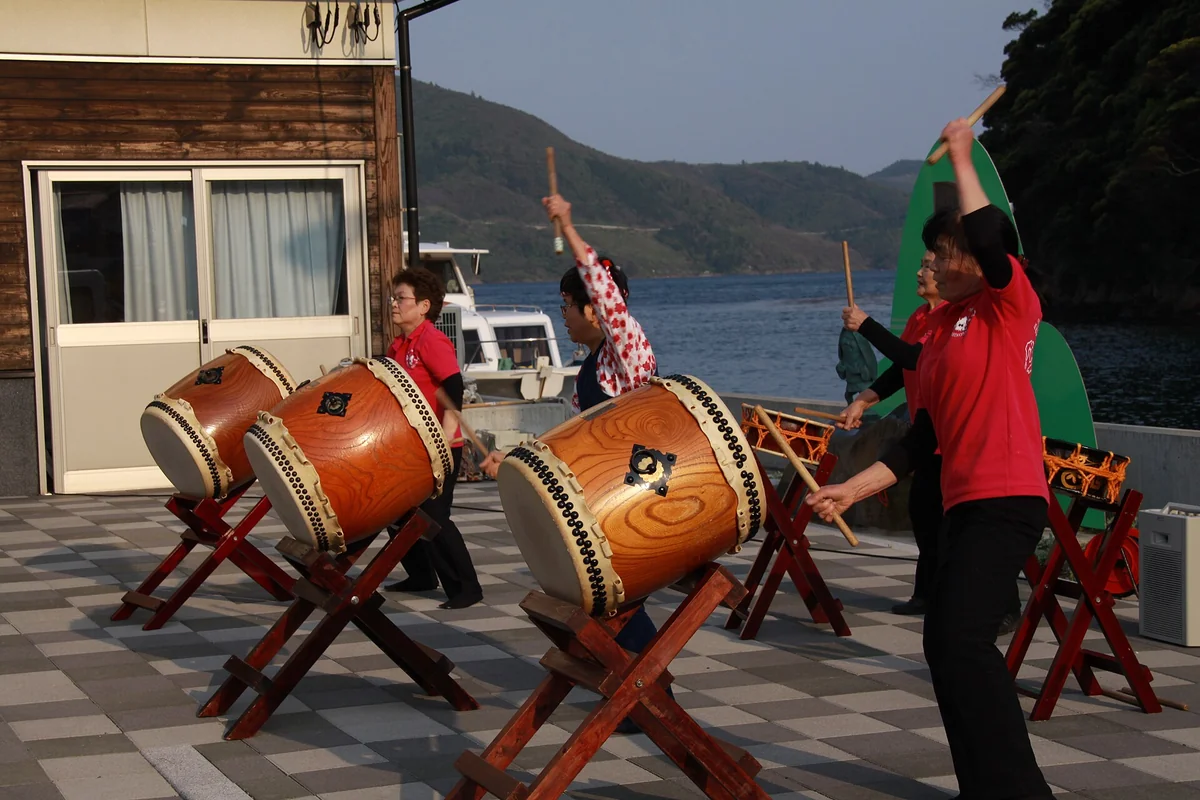
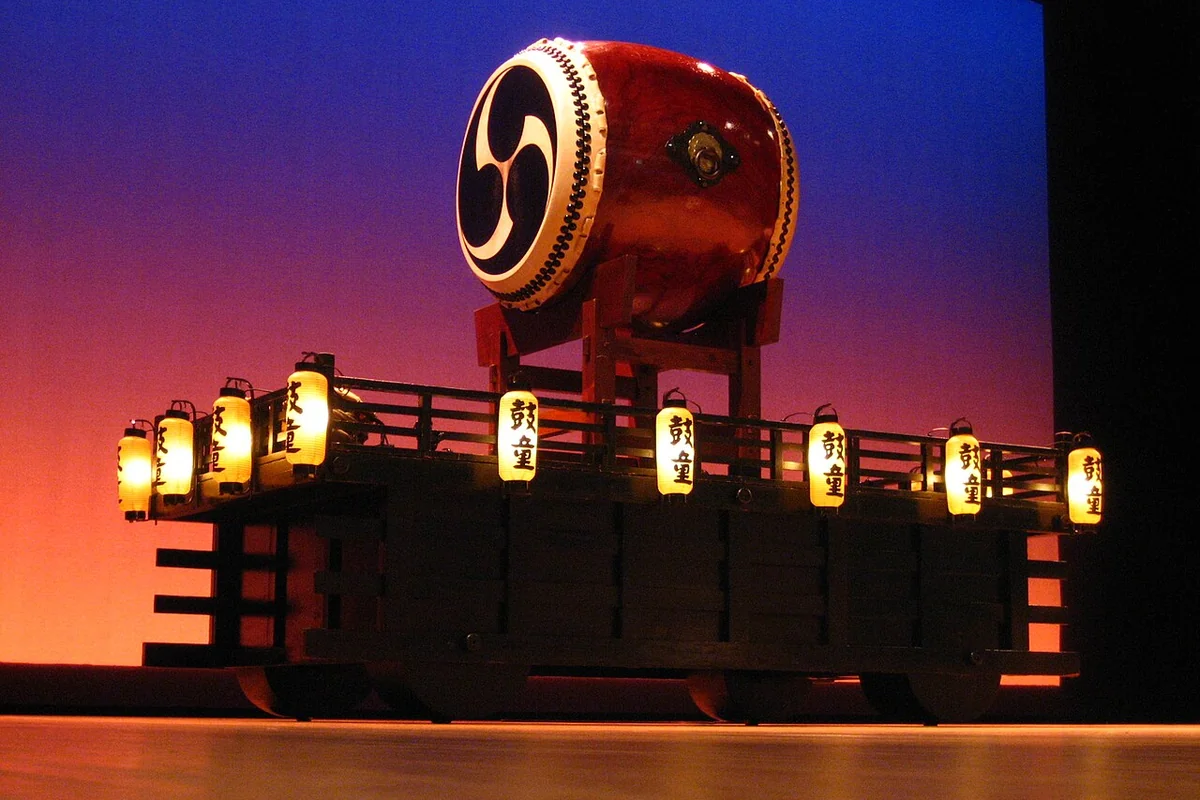
Taiko are grouped by how the skin is fixed. On byō-uchi-daiko the heads are nailed to a body hollowed from a single log, so they cannot be retuned. On shime-daiko the heads are stretched over rings and pulled tight with rope or bolts, so they can be tuned. A stage group mixes both kinds, each with a job to do.
| Drum | How it is made | What it does in a group |
|---|---|---|
| Ōdaiko (大太鼓) | The largest nailed drum, often on its own stand or float | The deep centrepiece, often played as a solo |
| Nagadō-daiko (長胴太鼓) | Nailed, barrel-shaped, the most common taiko | Carries the main rhythm; the chū-daiko is the mid-size version |
| Shime-daiko (締太鼓) | Small, rope or bolt tensioned, tunable | Keeps time with a steady base pattern, like a snare drum |
| Okedō-daiko (桶胴太鼓) | Stave-built like a barrel, rope tensioned, light enough to carry on a strap | Played on the move or with the hands |
| Tsuzumi (鼓) | Hourglass drums held on the shoulder or hip, rope tensioned | Noh and kabuki music, played with the fingers |
The hand drums of the Noh stage, the kotsuzumi and ōtsuzumi, belong to a much older and quieter tradition, which our guide to Noh theatre explains.


Before the Stage: Taiko at Shrines, Battles and the Bon Dance
The oldest evidence is clay. Haniwa figures from the 6th century found in Gunma Prefecture include a drummer striking a barrel-shaped drum with a stick. Drums came into court and temple music through contact with China and Korea, and on medieval battlefields they set the marching pace and signalled advance and retreat.
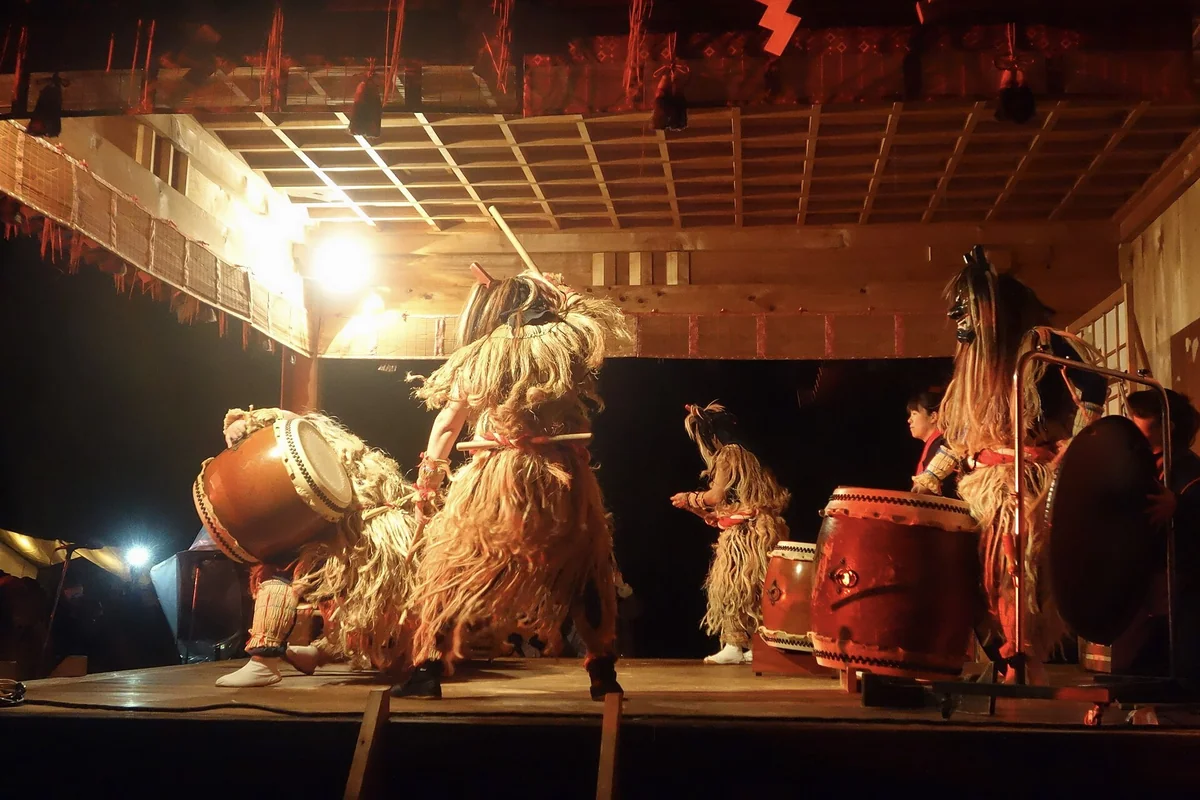
For ordinary people, the drum meant festivals. Lafcadio Hearn, in Glimpses of Unfamiliar Japan (1894, chapter six, “Bon-odori”), describes a village temple courtyard on the night of the Bon dance, with a great drum on a bamboo frame at its centre. The villagers wait in near silence, until a girl stands up and “taps the huge drum once” to start the dance. Bon dances are still danced to a drum across Japan every summer, and our guide to Japan in August covers the Obon festivals where you will hear them.
The theatre used drums as sound effects. Zoë Kincaid, in Kabuki: The Popular Stage of Japan (1925, chapter three), lists the code: regular beats of the big drum for wind, “soft, muffled, regular drum-beats” for falling snow, and for waves a hard stroke followed by a quiet tap, like the tide going out. In her chapter on kabuki audiences she notes that drumming still filled the empty theatre before a show, a reminder of the old drum tower that once called the town to the play.
Kumi-daiko: How Daihachi Oguchi Created Ensemble Taiko in 1951
Daihachi Oguchi was a jazz drummer in Nagano Prefecture. Asked to decipher an old piece of taiko music found at Suwa Shrine, he managed it with the help of an elderly man who had played it, but found the rhythm too plain to perform as it stood. His answer was to treat a group of taiko like a Western drum kit: a high shime-daiko would keep time like a snare, and a deep nagadō-daiko would add accents like a bass drum, with several players working together. In 1951 he founded Osuwa Daiko to play this way, and kumi-daiko, group taiko, was born.
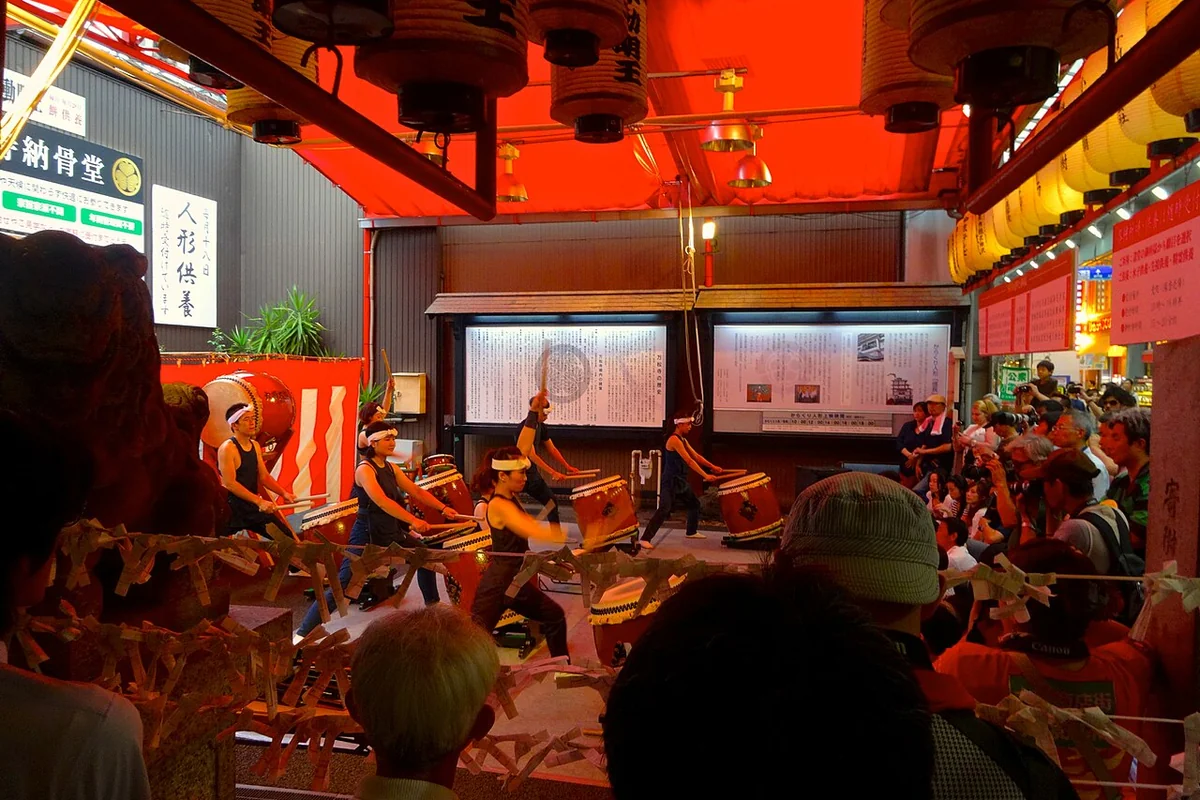
Taiko played at the 1964 Tokyo Olympics, and groups multiplied across Japan. It crossed the Pacific early: Seiichi Tanaka founded the San Francisco Taiko Dojo in 1968 and was one of the first teachers to admit women to a form that had been almost entirely male. Estimates of how many taiko groups now exist in Japan range from about 800 to 5,000.
Ondekoza and Kodo: Sado Island Takes Taiko to the World
At the end of the 1960s the organiser Den Tagayasu gathered young players on Sado Island, off the coast of Niigata, to live together and study folk arts. The group, Ondekoza, ran before breakfast and rehearsed all day, and Kodo’s own history dates its time on Sado to 1971 to 1981. Ondekoza made its American debut in 1975 by running the Boston Marathon and then playing a full set at the finish line. Pieces from its repertoire, such as Yatai-bayashi, based on the Chichibu festival, and the ōdaiko solo, are still played by groups everywhere.
In 1981 members who stayed on Sado formed Kodo, which made its debut at the Berliner Festspiele that year. The name has two readings: “heartbeat”, the rhythm a baby hears in the womb, and “children of the drum”. Kodo has since given more than 7,500 performances in over 50 countries and regions, runs the Earth Celebration festival on Sado every year since 1988, and has played on the soundtrack of Genshin Impact and in collaborations with Hatsune Miku.
Kodo in London in 2026, and what comes next
Kodo played the Royal Festival Hall at the Southbank Centre on 6 and 7 March 2026, on the European leg of “Kodo One Earth Tour 2026: Luminance”, part of its 45th anniversary. The programme opened with Yuki Hirata’s Shine a Light and paid tribute to Maki Ishii’s Monochrome, 50 years old in 2026. Its next international tour, listed on Kodo’s official site, is “Luminance” in the United States from January to March 2027, and no UK date had been announced when this guide was checked on 31 October 2026. Between tours, the Kodo Taiko School runs online group classes taught by Kodo members in Japanese and English.








Taiko Drumming in the UK: Groups and Classes
- Taiko Meantime (London): performing, recording and teaching taiko in the UK since 2001, with regular classes and workshops for beginners and improvers, plus school and team-building sessions. Its founder, Mark Alcock, played with Joji Hirota from 1994 to 2004. See Taiko Meantime’s London classes page.
- Tamashii School of Wadaiko-Dō (London): a London taiko troupe and school that plays several styles, including the festival style of Fukui on Japan’s west coast, and has appeared at Westminster Abbey and on Channel 4. Tamashii opened Japan Matsuri in Trafalgar Square on 4 October 2026. See the Tamashii site.
- Joji Hirota and the London Taiko Drummers: Hirota, born in Otaru in 1948, came to England in 1972 with Stomu Yamashta’s Red Buddha Theatre, founded his taiko group in the early 1980s, opened Live Earth at Wembley in 2007, opened Japan Matsuri 2024 and played on the soundtracks of Isle of Dogs and Ghost of Tsushima. He died in London on 6 September 2026, aged 78, as the London Metropolitan Orchestra announced. The group was named on the Japan Matsuri programme a month later.
- Kagemusha Taiko (south-west England): formed in 1999 by Jonathan Kirby, it plays its own compositions and is known for its work in schools.
- Eisa drumming: the London Okinawa Sanshinkai practises Okinawan eisa, a dance played on handheld drums, every Saturday from 3pm to 6pm at SOAS, after its sanshin session. See the Sanshinkai site.
Taiko sits at the loud end of a much wider family of instruments. Our guide to traditional Japanese instruments covers the shamisen, koto, shakuhachi and the rest.
Taiko in Games, Anime and Film Scores
Taiko is a shortcut composers use to say “Japan” on screen. For Ghost of Tsushima, Joji Hirota led a three-player taiko ensemble at AIR Studios in London. Kodo recorded for Genshin Impact in 2021. Anime scores lean on it too: Yasuharu Takanashi’s Naruto music uses taiko with shamisen and shinobue, and his touring band has had to recreate those sounds without a single traditional drummer.
Taiko Drumming Questions
What is taiko drumming?
Taiko drumming is Japanese drumming on taiko, barrel drums struck with wooden sticks called bachi. In festivals one or two drums accompany dancing. On stage, groups of players use drums of different sizes together, a style called kumi-daiko created by Daihachi Oguchi in 1951 and spread worldwide by groups such as Ondekoza and Kodo.
How old is taiko drumming?
The drums are ancient. Clay haniwa figures from the 6th century found in Gunma Prefecture show drummers, and taiko were used in court music, temples, festivals and warfare for centuries. The ensemble style seen in concerts is much younger: Daihachi Oguchi founded the first group, Osuwa Daiko, in 1951, and Kodo made its debut in 1981.
What are taiko drumsticks called?
They are called bachi, the same word used for the shamisen plectrum. Taiko bachi are thick wooden sticks made in many sizes from woods such as white oak, Japanese magnolia and bamboo. In ensemble playing they are usually held loosely between the thumb and index finger, so the stick rebounds off the drumhead.
Where can I learn taiko drumming in London?
Taiko Meantime runs regular classes and workshops for beginners and improvers in London, and the Tamashii School of Wadaiko-Dō teaches and performs in London too. For Okinawan eisa drum dancing, the London Okinawa Sanshinkai meets every Saturday afternoon at SOAS. Kodo’s own Taiko School also runs online classes in English.
Is Kodo touring the UK in 2027?
Not as of 31 October 2026. Kodo last played London at the Royal Festival Hall on 6 and 7 March 2026. Its announced international dates for early 2027 are a United States tour from January to March, and its December 2026 concerts are in Japan. New tours appear first on the events pages of Kodo’s official website.