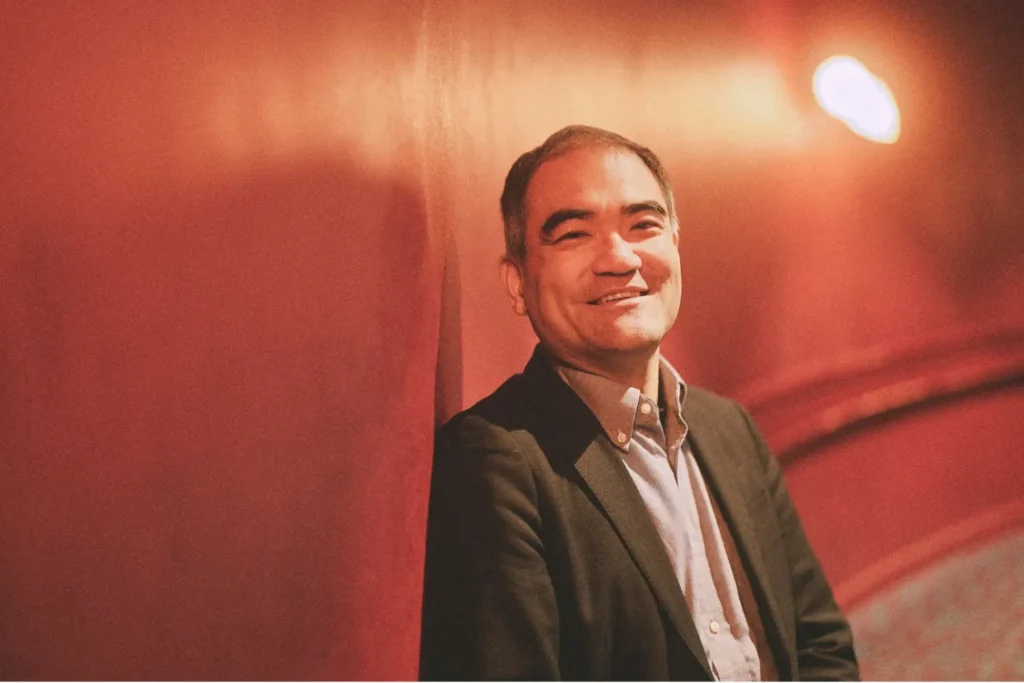
Search for the composer of Sadness and Sorrow, the piano and shakuhachi theme that has followed Naruto fans for more than twenty years, and the answer changes depending on where you look. Yasuharu Takanashi has said for years that he wrote it. Ahead of his first ever performance in the United Kingdom, we asked him to put it on the record.
Takanashi scored Naruto Shippuden from 2007 to 2017 and carried on into Boruto, and he wrote the music for Fairy Tail and Fairy Tail: 100 Years Quest. On Friday 2 October he plays Dingwalls in Camden with Far East Groove, the Japanese and Finnish band he founded in 2024, on the only British date of a ten city European tour.
He answered in writing through his team, Team-MAX. His answers appear here in full, in the order they were asked.
Sadness and Sorrow, and the three names attached to it
Search engines have never settled this one. Depending on which page you land on, the composer is Toshio Masuda, or Musashi Project, or Takanashi himself.
“Sadness and Sorrow” is credited to Musashi Project on the 2003 Naruto soundtrack, and you have said it was your first ballad for the series. Most streaming services, sheet music sites and cover videos now credit it to Toshio Masuda. Can you confirm that you wrote it, and can you tell us the title of the Naruto Shippuden soundtrack the rerecorded version appears on?
I composed it.
The rerecorded version appears on Naruto Shippuden Original Soundtrack III. The English title is “Nostalgia,” and the Japanese title is “届かぬ人に” (Todokanu Hito ni).
One clarification on the album itself. Soundtrack III lists these as two separate tracks. 届かぬ人に is track 22 and runs to three minutes and 27 seconds. ノスタルジア, the Japanese spelling of Nostalgia, is a different and shorter piece at track 21.
The Girei chant is invented words, and some of them run backwards
The chant under Pain’s theme is one of the most transcribed pieces of audio in anime fandom. None of the versions online came from the composer. Pain’s assault on the Leaf Village takes up two entries in our ten best Naruto episodes.
“Girei”, the Pain theme, has fan written lyrics all over the internet, both in made up English and in Japanese. You have said the chant is a word you invented. Does the chant have any official lyrics at all, and is there anything you would like fans to know about it?
They are completely invented words. Some of them are based on real words spoken backwards, so please have fun trying to find them.

13 April 1963, nine JASRAC International Awards, and a band named after a 1998 album
Different sources give your date of birth as 13 April 1963 and 13 April 1964. Which is correct?
13 April 1963 is correct.
Team-MAX lists eight JASRAC International Awards (2013, 2014, 2017, and 2020 to 2024). Is eight the correct total today?
I have received the award eight times for NARUTO and once for FAIRY TAIL. The award years are 2013, 2014, 2017, 2020 to 2024, and 2026.
Far East Groove is named after the 1998 second album of 六三四 Musashi. Who founded 六三四, and would you like them named in the article?
It was Katsunosuke Kobari, the original guitarist and producer of Musashi. I have no problem with his name being mentioned in the article.
Rainbow at the Budokan, and a British debut after twenty years of Shippuden
In your JASRAC interview you said the whole reason you became a musician was seeing a British band, Rainbow, at the Budokan, and that you wanted to travel the world as a band man. When you announced Far East Groove you named KISS and Deep Purple as the bands you idolised. On 2 October you will finally play in Britain, the country those bands came from. What does that night mean to you personally?
Britain is a very important place to me. It is the country that produced many of the musicians and bands who first inspired me to dream of becoming a musician myself.
You have also written that you were “a rock musician who never sold” and failed many times before anime. Does arriving in London at this stage of your career feel like the end of that story, or the beginning of another one?
This is not the end. I finally feel that I can see the door opening to the wider world. For me, this truly feels like the beginning of a new story.
This is your first ever performance in the United Kingdom, after nearly twenty years of Naruto Shippuden and Fairy Tail on British screens. Why has it taken until now, and what finally made a London date possible?
Of course, I was well aware of how popular these works are in the UK, and I had always wanted to perform there myself. However, for a Japanese artist to perform in Europe, there are many challenges, including the cost and the logistics of travelling. Thanks to the hard work of our managers and staff, a large-scale European tour finally became realistic, and that also made it possible for us to perform in London.
Anime music has become a regular fixture on British stages since. Two weeks after the Dingwalls show, a hundred musicians play the Attack on Titan score at the Royal Albert Hall.
Dingwalls holds 600 people and sits in Camden Market, which has been London’s rock and punk neighbourhood since the 1970s. What do you enjoy about a small room compared to a festival stage like Rock Imperium, and is there anything you have been told to expect from a British crowd?
I know very well that a great deal of rock culture has come from this city. I am also very happy to be able to meet the audience at such close range in a country I have admired since I was a boy. That is exactly why I feel that performing at this venue has such special meaning.

In Milan last year the band played four encores because the crowd would not stop singing. What do you want a London crowd to do during the show, and how will you know if the night has worked?
Of course, it is when I see the audience smiling and clearly enjoying themselves.
Ninety second cues, a violin covering shakuhachi parts, and a manipulator running the video
The tour is called The Battle for Glory. What does that title mean to you, and does it describe the shape of the set?
The Battle for Glory is the overall theme of this tour. We chose the title with the idea that the story continues on from last year’s tour, Beginning the Quest, as if the two tours are part of one ongoing journey.
A Naruto Shippuden cue might be ninety seconds long and written to sit under dialogue. How do you turn a cue like that into a full live song with a vocalist and a band? Could you walk us through one specific track, for example “Heaven Shaking Event” or “Reverse Situation”?
All of these pieces were originally created together with musicians who have a great deal of live experience and with whom I have a close relationship, so I think the music naturally works well when performed by a live band. For the live shows, sometimes we add a little to the arrangement and extend the length of a piece. In other cases, we respect the atmosphere and character of the original and perform it with very few changes.
Getting an anime score onto a stage is its own problem, whichever form it takes. The conductor Michael England told us about rehearsing 66 musicians and a rock band in a single afternoon for a London anime concert this autumn.
Your Naruto music is famous for shakuhachi, shamisen, shinobue and taiko. The touring band has keyboards, guitar, bass, drums, violin and synthesiser, but no Japanese traditional instrumentalist. How are those Japanese sounds handled live? Are they played on keyboard, sampled, or given to the violin?
I would love for you to come to the venue and discover that for yourself.
Tuomas Rounakari’s violin is the one acoustic instrument on stage. Which parts of your scores have you handed to him, and has the fiddle changed how any of the pieces feel?
For the FAIRY TAIL music, he mainly plays violin parts that were already present in the original scores. For the NARUTO music, we sometimes have him play parts that were originally written for shakuhachi, and we also create new arrangements by adding violin parts that were not there originally.
Funta7 is credited as synthesiser and manipulator. For readers who do not know the term, what does a manipulator do during a Far East Groove show?
He is responsible for managing and playing back the elements that are not performed live on stage, such as backing tracks and the click tracks used for our in-ear monitors. He is not only the Manipulator, however; he also performs on synthesiser, so I hope people will pay attention to that side of his performance as well.
Anime footage plays during the show. Who chooses the scenes, and how tightly is the band locked to the picture? Is there a click track, or can the band stretch a section if the crowd is with you?
When we use video during a performance, Team-MAX staff select and edit the footage to suit each piece, using material that has been approved for use by the relevant rights holders. During the show, the Manipulator manages the video so that the visuals are linked with the music. Whenever the performance and visuals need to be synchronised, the Manipulator is responsible for controlling that synchronisation.
The Rock Imperium set ran from “Dragon Force” to “Reverse Situation” in an hour, and included “Amazing Muscle” from Kinnikuman alongside Naruto and Fairy Tail. A headline show gives you more time. Without giving away the setlist, what does the extra time let you do, and will London hear anything from Pretty Cure, Log Horizon, Sailor Moon or Reincarnated as a Sword?
That is another thing I would love for you to come to the venue and discover for yourself.
You have said European crowds react most strongly to Fairy Tail. Do you change the balance between Naruto and Fairy Tail from city to city, and what are you expecting from London?
For this tour, we are basically planning to perform the same setlist in every city. Of course, there may be exceptions if we receive an unexpected encore, but more than anything, I will be happiest if everyone in London enjoys the show in their own way.
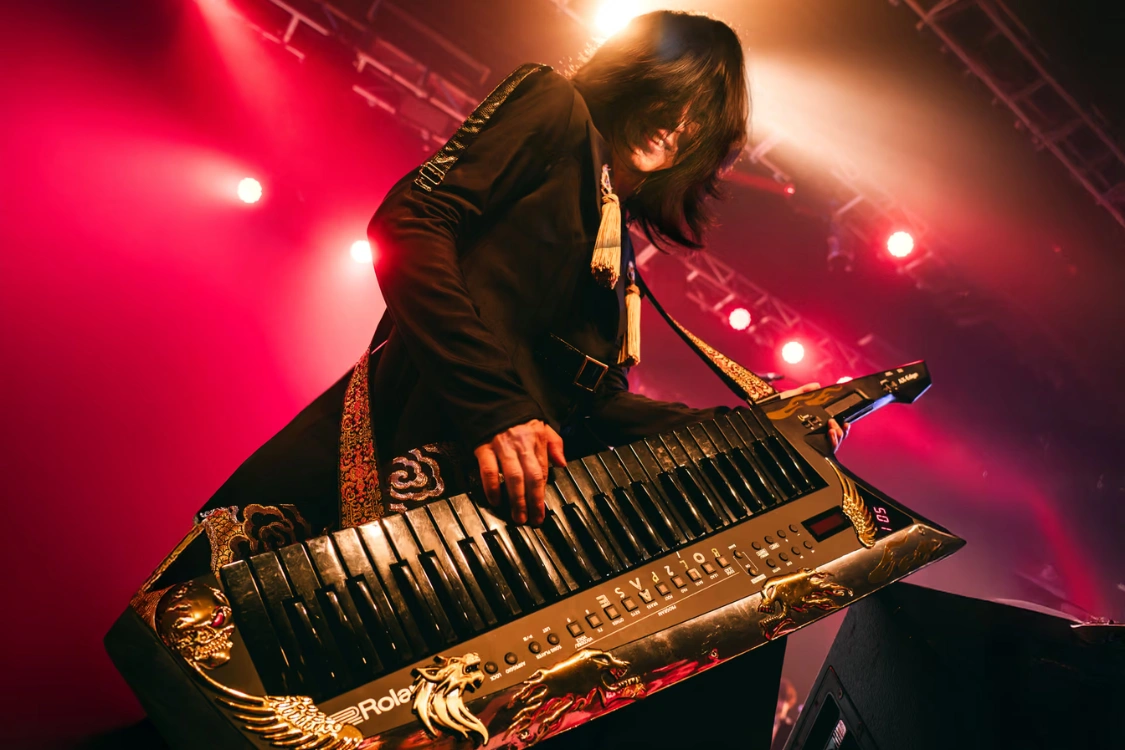
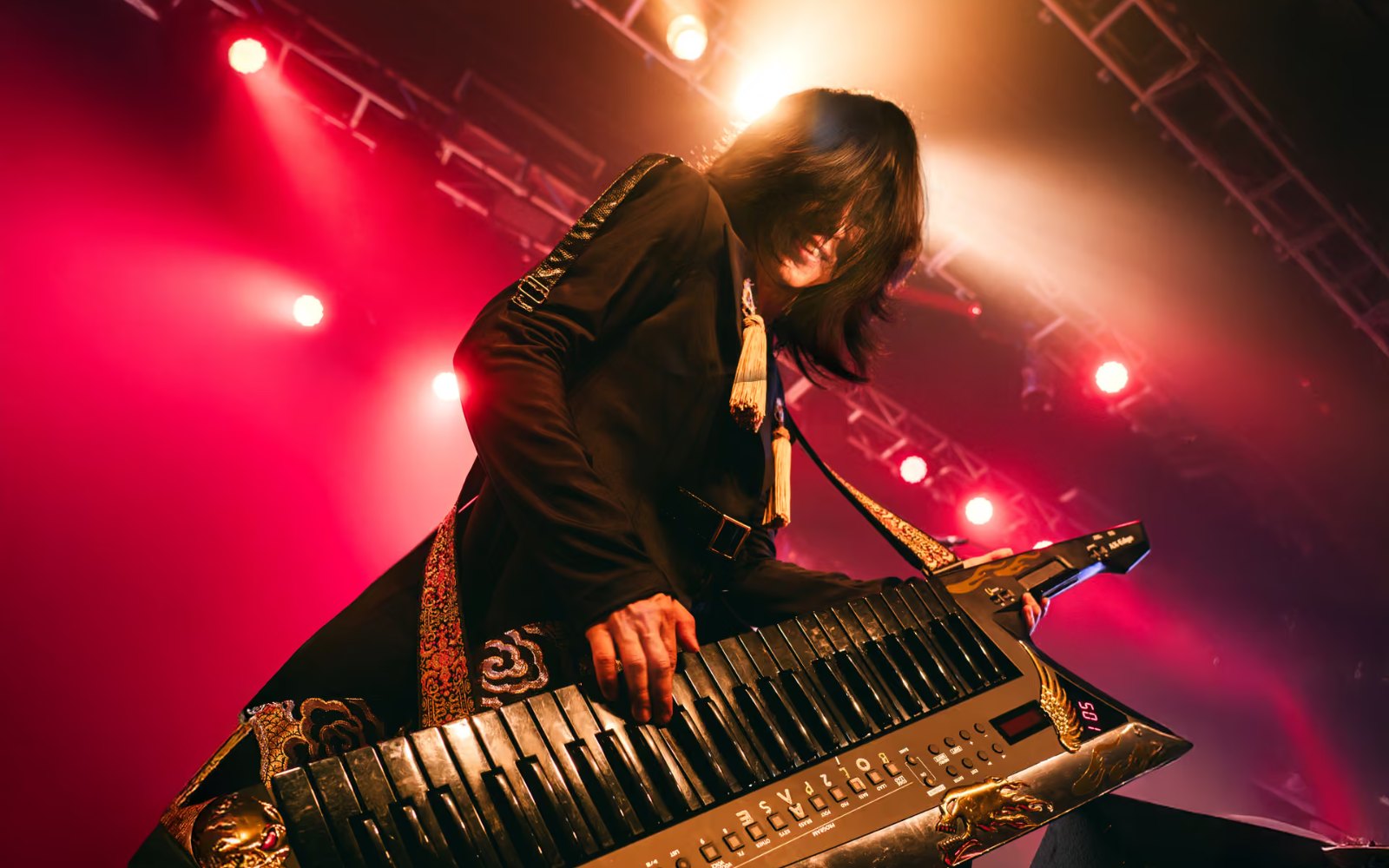
You play a keytar at the front of the stage rather than standing behind a keyboard rig. When did that start, and what does it change for you as a performer?
I think I started using a keytar more than ten years ago, and it changed my performance dramatically! Most importantly, it gave me much greater mobility and allowed me to move freely around the stage. It also has the practical advantage of reducing the amount of equipment we need to carry on tour, which makes transportation easier and less expensive.




Nozomu Wakai, Juno, and a drummer found on YouTube
Nozomu Wakai comes from Sigh, a black metal band, and he also manages this tour. How did the two of you first meet, and what does he bring to anime music that a session guitarist would not?
I first met Nozomu about ten years ago. Then, in 2021, I was involved in a project called THE LAST METAL. When we were looking for a guitarist, he applied, and that brought us together again. From that point, we became much closer, and I think that reunion helped lay some of the groundwork for what eventually became Far East Groove. A few years later, when we met again, we stayed up late talking at an old local diner, sharing our dreams and talking about what we hoped to achieve in the future. He has a great knowledge of both the Japanese and international music scenes, and he was also the person who encouraged me to start performing overseas. I am very grateful to him for that. He is also able to contribute far beyond his guitar playing, including management and the visual side of the project, such as merchandise and poster design, so his support has been extremely valuable to me.
Juno is of mixed heritage, was born and raised in Japan, and sings in English. How did you find her, and how do you write a vocal line for a piece that was written as an instrumental theme?
The first time I came across Juno was on YouTube! However, she did not join Far East Groove straight away. I later had the opportunity to perform at TOKYO SOUNDTRACK FESTIVAL, an event organised by my friend and fellow composer Yuki Hayashi. At the time, I was looking for a vocalist for the first live performance of “BEYOND THE QUEST,” and that was how Juno and I came to work together. That became the starting point for us, and since then she has become an indispensable part of my band. She has also been expanding her own range of work. For example, she has sung an insert song for Gachiakuta, which is scored by another composer friend of mine, Taku Iwasaki. Her vocal style is different from that of Noora Louhimo, who sang the original version of “BEYOND THE QUEST,” but Juno works extremely hard and has a unique quality and charm that belongs entirely to her. When we add vocals to a piece that was originally written as an instrumental, I usually begin by asking Juno to come up with lyrics and record a demo vocal. From there, we discuss the ideas together and gradually decide on the vocal arrangement and the overall arrangement of the piece.
The seed of the band was the sold out Epic East Meets Northern Beasts concert with Tuomas Rounakari in Lahti in January 2024. What happened at that concert that made you decide to build a permanent band around it?
When we performed together at Epic East Meets Northern Beasts, I was impressed not only by how excellent they were as musicians, but also by who they were as people. We immediately connected very well. After that, Nozomu and I started talking about forming a band that could perform internationally. When we began putting together a line up for Europe, I asked those musicians to join because I already knew that I wanted to work with them again. As for our drummer, Tino, we were looking for someone with a strong heavy metal style when a friend introduced him to us. I watched videos of him playing on YouTube and immediately thought, “He’s the one.” I first met him in person on last year’s tour. He is a wonderful person, and above all, he is an excellent drummer, and very cool to watch!
The band is Japanese and Finnish, so time in the same room must be short. How do you rehearse across two countries, and what language is used on stage and in the rehearsal room?
For rehearsals, the Japanese members travel to Finland a little earlier so that we can rehearse together there. English is our main language for communication, but there is also a strange and wonderful bond between us that seems to go beyond language. Compared with a conventional band, the amount of time we can all spend rehearsing together is certainly limited, but everyone is an excellent musician, so it has never been a major problem.
Your other band, 刃-yaiba-, has played this music in Japan for years with taiko, shamisen and shinobue. What can Far East Groove do that yaiba could not, and does yaiba continue?
Yaiba is essentially a band focused specifically on the music of NARUTO, whereas with Far East Groove I want to go beyond the boundaries of any one title and explore a much wider range of music. Another important purpose of Far East Groove is to make Europe one of our main areas of activity and to develop the band in a more international direction, including collaborations with musicians from different countries. That is also one of the major differences between Far East Groove and Yaiba. Yaiba actively incorporates traditional Japanese instruments and pursues a distinctly Japanese style of rock, while Far East Groove is intended to bring together musicians and influences from different countries. The two bands have different identities and different roles, so 刃-yaiba- will continue to operate separately from Far East Groove.
Hellen, Planet Earth, and the theme for PRIDE

Before anime you were the keyboard player in Hellen, whose 1985 album Talon of King is still called one of Japan’s great heavy metal records, and then in Planet Earth on Polydor in 1993. What did those bands teach you, about writing or about surviving in music, that you still use today?
Never forget the kindness and support you have received from other people, and never forget to remain humble.
In the JASRAC interview you spoke about a mentor who challenged you to learn orchestral arranging in one month. Who was that, and what was the first piece you arranged after learning?
I learned orchestration by getting advice from people who had the necessary knowledge, while also studying on my own and learning through a great deal of trial and error. One representative example would be the theme for the martial arts event PRIDE.
An album he wants to make, and the Shippuden cues still unreleased
Every announcement for this tour says the band plans to “develop original material”. Is there a Far East Groove studio album or live recording planned, and will the 2025 festival recordings be released?
I definitely want to make an album, so please look forward to what we do in the future.
Fans have asked for years about Naruto Shippuden cues that were used in the anime but never released on a soundtrack album. Do those recordings still exist, and is there any chance of a release?
I get asked this question a lot, so it is a slightly difficult one for me to answer! (laughs) The decision about whether to release those tracks belongs to the record company, so it is not something I can decide myself. But if the fans’ voices reach the people responsible, perhaps there may be a possibility of a release someday.
Naruto is marking its anniversary with new episodes that use your music. Is there anything you can share about what you were asked to do for them, even in general terms?
I cannot share any details yet, but please look forward to it.
Fairy Tail: 100 Years Quest brought you back to that world with around seventy new tracks. Is there a track from it you are proudest of, and will it be in the show?
“BEYOND THE QUEST,” which features a number of heavy metal musicians from around the world. We will be performing it on this tour as well!
What he wants a London crowd to say on the way home
Anime concerts have become a regular part of the London calendar. If you have never been to one, the tracks fans most want to hear played live gives a good sense of what these nights are built around.
If a London reader has never been to an anime concert, what should they expect from the night, and what do you want them to be talking about on the way home?
If people leave thinking, “That was fun!” and “I want to come again!”, nothing could make me happier. But more than anything, I hope everyone talks freely about whatever they personally felt and experienced during the show.

Is there one Naruto Shippuden or Fairy Tail piece you most want a British crowd to hear live, and why that one?
We have built the setlist around songs that are especially popular with the fans, so my answer is: all of them!
Yasuharu Takanashi and Far East Groove play Dingwalls, Middle Yard, Camden Lock, London NW1 8AL on Friday 2 October 2026. Doors are at 7pm, the VIP meet and greet runs from 6pm, and the band are on stage at 8pm. General admission is £36 and the VIP package is £72. Tickets are on sale through Snapticket.