Shin hanga, meaning “new prints”, is a Japanese woodblock print movement that began in Tokyo in 1915, when the publisher Watanabe Shozaburo started commissioning artists to design prints made in the old ukiyo-e way, by teams of carvers and printers, but with modern light, shadow and atmosphere. Its best known artists are Kawase Hasui, Hiroshi Yoshida, Itō Shinsui and Ohara Koson. Most shin hanga prints were sold abroad, which is why so many are now in Western collections, including the British Museum.
| Meaning | “New prints” (新版画) |
| Began | 1915, Tokyo, with the publisher Watanabe Shozaburo (1885 to 1962) |
| Peak | About 1915 to 1942, smaller revival after 1945 |
| How the prints were made | Artist designs, a carver cuts the blocks, a printer prints, the publisher sells |
| Main subjects | Landscapes, beautiful women, kabuki actors, birds and flowers |
| Key artists | Kawase Hasui, Hiroshi Yoshida, Itō Shinsui, Ohara Koson, Hashiguchi Goyō |
| See it in the UK | British Museum collection; past exhibitions at Dulwich Picture Gallery (2024) |
What shin hanga is
By the early 20th century the old ukiyo-e print trade was close to finished. Photography and cheap printing had taken over its jobs, and Japanese collectors treated prints as cheap goods, as our article on the story of ukiyo-e explains. Shin hanga kept the ukiyo-e working method alive but changed what the prints looked like.
Shin Hanga Artists, Techniques and Where to See Them
The method stayed exactly the same: an artist made the design, a specialist carver cut it into cherry wood blocks, a printer brushed on the colours and rubbed each sheet by hand, and a publisher paid for it all and sold the results. The look changed completely. Shin hanga artists, many trained in Western style painting, brought in the effects of light, weather and reflections, soft shadows and moods, and stopped copying the brushstroke outlines of older prints. The subjects stayed traditional: landscapes and famous places, beautiful women, actors, birds and flowers.
Watanabe also had his printers leave the marks of the baren, the hand pad that presses paper onto the block, visible as fine lines in a sky or a wall, and print speckled textures, on thicker and drier paper than older prints used.

Watanabe Shozaburo and the first shin hanga prints, 1915 to 1923
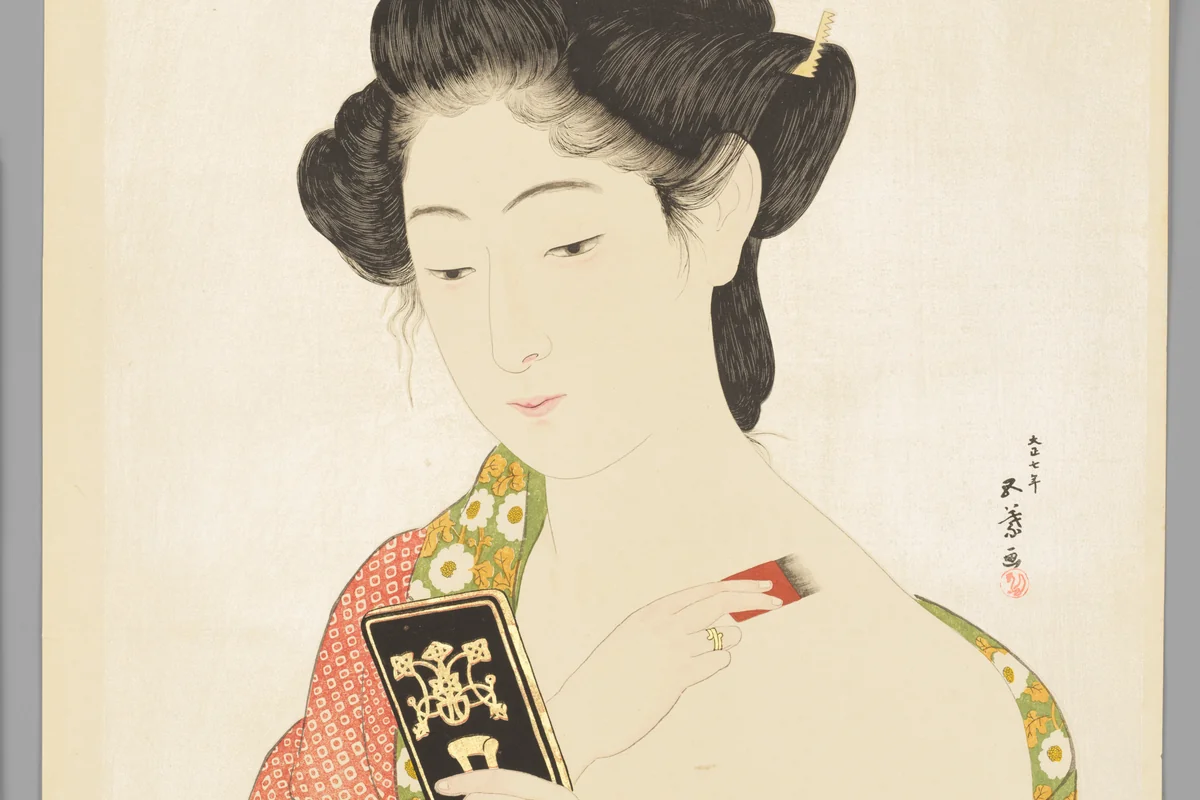
Watanabe Shozaburo had learned the export print business working for a dealer, Kobayashi Bunshichi, and married a woodblock carver’s daughter in 1908. His first venture, from 1907, was what he called new made prints (shinsaku-hanga): smaller, cheaper landscapes in the manner of Hiroshige, many by Takahashi Shōtei, sold mostly to tourists. Those souvenir prints paid for the more ambitious work that followed.
In 1915 he began commissioning prints from artists with a painter’s eye, and coined the term shin hanga for them. Among the first were European artists living in Tokyo, Friedrich Capelari and the British painter Charles Bartlett. Then he persuaded the painter and ukiyo-e scholar Hashiguchi Goyō to design a print of a woman bathing, published in 1916. Goyō disliked the result and went his own way, supervising his own carvers and printers. The print above, from 1918, is one of the 14 he designed before his death in 1921, and a reason his prints are among the most sought after in the movement.
In 1916 Watanabe saw a painting by the young Itō Shinsui of a woman arranging her hair before a mirror and turned it into a print, Before the Mirror. Two years later Kawase Hasui saw Shinsui’s landscape series Eight Views of Lake Biwa and asked Watanabe to publish him too. By 1920 the publisher had the artists who would define the movement.
Shin hanga, ukiyo-e and sōsaku hanga compared
Shin hanga had a rival from the start. The creative print movement, sōsaku hanga, dates from 1904, when Yamamoto Kanae drew, carved and printed a small print called Fisherman entirely by himself.
| Ukiyo-e | Shin hanga | Sōsaku hanga | |
|---|---|---|---|
| When | About 1670s to late 1800s | 1915 to the 1960s | 1904 onwards, strongest after 1945 |
| Who made the print | Artist, carver, printer and publisher | Artist, carver, printer and publisher | The artist, who drew, carved and printed it (or chose who did) |
| Look | Black outlines, flat areas of colour | Light, shadow, weather and mood, few hard outlines | Personal and experimental, later often abstract |
| Subjects | Actors, courtesans, landscapes, famous places | The same traditional subjects, seen in a modern way | Anything the artist chose |
| Main buyers | Townspeople of Edo | Mostly Western collectors | After the war, largely American collectors |
| Names to know | Utamaro, Hokusai, Hiroshige | Hasui, Yoshida, Shinsui, Koson, Goyō | Yamamoto Kanae, Onchi Kōshirō, Munakata Shikō |
For the most famous print series of the old ukiyo-e world, see our guide to Hokusai’s Thirty-six Views of Mount Fuji.
The shin hanga artists to know
Kawase Hasui (1883 to 1957)
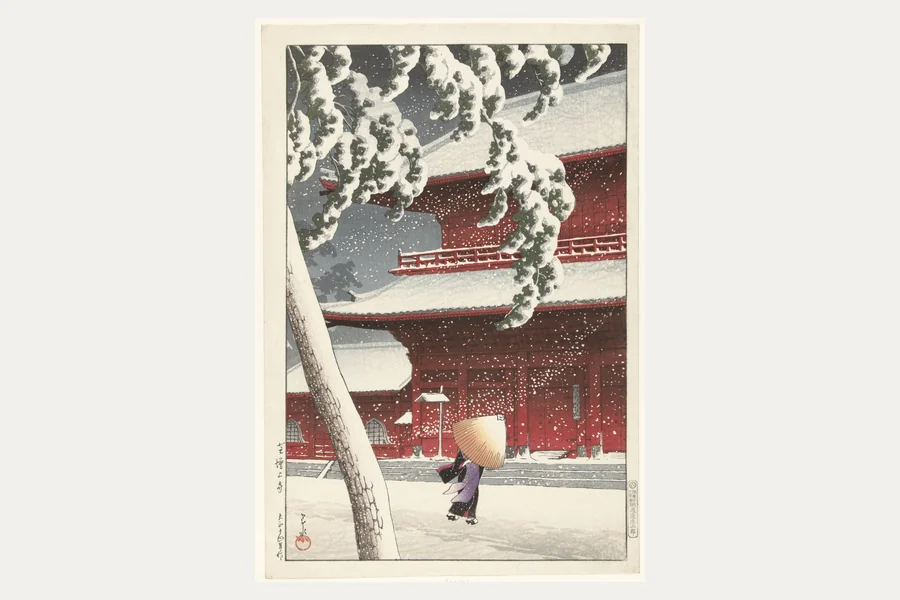
Hasui is the landscape artist most people picture when they hear shin hanga: snow falling on a temple gate, a moon over a canal, a single figure under an umbrella at dusk. Born Kawase Bunjirō in Tokyo, he took up art after the family rope business failed and studied under the painter Kaburagi Kiyokata, who gave him the name Hasui. He worked with Watanabe from 1918 for the rest of his career, travelled Japan to sketch quiet, little known places, and made more than 600 prints.
His best seller was Zōjō-ji in Shiba (1925), from Twenty Views of Tokyo. In 1956 the Japanese government named him a holder of an Important Intangible Cultural Property, the status known as Living National Treasure. Because his collaborators were part of the work, the committee had a new print, Snow at Zōjō-ji, made and recorded stage by stage to document the craft.
Hiroshi Yoshida (1876 to 1950)
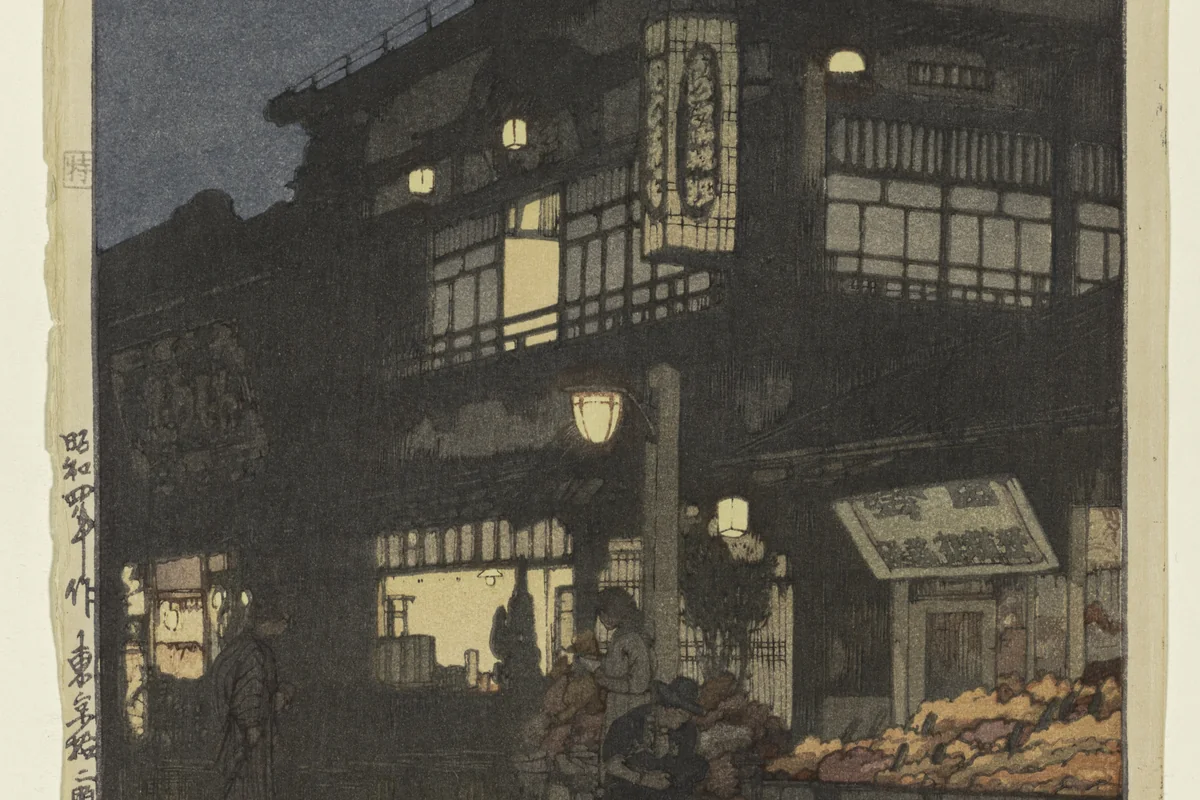
Yoshida was already a successful oil and watercolour painter, with exhibitions in Detroit, Boston and the Paris Exposition of 1900, when he made his first woodblock design with Watanabe in 1920, at 44. After the 1923 earthquake he went his own way: from 1925 he ran his own studio, hired his own carvers and printers, and supervised every impression. His prints average around 30 printings each, and some approach 100, building up colour in layers.
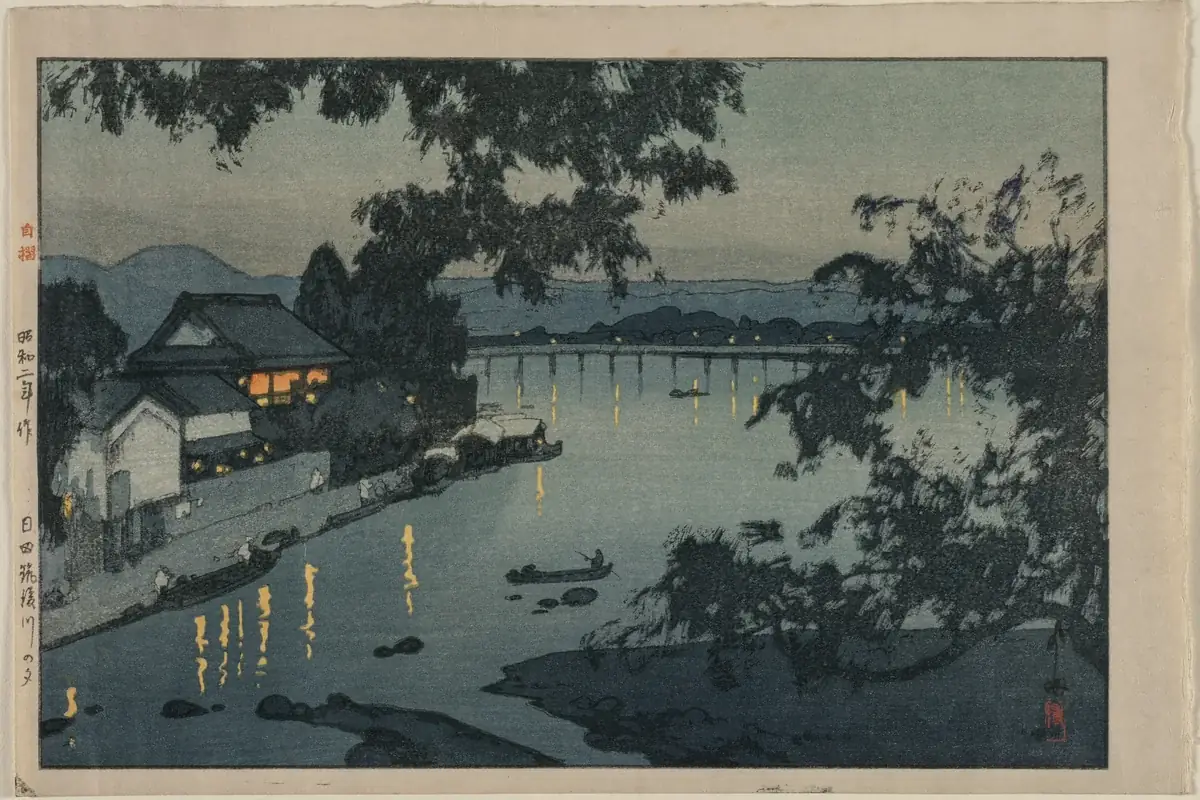
He was a mountaineer who climbed in the Japanese Alps every summer, and he travelled widely, so his subjects range from Mount Fuji (his Ten Views of Mount Fuji appeared in 1926 and 1928) to the Grand Canyon, the Swiss Alps and the Taj Mahal, which he sketched by full moon on an Indian trip in 1930 and 1931. In 1926 alone he published 41 prints. Yoshida also helped organise the two large shin hanga exhibitions at the Toledo Museum of Art in Ohio, in 1930 and 1936. The featured print at the top of this page, Evening on the Chikugo River (1927), was given to the Cleveland Museum of Art by Yoshida himself.
Itō Shinsui (1898 to 1972)
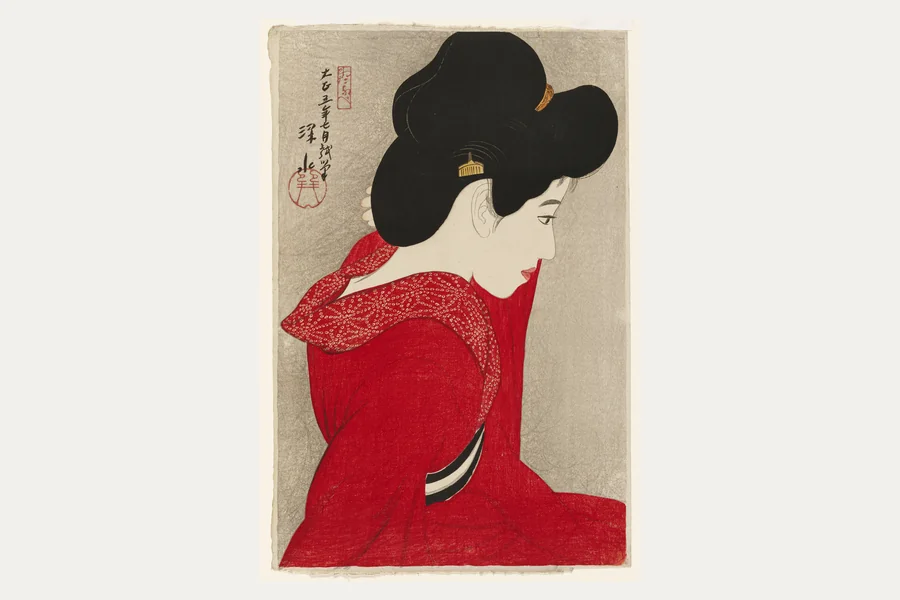
Shinsui was the movement’s great designer of beautiful women (bijinga). He left primary school early after his father’s business failed, worked as an apprentice in a printing shop, and was taken on as a pupil by Kaburagi Kiyokata, who also taught Hasui. His collaboration with Watanabe began in 1916 with Before the Mirror and lasted more than forty years, until the publisher’s death in 1962. In 1952 his woodblock design work was recognised as an Intangible Cultural Property.
Ohara Koson (1877 to 1945)
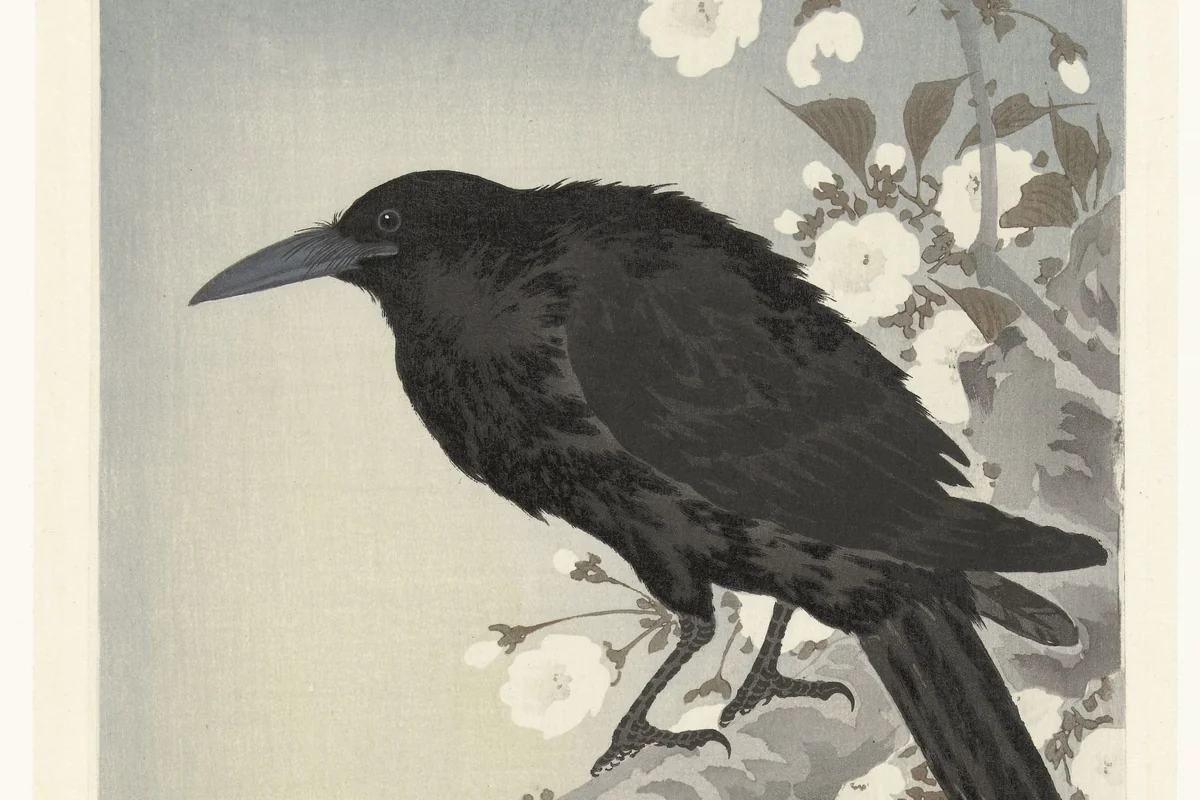
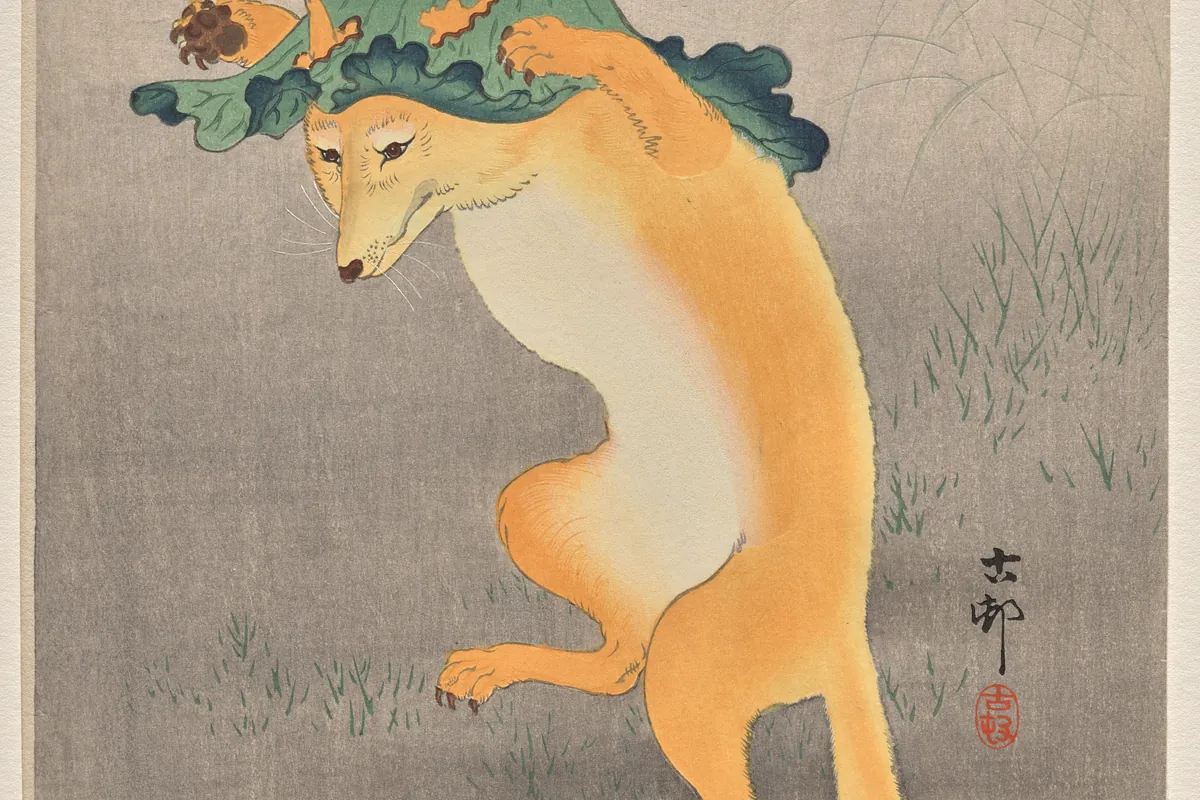
Koson was the master of birds and flowers (kachō-e). Born Ohara Matao in Kanazawa, he produced around 500 prints under three names: Koson for his early publishers, Shōson from around 1926 when he worked with Watanabe, and Hōson for the publisher Kawaguchi. Ernest Fenollosa, later curator of Japanese art at the Museum of Fine Arts, Boston, asked him to send prints to America. His work was so little known at home that Japanese collectors had to buy it back from abroad after it became popular there in the 1970s.
Hashiguchi Goyō (1880 to 1921)
Goyō designed the book covers for Natsume Sōseki’s I Am a Cat, studied the old ukiyo-e masters in depth, and made only 14 prints in his own lifetime, almost all between 1918 and 1921. His women, often modelled by a young woman named Kodaira Tomi, owe much to Utamaro but have the fuller, more individual faces of Western figure drawing. The blocks for his prints were destroyed in the 1923 earthquake. Reprints made later usually carry a small seal in the margin that the originals do not.

The 1923 earthquake and the American market
On 1 September 1923 the Great Kantō earthquake and the fires after it destroyed Watanabe’s workshop, with most of his stock of prints and the carved blocks. Hasui lost 188 sketchbooks. Many designs were later re-carved and reissued, often with small changes, which is why collectors distinguish “pre-earthquake” prints. There is more on the disaster itself in our history of earthquakes in Japan.
There was little market for shin hanga in Japan, where Western style oil painting held the prestige. Abroad it was another story. A Boston exhibition in 1924 was followed by a larger one in Indianapolis in 1926 and the two Toledo shows Yoshida helped organise. Through the 1930s, collectors such as Robert O. Muller bought in quantity. During the war, materials were rationed and overseas sales collapsed, and after 1945 American interest shifted towards the more modern sōsaku hanga. A few artists, Shinsui among them, kept the collaborative method going into the 1960s.
Watanabe’s firm still trades in Tokyo, run by his family.
Where to see shin hanga in the UK
The British Museum holds prints by Yoshida Hiroshi and Ohara Koson, among other shin hanga artists, and its collection website has artist pages for both. Prints rotate through the Japanese galleries, so check the online collection for “on display” before you go.
Dulwich Picture Gallery held the first UK exhibition of its kind, Yoshida: Three Generations of Japanese Printmaking, from 19 June to 3 November 2024, with more than 75 prints by Hiroshi Yoshida and his family. The gallery’s short film of that show is below. Dulwich’s current exhibition is Hokusai’s complete Thirty-six Views of Mount Fuji, until 17 January 2027.
For a longer introduction, the Embassy of Japan in the UK has published a recorded talk, Yoshida: A Family of Print Masters, on its YouTube channel.
Questions about shin hanga
What does shin hanga mean?
Shin hanga (新版画) means “new prints”. The publisher Watanabe Shozaburo coined the term around 1915 for woodblock prints made in the traditional ukiyo-e way, with separate artist, carver, printer and publisher, but designed with modern light, shadow and atmosphere influenced by Western painting.
What is the difference between shin hanga and ukiyo-e?
Both were made by teams of artist, carver, printer and publisher. Ukiyo-e dates from the 17th to the 19th century and uses strong outlines and flat colour. Shin hanga began in 1915 and adds Western effects of light, weather and reflections, with soft gradations and few hard outlines. Its subjects stayed traditional, and it sold mostly to collectors abroad.
What is the difference between shin hanga and sōsaku hanga?
Shin hanga kept the old division of labour, with professional carvers and printers working to the artist’s design under a publisher. Sōsaku hanga, or creative prints, began in 1904 with Yamamoto Kanae’s Fisherman and held that the artist should draw, carve and print the work, or at least control every stage. Sōsaku hanga became the more experimental and later more abstract of the two.
Who are the most famous shin hanga artists?
Kawase Hasui and Hiroshi Yoshida for landscapes, Itō Shinsui for beautiful women, Ohara Koson for birds and flowers, and Hashiguchi Goyō, whose 14 prints are among the most prized. Others published by Watanabe include Kasamatsu Shirō, Tsuchiya Kōitsu and the British artist Charles Bartlett.
Was Hiroshi Yoshida a shin hanga artist?
He began as one, designing prints for Watanabe Shozaburo in 1920 and 1921. From 1925 he ran his own studio with his own carvers and printers, which some writers treat as a separate path between shin hanga and sōsaku hanga. He is still usually named alongside Kawase Hasui as one of the two great shin hanga landscape artists.
Where can I see shin hanga prints in London?
The British Museum holds shin hanga prints, including work by Hiroshi Yoshida and Ohara Koson, and shows Japanese prints in rotation in its Japanese galleries. Check its online collection for what is on display. Dulwich Picture Gallery held a major Yoshida exhibition in 2024.