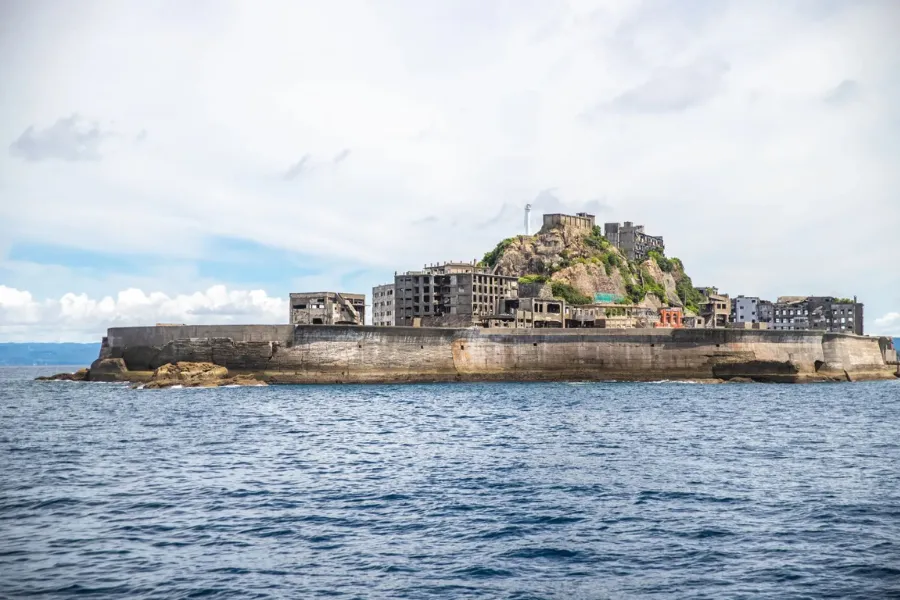
From the water, Gunkanjima first appears less like an island than a floating block of debris. Its official name is Hashima Island, but it’s easy to see how it got the nickname ‘Battleship Island’: seawalls form the hull, and the shells of apartment buildings tower like the body of a destroyer at rest in the sea. For anyone looking for an abandoned island in Japan, it is the image that tends to surface first.
Gunkanjima at a Glance
It is one of modern Japan’s paradoxes. A UNESCO World Heritage site and a popular Nagasaki day trip, people flock to Gunkanjima because no one lives there. At its working peak in 1960, around 5,300 people lived on Hashima. Today, visitors arrive by tour boat, stand on a patch of land deemed safe from the decay, and look at a century compressed into concrete. Meiji ambition, wartime labour, post-war recovery, decline, preservation and tourism are all rolled into one, making Gunkanjima a mirror of modern Japan.
A Look Into Gunkanjima

Hashima Island’s History: From Rock to City
Hashima Island’s history begins with Japan’s sudden confrontation with industrial modernity. In the 1850s, Commodore Matthew Perry’s black ships not only forced upon Japan’s hitherto closed ports, but also laid bare the problem of Japan’s technological distance from the West. After the Meiji Restoration of 1868, the new state tried to close this gap at extraordinary speed, sending missions abroad, hiring foreign experts and drawing on the zaibatsu, the great family-controlled industrial conglomerates that held the keys to industrial transformation.
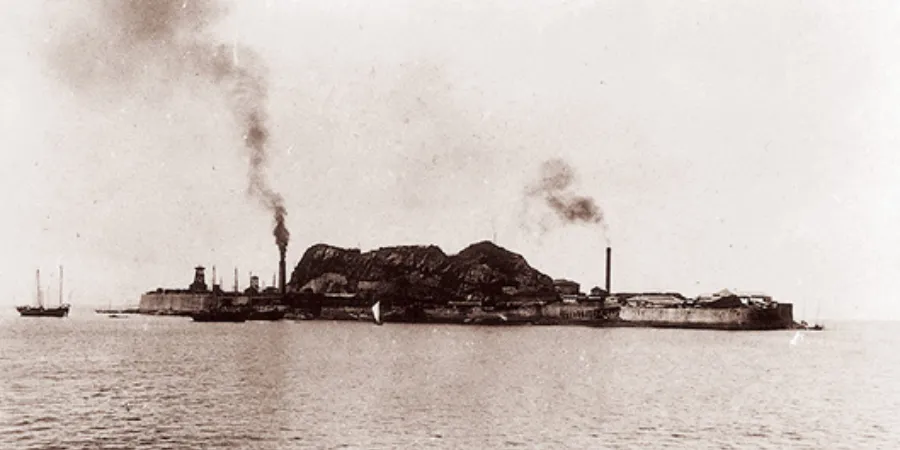
Coal was the lifeblood of that transformation. It powered steamships and factories, and gave Japan a fighting chance to be competitive with the West. Hashima, then little more than a rock off Nagasaki, became valuable because of what lay beneath the seabed. Mitsubishi, one of the zaibatsu, began developing the island’s coal operations from 1890, and this mine expanded to become a powerful cog in Japan’s industrial machine.
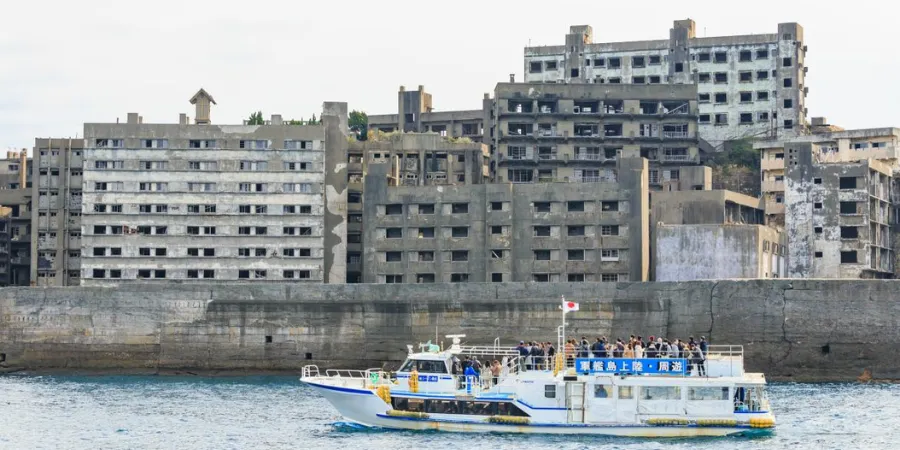
The island grew: land was reclaimed, seawalls were raised and the unwelcoming land became habitable. Every metre mattered. In 1916 Mitsubishi completed Building No. 30, Japan’s first large reinforced-concrete apartment block, built to house as many workers as possible while resisting the storms that battered the island.
Around it, a tiny city rose from the rock. Apartment blocks, schools, shops and entertainment spaces were crammed in to form a vertical city in miniature.
Life on the Island
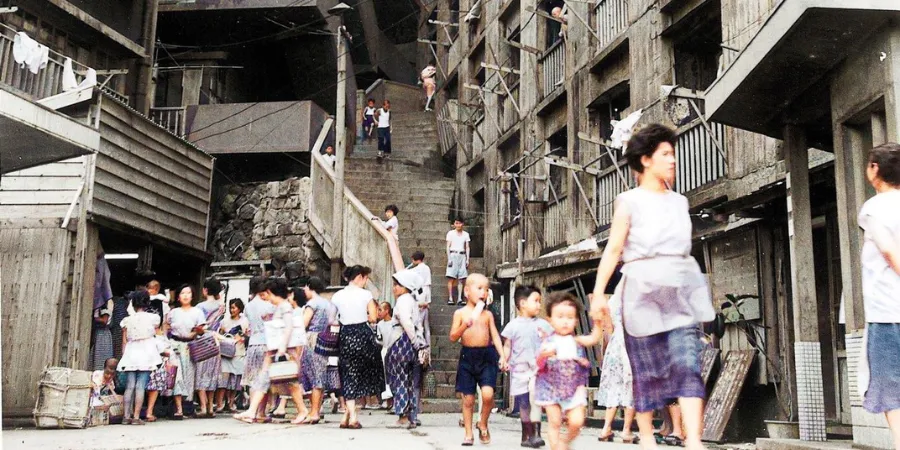
It’s easy to look at Gunkanjima now and imagine life on the island as grim. But for the workers and their families, it was home. By the Showa era, Hashima had become one of Japan’s most densely populated places, and among its residents there were memories not only of labour and discipline, but of neighbours, family, and life.
Former resident Higashi Kenichi moved to Hashima from Fukuoka in 1964 when he was a child. Higashi later recalled in an interview with Mansion Lab of his arrival on an impossibly packed island with buildings joined by corridors. His own family, as a staff household, lived in Building No. 3 in a three-room apartment with its own toilet and bath.
Children experienced the island differently to the working adults, and they navigated its winding paths with unparalleled freedom. Higashi remembers games of hide-and-seek that could stretch across the residential district, through stairwells, corridors and buildings. Life still found a way, even on a stranded rock.
Gunkanjima’s Korean Forced Labour and the UNESCO Controversy
Such idyllic memories were not shared by all, however. During wartime mobilisation, Korean and Chinese workers were transferred to Hashima and other industrial sites in Japan. The work was dangerous for all miners, undersea coal mining was cramped, back-breaking work, and injury was never far off. For these workers, those dangers were compounded by a disregard for their wellbeing and safety. Published accounts commonly describe hundreds of Korean workers on Hashima during the wartime peak. How that work should be described is still disputed. UNESCO’s own 2021 record refers to a large number of Koreans and others brought against their will and forced to work under harsh conditions. Japan’s government maintains that these workers were mobilised under the wartime National Requisition Ordinance and that this does not amount to forced labour. South Korea rejects that reading.
This made Hashima’s inclusion into UNESCO in 2015 incredibly controversial. In 2023, UNESCO acknowledged that Japan had taken steps to address the visibility of forced labour, but still encouraged further dialogue and further representation for the workers concerned. A more nuanced history of a site that continues to fascinate domestic and international tourists alike would only add to its longevity and appeal.



Coal to Oil: Why Gunkanjima Was Abandoned
What made Hashima essential also made it vulnerable. Coal had powered Japan’s industrial rise, but by the 1960s and 1970s the country was moving away from domestic coal and towards oil. This resource shift destroyed work and communities across the world, and on Hashima this destruction was instant and total. Mitsubishi closed the mine on 15 January 1974 and began transferring its workers, and by April the island was emptied. Decades of gradual build-up was abandoned in weeks.
As Japan adapted from coal to oil, from heavy industry to cars and electronics, and from manufacturing towards services and culture, places that had been central to one national project became leftovers of another. Once before, in the name of progress Gunkanjima had morphed from a rock into a tiny city, and once again in the name of progress it would change, this time becoming a ruin and a crumbling reminder of how Japan got here.
Decay and Rediscovery
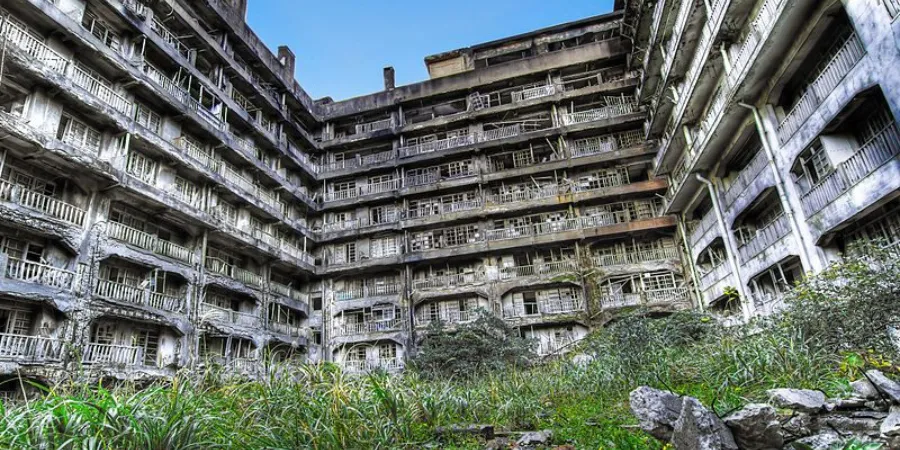
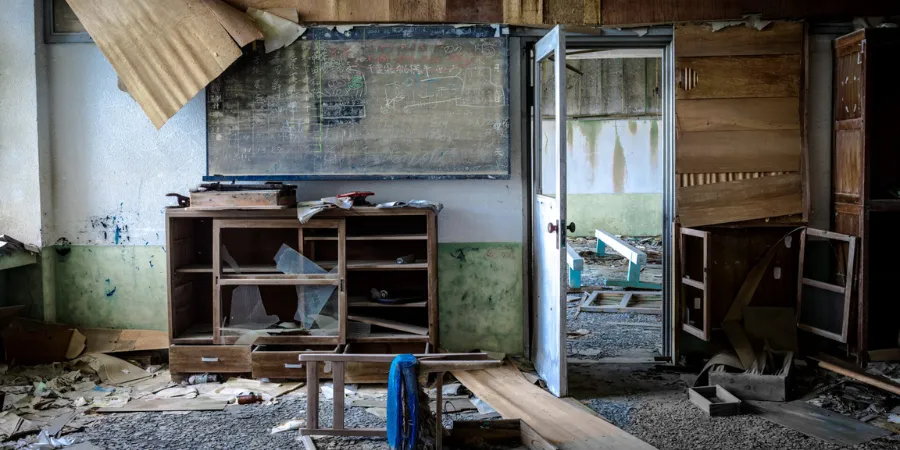
For decades after its closure, Gunkanjima sat empty, exposed to typhoons, sea air and waves. Concrete cracked and slumped, and rooms that had once held the vestiges of life were exposed to nature.
But amid speculation that it would turn into an industrial-waste site, voices emerged that sought to preserve the story that the ruins still told. One of the most prominent voices was former resident Dotoku Sakamoto, who had lived on Hashima as a child. In 2003, he helped establish the NPO Way to World Heritage Gunkanjima, campaigning to protect the island and to frame it as an integral part of Japan’s industrial memory.
In 2009, Gunkanjima reopened to visitors, and has since become an iconic part of Nagasaki’s tourism. Its eerie silhouette still fascinates; the approach to the island and its distinct shape served as inspiration for Raoul Silva’s island in Skyfall, for example. Through its new identity, the discarded island has become valuable again. This time, it serves as a tangible memory, a visible piece of Japan’s modern history and the rapid changes it underwent.
Gunkanjima Tour: How to Visit and What to Expect
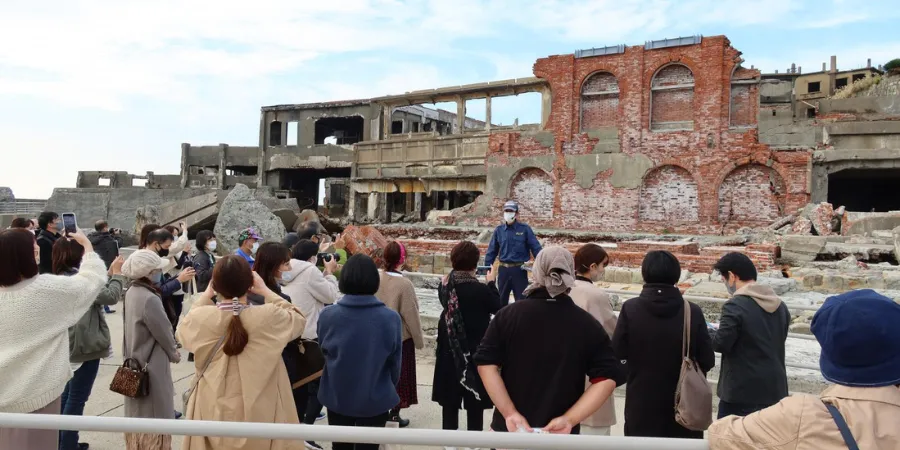
Hashima is easily accessed by boat from Nagasaki City. Several operators run cruising and landing tours from Nagasaki City, including Yamasa Shipping, Gunkanjima Cruise, Seaman Company, Gunkanjima Concierge and Dainana Ebisumaru. Tours cost around 3,600 to 6,000 yen for an adult, plus a 650 yen Nagasaki City landing fee, and last around two to three hours.
Tours are incredibly weather dependent, with April, May, October and November usually offering the calmest sea conditions, though landings are decided on the day. If conditions allow, boats will land on the island for a closer look, but entering buildings and free exploration are strictly prohibited due to the instability of Hashima’s buildings. If you want to better imagine the lives of those who lived on the island, the Gunkanjima Digital Museum in Nagasaki reconstructs areas visitors cannot enter to show the island as it was before it became a ruin.
A Monument to a Century
Viewed from the water, Gunkanjima still looks like a battleship. No new metaphor is needed. But the Taisho and Showa buildings, now rendered useless, show how abruptly a national future can become a preserved past.
Like Japan throughout the twentieth century, Hashima metamorphosed from an industrial island to a tourist destination and a pop-culture hotspot. People may flock to see the ruin, but they are confronted with the signs of a country’s rapid progress, looking back at itself from the sea.
FAQs
Why was Gunkanjima abandoned?
Gunkanjima was abandoned because Japan moved away from domestic coal towards oil, making the coal mine obsolete. Mitsubishi closed the mine in January 1974, and the island was empty by April.
Can you visit Gunkanjima?
Yes, but only on an organised tour from Nagasaki. Independent visits are not allowed because of the instability of the buildings.
How do you get to Battleship Island from Nagasaki?
You book a Gunkanjima tour from Nagasaki Port or another operator-specific departure point in Nagasaki City. If weather conditions allow for it, the boat will dock at Gunkanjima.
Was Gunkanjima used in Skyfall?
Gunkanjima inspired Raoul Silva’s island lair in Skyfall. The approach used footage of Hashima, but the main ‘Dead City’ scenes were created through sets.
Why is Gunkanjima a UNESCO World Heritage Site?
Hashima Coal Mine is one of 23 component sites in the Sites of Japan’s Meiji Industrial Revolution: Iron and Steel, Shipbuilding and Coal Mining, inscribed in 2015 under criteria two and four for Japan’s rapid industrialisation.
Is Gunkanjima safe to visit?
It is safe to go to the island but not to enter its buildings. If tour operators deem it unsafe, tours may be cancelled.
How long does a Gunkanjima tour take?
Most tours take roughly two to three hours, depending on whether landing is possible.