A Japanese idol (アイドル, aidoru) is a young singer and performer marketed as much on personality and closeness to fans as on talent. Idols are signed to talent agencies, usually perform in groups, and earn through music, television, advertising and fan events such as handshakes, which is why fans talk about supporting an idol rather than simply liking one.
This guide explains where the idea came from, how the big agencies work, what changed when Johnny & Associates became STARTO ENTERTAINMENT, how underground and virtual idols fit in, and where to see idol culture in the UK this winter.
Japanese idols: key facts
- Word: アイドル (aidoru), from the English “idol”
- First idol group: Johnnys, formed in 1962 by Johnny Kitagawa, is usually counted as the first
- Golden age: the 1980s, with Seiko Matsuda, Akina Nakamori and Onyanko Club
- Best-known group model: AKB48, whose own theatre in Akihabara opened on 8 December 2005
- Biggest change of the decade: Johnny & Associates renamed itself SMILE-UP. in October 2023, and its acts moved to STARTO ENTERTAINMENT
- Next UK date: HATSUNE MIKU EXPO 2026 EUROPE opens at The O2, London, on Thursday 12 November 2026
Japanese Idols, From Showa Television to Virtual Stages
No headings found.
What a Japanese Idol Is, and What Makes One Different From a Pop Star
Idols are mostly singers, but they are trained to act, dance, model and present too, and the agency builds and manages the whole public image. The part that sets them apart from a Western pop star is the relationship with fans. Idols are often recruited young, sometimes with little stage experience, and fans follow them as they improve. Visible effort, sincerity and accessibility count for as much as a perfect vocal.
That closeness is built into the business. Fans buy CDs, photos and goods, vote, attend small theatre shows and queue for handshake events, where they get a few seconds to talk to a member. Japan’s own word for this kind of devoted support is oshikatsu, supporting your favourite, and it grew out of idol fandom before spreading to anime characters and VTubers.
The scale is large. By 2017 more than 10,000 teenage girls in Japan were working as idols across more than 3,000 active groups, and between 50 and 70 per cent of adverts in Japan feature an idol.


Japanese Idol History: A Timeline From 1962 to Today
| Year | What happened | What it changed |
|---|---|---|
| 1962 | Johnny Kitagawa founds Johnny & Associates and forms the group Johnnys | Often called the first idol group; Kitagawa also created the trainee system |
| 1970s | Television audition shows launch Momoe Yamaguchi, Junko Sakurada, Saori Minami and Mari Amachi | TV makes idols household names |
| 1980s | The “golden age of idols”: Seiko Matsuda, Akina Nakamori, Kyōko Koizumi | Idols move into adverts and TV dramas |
| 1985 | Onyanko Club debuts with a school club concept | Introduces school uniform costumes and the idea of members “graduating” |
| 1997 to 1998 | Morning Musume form after the TV audition show Asayan; debut single Morning Coffee, January 1998 | Start of the Hello! Project family of groups |
| 2005 | AKB48 Theater opens in Akihabara on 8 December | “Idols you can go and see”, performing in their own venue |
| 2007 | Crypton Future Media releases Hatsune Miku | The best-known virtual idol |
| 2010s | The “Idol Warring Period”: Tokyo Idol Festival starts in 2010; Momoiro Clover Z play the National Stadium in 2014 | Hundreds of groups compete for niches |
| 2023 | BBC documentary on Johnny Kitagawa (March); Johnny & Associates becomes SMILE-UP. (October); STARTO ENTERTAINMENT established (17 October) | The biggest male idol agency is dismantled |
| 2023 | YOASOBI’s “Idol”, the theme of the anime Oshi no Ko, tops the Billboard Japan Hot 100 for 22 weeks | A song about the idol industry becomes the year’s biggest hit |
For how idol music sits within the wider sound of Japanese pop, from kayōkyoku to anime themes, see our guide to J-pop for beginners.
AKB48 and the Theatre in Akihabara: “Idols You Can Go and See”
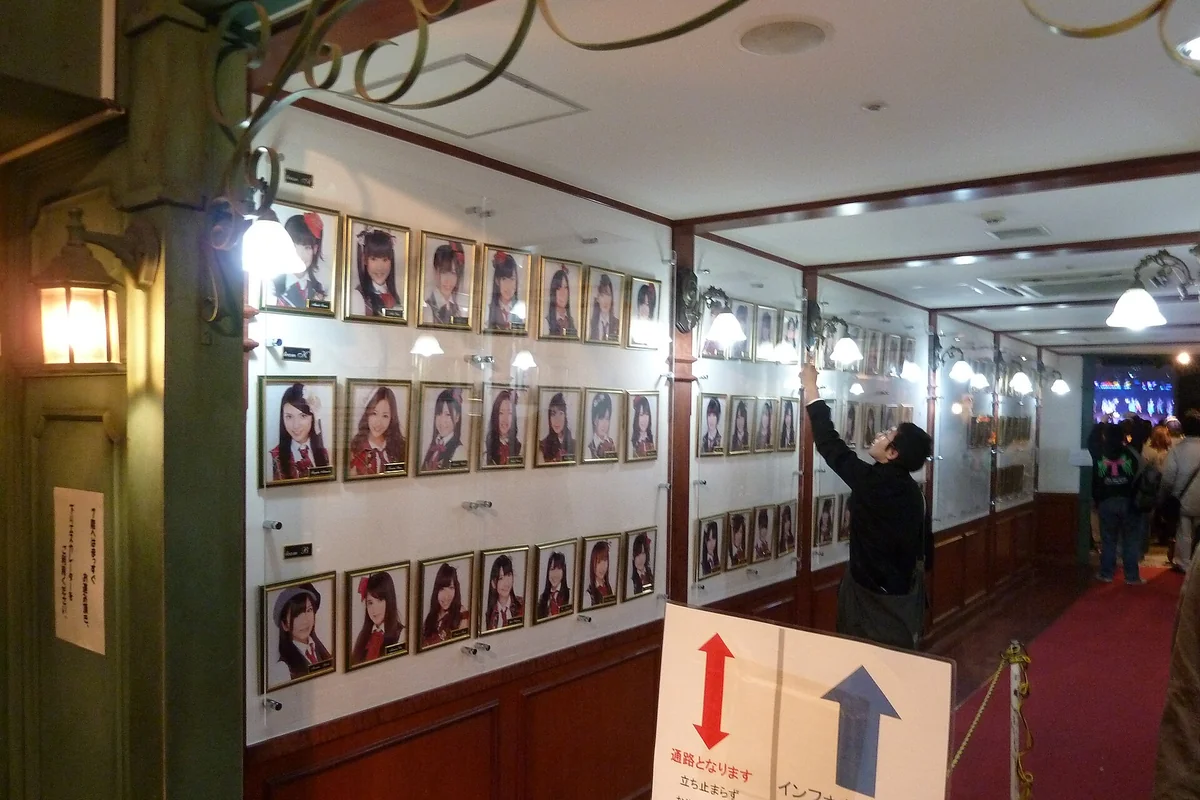
AKB48 began with a room. Its theatre, on the eighth floor of the Don Quijote store in Akihabara, opened on 8 December 2005 with the slogan 会いに行けるアイドル, “idols you can go and see”. According to AKB48’s own history, only seven people came to the first show. The idea was that fans could watch the group close up on its own stage, instead of waiting for a TV appearance.
The producer, Yasushi Akimoto, built the business around participation. Large rotating teams meant there was always a new member to follow. CDs came with tickets for handshake events, and fans voted in annual “general elections”, held from 2009 to 2018, to decide which members stood at the front of the next single. The model was copied across Asia, and AKB48’s own site lists sister groups including JKT48 in Jakarta and BNK48 in Bangkok.
The theatre still runs. It is at Sotokanda 4-3-3, Chiyoda, about five minutes’ walk from the Denki-gai exit of JR Akihabara Station, and tickets are applied for through the AKB48 ticket centre, as the official theatre guide explains.
Morning Musume and Hello! Project
Before AKB48 there was Morning Musume. In 1997 the rock singer Tsunku held auditions on the TV programme Asayan for a female vocalist. The winner went solo, and Tsunku offered five runners-up a chance to form a group if they could sell 50,000 copies of a demo single in five days. They did, and Morning Musume’s first official single, Morning Coffee, came out on 28 January 1998.
The fan club name, Hello! Project, became the name for the whole family of girl groups at the agency Up-Front Promotion. Tsunku produced most of its songs until 2014. Today’s groups, as listed on helloproject.com, are Morning Musume, Angerme, Juice=Juice, Tsubaki Factory, BEYOOOOONDS, OCHA NORMA and Rosy Chronicle. Tsunku also revived Onyanko Club’s word “graduation” for Yuko Nakazawa’s departure in 2001, the first in Hello! Project’s history, and every idol group has used it since.




Johnny’s to STARTO ENTERTAINMENT: What Changed After 2023
For sixty years, Johnny & Associates managed almost every major Japanese boy group, from SMAP to Arashi. Its founder, Johnny Kitagawa, died in 2019. In March 2023 the BBC documentary Predator: The Secret Scandal of J-Pop set out claims that he had sexually abused boys in the agency for decades, and an independent investigation commissioned by the company reported in August 2023 that the abuse had happened repeatedly.
In October 2023 Johnny & Associates renamed itself SMILE-UP. and turned to compensating victims; its website now opens with an apology. A new company, STARTO ENTERTAINMENT, was established on 17 October 2023, according to its company profile, and took over management of the former Johnny’s acts, beginning full operations in April 2024. Its roster on starto.jp includes Snow Man, SixTONES, King & Prince, timelesz, Travis Japan and Hey! Say! JUMP. If you see “Johnny’s” in older articles or on CDs, STARTO is where those groups are now.
Momoiro Clover Z: From Yoyogi Park to the National Stadium

Momoiro Clover Z show the other route to the top. Formed in spring 2008 under the agency Stardust Promotion, the group started as a street act performing for passers-by in Yoyogi Park at weekends, because the members were still at school. They added the Z in 2011 and, in March 2014, became the first female group to headline a solo concert at the National Olympic Stadium in Tokyo, with about 150,000 people watching over two days in the stadium and at live screenings.
Each member wears her own colour on stage, like a team of Super Sentai heroes, and fans wave penlights in their favourite’s colour. The group has also recorded theme songs for Sailor Moon Crystal and Dragon Ball, and in 2015 recorded with the American rock band Kiss.
Underground Idols (Chika Idols) and Akihabara Live Venues

Below the arena groups sits a much larger scene. Underground idols, chika aidoru (地下アイドル), are independently managed and perform in small live houses rather than on television. They are also called live idols, and many sell their own CDs and goods at the venue. Akihabara has its own strand, Akiba-kei idols, who draw on otaku culture; Dear Stage in Akihabara is a dedicated venue for them.
The 2010s also produced “alternative idols”, a term English-speaking fans coined for groups with darker images or heavy rock sounds. BiS and the singer Seiko Oomori led the way, and BiS’s successor BiSH made the style popular. The biggest annual showcase for every kind of idol is Tokyo Idol Festival, running since 2010, which had more than 200 groups and over 80,000 visitors in 2017.
Handshake Events, Graduations and Dating Bans: The Rules of Idol Life
- Handshake events (akushukai): meet-and-greets where a fan shakes hands and speaks briefly with a member, often unlocked by buying a CD.
- Member colours: each member has a colour, and fans light penlights in it at concerts.
- Graduation (sotsugyō): when a member leaves, the group holds a farewell show. The word was borrowed from Onyanko Club’s school concept, and a graduation is seen as a happy ending, where a sudden contract termination suggests a scandal.
- Dating bans: most idols cannot date, or need their agency’s permission to marry. Members of Morning Musume and AKB48 have been demoted or forced out after relationships were reported, and an AKB48 member’s tearful apology video drew criticism from around the world.
The closeness that makes idols popular has a darker side. Critics say it encourages obsession, and several female idols have been attacked by fans. The 1997 film Perfect Blue, about an idol who becomes an actress and is stalked by a fan, is still the sharpest screen portrait of that pressure; our introduction to Satoshi Kon’s films puts it in context.
The idol industry has also become a subject in its own right. YOASOBI’s “Idol”, the opening theme of the 2023 anime Oshi no Ko, which follows the twin children of a famous idol, topped the Billboard Japan Hot 100 for 22 non-consecutive weeks and was the chart’s number one song of 2023.
Virtual Idols: Hatsune Miku, Kyoko Date and the VTuber Agencies
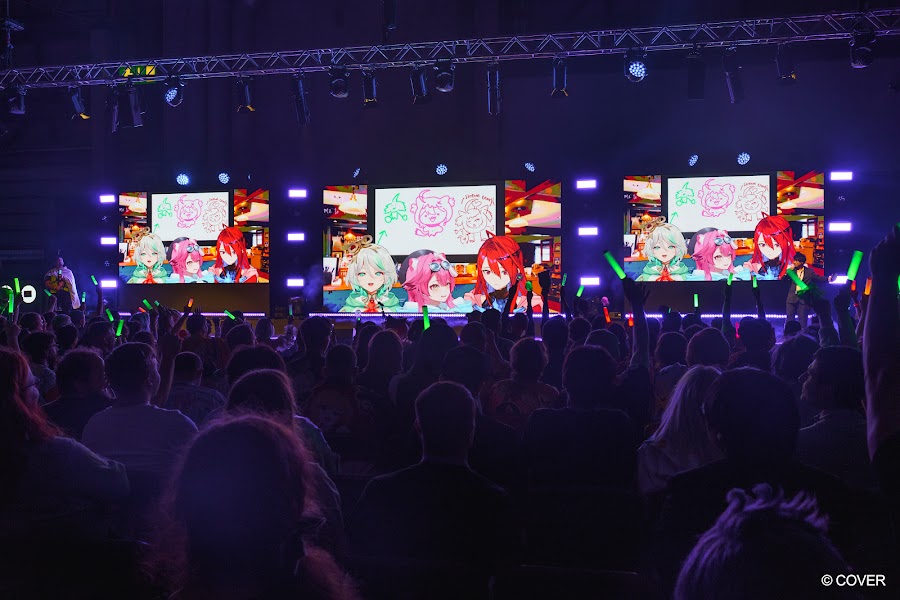
Some idols never age, date or graduate, because they are not human. Kyoko Date, created in 1997, was the first virtual idol. Ten years later Crypton Future Media released Hatsune Miku, a singing voice synthesiser with a turquoise-haired character, and producers around the world began writing songs for her. Miku now headlines arenas, projected on a screen with a live band.
The newest branch is the VTuber. Agencies such as hololive production and Nijisanji run their talents much like idol groups, with generations, member colours, concerts and graduations; our guide to what a VTuber is and how the agencies work explains the model.
Japanese Idols in the UK: MIKU EXPO at The O2 and VeXpo in Birmingham
Live Japanese idol shows are rare in Britain, but idol culture reaches the UK through its virtual stars and conventions.
- Thursday 12 November 2026: HATSUNE MIKU EXPO 2026 EUROPE opens its tour at The O2, London, with doors at 6:30pm and the show at 8pm, according to the official tour page. Our guide to MIKU EXPO 2026 at The O2 and Heaven has tickets and the club night the following evening.
- Every September: the UK VTuber convention returns to the NEC in Birmingham. In 2026 nine hololive talents appeared; our page on VeXpo at the NEC covers what happened.
- Hyper Japan: London’s summer Japanese culture festival has booked idol acts before, including Tokyo Girls’ Style in 2015.
To follow an idol group from the UK, start with its official YouTube channel for music videos. Goods sold only in Japan reach UK fans through proxy buying services; the oshikatsu guide linked above explains how import VAT works on them.
Japanese Idols: Questions
A Japanese idol is an entertainer, usually a young singer, who is marketed on image, personality and a close relationship with fans as well as on performance. Idols are signed to talent agencies, often perform in groups such as AKB48 or Morning Musume, and also act, model and appear in adverts. Fans support them through CDs, goods, concerts and handshake events.
K-pop borrowed its trainee system from Japan, where Johnny Kitagawa developed it from the 1960s. Japanese idol culture leans more on accessibility, with small theatre shows, handshake events and members who improve in front of fans, and on the home market. K-pop groups usually train longer before debut and aim at a global audience from the start.
After the BBC documentary in March 2023 and an independent investigation that August confirmed that founder Johnny Kitagawa had repeatedly abused young trainees, Johnny & Associates renamed itself SMILE-UP. in October 2023 to handle compensation. Its groups, including Snow Man, SixTONES and King & Prince, are now managed by STARTO ENTERTAINMENT, established on 17 October 2023.
Most agencies forbid dating or require permission to marry because the business depends on fans feeling personally close to an idol. AKB48’s producer Yasushi Akimoto compared the rule to the dating bans on high school baseball teams before a tournament. Critics argue it sells a fantasy, and idols have been demoted or have left groups after relationships were reported.
An underground idol, chika aidoru in Japanese, is an independently managed idol who performs in small live houses rather than on television. They are also called live idols or indie idols. The scene took off in the 1990s, and Akihabara venues such as Dear Stage host Akiba-kei idols, a strand that draws on anime and otaku culture.
Hatsune Miku is the best-known virtual idol. She is a singing voice synthesiser released by Crypton Future Media in 2007, with a character design that fans and producers have built a career around. She performs arena concerts on a projection screen with a live band, and MIKU EXPO 2026 EUROPE opens at The O2 in London on 12 November 2026.