Kabuki is Japan’s classical popular theatre, a mix of drama, dance and music that has been performed for about 400 years, with every role, including the women, played by men. The word is written with three characters meaning song (ka, 歌), dance (bu, 舞) and acting skill (ki, 伎), and it is thought to come from the verb kabuku, to lean or to be out of the ordinary.
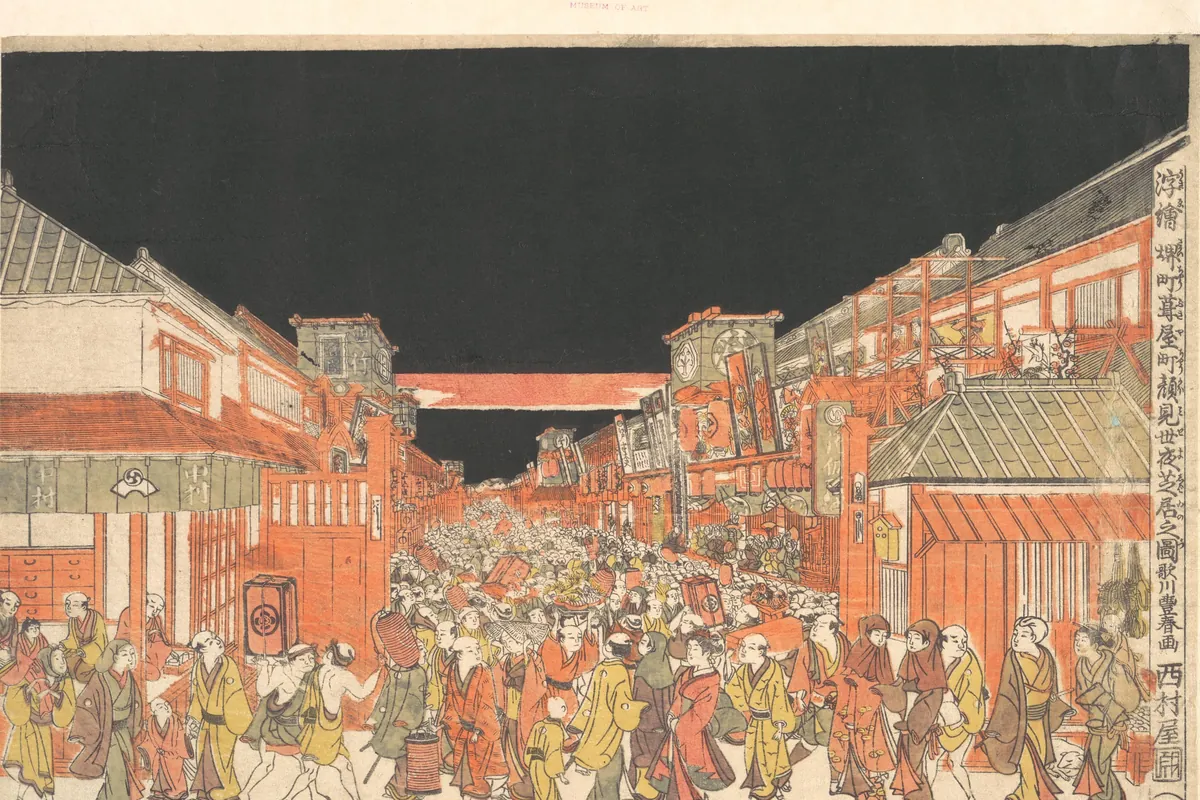
It began in Kyoto at the start of the 17th century with a woman, Izumo no Okuni, and grew into the theatre of Edo’s townspeople, with painted faces, frozen poses and a walkway that runs through the audience. Today you can see it at the Kabukiza theatre in Tokyo from ¥1,600 for a single act, and in London at Sadler’s Wells in January 2027.
- Meaning: written 歌舞伎, song, dance and acting skill; from kabuku, to be out of the ordinary
- Began: Kyoto, early 1600s, usually dated to 1603, with the dancer Izumo no Okuni
- Performers: men only since women were banned from the stage in 1629
- UNESCO: proclaimed in 2005 and inscribed in 2008 on the list of the Intangible Cultural Heritage of Humanity
- Main theatre: Kabukiza, Ginza, Tokyo; single act seats from ¥1,600 in November 2026
- Next in London: Sadler’s Wells, 30 and 31 January 2027, from £15
Kabuki Meaning, History and Make-Up, Explained
Kabuki Meaning: Song, Dance and Acting Skill
Shochiku, the company that has produced kabuki for over a century, explains the word through its three characters: 歌 for song, 舞 for dance and 伎 for acting skill. Together they describe a theatre that does all three at once, where in most countries they would be separate arts. Those characters were chosen to fit the sound, though. The word itself is believed to come from the verb kabuku, to lean or to be off-centre, which gave kabukimono, the name for the outlandishly dressed young men of early 17th century Kyoto who, as the Japan Arts Council puts it, “do completely new and bizarre things”.
So the kabuki meaning a Japanese speaker would have heard in 1603 was something close to “the wild new thing”, and the theatre has kept a taste for spectacle ever since.


Izumo no Okuni and the Riverbed Dances of Kyoto
Kabuki’s founder was a woman. Izumo no Okuni, who called herself a shrine maiden from Izumo Taisha in present-day Shimane, drew crowds in Kyoto at the start of the Edo period with a new style of dance, kabuki-odori, performed on the dry bed of the Kamo River. Most histories date it to 1603. Zoë Kincaid, whose 1925 history Kabuki: The Popular Stage of Japan is in the Japan Nakama library, gives an earlier start of 1596 from the Japanese records she worked from, and puts Okuni at the height of her fame in 1601.
Kincaid describes Okuni’s first performances as almost religious: a black priest’s robe, a small Buddhist gong on a vermilion cord, a chanted sutra. The crowds came when she changed character and danced as a man, with two swords through her belt. The Japan Arts Council’s history describes the same shift: her company played scenes of men visiting teahouses, with the women dressed as men, and the audience took in commoners, samurai and nobles alike (Kincaid, 1925, chapter 7).
A bronze statue of Okuni stands by the Kamo River in Kyoto, close to the Minamiza theatre, where kabuki is still performed today.
Why Men Play Women: The Bans of 1629 and the Onnagata
Women’s kabuki spread fast, and so did the trouble around it. Fights broke out in audiences, many of the leading performers also worked in the pleasure quarters, and the shogunate stepped in. In 1629, under the third shogun Tokugawa Iemitsu, women were banned from performing in public, a ban Kincaid says reached even the women who sang for the puppet theatre (Kincaid, 1925, chapter 8).
Troupes of young men, wakashū kabuki, took over, and were banned in their turn for the same reasons. Kincaid dates that ban to 1644; most modern histories give 1652. Either way, the authorities ordered the young actors’ front hair shaved off, and what followed was yarō kabuki, performed by adult men with shaved forelocks (Kincaid, 1925, chapter 9). That is the theatre that survives today.
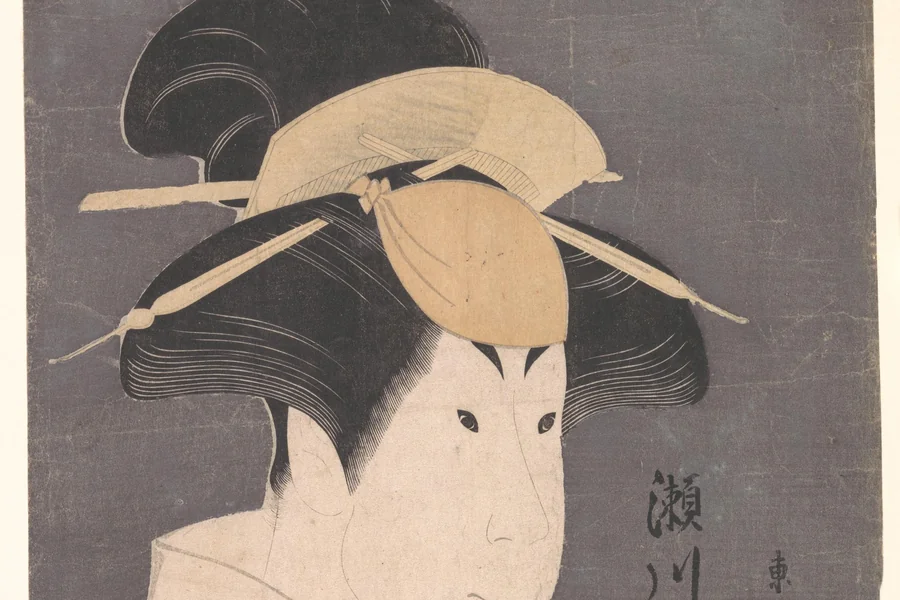
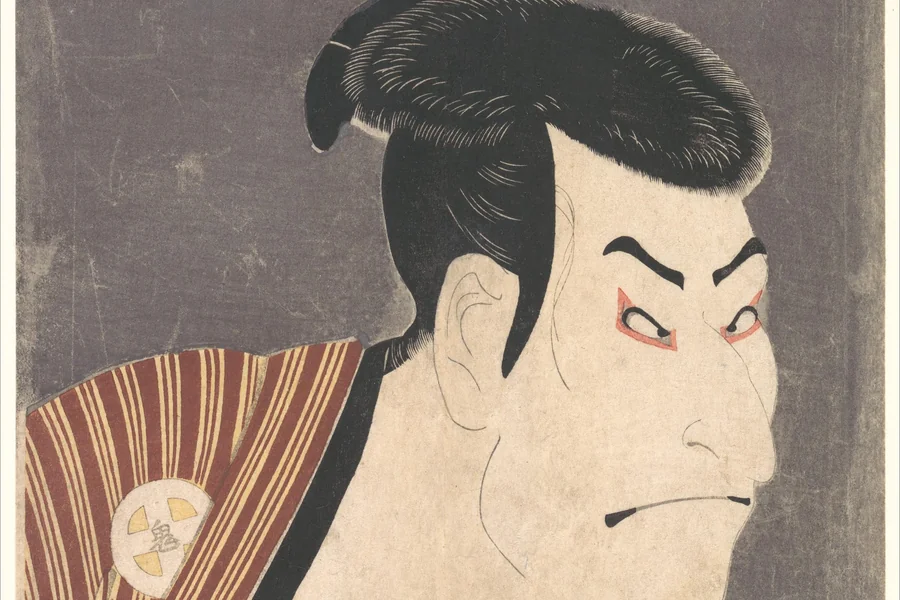
The actors who specialise in women’s roles are called onnagata. With no women on stage to copy, they built their own idea of femininity from movement. The Japan Arts Council lists the techniques: walking pigeon-toed with the knees turned in, lowering the shoulder blades to slope the shoulders, and keeping every gesture soft. Yoshizawa Ayame I, an onnagata of the late 17th century, is said to have lived as a woman in daily life to perfect the role. Sharaku’s 1794 print above shows the onnagata Segawa Tomisaburō II in a woman’s role.
The 2025 film Kokuho follows two onnagata across fifty years, and our guide to Kokuho and the onnagata tradition shows how much of the real training the film puts on screen.
Kumadori Make-Up: Red for Heroes, Blue for Villains
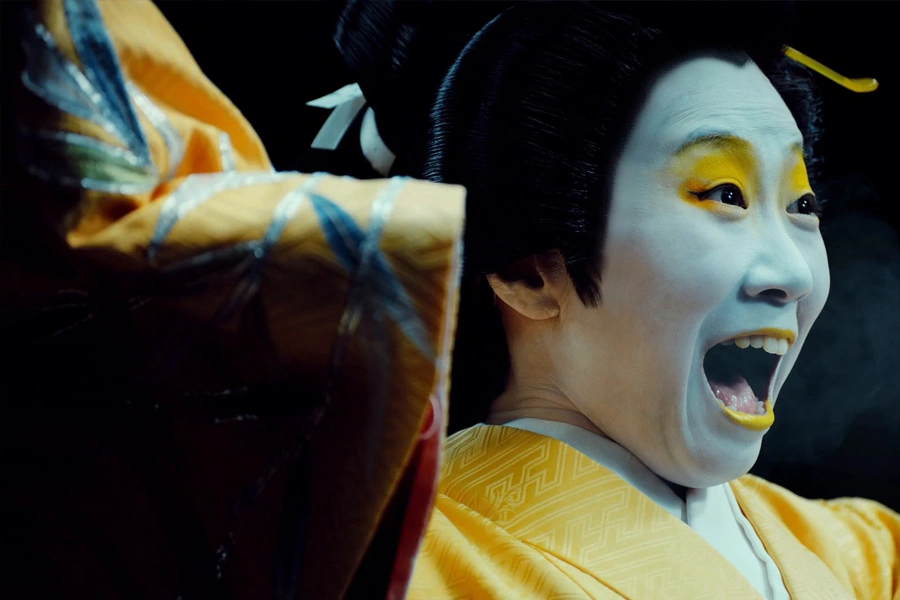
The painted faces most people picture when they hear the word kabuki are called kumadori. Kincaid translates the word as “to make borders”: coloured lines are painted over a white base to exaggerate the muscles and veins of the face (Kincaid, 1925, chapter 3). Only four colours are used, and each one tells the audience who they are watching.
| Kumadori colour | What it marks | Example |
|---|---|---|
| Red | A brave, righteous hero | Kamakura Gongorō, the hero of Shibaraku |
| Blue | A villain, a ghost or a fox spirit; jealousy and fear | The fox Genkurō in Yoshitsune and the Thousand Cherry Trees |
| Brown | Demons and other non-human spirits | The ground spider in Tsuchigumo |
| Black | Sharpens eyebrows and the line of the mouth | Used in every pattern |
Kumadori belongs to aragoto, the “rough style” of superhuman heroes that the actor Ichikawa Danjūrō I created in Edo in the late 17th century and his son Danjūrō II perfected. Kincaid notes that the make-up conventions were handed down by word of mouth from one Danjūrō to the next (Kincaid, 1925, chapter 3), and the Ichikawa family still carries the style today. Shibaraku (“Wait a Moment!”), starring the red-faced warrior Kamakura Gongorō, is one of the eighteen plays the family treats as its own.
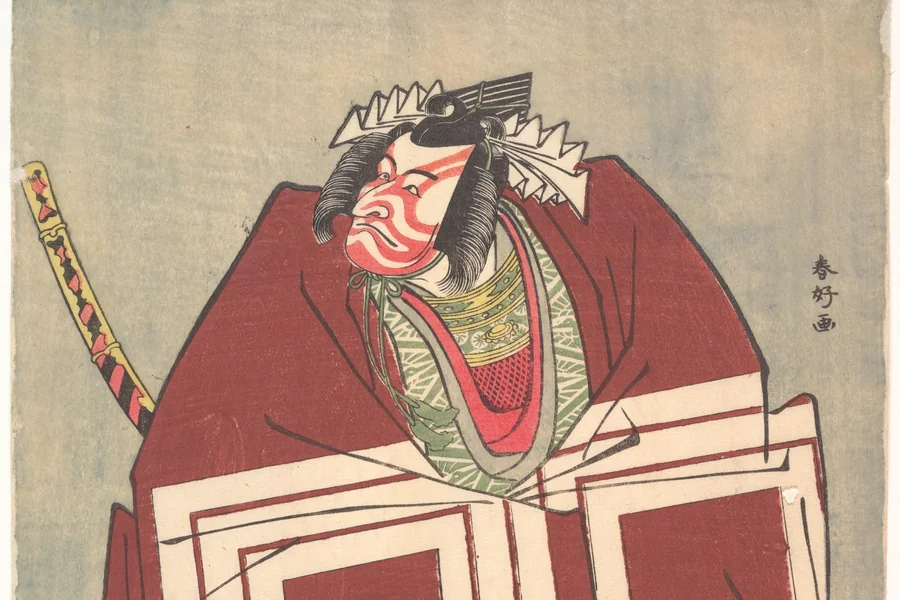
The other great house style, wagoto, grew up at the same time in Kyoto and Osaka, where audiences preferred soft, realistic acting, and its leading actor was Sakata Tōjūrō I. Kabuki actors still belong to hereditary families and pass stage names down the generations, which is why so many prints, like the ukiyo-e portraits sold in Edo, name the actor and his generation number.








The Mie Pose, the Hanamichi and Other Kabuki Stage Tricks
Three pieces of stagecraft make kabuki look like nothing else.
Mie. At the peak of a scene the actor stops dead in a held pose, and wooden clappers, tsuke, often crack out at the same moment. The Japan Arts Council compares it to a film close-up. The Japanese phrase for showing off, ōmie o kiru, “to cut a big mie”, comes from it.
Hanamichi. The “flower way” is a walkway that runs from the stage through the audience to the back of the theatre. The great entrances and exits happen here, including the roppō, an exaggerated striding exit used by aragoto heroes, and in some plays an actor is lifted on wires from the hanamichi and flown over the seats. Kincaid, who sat among the Tokyo critics for twelve years, wrote that the hanamichi makes “every person in the audience” feel part of the play (Kincaid, 1925, chapter 3).
Machinery. Revolving stages and trapdoors let whole scenes turn and actors rise or vanish through the floor, devices UNESCO’s listing singles out. Kabuki also uses quick costume changes on stage, and a sky blue curtain that drops in an instant to reveal the next scene.
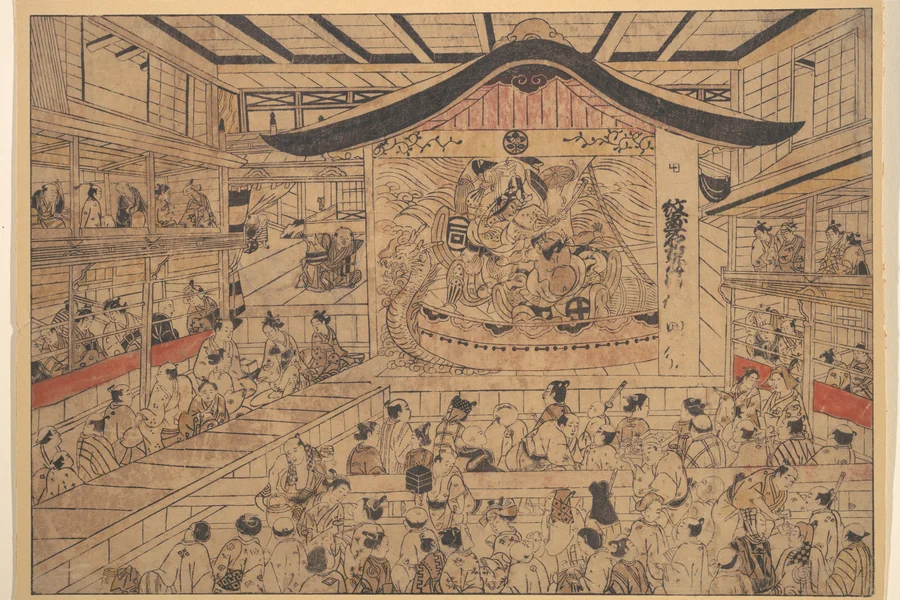
Kabuki borrowed its first stage from the older Noh theatre, including the roofed main stage and the bridgeway, and took plots from Noh plays too. Our guide to the Noh theatre and its family schools explains the older form.
| Kabuki | Noh | |
|---|---|---|
| Took its classic form | 17th century, Edo period | 14th century, Muromachi period |
| Original audience | Townspeople of Edo, Kyoto and Osaka | Shogun’s court and samurai |
| Faces | Painted make-up, including kumadori | Carved wooden masks |
| Pace | Spectacle, fights and quick changes | Slow, restrained chant and dance |
| Performers | Men only | Traditionally men |
Famous Kabuki Plays: Chūshingura, Shibaraku and Dōjōji
About 400 plays are still performed, according to the Japan Arts Council. They fall into two main groups: jidaimono, history plays set before the Edo period, and sewamono, domestic dramas about ordinary people of Edo. Dance plays, shosagoto, sit alongside both. These five are the ones worth knowing before a first visit.
- Kanadehon Chūshingura (The Treasury of Loyal Retainers). The story of the 47 masterless samurai of Akō who avenge their lord, with the names changed and the story moved back to the 14th century. It began as a puppet play and is one of kabuki’s “three great masterpieces”. A full English translation by Jukichi Inouye, Chushingura, or The Treasury of Loyal Retainers (1917), is free on Project Gutenberg.
- Yoshitsune and the Thousand Cherry Trees and Sugawara and the Secrets of Calligraphy. The other two of the three great masterpieces, both first written for the puppet theatre in the mid-18th century.
- Shibaraku (“Wait a Moment!”). The red kumadori warrior Kamakura Gongorō in the purest example of aragoto, and one of the Ichikawa family’s eighteen favourite plays.
- Musume Dōjōji (The Maiden at Dōjōji Temple). One of kabuki’s most famous dances: a girl who becomes a serpent out of jealousy and destroys the temple bell her lover hides under, with costume changes on stage.
- Sonezaki Shinjū (The Love Suicides at Sonezaki). Chikamatsu Monzaemon’s 1703 tragedy of Tokubei, an orphaned oil clerk, and the courtesan Ohatsu, first written for the puppet theatre and a model for the sewamono domestic drama.
Kabuki dance travels further than the dramas. In October 2026 the dancer Suleiman Suleiman performed scenes from the kabuki dance Yasuna between Schubert songs in A Kabuki Winterreise at Wigmore Hall, and directors have staged Shakespeare in kabuki style since 1885, as our list of Japanese theatre adaptations of Western classics shows.
How to Watch Kabuki at Kabukiza in Tokyo: Single Act Tickets From ¥1,600
Kabukiza in Ginza is the home of kabuki, with a new programme most months, running for most of the month. A full programme is long: the matinee and the evening show each run for about four hours, with intervals for a boxed obentō lunch. That is why the usual way in for first-timers is a single act seat (hitomakumi), which lets you watch one play or dance, between 30 minutes and two hours long, for a fraction of the price. Single act seats are sold only at Kabukiza.
Prices change every month with the programme. These are the prices for November 2026, when Kabukiza performs the whole of Kanadehon Chūshingura from 1 to 25 November (no performances on 9 and 17 November).
| Ticket | November 2026 price |
|---|---|
| Single act seat (4th level) | ¥1,600 to ¥3,000 per act |
| Upgraded single act seat (2nd level) | ¥5,800 to ¥10,800 per act |
| Full programme, Upper Tier B | ¥5,000 |
| Full programme, Upper Tier A | ¥6,500 |
| Full programme, Second Class C to A | ¥9,000 to ¥15,000 |
| Full programme, First Class | ¥18,000 |
| Special seat or box seat | ¥20,000 (not sold online) |
| English caption device | Add ¥1,500 when booking online |
How to book: full programmes and reserved single act seats sell online through Shochiku’s multilingual ticket site; the theatre’s own single act page posts each month’s acts, times and prices. Unreserved 4th level single act seats are also sold on the day at the single act box office. The main box office is in Kobikichō Square, two floors below the theatre.
Before you go: there is no dress code, but hats come off during the performance. Photos and filming are not allowed while the play is on. You can eat in your seat in the intervals, and the theatre sells obentō and sweets on the 1st and 3rd levels.
Address: Kabukiza, 4-12-15 Ginza, Chūō-ku, Tokyo 104-0061. Station: Higashi-Ginza (Hibiya and Toei Asakusa lines), Exit 3 leads straight to the theatre; Ginza station Exit A7 is a five-minute walk.
Map of Kabukiza Theatre
In Kyoto, the Minamiza theatre at the east end of the Shijō bridge holds the annual kaomise (“face-showing”) all-star programme from 1 to 24 December 2026, with seats from ¥6,000 to ¥26,000. Gion-Shijō station Exit 6 is next to the theatre.
If Japan is not on the cards, Shochiku’s official streaming service, Kabuki On Demand, rents filmed kabuki performances with English explanation for seven days at a time, and is available outside Japan.
Kabuki in London: Somegorō and Tatsunosuke at Sadler’s Wells, January 2027
Shochiku brings kabuki to Sadler’s Wells for two performances on Saturday 30 January 2027 at 7.30pm and Sunday 31 January 2027 at 2pm. Sadler’s Wells calls it kabuki’s return to London after 17 years. Tickets start at £15.
It is also the international stage debut of two young actors from two of kabuki’s leading families. Ichikawa Somegorō VIII first appeared on stage at two, and his grandfather and father both performed in London in 1990 and 1991. Onoe Tatsunosuke III first appeared at three, and starred in Kabuki Symphony No. Q: Evangelion. The programme is a triple bill of dances:
- Fuji Musume (The Wisteria Maiden): Tatsunosuke as the spirit of the wisteria, a figure from Ōtsu-e folk paintings, dancing a woman’s longing for a man who ignores her.
- Yuki no Shakkyō (The Snowbound Stone Bridge, a lion dance): Somegorō as the mythical shishi lion, shaking its long mane, in a dance that follows the Noh play Shakkyō.
- Meoto Dōjōji (A Man and Woman at Dōjōji Temple): both actors in a two-dancer version of the Dōjōji legend, in which one dancer turns out to be a man in disguise.
The performance lasts about two hours with one interval, has English surtitles and is recommended for ages 6 and over. Sadler’s Wells is on Rosebery Avenue, London EC1R 4TN; the nearest Tube is Angel.
Map of Sadler's Wells Theatre
For kabuki on screen, Lee Sang-il’s film Kokuho follows two onnagata from 1964 to 2014 and was nominated for the Academy Award for Best Makeup and Hairstyling. Kabuki Club, a monthly publication and live performance platform founded by the dancer Suleiman Suleiman, covers kabuki and other Japanese performance.
One thing to avoid confusing: Hideki Noda’s A Night at the Kabuki, which played Sadler’s Wells in September 2022, is a modern retelling of Romeo and Juliet set to Queen’s music, not a kabuki performance.
Kabuki Questions and Answers
Kabuki is written with three characters meaning song (歌), dance (舞) and acting skill (伎), which describe a theatre that combines all three. The word itself is thought to come from the verb kabuku, to lean or to be out of the ordinary, which gave kabukimono, the name for flamboyant young men in early 17th century Kyoto.
Yes, in the professional theatres. Kabuki was started by a woman, Izumo no Okuni, but the shogunate banned women from the stage in 1629 and then banned the young men’s troupes. Adult male actors took over, and specialists called onnagata have played the women’s roles ever since.
No. Masks belong to Noh, the older theatre, whose actors wear carved wooden masks. Kabuki actors paint their faces instead: a white base for most roles, and bold kumadori lines in red, blue or brown for superhuman heroes, villains and demons.
The make-up tells the audience who a character is before he speaks. In kumadori, bold coloured lines over a white base exaggerate the face: red marks a brave hero, blue a villain or ghost, and brown a demon. The style belongs to aragoto, created by Ichikawa Danjūrō I in the late 17th century.
At Kabukiza in Tokyo, the matinee and the evening show each run for about four hours, with intervals. A single act lasts between 30 minutes and two hours, which is why single act seats suit first-timers. The Sadler’s Wells programme in January 2027 runs about two hours with one interval.
At Kabukiza in November 2026, single act seats on the 4th level cost ¥1,600 to ¥3,000 per act, and upgraded 2nd level single act seats ¥5,800 to ¥10,800. Full programme seats ran from ¥5,000 to ¥20,000. Prices change monthly, and an English caption device adds ¥1,500.
Yes. Shochiku brings kabuki to Sadler’s Wells on 30 and 31 January 2027, with Ichikawa Somegorō VIII and Onoe Tatsunosuke III in three classic dances, English surtitles and tickets from £15. Sadler’s Wells says it is kabuki’s first visit to London in 17 years.