French filmmaker François Truffaut famously stated the following:
“There’s no such thing as an anti-war movie.”
Beginning as a passing reference thrown around in conferences and discussed in his biography (Truffaut: A Biography, 1996), this remark has since developed into a compelling argument, one that every film critic has in consideration. Some critics, however, see it as gospel, as evidenced by the existence of the famous trope “Truffaut was right,” which references how it is impossible to make an anti-war piece in the inherent glamour of cinema.
This being said, if there ever was a film that made critics challenge Truffaut’s statement, that would be Masaki Kobayashi’s (小林 正樹) The Human Condition (人間の條件). A 6-part, 3-movie, 9 and a half-hour experience, The Human Condition is one of the crowning achievements of cinema, not only for Japan, but for the world. Film critic David Shipman, famous for writing the book series The Story of Cinema, said that it was “unequivocally the greatest film ever made” (Shipman, 1982, p. 650). Indeed, there’s no shortage of praise The Human Condition has received for masterfully telling us the story of Kaji and his experiences in World War II, with an anti-war message at the centre of it.
Yet, the question remains: by Truffaut’s definition, can The Human Condition truly be anti-war? Can any film manage it? Kobayashi’s epic argues that it can, not through slogans or sentiment, but through an uncompromising refusal to make suffering look noble. It’s the rare exception, the masterpiece that succeeds where so many “anti-war” films quietly fall short.
Understanding the No Anti-war Argument
The most crucial thing we need to keep in mind when addressing the “no anti-war” argument, is that it doesn’t argue that there could not be an anti-war script. A film can tell an anti-war story and still prove Truffaut right. Cinema turns conflict into spectacle, it can make violence look thrilling, no matter what the director intends.
To borrow a term commonly used in video game critiques, there is a cinematic–narrative dissonance when it comes to war films. Dan Olson, of the YouTube channel Folding Ideas, explained this concept perfectly in his video on Ludonarrative dissonance, using the film Transformers. He argues that, while the script shows Megan Fox’s character as a competent agent in the story, the camera treats her like a piece of meat for the audience’s delight. So, returning to our argument, while a script can be condemning war, the camera will inevitably show it as exciting. The use of editing, cinematography, and musical scores can make a terrifying scene into something beautiful, and that’s not a mistake, is the point. Film turns violence into an aesthetic, making war a thrilling prospect.
So, if an anti-war film could ever exist, its filmmaking and narrative would have to be in complete agreement. This, in the context of a truly anti-war script, means an agonising experience. Here, suffering can’t be noble, a soldier’s transformation is exclusively corrosive, and war is not merely bad, but unnecessary. Battles are not won, but survived, and the audience can only get that impression. There can’t be a single sequence where violence can be read as aspirational or even as a necessary evil. Could a film like that even be made? Well, it has, but now is time to delve into it to fully understand it.
Built for a Different Purpose
While The Human Condition is partly based on the novel of the same name by Junpei Gomikawa (五味川 純平), it is no secret that Masaki Kobayashi drew heavily on his own experiences in World War II to tell the story. He was, just like protagonist Kaji, a pacifist and a socialist who was drafted and, according to his diary, lamented the destruction the war caused. A conscientious objector to the Japanese army’s method, he ended up sharing the same fate as many of the perpetrators he opposed, becoming a prisoner in a labour camp. Kobayashi, in short, had a clear vision when it came to telling a story about the realities of war, one that wasn’t restrained by the audience’s expectations of what the spectacle of battle should look like.
Moreover, it should be noted that Traffaut’s arguments were, as a French filmmaker, mostly aimed at Western cinematic tradition. This isn’t to say they’re invalid when it comes to Japanese filmmakers, as there are Japanese films that definitely glamourise war. However, most of Western cinema focuses on the winners of World War II, and thus fails to consider some unique perspectives brought forth by filmmakers like Kobayashi.
Coming out of an authoritarian regime, Kobayashi rejects both the militaristic heroism and the self-pity that haunted the nations defeated in the war. For him, there’s no honour in battling for an oppressive system, no lamenting loss without acknowledging sin, and no justifiable war. The Human Condition, in both form and narrative, is the ultimate statement of that.


The Cinematic Language of an Anti-war film

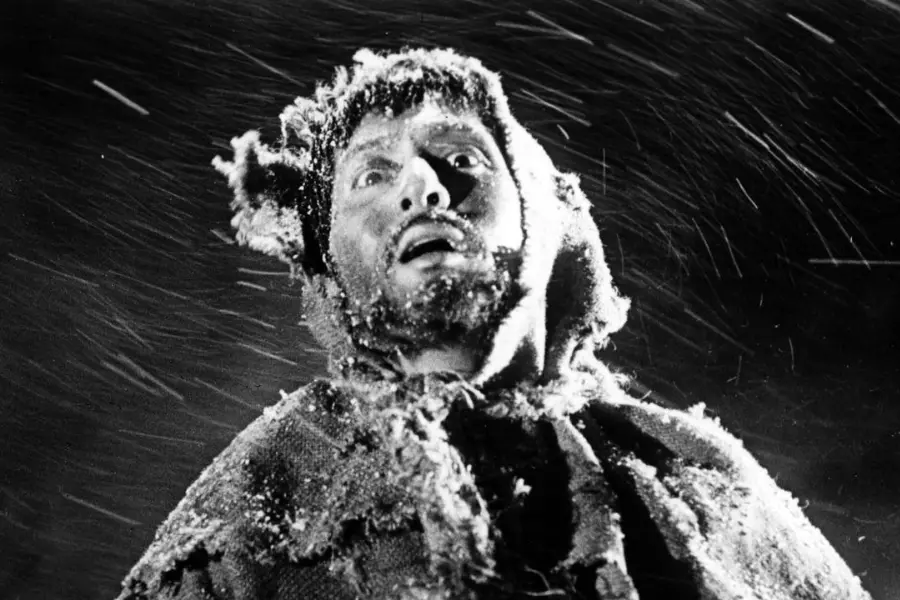
Kaji turned into a Soviet prisoner.
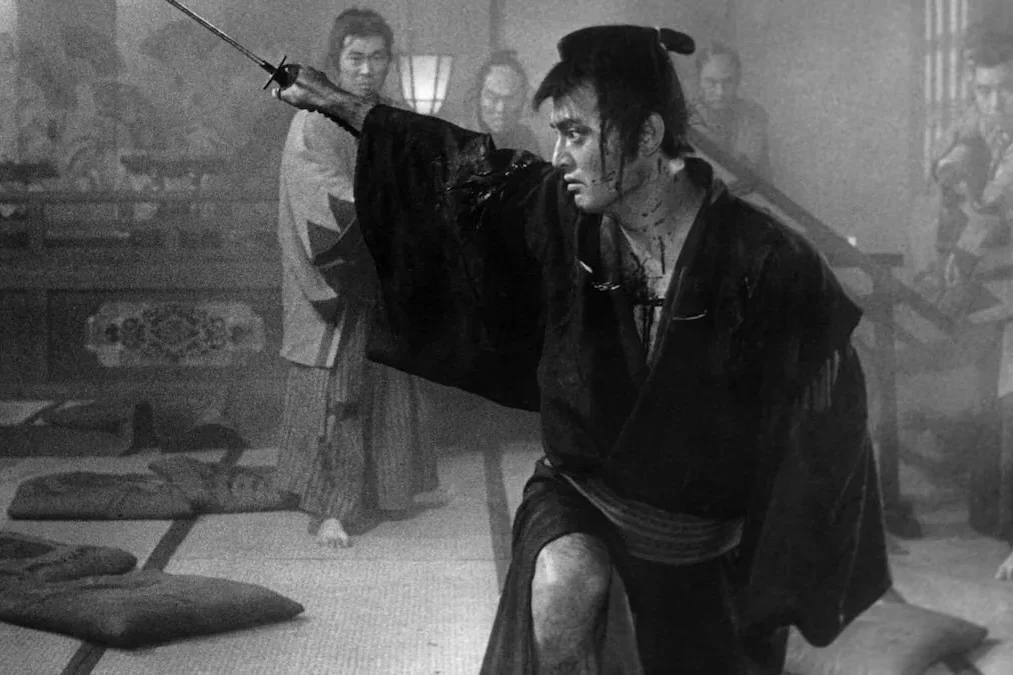
Let’s begin by saying that The Human Condition (Part 1, Part 2, Part 3) has a very outspoken anti-war script. The story of Kaji (played by Tatsuya Nakadai, 仲代 達矢), as he goes from idealist pacifist trying to improve life in a labour camp, to murderer, army deserter, prisoner of war and beggar, is heartbreaking. What little glimpses of humanity there exist in the film, like soldierly camaraderie and the love Kaji has for his wife Michiko (Michiyo Aratama, 新珠三千代), are systematically erased as war enters the frame. Kobayashi essentially argues that war is not only physically destructive, but psychologically and emotionally too. Morals are compromised, dialogue ends with the tip of a bullet and people don’t die for honour or their country, they just die.
However, as far as Truffaut and his supporters are concerned, the question remains: Could someone watch this movie and come out thinking war is something to aspire towards? Better still: if you sliced the film into ten-minute segments, could any single piece be mistaken for something pro-war?
No, so long as it’s Kobayashi’s cut, left exactly as he made it: no added music, no re-editing, no extra effects. The reason is simple: the film’s anti-war meaning isn’t carried by the plot alone. It’s built into the film language itself: how scenes are framed, how shots are cut, how the camera holds or pulls away. Kobayashi understood how powerfully composition and editing shape what an audience feels, and he uses those tools deliberately to keep the message clear. So let’s look at exactly how he achieves that.
Length and Scale

Kaji leaves the forest, struck by the vastness of Manchuria.
A common, yet reductive, argument states that The Human Condition’s length is the first step into understanding its psychological effects. For many, the nine-hour runtime signals the movie is not trying to be entertainment, but an ordeal: a harsh, depressing and difficult thing to get through. However, this is not entirely true. The film can be difficult, yes, but it does have sparks of beauty sprinkled throughout and, contrary to popular belief, can definitely be entertaining.
When the movie really wants to be an ordeal, however, it uses editing. Or, more accurately, the lack of it. Long, unpaused, wide shots are some of the most effective ways Masaki Kobayashi uses to convey the dreadful feeling of war. This is especially true in the last film (A Soldier’s Prayer, 人間の條件 完結篇, 1961), where war develops from a looming threat into a vivid, inescapable reality.
The Human Condition doesn’t want to capture the audience like other “anti-war” films, it keeps them at a distance, sometimes uncomfortably so. The length of shots is used to convey a sense of psychological fatigue and weariness, one that directly mimics the character’s experience. Moreover, the film uses monumental, large scale shots to make this message clear. The vast, black-and-white Manchurian landscapes the movie focuses on, while beautiful, are often framed in a hostile manner: there’s nothing beyond the horizon. One can either surrender to the scenery, or die trying to cross it.
For a specific example, there’s a scene in the last film when Kaji, some soldiers that follow him, and a group of refugees finally exit a forest in which they were lost. Yet, the feeling of escaping is not of victory, but sorrow, as the mostly empty fields of Manchuria hold no promises beyond starvation. Each of the characters is shown walking towards nothingness as the camera lingers on their tired bodies, whose struggle is made insignificant by the immensity of the country. The last characters to appear simply collapse, and we’re left wondering if this scene will ever end.
Claustrophobia in Composition, Framing and Set Design
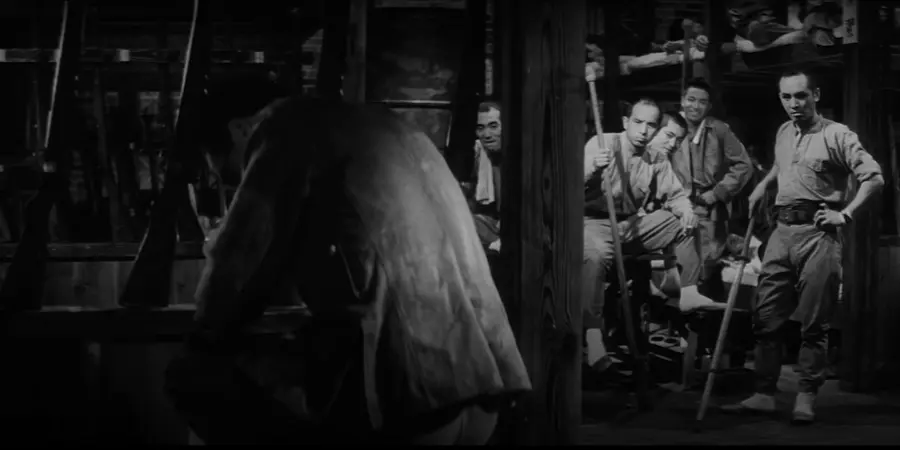
Obara being forced to role-play as a prostitute.
While Masaki Kobayashi’s use of a wide, unpaused shot is surely effective, it is not the only technique up his sleeve. The opposite of it, close, proximity-focused shots are also used throughout the film, especially when showing Kaji traversing through the systems related to war (i.e. the prisoner camp and the army settlements). The purpose of this is to enhance the feeling of claustrophobia, portraying war as something that, even if distant, makes breathing difficult.
Set design and composition are especially crucial here, as they work in tandem to emphasise the inhumanity in which people are being kept. These structures (either the barracks of the army recruits, or the electrified fenced stables of the prisoners) are inhumane, with bodies piling together as if their death was a given. The editing and framing then focus on this oppressing density, enhancing the feeling of paranoia and moral fatigue.
One of the best examples of this comes in the second film (Road to Eternity, 第四部戦雲篇, 1959), in the scene where a soldier called Obara (played by Kunie Tanaka, 田中 邦衛), is bullied into suicide. Set in the army barracks, the other soldiers accuse him of being too feminine for the army and suggest he would make a great prostitute. The already tight space becomes even tighter as the rifles become props for his forced prostitution act. The camera gets closer and we, as viewers, are forced into a painful intimacy with Obara, with conformity slowly fading. By the end, we understand the institutionally backed forces that will eventually drive him to take his own life.
The Sound Design and Music
Michiko and Kaji last goodbye in the army settlement.
Kobayashi, as a master in the language of filmmaking, understands the psychological effects of sound design, and employs it to guide the audience towards his anti-war vision. The previously discussed techniques (wide, lingering shots and oppressive close-ups) are both, in different ways, made stronger by the smart use of sound in the film. When it comes to the long, spacious shot, the characters’ voices are almost muted, if not entirely replaced by the rarely used internal monologue, while the wind makes its presence heard. On the other hand, the claustrophobic close-up shots are loud, one can hear the characters breathing arrhythmically, adding to the sense of proximity and unease.
Equally important is the film’s use of music, which maintains a deliberate balance between its presence and its absence. The film’s score, written by Chuji Kinoshita (木下忠司), fluctuates between hope and tragedy, with soft and loud melodies contending for emotional dominance on screen. Most of the time, however, the film settles for tragedy, letting the music fade away into the silence of war.
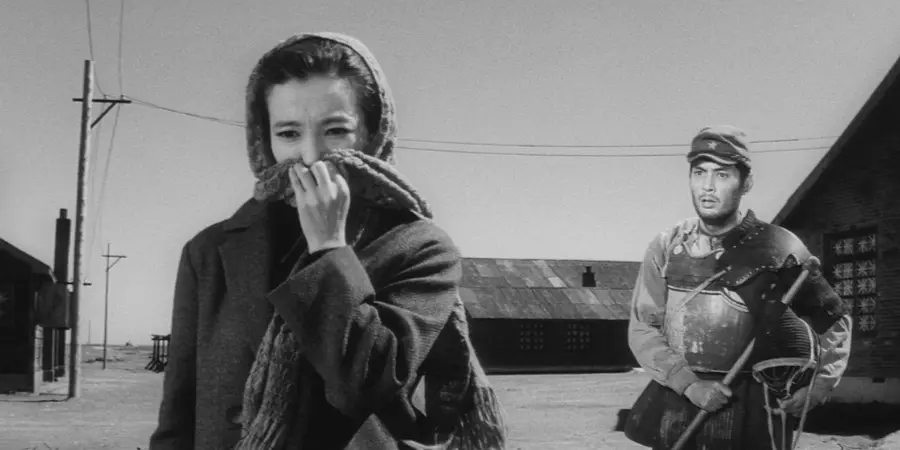
For an excellent example, we can look at a scene in the second film, where Kaji and Michiko see each other for the last time. Here, the music is of melancholic bitterness, as the characters don’t say goodbye, expecting to reunite after the war. The actors’ movements and voices sink into the score, conveying an eerie sensation of a promise that can’t be kept, but it’s made anyway. The scene then fades into black and we’re thrown into the silent bureaucracy of war, as a general complaint about a soldier’s lack of resilience, foreshadowing the reality of war that’s about to hit our protagonist.
The Rejection of Spectacle

Kaji and Michiko spotting each other in the distance.
Perhaps the most crucial distinction between The Human Condition and other “anti-war” films is its rejection of cinematic spectacle. This isn’t to say the movie lacks poetic or even entertaining scenes, because it most certainly does. Instead, it flirts with spectacle only to undercut it, lifting ideals into view just long enough for war to crush them. The film doesn’t begin as a depressing anti-war story, but as a hopeful love story where promises are made. And this is all achieved thanks to (not in spite of) the medium of film, with the camera guiding us and making sure we understand what Kobayashi is for and against.
To better understand this, we could look at two scenes that perfectly complement each other in how they draw our attention towards a theme. The first one is the last scene of the first movie (No Greater Love, 第一部 純愛篇/第二部 激怒篇, 1959), where Kaji and Michiko frantically run through mountains of dirt to embrace each other. While the context of the scene is melancholic (this could be their last time together), the cinematography and musical score show it as triumphant. This is because, as the film has developed, the love these characters have for each other has as well. Despite all the hardship, despite the looming threat of war, love can thrive. And this theme of love over hardship is one of the things Kobayashi wants us to take away from The Human Condition.
Now, let’s contrast that with the last scene of the second film, where battle ensues as Soviet tanks appear on the horizon. The camera doesn’t focus on feats or heroes, because what we’re shown is a nameless massacre. We see most of Kaji’s men died in front of our eyes, others simply died off-screen, and what’s left of the survivors can hardly be called men. Soldiers died like dogs, mad and broken, one even has foam coming out of his mouth and Kaji is forced to take him out. The language of film is used to portray war not as something exciting (even by proxy), rather, as a terrifying nightmare whose impact will forever haunt whomever experienced it.
Reception and Legacy
The Human Condition is a film that asks a lot of the audience. Sitting through it, while not as unbearable as some critics have made it out to be, still requires a great degree of emotional vulnerability. Audience members are confronted not only with a harsh story told in a harsh way, but a story they know could’ve ended in a different, more satisfying way. And they know this because of the countless other war stories (pro and against) that exist all around them.
It’s a nuanced experience that prompts questions on ethics and even cinema itself. It can, for instance, lead viewers to wonder about their responsibility when watching suffering, making them question if it’s even good to consume something that delves into such a subject. While fiction is a safe place to experience things (war being an example), fiction isn’t harmless, and the ideas it plants do take root. Moreover, do films even have to be entertaining? Can a film that dwells in discomfort awaken in someone a sense of moral clarity? Kobayashi would respond to that with an enthusiastic yes.
Because of this unique position, the trilogy holds a particularly interesting legacy. Though critically acclaimed in Japan and cinephile circles around the world, due to its runtime, subject matter and unflinching execution, the film is rarely screened in cinemas. Compared to other, more accessible “anti-war” films, The Human Condition is more cited than actually watched. Those who’ve seen it, however, defend it as the unequivocal masterpiece that proves that anti-war films are not only possible, but necessary.




Next Steps

Kaji after the battle with the Soviet army, realising he is alone.
François Truffaut’s words have, and will undoubtedly continue to be, true in the majority of cases that they have been applied in. This is especially true in today’s Hollywood dominated cinematic industry, where violence is often portrayed as cool and studios greenlight films with a viewer-friendly watching experience in mind. Don’t misinterpret us, these films can be amazing, a perfect example is the Sam Mendes’ 2019 film, 1917. This is a film that is not merely competent, but fantastic in its execution, using a technique mimicking a long, continuous shot through its entire runtime. Yet, for as much as the script wants to insist on its anti-war message, the film itself ultimately portrays war as glamorous.
Masaki Kobayashi’s The Human Condition, however, presents a dilemma for Truffaut’s thesis. It is either the exception that proves the theory right, or the glaring oversight that means it was incomplete. Its legacy on this question may depend on what future filmmakers make of it. Will they follow its example, or will they continue with what’s been working so far? What we can say is that it is a fantastic film, whose director’s uncompromising vision and expertise in the medium allowed it to stand as one of (if not the only) truly anti-war films.