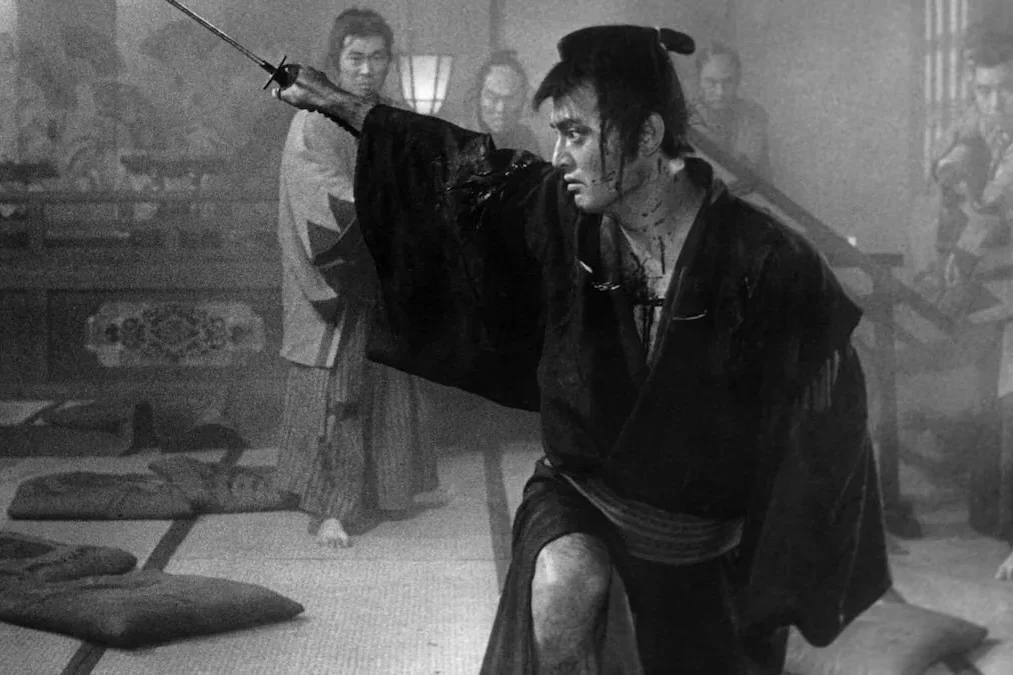
If you caught our earlier piece, you’ll remember Masaki Kobayashi’s (小林 正樹) The Human Condition (人間の條件) as the rare anti-war film that doesn’t blink. In it, we briefly covered the film’s legacy as an enduring and beloved masterpiece. Indeed, The Human Condition is still periodically screened in Japanese theatres, and it’s consistently cited as one of the best films ever made by various Western critics. What we have not yet discussed, however, is how remarkable this lasting legacy truly is.
Despite being a nine-hour-long trilogy, The Human Condition is hardly an epic in the traditional sense. Compared to something like The Lord of the Rings (whose runtime is quite similar), Kobayashi does not promise audiences the thrill of adventure, but rather the horrors of war in painful honesty. Essentially, it uses fiction not as a way to escape reality, but to force uncomfortable engagement with it. It is a film that becomes progressively (and aggressively) more difficult to watch, so why is it so revered?
Moreover, upon release, the Japanese reception of the film was complex, tainted by political controversy. In a country that has been heavily criticised for not acknowledging the extent of its war crimes, comes a film that unapologetically begins by depicting them in colonised Manchuria (then known as Manchukuo, 満洲国). And while it’s not the only film of the time to condemn Japan’s actions in the Second World War, it’s arguably the one whose legacy has endured most strongly.
This combination of factors makes The Human Condition‘s status as a masterpiece puzzling. How has it persisted over other, more accessible and less controversial films? Can it all be attributed to filmmaking mastery, or is there more to the story? These are precisely the questions we’ll be answering in this article.
Why it Endured
- It outlived early controversy because it’s built like a testimony, deliberately sacrificing entertainment value in order to preserve Kobayashi’s unfiltered vision of war.
- It became teachable in academic circles thanks to its expert use of cinematic language, making it a model for how editing, framing, and sound can all serve a clear artistic and moral intent.
- It sustains multiple layers of meaning, delivering a direct anti-war, anti-imperial message while also probing humanity’s violent and irrational impulses in the face of hardship.
- It stands as an honest, carefully argued declaration of ideas that viewers and critics return to whenever political climates shift, and questions of responsibility and remembrance resurface.
The Unwavering Vision of Masaki Kobayashi

Image credit: Alamy, photo of Masaki Kobayashi
The Human Condition is more than just a series of films; it’s an artistic, political, and aesthetic statement shaped by the unwavering conviction of its creator, Masaki Kobayashi. And, like all good declarations of ideas, its lasting power comes from its refusal to compromise. Kobayashi was aware he could potentially alienate audiences with his ideals, but he bet on them anyway, believing in their validity. So it begs the question, what were these ideals?
The first one is a strong commitment to truth, especially surrounding Japanese action in World War II. Masaki Kobayashi wasn’t just adapting Junpei Gomikawa’s (五味川 純平) six volume novel for the screen, but also telling his own story as a Japanese soldier. Film protagonist Kaji (played by Tatsuya Nakadai, 仲代 達矢) shares various similarities with Kobayashi, being a socialist pacifist who opposed imperial Japan’s methods. Given this first-hand experience, Kobayashi felt a personal commitment to telling the horrors of the Japanese regime and the failure of post-war ideals. However, unlike other directors of the time, Kobayashi wasn’t content with pointing the finger at the system and blaming it for leading the people astray. Rather, he wanted to depict and acknowledge the horrors the Japanese inflicted on others. He rejected self-pity, essentially saying: while we might have been misguided, we were still perpetrators. And that, at the time, was revolutionary.
The other uncompromising ideal was Kobayashi’s commitment to the medium of film. While it’s true the movie is not an epic in the traditional sense, it’s still a monumental achievement for the art form. Production-wise, it was a massive undertaking, requiring the movement of a large cast across extensive shooting locations. The film’s editing, given that context, is just as impressive, with a nine-hour-long experience that uses the language of film to its fullest capacity to make its point. In short, Kobayashi not only wanted to tell the truth about the war, but to prove that film was an adequate way of doing so.


The Narrative, Production and Filmmaking Foundations

Scene of Chinese prisoners of war working in an iron mine (first film).
Having discussed Masaki Kobayashi’s ideals, it is only fair that we delve into them to see if they hold up to scrutiny. After all, a lot of films are statements, but if we are concerned with their enduring power (i.e. their legacy), their arguments must be backed by strong foundations. What good would Kobayashi’s truth be if he failed to consider more than one angle? What good would a large-scale production be if it distracted rather than added to the experience? Luckily, The Human Condition is aware of these possibilities, and its foundations are a strong testament to that.
To prove this, let us examine the film’s plot, production, and filmmaking prowess:
The Plot
The films begin with protagonist Kaji rejecting his lifelong partner, Michiko (played by Michiyo Aratama, 新珠三千代), marriage proposal for fear of being drafted. However, he is eventually given the opportunity to avoid the draft by working as a supervisor in an iron mine in colonised Manchuria. As a socialist, he believes he can make a difference there, increasing productivity by treating the workers more humanely. A win-win situation. With that in mind, Kaji finally marries Michiko, and the story officially begins.
As one would expect, things don’t work as planned, with war slowly settling in the story. The first film in the trilogy, No Greater Love (第一部 純愛篇/第二部 激怒篇, 1959) sees Kaji’s expectations crushed as prisoners of war are sent to the mine. Kaji eventually sides with them in opposition to the Japanese Army’s cruelty and is drafted for insubordination.
The second film, Road to Eternity (第四部戦雲篇, 1959), details his experience as a soldier and eventually squadron leader. While camaraderie is still possible in the violent environment prompted by the Japanese army, what little of it exists is eventually destroyed as battle with the Soviet forces ensues, leaving a pile of corpses of what were once men.
The last film, A Soldier’s Prayer (人間の條件 完結篇, 1961), sees Kaji as a deserter trying to make his way back to Michiko, consistently compromising his ideals. In the end, the man we came to know dies, first psychologically, as he becomes a murderer, and then physically, when his tired body gives in to the snow.
In line with Kobayashi’s commitment to truth, The Human Condition has us empathising with the Chinese prisoners, Japanese soldiers, and the desperate deserters of war. It’s consistently framed to criticise the apparatus of war and those who, misguided or not, benefited from it. In one heartbreaking scene in the 3rd film, Kaji refuses to bury a Chinese guerrilla whom he defeated in battle. And this, crucially, is portrayed as horrific, as pre-war Kaji would’ve understood the precarious position the guerrilla was in, treating them with at least some dignity. Whilst it is true that war changed him, he is, as Kobayashi wanted to show, a murderer, and has to face that fact.
The Production

Scene Kaji in the infantry division of the Japanese Army (second film).
Given that the story dealt directly with Japanese war crimes, the studio, Shochiku, was initially reluctant about moving forward with the film, fearing audience backlash. Complicating matters further was the fact that The Human Condition is set in Japanese-occupied Manchuria, and China–Japan relations at the time were effectively non-existent due to their recent history of colonisation, making filming there impossible. This meant the film was, by any stretch imaginable, set up for failure. However, according to Philip Kemp of the Criterion Collection and interviews with lead actor Tatsuya Nakadai, Kobayashi fought relentlessly to make the film what it is today.
After acquiring the rights to Gomikawa’s novel, Kobayashi spent a great deal of his time convincing Shochiku to allow him to make the film on his own terms. Eventually, they let him do it when he threatened to quit the project altogether. According to Nakadai, Kobayashi felt intimately connected to Kaji and sought to create an accurate portrayal, which is why he famously carried a copy of the original novel on set. Moreover, if a scene was in the book but not the script, Kobayashi would add it upon realising. Understandably, this meant the production was constantly expanding, which is why it took four years to complete. While it is true that Kobayashi always envisioned the film to follow the six volumes of the original novel, the nine-hour runtime might’ve come as a result of these changes.
As for the filming, most of it was done by cinematographer Yoshio Miyajima (宮島義勇) in several locations around Hokkaido. But, true to his vision, Kobayashi ensured to scout for places that resembled the Manchurian landscape. Moreover, the sets built for the films masterfully show Kobayashi’s commitment to accuracy in service of his film message, using his own experiences as a POW to add realism to the environment. Further proof of this commitment is how, despite mostly using Japanese actors, there are several scenes in Chinese and even Russian, with great attention placed on the phonetics of these languages. The end result is the immersive experience the finished film provides.
The Cinematic Language
We would highly encourage you to read our previous article on The Human Condition for the full breakdown of its cinematic techniques and how they’re so effectively used. But, as a quick summary, Kobayashi uses editing, duration, composition, music and sound design in a poignant way, always leading the audience into the specific reading he has on the story. He had a clear message to give with the film and felt that any deviation of form would be compromising it, or worse, suggesting he was still unsure of its validity.
As we’ve explored in our previous article, this is easier said than done. Many directors (many all-time great directors) end up making violence an aesthetic, turning what was effectively an anti-war script into a pro-war movie. Kobayashi is the rare exception who, committed to his ideals, understood the psychological effects of cinematic language and used them to make his message clearer.
For a great example of these elements at play, we can look at the famous execution scene. Here, several Chinese war prisoners are set to be executed for allegedly trying to escape the mine. Kaji, believing in their innocence, tries to prevent it and is, consequently, forced to be a witness. The film uses wide shots to portray the scale of the tragedy, close-ups of Kaji’s face to show the shame he feels, and punctuates it all with excellent sound design. Eventually, Kaji defies the Japanese army and stops the execution; just as the executioner is set on taking him down, the Chinese prisoners chant in protest, saving his life. This is one of the few truly triumphant scenes in the entire trilogy, using shot composition to portray unity as a revolutionary act of defiance. This is, of course, entirely in line with Masaki Kobayashi’s ideals.
The Global Reception and Critical Success
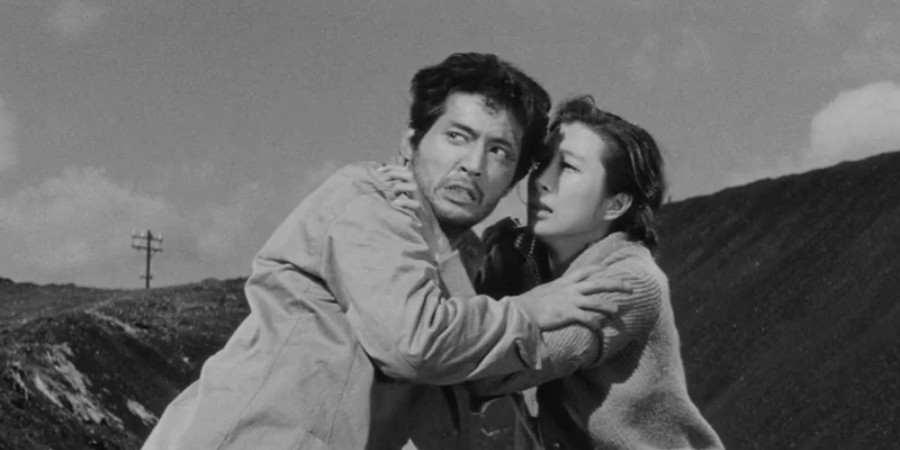
Scene of Kaji and Michiko embracing each other (first film).
Due to Masaki Kobayashi’s uncompromising ideals, the initial Japanese reception of The Human Condition was filled with tension. As previously noted, Kobayashi rejected self-pity and thus refused to sanitise the narrative for domestic comfort. This occurred at a time when Japan was largely focused on its own post-war recovery rather than its wartime accountability. The country wanted to move on from its past, but Kobayashi urged them to remember it. This meant that, while the majority of Japanese cinemagoers praised the film’s technical brilliance, a not insubstantial number of them rejected the film’s existence altogether.
However, Masaki Kobayashi’s commitment to his vision would eventually pay off once the film travelled West. Thanks to screenings in various international film festivals, such as the Venice International Film Festival (where it won the San Giorgio Prize and Pasinetti Award), critics quickly understood that these films were special. The scope of the narrative, the monumental production value, the brave and heartbreaking story, and Kobayashi’s risk-taking did not go unnoticed; he was rightfully recognised as a Japanese auteur of the same stature as Akira Kurosawa (黒澤 明). Crucially, this perception travelled back to Japan, where the original champions of the film could celebrate its international recognition.
Today, thanks to the inclusion of The Human Condition in the Criterion Collection, the film is accessible to cinephiles around the world, both old and young. As such, it has become a sort of rite of passage for film scholars. It is a long, slow and difficult thing to get through, but doing so is a testament that film, as an art form, can be more than entertainment: it can incite deep philosophical questions. Masaki Kobayashi’s statement persists to this day because it ultimately prompts a timeless meditation on the fragility of the human soul.
The Cost of an (Un)compromising Vision

Scene of Kaji in the battle with the soviet forces (second film).
For as much as the film is praised, with some critics even calling it “unequivocally the greatest film ever made” (Shipman, 1982, p. 650), the reality is that The Human Condition is more often cited than watched. Its runtime and harrowing subject matter mean the film is less accessible to general audiences than its contemporaries, making it difficult to justify theatrical screenings outside of Japan. This is, quite ironically, the compromise of Kobayashi’s uncompromising vision.
However, as we have hoped to show, the film’s legacy rests entirely on Kobayashi’s refusal to adhere to what was standard practice. A shorter, more sanitised version of The Human Condition would likely never have reached the critical heights it eventually attained. Had Kobayashi cut the film down, the fatigue of war that the audience is forced to feel would have been lost, reducing the experience to mere historical drama.

Scene of Kaji turned into a Soviet prisoner of war, wearing a sack of food to keep himself warm (third film).
In many ways, the film shares an allure similar to that of a classic novel. Not many people can tell you what exactly happened in the twentieth chapter of Don Quixote, but, if they’ve read it, they can tell you what the experience made them feel. The Human Condition works under the same foundation. While not everyone might remember how exactly it all played out, they will surely retain the last scene of Kaji as he collapses in the snow. The slow moral erosion of the character, the denial of closure, and the feeling that things could’ve been better will forever remain in everyone who watches the film.
In this sense, the film is content with its status as a challenging masterpiece. It operates on the understanding that the responsibility now lies with the viewers themselves. If one is able to endure the runtime and the uncomfortable exploration of wartime realities, they will be rewarded with one of the most profound cinematic experiences in existence. It’s difficult, yes, but it is precisely because of this difficulty that it has persisted where other, more accessible films have been forgotten.








Audience Guide
All that remains now is to encourage you to give this fantastic series of films a try. Do not let the nine-hour runtime deter you; the experience is well worth the time invested.
While it’s true the film is considered a rite of passage due to its difficulty, you can overcome that by approaching it with the right mindset. First, don’t try to binge-watch it. The films are not just long in a literal sense, but they’re deliberately exhausting psychologically. Watching one per day (or even half of one, as they’re all divided into two parts) is the best way to guarantee you’ll retain what the films are arguing for and against.
As is the case with most films, the preferable way to watch it would be in the collective privacy of a theatre, but as we’ve previously stated, that is only consistently feasible in Japan. Instead, you should prioritise good audio and image quality, which can be obtained on Blu-ray or one of the many services that stream the movie (Apple TV, The Criterion Channel, Mubi, etc)
And this shouldn’t be left unsaid, but the film is emotionally challenging, dealing directly with not only war, but issues of rape, murder, starvation and more. If you’re personally sensitive about those issues, take this as our content warning before watching the film. Having acknowledged that, it should be said that The Human Condition is one of the few films that do these subjects justice, unflinchingly condemning their horrifying existence.
Next Steps

Scene of Michiko saying goodbye to Kaji (first film).
The Human Condition remains a cornerstone of cinematic expertise, using the medium in an uncompromising manner in service of a harrowing story. It is, indeed, an epic, one that is not there to provide audiences with escapism, but to make them engage with reality in a meditative way. For contemporary filmmakers, it serves as a reminder that entertainment is but one quality of the medium, and that film can be whatever their imagination requires it to be.
In today’s media landscape, which not only packages and aestheticises violence but also streamlines art for mass consumption, Kobayashi’s trilogy feels almost impossible. Not merely a remnant of a bygone era, but a relic of a better one, where film more often resembled the director’s original vision. Its refusal to be anything but what the director intended is why it has such an enduring legacy, and why now is as important as it will ever be.