Imagine stepping into a world where art knows no borders, a place where you can interact with, reshape, and immerse yourself in mesmerising digital landscapes. This is the promise of teamLab Borderless: MORI Building DIGITAL ART MUSEUM, the permanent museum at Azabudai Hills created by teamLab, a ground-breaking international art collective. It has become a must-visit for anyone exploring Tokyo. Through art, this interdisciplinary group of specialists, including artists, programmers, engineers, CG animators, mathematicians, and architects, aims to explore the relationship between the self and the world, and new forms of perception.
Whether you’re an art lover, a technology enthusiast, or a first-time visitor to Tokyo, teamLab Borderless in Tokyo promises an unforgettable experience. The museum offers a fusion of art and technology that engages all of the senses, allowing visitors to truly become a part of the artwork. This place is about exploring with intention, creating and discovering a new world with others.
teamLab Borderless Tickets, Artworks and Map
- What is teamLab Borderless?
- History of teamLab
- From Odaiba to Azabudai Hills
- teamLab Borderless vs teamLab Planets, side by side
- Artworks inside teamLab Borderless, including the 2026 special exhibition
- Getting there from Kamiyacho and Roppongi-itchome
- Is there a teamLab Borderless map?
- Ticket prices, dynamic pricing and opening hours
- Questions about teamLab Borderless
What is teamLab Borderless?

Image Credit: teamLab, Microcosmoses: Wobbling Light and Environmental Light © teamLab
teamLab Borderless is an immersive museum of artworks without boundaries. Each installation is guided by its own unique concept, inviting visitors to explore spaces where art and interaction flow freely, with the environment responding to your presence and movement.
History of teamLab
teamLab was founded in 2001 by Toshiyuki Inoko and several of his friends to create a “laboratory to experiment in collaborative creation”, i.e. “teamLab”. Through art, teamLab is interested in creating new experiences to explore what the world is for humans. teamLab has been creating art since the beginning with the unchanging aim to change people’s standards of value and contribute to societal progress.
In the beginning, teamLab had neither the opportunity to present themselves, nor could they imagine how to financially sustain their art creation. However, teamLab believed in the power of digital technology and creativity, and kept creating something new, no matter which genre it would turn out to be. Its debut finally came in 2011 at the Kaikai Kiki Gallery in Taipei, to which the collective was invited by the artist Takashi Murakami.
Since then, teamLab has gained opportunities to join major contemporary art exhibitions in cosmopolitan cities starting with the Singapore Biennale 2013. In November 2014, teamLab opened a major exhibition at the National Museum of Emerging Science and Innovation in Tokyo, which ran until May 2015 and drew around 470,000 visitors.
These events further accelerated their evolution and gave them opportunities to exhibit internationally, including New York, London, Paris, Singapore, Silicon Valley, Beijing, Taipei and Melbourne. In 2025 came two more permanent museums: teamLab Phenomena Abu Dhabi opened on 18 April and teamLab Biovortex Kyoto on 7 October.
As of today, teamLab has welcomed over 35 million visitors to its art exhibitions worldwide.


teamLab Borderless moves from Odaiba to Azabudai Hills

Image Credit: © teamLab
teamLab Borderless first opened in Odaiba on 21 June 2018 and welcomed over 2.3 million visitors in its first year. It closed there on 31 August 2022 and reopened at Azabudai Hills on 9 February 2024. The sprawling, state-of-the-art facility reflects a more expansive and accessible concept, aimed at both broadening the artistic experience and integrating more deeply with the city’s pulse.
Azabudai Hills brings together a blend of innovative architecture, high-end shopping, and cultural institutions. The neighbourhood’s modern aesthetic provides the perfect backdrop for teamLab’s immersive experiences. This transformation aligns with Tokyo’s reputation as a global hub for art and technology, making the move a strategic and symbolic one.
teamLab Borderless vs. teamLab Planets

Image Credit: teamLab, Floating Flower Garden: Flowers and I are of the Same Root, the Garden and I are One © teamLab
Although both teamLab Borderless: MORI Building DIGITAL ART MUSEUM and teamLab Planets TOKYO DMM offer stunning digital art experiences, the two have distinctly different approaches. First, the teamLab Borderless exhibition is based on interconnected spaces where art flows and evolves as you move through it.
The experience is boundless, allowing you to explore every corner of the exhibit without boundaries, hence, its name. It is a free-roaming space that adapts to your actions. The same room can change into a different work of art depending on the time of day and the season. Even if visitors have visited a room once, they are encouraged to try visiting it again at a different time.
On the other hand, teamLab Planets is a tactile and more physically immersive experience that includes water and touch-based interactions. It is a linear experience that guides you from room to room, making it a more structured journey than teamLab Borderless.
If you are looking for a fully immersive, unrestricted environment, teamLab Borderless will captivate your imagination. For those seeking a more sensory-based experience, teamLab Planets is your ideal destination. Bear in mind that teamLab Planets in Toyosu is scheduled to close at the end of 2027, while teamLab Borderless at Azabudai Hills is a permanent museum.
Here is how the two Tokyo museums compare on the details that decide most visits, using teamLab’s official pages on 31 October 2026. teamLab now has eight major sites across Japan, from Kyoto to Okinawa, and our guide to every teamLab location in Japan compares them all.
| teamLab Borderless | teamLab Planets | |
|---|---|---|
| Where | Azabudai Hills Garden Plaza B, B1, Toranomon 5-9, Minato-ku | Toyosu 6-1-16, Koto-ku |
| Nearest station | Kamiyacho (Hibiya Line), Exit 5, 2 minutes | Shin-Toyosu (Yurikamome), Exit 1A, 3 minutes |
| Open since | 9 February 2024, permanent | 7 July 2018, until the end of 2027 |
| Adult ticket | Listed at ¥3,400, dynamic | Listed at ¥3,800, dynamic |
| Children | ¥2,800 (13 to 17), ¥1,500 (4 to 12), under 4 free | ¥2,800 (junior high and high school), ¥1,500 (4 to 12), under 4 free |
| Any-time pass | Flexible Pass ¥12,000 | Premium Pass ¥12,000 with priority entry |
| Hours | 8:30 to 21:00, many days to 22:00 | 8:00 to 22:00 |
| How you move | No route and no map, works drift between rooms | A set route through Water, Garden and Athletics Forest areas |
| Barefoot and water | No | Yes, water can reach knee height |
| Food and drink inside | EN TEA HOUSE | Vegan Ramen UZU Tokyo and other cafes |
| Tickets at the door | Book online; limited on-site sales cost ¥200 more | Not sold on site |
Artworks to find inside teamLab Borderless at Azabudai Hills
The experience within teamLab Borderless is a multi-sensory journey. As you walk through its interconnected spaces, you’ll notice how sound and light work in tandem to create surreal environments.
The soundscape shifts with your movements, while the artwork responds to your presence, providing a sense of active participation. You become part of the art, blurring the lines between the observer and the observed. There are no artwork captions and no map inside, because the works move between rooms, so the free teamLab app is the way to read about the artwork closest to you.
Continuous Trajectories: One Stroke

Image Credit: teamLab, Continuous Trajectories: One Stroke © teamLab
This exhibit reimagines calligraphy by transforming it into a three-dimensional experience. As you walk through the space, the characters evolve and expand, constantly shifting shape. The movement creates an ever-changing visual narrative, making each visit unique. It is an incredible fusion of traditional art forms with cutting-edge technology, creating a hypnotic interaction between past and future. Through various groups of artworks, one continuous world without boundaries is created.
Infinite Crystal World

Image Credit: teamLab, Infinite Crystal World © teamLab
Step into a boundless universe of light and reflection in the Infinite Crystal World. This installation is filled with countless mirrors that expand in all directions, creating an illusion of infinite space. As you move through this environment, the reflections multiply, immersing you in a kaleidoscopic realm where space and time blur. The constantly shifting colours create an entrancing effect, drawing you deeper into the artwork.
Light Sculpture: Flow

Image Credit: teamLab, Light Vortex © teamLab
In this space, a continuous stream of light rays forms a sculpture that seems to grow and evolve with each passing moment. The interaction between light and space makes this artwork feel alive.
As you walk around it, the sculpture shifts, reacting subtly to your presence whilst transforming the space around you. It is a dynamic creation that plays with the concept of transformation, where light itself becomes a form of art, challenging the boundaries between the tangible and the ephemeral.
The Light Sculpture: Flow space has reopened after maintenance, and teamLab is marking the reopening with a special exhibition, On the Asymmetry of the Universe (see below).
Sketch Ocean

Image Credit: teamLab, Sketch Ocean © teamLab
This exhibit invites visitors to colour in a fish on the paper provided, which is then brought to life in an interactive digital ocean. Scan your drawing and watch as your fish swims onto the wall-sized display alongside fish drawn by other visitors.
Touch a fish and it swims away, or touch the food bags to feed them. Every so often the fish leave the room altogether and swim out into neighbouring artworks. It is a fun and personal way to engage with the art, allowing your unique creativity to directly shape the experience and contribute to a growing, communal seascape.
Memory of Topography

Image Credit: teamLab, Memory of Topography © teamLab
This exhibit is a breathtaking visual depiction of a rural mountain landscape rendered in digital layers. As you observe the topography, it changes with the passing of time: rice plants that are small in spring grow taller through the summer and turn golden in autumn.
The installation responds to environmental cues, giving the illusion of being transported through both time and place. The blend of virtual imagery and emotional resonance evokes a powerful sense of nostalgia and invites quiet reflection on our relationship with the natural world. Memory of Topography is a seasonal work (it runs from September to November in 2026), so check the official website to see whether it is showing on your date.
Black Waves: Frozen Transparency

Image Credit: teamLab, Black Waves: Frozen Transparency © teamLab
The waves in this exhibit are caught in a delicate balance of movement and stillness, suspended in a frozen dance of fluid motion. Black ink-like visuals ripple across transparent screens, their flow guided by invisible forces.
As you move around them, the perspectives shift, allowing you to feel both the weight and the grace of water in motion. The waves symbolise the ever-changing nature of time and space, providing a serene yet captivating experience that merges traditional Japanese wave motifs with modern visual technology.
Bubble Universe

Image Credit: teamLab, Bubble Universe: Spherical Crystallized Light, Wobbling Light, and Environmental Light, One Stroke © teamLab
Bubble Universe fills a mirrored room with hundreds of spheres made of light. Stand still and the sphere nearest to you brightens, then passes that brightness on to the spheres around it, so the room ripples outwards from wherever people are standing.
The mirrors multiply every sphere into what looks like an endless field of light. It is one of the most photographed rooms in the museum, so it is worth heading there early in your visit, before it fills up.
Animals of Flowers

Image Credit: teamLab, Animals of Flowers, Symbiotic Lives © teamLab
In this mesmerising exhibit, digital animals are made entirely out of blooming flowers. As you approach, they react to your presence: petals shift, stems unwind, and blossoms scatter like confetti. The animals fade and reassemble in response to touch and movement, emphasising the transient beauty of both flora and fauna. It is a poetic portrayal of the interconnectedness of life, reminding viewers of the harmony and fragility within nature, reimagined through the lens of technology.
EN TEA HOUSE

Image Credit: teamLab, Tea Tree © teamLab
Step into this tranquil space where traditional Japanese tea culture meets art in a meditative setting. As you sip your tea, beautiful digital flowers bloom inside your cup, swirling in response to your touch and disappearing with each sip. You will also find other immersive artworks here, including Tea Tree, a calming visualisation that evolves as you relax, and an Enso, a circle drawn in light as spatial calligraphy and inspired by Zen philosophy and the beauty of simplicity.
The EN TEA HOUSE menu features Cold Brew Green Tea, Yuzu-infused blends, and even Frozen Matcha Coconut Gelato, offering a multisensory journey through both flavour and art.
The tea house opens 30 minutes after the exhibition begins, with last orders taken 30 minutes before closing. It is a space for quiet introspection and serene delight while providing an ideal pause within the dazzling gallery experience.
On the Asymmetry of the Universe: Asymmetric Existence and Chromatic Existence
© teamLab
The newest works at Borderless sit in a special exhibition held to mark the reopening of Light Sculpture: Flow. Asymmetric Existence is a single sculpture made of two light sculptures, one that appears only in the room and is not reflected in the mirror, and one that appears only inside the mirror. You only see the whole shape by looking at both at once.
© teamLab
Chromatic Existence works with colour instead of light rays: as colours flow through the space and settle into order, a sculpture made only of colour appears, with no surface you could touch. teamLab has not published an end date for the exhibition, so check the official Borderless page before you go.
Autumn seasonal works: Memory of Topography and Proliferating Immense Life
Some rooms change with the calendar. Memory of Topography shows from September to November, and Proliferating Immense Life: A Whole Year per Year is listed for October, so a visit in autumn 2026 catches both. teamLab also warns that individual works can close for crowding or maintenance on the day.
Sketch Factory: take your fish home
The fish you colour in for Sketch Ocean do not have to stay in the museum. At the Sketch Factory your drawing can be printed onto a badge, magnet, hand towel, T-shirt, tote bag, puzzle, papercraft or stickers to take home, which makes it one of the few teamLab souvenirs that is genuinely yours.








Getting to teamLab Borderless from Kamiyacho and Roppongi-itchome stations

Image Credit: Azabudai Hills
Reaching teamLab Borderless has never been easier with Tokyo’s efficient metro system.
First, you can take the Tokyo Metro Hibiya Line to Kamiyacho Station and use Exit 5, which is a two-minute walk from the museum. Alternatively, you may take the Tokyo Metro Namboku Line to Roppongi-itchome Station; from Exit 4, it’s just a short 6-minute walk to your destination. Both stations link to Azabudai Hills through an underground passage, so you can follow the signs without going up to street level. The museum itself is on floor B1 of Azabudai Hills Garden Plaza B.

For those travelling by car, the museum has no car park of its own, so use the Azabudai Hills P6 parking lot. Take elevator D up to floor B1 and the teamLab Borderless entrance is immediately on your left.
Moreover, teamLab Borderless is accessible to all, including families and visitors with disabilities. Upon arrival, guests with disabilities can receive a tablet with accessibility maps, ensuring that everyone can fully enjoy the experience.
teamLab Borderless map: there is no floor plan inside
teamLab describes Borderless as “a museum without a map”, and it means it. There is no floor plan, no set route and no captions on the walls, because the artworks move out of their rooms and mix with each other. Instead, the free teamLab app tells you the name and concept of the artwork closest to you as you walk.
The room guide below brings the spaces teamLab lists for the museum into one picture, with the works to look for in each and the way in from both stations. It gives no positions, because teamLab publishes none and the works keep moving.
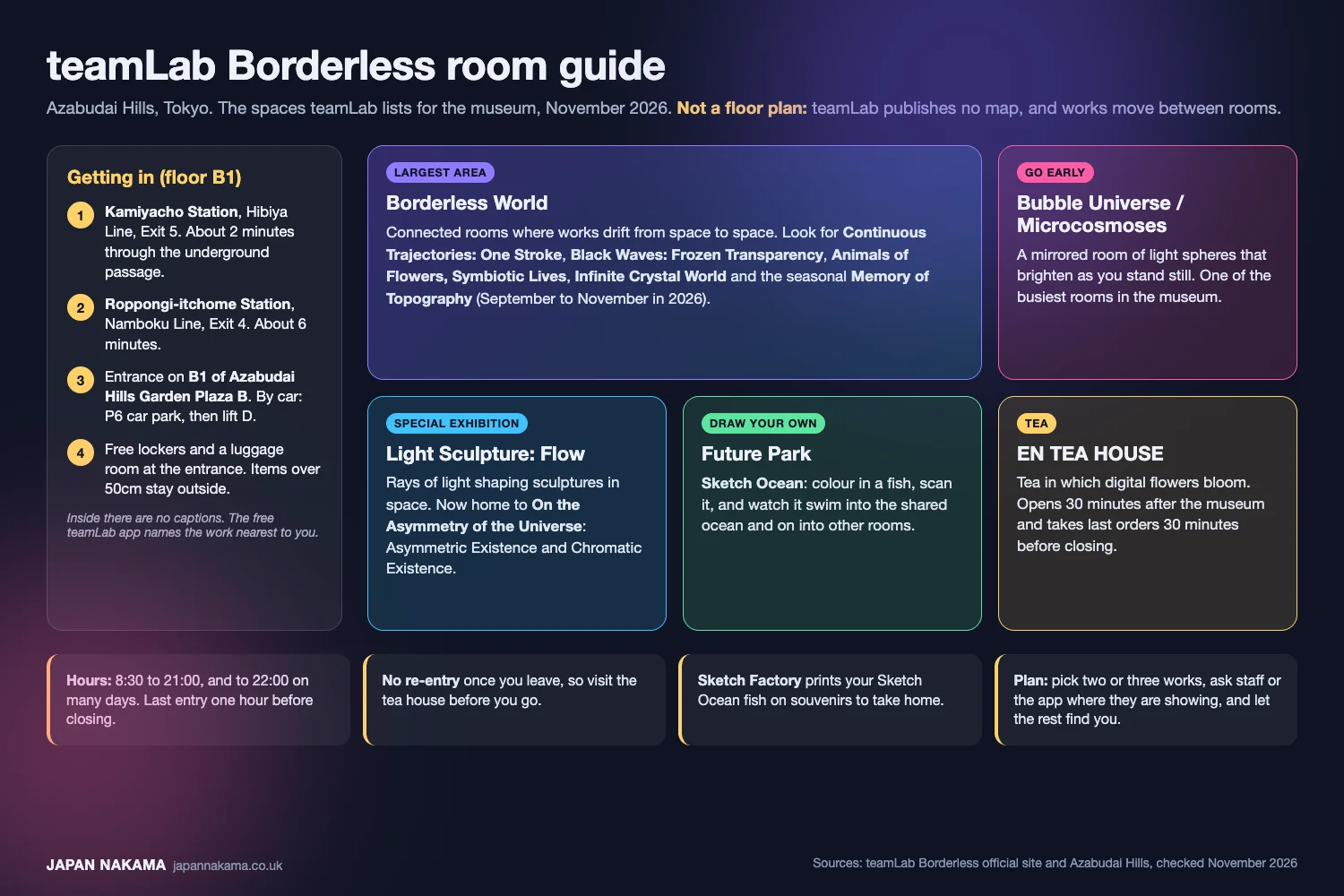
Japan Nakama’s teamLab Borderless room guide, based on teamLab’s official site, November 2026. It is not a floor plan.
The only maps you need are for getting in. The entrance is on floor B1 of Azabudai Hills Garden Plaza B, reached through the underground passage from Kamiyacho Station (Exit 5) or Roppongi-itchome Station (Exit 4), and the Azabudai Hills access map shows both routes. Inside, free lockers take bags, strollers go into the luggage room, and items over 50cm are not allowed past the entrance. A good plan is to pick two or three works you want to see, ask staff or check the app where they are showing, and let the rest find you.
teamLab Borderless ticket prices and opening hours
Tickets for teamLab Borderless: MORI Building DIGITAL ART MUSEUM are sold for a set date and entry time, and adult prices follow a dynamic pricing system, so the cost changes with the day you pick. Check the price for your date on the official ticket website before you book. Buying on site adds ¥200 per ticket, and popular dates can sell out.
- Adults (18 and over): listed at ¥3,400, with the price changing by date and entry time
- Ages 13 to 17: ¥2,800
- Ages 4 to 12: ¥1,500
- Ages 3 and under: free
- Visitors with a disability certificate, plus one companion: ¥1,700 each (adult price varies by date)
For added flexibility, there is also a Flexible Pass at ¥12,000 for both adults and children. It is valid for one date and lets you arrive at any time up to last entry.
The museum opens from 8:30am to 9pm, and on many days it stays open until 10pm. In November 2026 the late days are 2, 5, 6, 9, 12 and 13 November, and 26 to 30 December also run late. The museum is closed on Tuesday 24 November and Tuesday 8 December 2026. Last entry is one hour before closing, and re-entry is not permitted.
How teamLab Borderless dynamic pricing works
Adult tickets, and tickets for visitors with a disability certificate, use dynamic pricing. teamLab sets a price for each date and entry time, so two people booking for different days can pay different amounts. Children’s tickets stay at ¥2,800 for ages 13 to 17 and ¥1,500 for ages 4 to 12, and under fours go free.
- The price you see in the ticket calendar for your slot is the price you pay online. Buying at the venue, where sales are limited and only while they last, adds ¥200.
- Open the calendar and compare a few dates and times before you pay, because the adult price is not fixed.
- Tickets bought on the official site can be moved to another date up to three times, up to two hours before your entry time (or two hours before last entry for a Flexible Pass). They cannot normally be cancelled.
- Tickets are also sold on KLOOK, which teamLab lists as an official seller. Tickets from any other reseller may be refused at the door.
- The ¥12,000 Flexible Pass costs the same for adults and children and removes the entry time, which suits anyone whose day is hard to pin down.
teamLab Borderless in 2026: a permanent museum at Azabudai Hills

Image Credit: teamLab, What a Loving, and Beautiful World © teamLab
teamLab Borderless offers an unparalleled, one-of-a-kind art experience that blurs the lines between the viewer and the art. With its stunning exhibits and immersive digital creations, it is a must-visit destination in 2026. Every step through its vast, ever-shifting landscape invites you to interact, explore, and lose yourself in a world where art transcends physical boundaries. Unlike traditional museums, the artworks here are not confined to frames or walls.
Whether your interests lie in creativity, innovation, or unforgettable adventures, teamLab Borderless promises to leave you awe-struck. It is a place where imagination knows no limits and where each visit offers something entirely new.
Don’t miss out on the chance to be part of this truly enchanting digital universe. Book your tickets now and prepare yourself to be transported beyond borders.
Questions about teamLab Borderless
teamLab lists adult tickets at ¥3,400, but the adult price changes with the date and entry time, so check the official calendar for your day. Ages 13 to 17 pay ¥2,800, ages 4 to 12 pay ¥1,500 and under fours go free. A Flexible Pass with no fixed entry time costs ¥12,000.
No. teamLab calls Borderless a museum without a map, because the artworks move between rooms. There are no captions either. Use the free teamLab app, which shows the artwork nearest to you, and use the Azabudai Hills access map to find the entrance on floor B1 of Garden Plaza B.
Plan on half a day. There is no time limit once you are inside, the works change as you walk, and many rooms reward a second visit later in your stay. Re-entry is not allowed, so leave enough time for the EN TEA HOUSE before you exit.
Yes, online, if your slot has not sold out. Sales at the venue are limited, only while they last, and cost ¥200 more than online. Weekends, holidays and the cherry blossom and autumn leaf seasons sell out first, so book ahead for those dates.
Borderless suits people who like to wander, with no route and works that move between rooms. Planets is a set route where you walk barefoot through water and a floating orchid garden. Planets is due to close at the end of 2027, while Borderless is permanent.
Kamiyacho Station on the Tokyo Metro Hibiya Line, two minutes from Exit 5. Roppongi-itchome Station on the Namboku Line is six minutes from Exit 4. Both connect to Azabudai Hills underground, so you can follow the signs without going up to street level.
Yes. Photos and video are allowed, but flash is not, and monopods, tripods, selfie sticks and other aids of 30cm or more are banned. Filming for commercial use needs teamLab’s permission.
Comfortable shoes, because you will be on your feet for hours in dark rooms with uneven floors. Some artworks have mirrored floors, and the museum lends wrap skirts near those rooms. Flashing shoes or light-up accessories are not allowed, because they affect the artworks.
Yes. The Future Park area, with Sketch Ocean, is built for children, and under fours go free. Children of elementary school age and younger need an adult aged 18 or over, with one adult for every five children. Strollers go into the luggage room, and child harnesses are not allowed.
The original Borderless opened in Odaiba on 21 June 2018 and closed on 31 August 2022. The museum reopened at Azabudai Hills in Minato-ku on 9 February 2024 as a permanent site, under the full name teamLab Borderless: MORI Building DIGITAL ART MUSEUM.