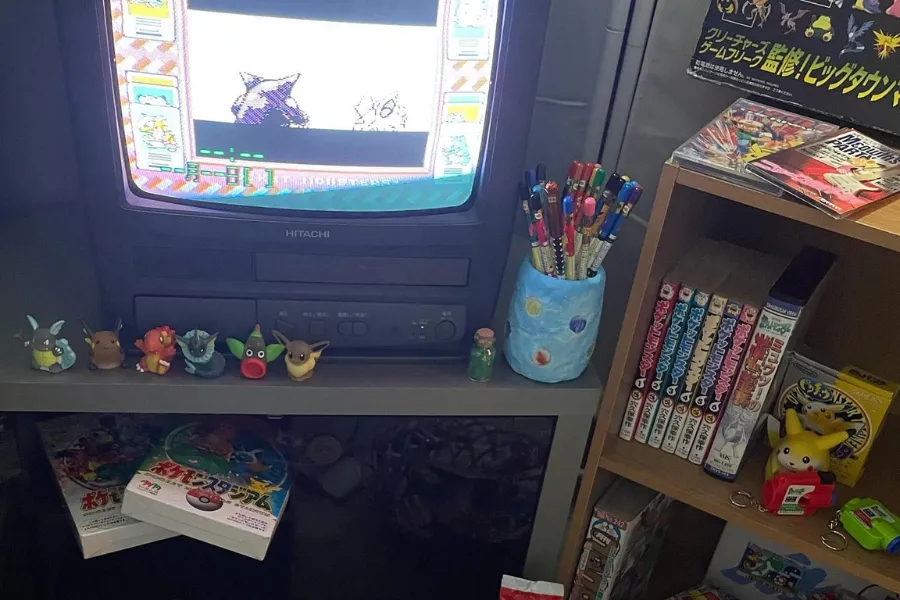
If you run a boutique, museum shop, café-retail, or a concept store, Japanese-made goods earn more than their shelf space. They blend provenance (where it’s from), craft (how it’s made), and purposeful design (why it’s kept). That trio lifts basket size, builds repeat purchase, and keeps returns low.
Add today’s appetite for Japanese design and collectibles, fuelled by rising travel, plus anime and kawaii fandom that spans generations, and you get a range that’s both of-the-moment and built to last.
What you’ll get from this playbook:
- first, a fast read on global demand; then what tourism to Japan means for sales at home;
- next, the exact categories rising with UK/US travellers;
- and finally, a direct route to source, without heavy MOQs or shipping headaches.
The Japan Product Retailer's Playbook
The Global Demand for Japanese-Made Goods

Japanese-made goods have a strong and rising global demand, fuelled by consumers seeking authenticity, quality, and craftsmanship. With the label “Made in Japan” recognised globally as a symbol of precision and heritage, these products offer retailers a way to meet evolving consumer preferences while elevating their brand identity.
Why Japanese Goods Win Globally
1. Consumer Trends Favouring Authenticity:
Across North America, Europe, and the UK, shoppers are turning away from mass-produced items in favour of goods with cultural meaning and artisanal quality. The global handmade goods market, valued at $1.1 trillion in 2024, is expected to more than double by 2032 (Grand View Research, 2024). Japanese products, deeply rooted in tradition and story, align perfectly with this shift.
2. Booming Craft and Design Markets:
The North American crafts market is set to grow from $361 billion to $768 billion by 2033 (Business Research Insights, 2024). Europe follows closely, doubling from $209 billion to $417 billion in the same timeframe. In both regions, there’s high demand for story-rich, sustainable, and design-led products, a natural match for Japanese goods.
3. Cultural and Aesthetic Appeal:
Japanese craftsmanship combines heritage techniques with minimalist design, resulting in objects that feel premium and intentional. With over 230 nationally recognised traditional crafts (METI Japan, 2023), Japan offers a diverse catalogue of products that resonate with today’s values: simplicity, longevity, and authenticity.
4. Export Growth and E-Commerce Access:
Japan’s traditional goods exports are steadily rising, with the U.S., France, and Germany as top buyers (JETRO, 2023). Trade agreements like the Japan-EU EPA have reduced tariffs (European Commission, 2022), while platforms like SUPER DELIVERY and Etsy make it easier than ever for overseas retailers to source directly from Japan.
5. Proof in market:
From MUJI’s global footprint to kimono-inspired jackets selling at scale on UK high streets, Japanese-made and Japan-inspired goods perform, from niche boutiques to volume retail.
- MUJI operates 750+ stores globally, exporting its “no-brand” Japanese design ethos (MUJI IR, 2025).
- UK fashion retailers sold 40,000 kimono-inspired garments weekly during peak seasons (WGSN via The Guardian, 2023).
- Pop-ups and museum stores across Europe showcase Japanese craftsmanship with strong sell-through (Wallpaper*, 2024).
The Key Takeaway for Retailers

Japanese-made goods consistently perform because they meet global demand for authenticity, cultural value, and quality. From design-conscious millennials to collectors and wellness consumers, audiences are willing to pay more for something meaningful. Retailers who stock Japanese products gain not only sales but a brand halo, standing out for quality, taste, and storytelling.
Stocking Japanese-made goods is more than a product choice; it’s a strategic move. The global appetite for quality, story-driven, and culturally rich products continues to grow. Retailers who act now can tap into this demand and position themselves at the intersection of tradition and trend.


Meet SUPER DELIVERY: Your Direct Line to Made-in-Japan
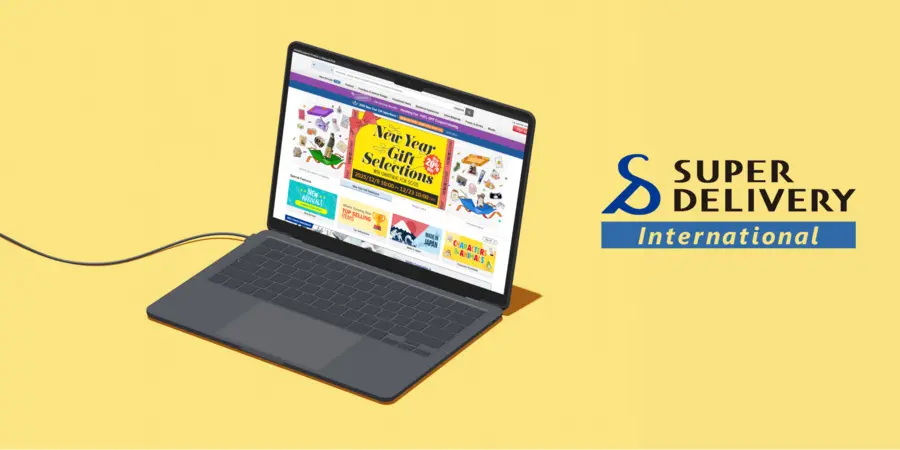
SUPER DELIVERY is Japan’s B2B wholesale marketplace, built for verified business buyers (not consumers). It connects you to thousands of Japanese suppliers across home & living, tableware, stationery, fashion, beauty, gifts, toys, and more, while handling export preparation and international shipping end-to-end.
Scale & access (as of Jan 2024)
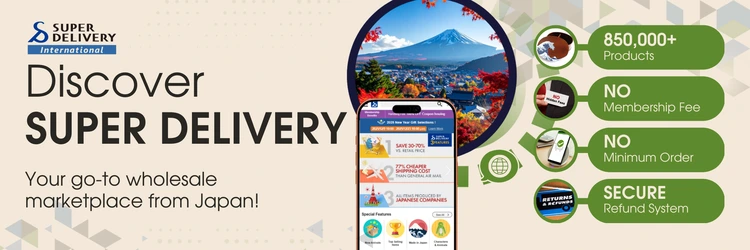
- 1,900+ vendors and 850,000+ items on SUPER DELIVERY International; supporting buyers in 134 countries.
- No minimum order value, most products can be purchased from 1 piece.
- Wholesale prices typically 30 to 70% below retail with Japan tax-free pricing (consumption tax not applied to international orders).
- 24/7 ordering; English support available.
SUPER DELIVERY for international buyers
As an international retailer, also refer to SUPER DELIVERY’s International export-ready site built for overseas retailers. You’ll see assortments cleared for international sale, pay in Credit Card / PayPal / T/T, and check out with a simple ¥1,300 per-vendor handling fee.
SUPER DELIVERY prepares the export paperwork; your local carrier will contact you to settle import duties and taxes on arrival.
How SUPER DELIVERY works
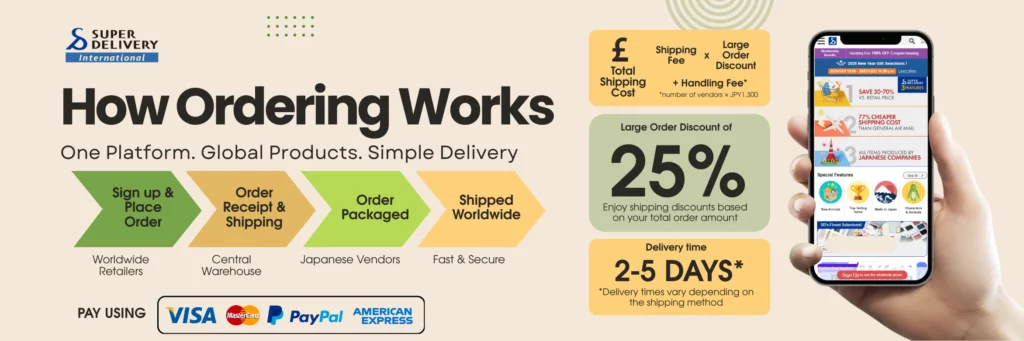
- Sign up here, and register for free as a business; approval by review.
- Go through the sign up process, providing your business name, address and additional details to gain access.
- Browse & apply to vendors and view member-only wholesale prices.
- Add items across multiple vendors to one cart.
- Export-warehouse processing: SUPER DELIVERY consolidates items from multiple vendors into one outbound shipment, so you pay for a single international delivery rather than several.
- Choose shipping (DHL, UPS, EMS, Air/Sea Mail, ECMS, etc). Transit time depends on method and destination.
- Customs & duties: Import taxes/fees are set by your country. Check with a local customs broker for category-specific tariffs before you buy.
- Aftercare: Lost/damaged items can be claimed within 14 days of delivery (refunds via SD points or PayPal).
What international retailers get
- Reliable export routes direct from Japan (no need to arrange forwarders)
- Small-lot testing to de-risk new categories and styles.
- Early access: many products appear on SUPER DELIVERY for overseas buyers at the same time they launch in Japan.
- Breadth + niche: design-led labels, regional craft makers, seasonal drops, and character goods, many not otherwise selling overseas.
Browse Featured CollectionsMade in Japan items, Japanese Stationery, Japanese Pottery, Matcha products, Fashion items, kawaii collectables.
Delivery & fees snapshot
- Typical delivery windows vary by carrier and destination (express vs economy). See current ranges here.
- Estimate costs by country and method. See Shipping Fee Calculator.
- Handling fee: JPY 1,300 per vendor covering export processing at SUPER DELIVERY’s export warehouse (consolidation, repacking, heavy-duty packaging, export documents). Refer to shipping & handling fees.
- Consolidation: Items from multiple vendors are combined at the export warehouse, so you pay for only one international shipment (Larger consolidated orders may qualify for bigger shipping discounts).
Travel to Japan Is Supercharging Demand for “Made in Japan”

International trips to Japan aren’t just fueling Instagram feeds, they’re converting into shopping behaviour that follows travellers home. Japan National Tourism Organization (JNTO) data for US and UK visitors points to three reinforcing signals: rising arrivals, higher per-visitor spend, and greater use of tax-free shopping for tangible souvenirs.
After COVID-19, Japan’s tourism rebound didn’t just recover, it set a new high: 36.87 million visitors in 2024, topping the previous 2019 peak of 31.88 million and signalling demand well above pre-pandemic levels. Travel to Japan continues to rise year on year and people aren’t just sightseeing; they’re shopping with intention and returning determined to keep that experience alive.
Here’s what the data says and how those trends translate into retail opportunities, and exactly what to stock next if you want to win with authentic, Made-in-Japan goods.
Shopping Is a Meaningful Share of Spend, and It’s Actionable for Retail
Looking at the shopping stats by category from JNTO. We can see;
United States
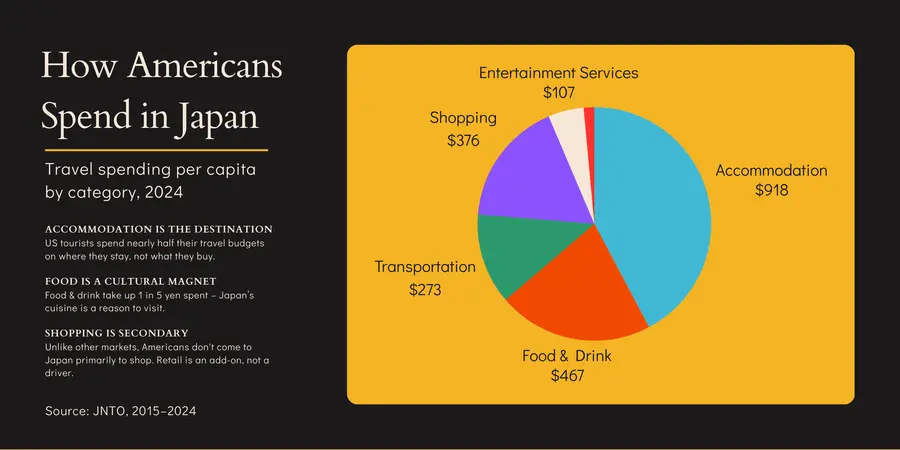
When nearly 1 in 5 yen is allocated to shopping, US travellers aren’t browsing, they’re hunting for a keepable culture. Many will return home primed to continue the collection.
- Shopping: ¥58,336 → ≈ US $376
- Accommodation: ¥142,256 → ≈ US $916
- Food & drink: ¥72,435 → ≈ US $467
- Transportation: ¥42,384 → ≈ US $273
- Entertainment: ¥16,560 → ≈ US $107
United Kingdom
UK visitors aren’t just sightseeing in Japan, they’re budgeting to take a piece of it home. I, shopping accounted for ¥56,046 per visitor (14.7%) of UK travellers’ in-country spend, a share that sits just behind food and accommodation and comfortably ahead of entertainment. In practical terms, that means roughly one in every seven yen spent during the trip is earmarked for “keepable” purchases, not incidental browsing.
The pattern also aligns closely with the US profile (17.6% shopping share), signalling a cross-market habit rather than a UK-only quirk. For retailers, The implication is clear: demand for authentic, Made-in-Japan goods is clear and persistent, people actively seek them out and want them in their everyday lives.
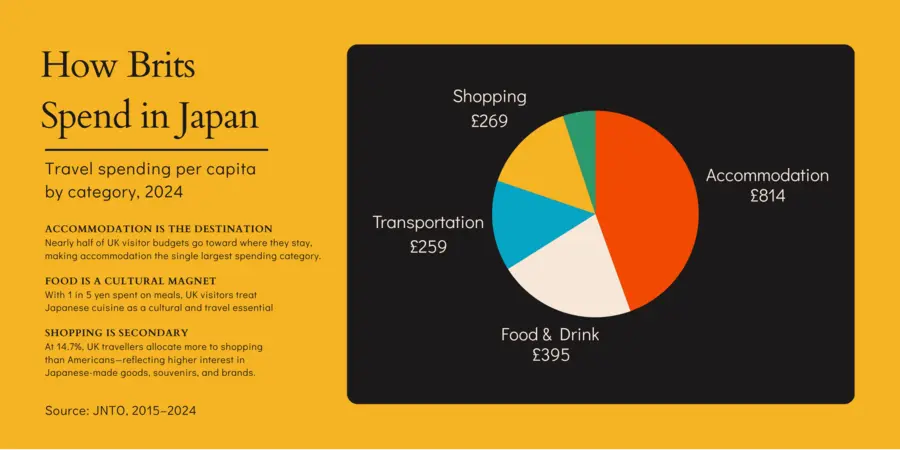
Per-capita spend during the stay:
- Shopping: ¥56,046 → £270.70 (14.7%)
- Accommodation: ¥169,708 → £819.69 (44.5%)
- Food & drink: ¥82,359 → £397.79 (21.6%)
- Transportation: ¥53,886 → £260.27 (14.1%)
- Entertainment services: ¥19,284 → £93.14 (5.1%)
- Others: ¥35 → £0.17 (0.0%)
Where Travellers Shop in Japan
Across both the US and UK markets, JNTO’s 2024 shopping data shows a broad-based upswing in visits to nearly every store type in Japan versus 2019, evidence that shopping has become a core part of a Japan trip.
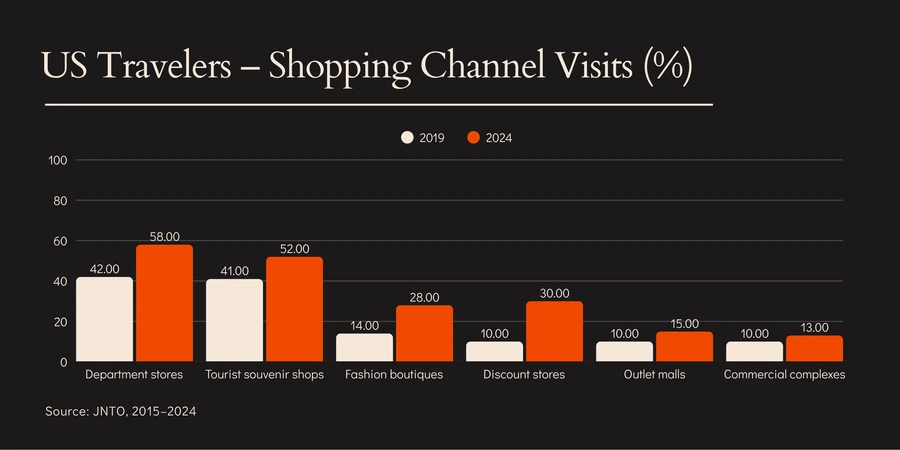
Among US travellers,
- Department-store visits climbed from ~42% to ~58%,
- Tourist souvenir shops from ~41% to ~52%,
- Fashion boutiques nearly doubled to ~28%;
Even value channels surged (discount stores ~10% → ~30%, outlet malls ~10% → ~15%, commercial complexes ~10% → ~13%).
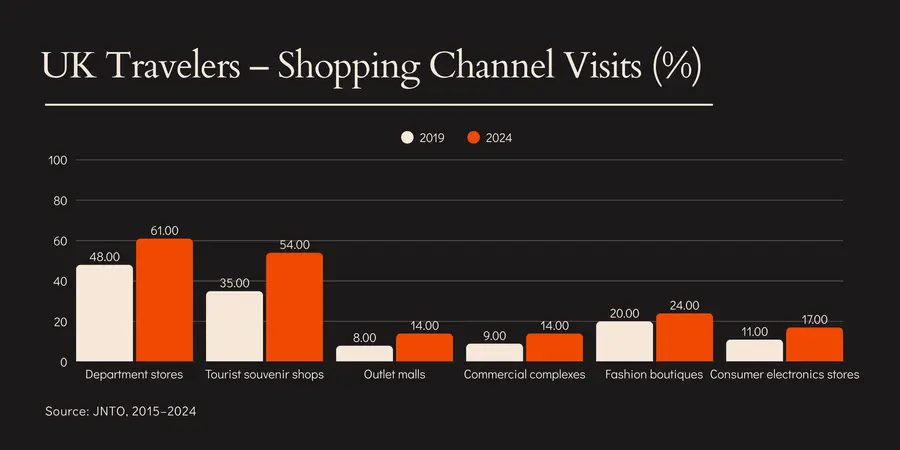
The UK pattern is similarly strong:
- Department stores ~48% → ~61%,
- Tourist souvenir shops ~35% → ~54%,
- Outlet malls ~8% → ~14%,
- Commercial complexes ~9% → ~14%,
- Fashion boutiques edging up to ~24%
- Consumer electronics stores rose to ~17%
More visitors are actively seeking places to buy, not just browse. They gravitate to where discovery is easy and authenticity reads at a glance, department stores, big souvenir floors, and duty-free for wrap-up buys, while still making time for value hunts (discount/100-yen) and style stops (fashion boutiques, outlets).
For international retailers, that pattern maps cleanly to what sells after the trip: clear stories, visible quality cues, and stepped price ladders so shoppers can grab an affordable memento or trade up to a display-worthy piece.
What UK & US travellers Actually Buy: Wearables, Leather, Beauty
JNTO’s tax-exemption data for UK and US travellers points to three clear patterns: apparel and accessories are now the standout take-home categories; beauty is breaking out (especially among US visitors); and “quality you can show” is edging out single-use snacks as the anchor souvenir.
Because tax-free shopping typically offers around 10% off with a foreign passport at participating stores, these claims are also a strong proxy for where real spend is flowing.
1) Fashion moved to the front of the queue.
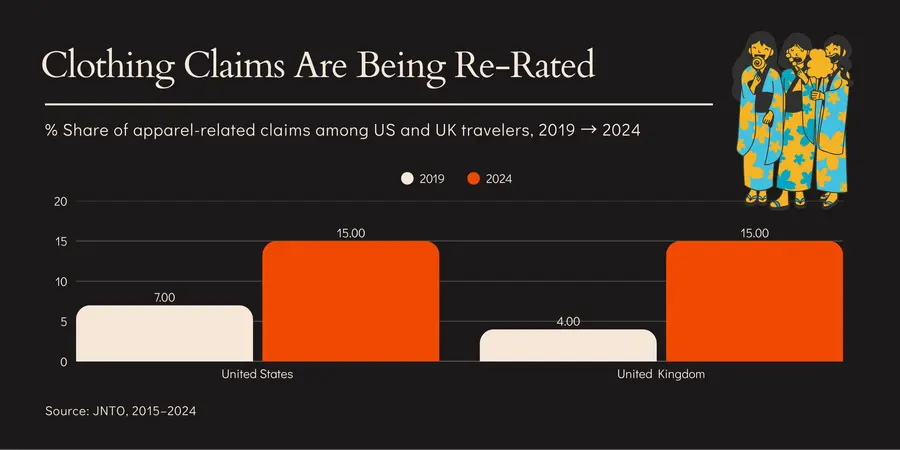
Both markets show a decisive step-up in clothing claims. For US travellers, apparel nearly doubled its share of claims from ~7% (2018) to ~15% (2024); UK travellers show a similar rise from ~4% to ~15% over the same period. That isn’t a marginal swing, it’s a category re-rating. It reflects travellers seeking well-made, design-forward pieces with a Japanese point of view (cuts, fabrics, collabs) that continue the trip narrative every time they’re worn.
2) Leather goods and shoes are having a moment.
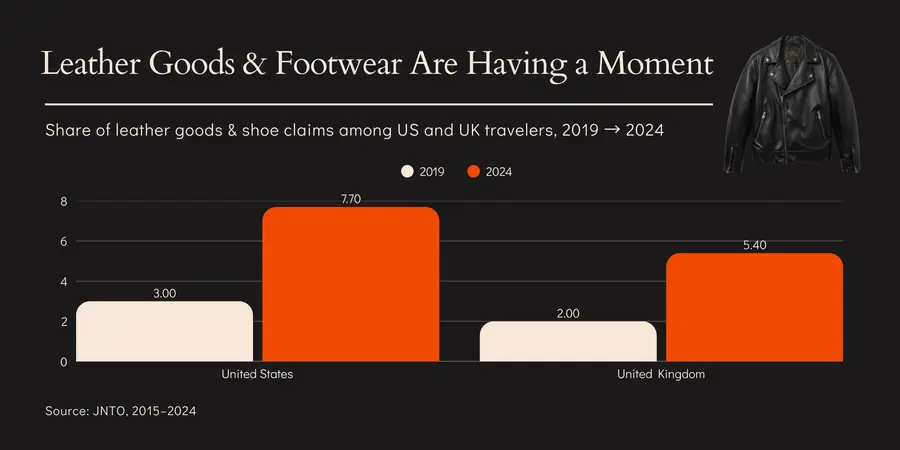
Accessories are surging as “hero” purchases. Among US visitors, shoes/bags/leather climbed from ~2 to 3% pre-COVID to ~7.7% in 2024, while the UK moved from ~2% to ~5.4%. These higher-ticket, long-life items signal confidence in Japanese craftsmanship and brand discovery during the trip, often catalyzed by department-store edits and outlet finds.
3) Beauty breaks out, led by the US.
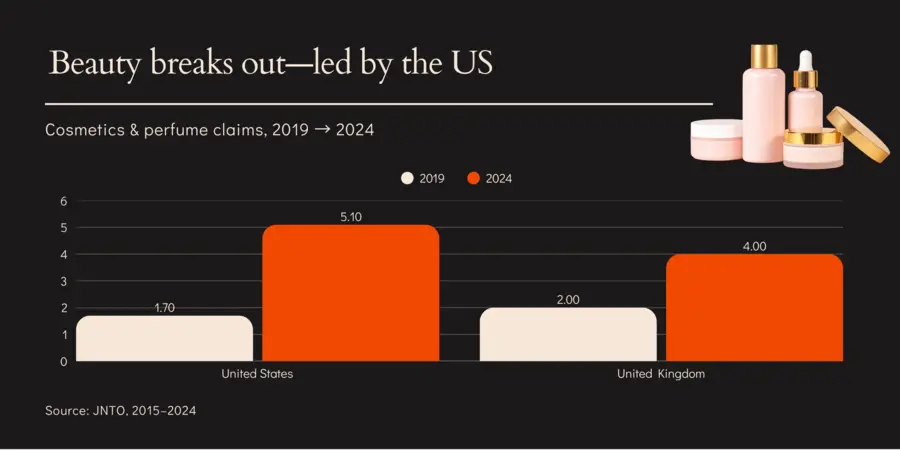
US cosmetics/perfume claims jumped to ~5.1% (2024) from ~1.7% (2018). That upswing suggests strong word-of-mouth around Japanese formulations, packaging, and value when purchased in-country tax-free. The UK shows a steadier but positive trajectory, roughly ~2 to 4% by 2024. Beauty’s rise also dovetails with airport and urban duty-free upgrades that make last-stop replenishment easy.
4) Electronics inch up, not spike, craft stays steady.
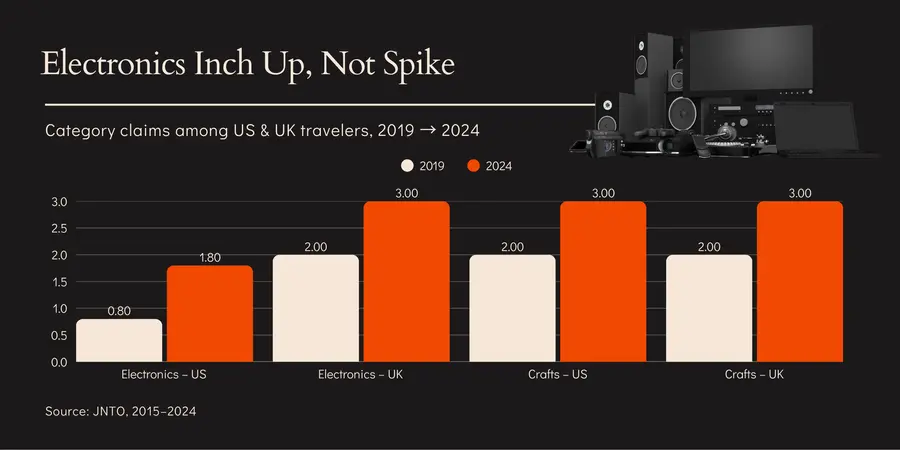
“Big-box” electronics aren’t the growth engine they once were, but they’re edging higher again as niche categories (audio, cameras, peripherals) regain appeal: US claims move from ~0.8% (2018) to ~1.8% (2024); the UK hovers ~2 to 3% in recent years. Meanwhile, folk crafts/traditional crafts hold a consistent ~2 to 3% share across both markets, small but resilient, indicating a stable audience for hand-made, region-tied goods.
5) Sweets and one-off consumables are no longer the only default.
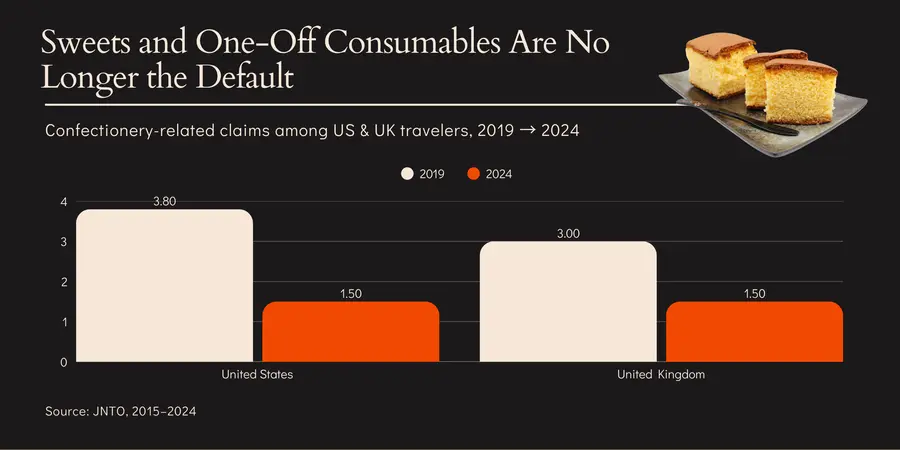
Confectionery claims have softened compared with durable goods. For the US, shares slid from ~3.8% (2018) to ~1 to 2% (2023); the UK shows a similar low-single-digit band. Travellers are still buying snacks, but when it comes to tax-free paperwork, they’re prioritising items with longevity and story value.
What this means
Travellers are using their Japan trip to “upgrade” daily life back home. The items rising fastest are the ones that signal quality at a glance, are used frequently, and carry a distinct Japanese aesthetic, a jacket with impeccable construction, a leather tote from a discovered maker, a skincare line they can’t easily get at home. Even modest gains in electronics and steady interest in crafts underline the same idea: people want items that feel considered, built to last, and rooted in place.
SUPER DELIVERY FAQs for Retailers
- Who can register? Verified business buyers only (retailers, online shops). See: “SUPER DELIVERY for international buyers”.
- Is there a minimum order quantity? Platform-wide no; some vendors set their own. Check each product page. See: “Scale & access” (anchor link to section).
- Are prices wholesale and tax-free? Yes, wholesale pricing; Japan consumption tax isn’t applied to export orders. See: “SUPER DELIVERY for international buyers”.
- What are the fees? One handling fee per vendor (¥1,300) for export prep at the warehouse. See: “Delivery & fees snapshot”.
- How does shipping work? Add items from multiple vendors; SUPER DELIVERY consolidates into one outbound shipment. Choose DHL/UPS/EMS etc. See: “How SUPER DELIVERY works”.
- How long does delivery take? Varies by method and destination. Use the shipping calculator for your route. See: “Delivery & fees snapshot” (anchor link to section).
- Who pays duties and VAT/GST? You do, at import, per your country’s rules. See: “Customs & duties” (anchor link to section)
- What payment methods are supported? Cards (Visa/Mastercard/AmEx/JCB/Discover/Diners), PayPal, bank transfer (T/T). See: “Which payment methods are accepted?”.
- How do returns or damage claims work? Report within 14 days of receipt; refunds via SD points or PayPal. See: “How do returns/refunds work?”.
- Any tips for first-time buyers? Start with small lots, consolidate vendors per drop, and have HS code guidance ready. See: “Best practices for first-time buyers” (anchor link to section)







Make Japan Your Edge
Travel is seeding the habit; the data confirms the spend; SUPER DELIVERY gives you the supply route; apparel with a Japanese POV, leather that ages beautifully, beauty that works, utsuwa for daily rituals, and stationery that performs. Build tidy price ladders and clear stories so customers can buy in at any level, then trade up.
Ready to sell made in Japan products? Create a SUPER DELIVERY International account, shortlist 30 to 40 SKUs across 6 to 8 vendors, place one consolidated trial order, and reorder winners monthly. Keep the range fresh with quarterly drops, and let the “Japan Edit” become the reason customers return.