It’s no secret that Japanese and Western media are very different in the way they approach nuclear bombs, or nuclear power as a whole. For a very well known example, we could look at Godzilla and the Incredible Hulk, two characters created just a few years apart. The underlying message present in this dichotomy is easy to note: in the West, nuclear power makes superheroes; in Japan, it creates monsters. But we don’t have to look so far into the past to find a noticeable response. The fact that a film as recent as Chirstopher Nolan’s Oppenheimer (2023) was released in Japan with a controversial delay, months after its theatrical release, shows Japanese audiences’ unique sensibilities around the issue. So yes, the Japanese response is very different. However, it isn’t one set in stone, and one only needs to look at Japanese pop culture to discover that.
As Japan developed through the different phases of its postwar history, the way artists reflected upon the nuclear bombs varied widely. In today’s article, we will be looking at this evolution through the lens of Japanese pop culture. To state this upfront: this is not a change of opinion as the events of Hiroshima and Nagasaki were seen in hindsight. Far from it. This is a conscious response, made by Japanese artists to reflect on Japan’s shifting social and political climate. Here, the nuclear bombs are a reference point: a moment in Japan’s history that continues to shape (and haunt) Japan’s cultural landscape. From Godzilla to Neon Genesis Evangelion, the nuclear bombs changed Japanese Pop Culture in massive ways, and we want you to explore this topic with us.
The Immediate Aftermath (1950s-1960s)
After losing World War II, Japan was occupied by the American forces from 1945-1952. This period was marked by the dismantling of the Japanese arm industries, the revitalisation of the economy through sweeping reforms and, most importantly, the creation of a new Japanese Constitution (1947). Overall, the American efforts to reintegrate and revitalise Japan after the war were considered successful, as the country would slowly, but surely, become an important leader on the world stage. Culturally, however, Japan was left to wrestle with their past and how to move forward after such a massive loss. In the niche art circles, there are plenty of examples of artists finding directions, such as the Buraiha writers or Butoh dancers. In pop culture, however, artists found a clear subject they could comment on.
With the United States taking its place as a global superpower, narratives coming from them were greatly influential. One such narrative was the one regarding nuclear power, as it was said to be the inevitable future of civilization. Japan, as a country that had experienced the worst of what nuclear power was capable of, was uniquely positioned to comment on this trend. We’re not only talking about the bomb, as there was also the 1954 Daigo Fukuryū Maru fishing boat incident, where fishermen were exposed to nuclear fallout. These events laid the groundwork for the nuanced and allegorical response that Japanese artists were about to make.
Godzilla (1954)
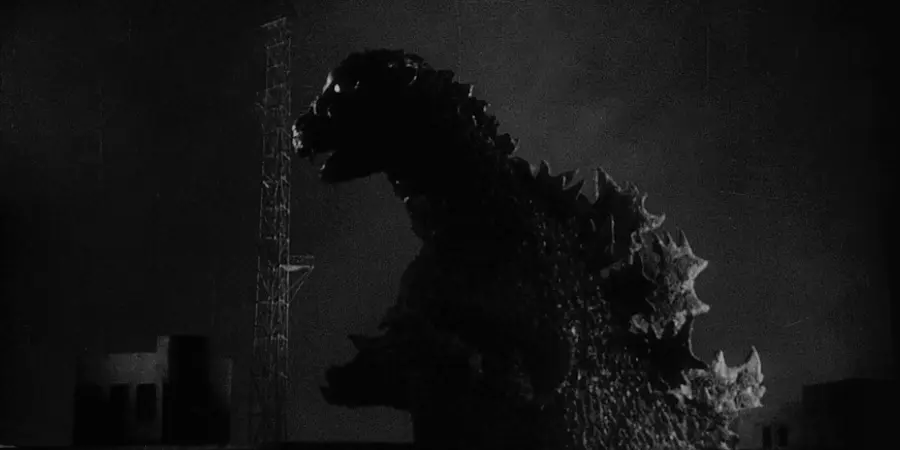
Godzilla (1954), directed by Ishirō Honda
It’s only fitting we start with one of the most famous and influential films Japan has ever produced regarding the nuclear subject, 1954’s Godzilla. A groundbreaking film in more than one way, Godzilla immediately stood out for its innovative use of special effects and an argument that would give birth to the Kaiju genre. This, of course, without mentioning the countless sequels and spinoffs Godzilla itself would get as a result of its success.
To briefly summarise the plot, Godzilla is the story of an underwater monster that emerges and terrorises Japan after being perturbed (and enhanced) by the nuclear bombs thrown in the Pacific Ocean. After futile attempts to control the beast by Japan’s defence forces, one of the film’s protagonists sacrifices himself to defeat the monster. The movie ultimately ends with a warning, as the protagonists wonder if another Godzilla could emerge if nuclear testing continues.
The connection between Godzilla and the nuclear bombs is one explicitly stated, and its director, Ishirō Honda, always stood his ground on that fact. However, the genius of Godzilla is how it manages to both embody the nuclear weapons and what it means to be a victim of them. On one hand, the monster destroys Japanese cities and wildlife, events that mirror the bombings of Hiroshima, Nagasaki and the nuclear test that the US did in Japanese territory. On the other hand, Godzilla itself was transformed from a simple creature into a monster due to these weapons, and, for many viewers, its wrath was justified. Japanese audiences connected deeply with this duality, and this is evident in the fact Godzilla became a media franchise and a long-lasting symbol of postwar Japan.
Astro Boy
Despite its history with nuclear energy, Japan wasn’t blind to the potential benefits the atomic age could bring to humanity, and Astro Boy reflected their position perfectly. Written by legendary mangaka Osamu Tezuka, Astro Boy was a comic series that ran from 1952 to 1968. Eventually, the manga would receive an anime adaption in 1963, which led to an influx in popularity with Japanese and Western audiences alike.
Originally conceived as a mix of Pinocchio and the nuclear optimism of the era, Astro Boy is the story of Doctor Tenma who, after losing his son, creates a robot to replace him. The result is the protagonist of the show, a nuclear-powered robot named Astro (in Japan, Atom), that is unable to fill the gap the doctor’s son left. At some point in the story, though this varied depending on the iteration, Astro falls under the possession of circus owner Hamegg. While in there, Professor Ochanomizu notices him and becomes his legal guardian, treating Astro kindly and discovering he has human emotions.
What follows is a story that would shape the Shonen genre, a category of Japanese media aimed at young people, often featuring teenage protagonists growing stronger through friendship and hardship. Astro Boy, in turn, became a story about a boy discovering himself through fighting evil robots, aliens and humans, inspiring countless artists such as Hayao Miyazaki and Akira Toriyama in the process. If we see it through the framing of nuclear energy, Astro Boy addresses the anxieties of postwar Japan.
The nuclear age seemed inevitable, and Japan was well aware that things could go wrong, which is why they must be there to ensure it doesn’t. Because yes, this power can be used for evil, but we can counteract that by treating the technology with respect. It’s our choice to be like Tenma or Ochanomizu, to have an Astro or any of its antagonists.
Cold War Anxiety (1970s and 1980s)
During the 1970s, the country was coming out of the period known as the Japanese economic miracle, becoming an economic powerhouse able to rival the US. We have an entire article dedicated to this subject, but what’s important to note here is that Japan shifted its economic focus from manufacturing to technology. They did it so swiftly, in fact, the rest of the world was unable to compete with them. Eventually, this led to the US, under Reagan, to weaken the dollar relative to the Yen with the signing of the Plaza Accord of 1985. The Japanese Bank, fearing recession, dropped interest rates and sparked an economic bubble that would last until the end of the 1980s.
While all of this was occurring, two things were properly established: the rise of a new social critique and the Cold War. The first one was a direct response to the economic miracle, addressing the environmental losses and corporate greed that power Japan’s meteoric rise. It was, in one phrase, sceptical of capitalism’s promise of infinite growth. The second was the arms race the Soviet Union and the US were entangled with, making the threat of nuclear war palpable. Japan, as one would imagine, was specially concerned with this topic and its potential consequences.
Considering they had achieved an economic status that made them a key player in the global stage, many Japanese artists felt the need to comment on the possibility of nuclear annihilation. The way they did it is nothing short of genius. They took into account the rise of new technology and blended that with the developing social critiques of the time. The results were fantastic works of art that, to their benefit and detriment, are chillingly relevant to this day.
Akira (1988)

Akira (1988), directed by Katsuhiro Otomo
Who could forget the iconic opening to Katsuhiro Otomo’s Akira? The city of Tokyo, in an almost photorealistic style, is destroyed as a massive blast of energy detonates. We’re then transported thirty years into the future to Neo-Tokyo; a grim shadow of a city that once was a centre for human innovation. The frame rushes through the neon building into the chaotic streets, where a group of motorcycle outlaws tells us all we need to know: the world benefits few, so to achieve freedom one must make its own rules.
Our two protagonists are then established: Kaneda and Tetsuo. One is the confident leader of the bikers, the other an insecure gang member who looks up to Kaneda with jealousy. After a series of unfortunate events, Tetsuo acquires psychic powers and gets taken by the government. While he is examined alongside other psychic kids called Espers, we learn about Akira; a kid whose power caused the explosion in the beginning, leading to World War Three. Eventually, Tetsuo’s insecurities clash with his newfound thirst for power, driving him mad. In the end, a final confrontation between him and Kaneda takes place, which culminates in a massive explosion that Kaneda only survives thanks to the Espers.
In Akira’s universe, Japan not only participated in nuclear war, it instigated it. Their research into psychic abilities was successful, but that was at the cost of the Espers’ mental health. The kids were mistreated, and Akira outburst was the inevitable result of that. Tetsuo, thus, mirrors Akira: youths failed by society, whose insecurities become destructive when fused with great power. Returning to the subject of nuclear weapons, which the psychic outbursts were designed to resemble, it is almost as if Katsuhiro Otomo is warning us. Are the advancements of technology worth our people? Do you know what we’re playing with?
Nausicaä of the Valley of the Wind (1984)

Nausicaä of the Valley of the Wind (1984), directed by Hayao Miyazaki
Nausicaä of the Valley of the Wind is an important film in more ways than we could enumerate on this segment. It was Hayao Miyazaki’s breakthrough and led directly to the founding of Studio Ghibli. Additionally, it was a big step for Japan into the genre of fantasy, with Miyazaki taking inspiration from Tolkien, Asimov, and Herbert, as well as Japanese folk tales like the Heian-era classic Tsutsumi Chūnagon Monogatari. But, relevant to this article, is the film’s pro-environmental message.
As a brief refresher, the story is set thousands of years into the future, after an event called Seven Days of Fire caused an ecocide, creating a toxic jungle with mutated monsters. In this context, Princess Nausicaä of the Valley of the Wind discovers the toxic jungle is not a threat, but a force of purification. Her belief throughout the movie is based around this discovery, knowing that humanity can once again coexist with nature. The militaristic Tolmekian Empire, the antagonists, on the other hand, engage in conquest to sustain themselves in this toxic wasteland. The film frames their continuing violence and lack of understanding as the issue, as dialogue with the natural world can provide a solution. The ending ultimately reinforces this, as the toxic jungle sprouts a non-toxic plant.
The film’s connection to the theme of this article lies in its post-nuclear world. The implied message Miyazaki lays down is the following: if this development continues without oversight, an ecocide is a likely possibility. Additionally, we mustn’t overlook the Tolmekian Empire, which pours its resources into military might. This, given the context of the film, can be read as a critique of the nuclear arms race of the Cold War. After seeing the movie, it is difficult not to ask: why allocate all that power to rule over a world in ruin, when genuine survival comes from healing and understanding?


The Cyberpunk and Mecha Renaissance (1990s – 2000s)
Entering the 1990s, Japan’s aforementioned economic bubble finally burst, creating a lengthy period of economic stagnation now known as the Lost Decades. People differ regarding the length of this period, some even argue it continues to this day; but most agree it covered at the very least two decades: the 90s and 2000s. The long-lasting effects of the economic crash are worth their own article, but for a quick summary, the country’s GDP fell, wages stagnated, the national debt increased and the lifetime-employment system crumbled. For everyday Japanese citizens, this meant that their purchasing power was lowered, saving for the future became harder, and jobs no longer guaranteed stability.
And yet, for many outsiders looking in, Japan was still a leader of cultural exports and the technology sector. If Japanese products were everywhere, how could they be doing so badly? This logic, although flawed, was persistent, and also one many Japanese artists were becoming keenly aware of. Thanks to globalisation and the early internet, they could see the difference in how they were perceived and how they actually were. Because of this, we start seeing pop culture take a darker shift, depicting futuristic worlds whose residents lived among the slums. Cyberpunk and Mecha anime, for stylistic and thematic reasons, were able to tackle this dichotomy perfectly.
How does this relate to the nuclear bombs? Well, due to the previously discussed media depictions, as well as the then-recent Chernobyl disaster of 1986, atomic imagery in Japan became almost synonymous with the end of the world. In doing so, artists often allude to it as a likely outcome if the current state of affairs continues. If history repeats itself, look at what happened then, and be ready for what’s about to come.
Neon Genesis Evangelion
Directed by visionary artist Hideaki Anno, Neon Genesis Evangelion is, in essence, a Mecha anime and a subversion of them. It’s a very complex show, and completely untangling the mysteries of its plot and subtle nods to religion and philosophy, it’s a job best suited for another article. What is easier to understand about Evangelion is its appeal.
Our protagonist Shinji, a normal teenager, is given the chance to live the dream many Japanese kids dreamed of, both in real life and the show’s universe: pilot a giant robot and defeat monsters the likes of Godzilla. However, for personal and psychological reasons, Shinji is reluctant to pilot them. The show, subsequently, goes to great lengths to prove his concern, as piloting an EVA robot is dangerous, both physically and mentally. Add to this the design of the robot, sleek and humanoid, almost resembling the monster they’re fighting, and one can’t shake the feeling Shinji is a peon in a larger plot. It’s engaging, it looks awesome, and it’s no surprise many gravitated towards the story Anno presented.
Relevant to our discussion are the “Impacts.” These were, in short, cataclysmic events prompted by interaction between Earth and the First Ancestral Race. The series is set after the events of the Second Impact, and we are led to believe the goal of our heroes is to prevent the third. Here, the Impacts can be read as allegories for the World Wars. The Second Impact, for example, holds major plot relevance, and is often used to explain many of the character motivations. This, of course, mirrors how Japanese people came to understand their current situation, with WW2 and the bombs playing a massive role. For Neon Genesis Evangelion, the bombs are an open wound, and Japanese youth suffer the consequences of their parents’ actions and unresolved trauma.
Ghost in the Shell (1995)

Ghost in the Shell (1995), directed by Mamoru Oshii
The Ghost in The Shell film of 1995 is still widely regarded as one the best cyberpunk stories of all time, and for good reason. At its core, it’s a classic detective story, compelling and easy to grasp on a narrative level. But as the film progresses, it gradually reveals itself as a profound meditation on our relationship with technology, our perceived self image, and transhumanism as a whole. The topic of gender, for example, is handled masterfully, with characters that challenge gender norms in appearance and attitude, presented free from the shackles of them.
Set in a futuristic and dystopian 2029, we follow Motoko Kusanagi, the cyborg commander of a police force known as Public Security Section 9. She and her elite team are tasked with hunting down the Puppet Master, a legendary hacker who can illegally hack into people’s minds. As their investigation progresses, they discover the puppet master is no person, but a self-aware AI that is looking for a host. Major Kusanagi, for questioning what being human is throughout her investigation, is seen as a perfect candidate for the Puppet Master’s control. It is only by understanding herself in a more complex way, seeing her humanity in a fluid and, therefore, free manner, that she is able to defeat the Puppet Master in the end.
Ghost in the Shell could be related to the nuclear bombs through various means. Its futuristic future, for starters, is a direct consequence of World War III. By now, this war is not the one to end all of them, but all of us. The bombs, in this context, are a sort of original sin, a point of no return for humanity that proves we are beyond salvation. Transhumanism, therefore, provides a solution: a way to escape humanity altogether. Judging by the film’s enduring legacy, both domestically and internationally, these concerns resonate deeply with the atomic age.
Contemporary Reflections (2010s – today)
The 2010s saw anime achieving mainstream success, with shows like Attack on Titan and Demon Slayer taking the world by storm. Most of these, if not all of them, are direct manga adaptations from young artists, whose relationship with the bombs is purely historical. Moreover, the model of manga adaptation ensures most series are created, at its core, by one person. This, on one hand, adds diversity to the anime industry; but on the other, makes finding common historical threads difficult. All of this to say that, what is considered Japanese Pop Culture nowadays, is not directly connected to the nuclear bombs. However, it is connected to previous depictions of them that prior generations of artists popularised. Akira, Astro Boy and Godzilla are still alive and well rooted in Japan’s cultural landscape, in no small part due to young artists taking overtly inspiration from them.
Taking that into account, we see how many artists are trying to tackle the nuclear subject by taking notes of what the previous generation did. We could talk about the inventive quasi-nuclear bombs of HunterxHunter Chimera Ant Arc, or the way the Colossal Titan of Attack on Titan implodes in a blast of energy so massive it resembles a nuclear bomb. But, perhaps the best way to show the contemporary reflection is by seeing how Japanese Pop Culture addressed the Fukushima disaster of 2011. This was a Chernobyl level nuclear disaster prompted by the Tōhoku earthquake and tsunami of the same year. For many Japanese artists, the event carried a certain irony, as it was no foreign power doing it to them, but a nuclear plant they built and relied on. Knowing that, they knew they needed a certain monster back.
The Godzilla Renaissance
It’s only fitting we end this article the way it began, talking about Godzilla. After the release of Godzilla: Final Wars in 2004, the Godzilla franchise appeared to reach its logical conclusion. Without spoiling the film, Godzilla finally proved what everyone intuitively knew: he was the king of the monsters. Having arrived at that point, it appeared there was no reason to bring the monster back, so he remained dormant.
In the 2010s, however, Hollywood saw an increase of interest in remakes and IPs, which in 2014 led to the film simply titled Godzilla. This began a series of American films that is still ongoing, with the latest installment being 2024’s Godzilla x Kong: The New Empire. Much more interesting for this article are the parallel Japanese films, which were prompted by the aforementioned Fukushima disaster. These began in 2016 and, like their American counterpart, are still going strong.
Whereas the American films are interested in Godzilla’s status as the king of the monster, the new Japanese films care about its nuclear origins and its underlying environmental message. They not only wanted to bring Godzilla back, but also what it was meant to represent. This has led to some of the best godzilla (and kaiju) films of this time, with notable standouts being Shin Godzilla and Godzilla Minus One.
Shin Godzilla (2016)
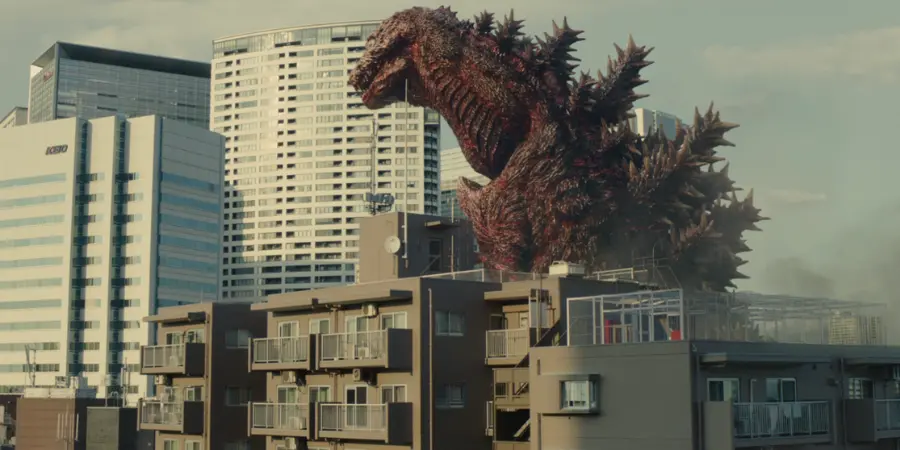
Shin Godzilla (2016), directed by Hideaki Anno and Shinji Higuchi
Coming after a twelve year hiatus, Shin Godzilla revitalised the franchise and brought it to a modern audience in the best possible way. Directed by Neon Genesis Evangelion creator Hideaki Anno, and Japanese Academy award winning Shinji Higuchi, Shin Godzilla was conceived as a reboot of the series. The directors reflected back on the original 1954 film, and figured the best way to approach a reboot was to do the same thing Ishirō Honda did all those years back. If Godzilla was born out of post-war anxieties regarding nuclear power, this new Godzilla will begin with Fukushima and Japan’s contemporary socio-political relations.
Similar to the original film, Shin Godzilla is about a nuclear powered monster that suddenly appears on Tokyo’s bay. The notable difference is that, due to the movie being set in 2016, in a world with internet access, the American government gets involved. After futile attempts to stop Godzilla with conventional artillery, the US is ready to drop the nuclear bombs to defeat the monster. Japan, for what should be by now obvious reasons, will not accept another nuclear bomb being dropped on their territory. Eventually, our heroes realised that Godzilla’s blood works as a sort of cooling system. They, in turn, coagulate it, causing the monster to freeze, which prevents it from destroying and the Americans from bombing.
The cooling part of Shin Godzilla is a direct nod to the Fukushima disaster, as the power plant was so damaged it wasn’t able to sufficiently cool its reactor. Moreover, Godzilla is presented as a force of nature, bringing with him tsunamis, earthquakes, and nuclear power on top of that. Keep in mind, this presentation is nothing new in the Godzilla franchise, but this time it was directly playing with recent historical events, which spectators clearly recognize. Finally, the subplot regarding the US and the possibility of Nuclear Bombs is as if the directors are saying they’re tired of their intervention. The answer is no. No more nuclear bombs, no more intervention. It is time for Japan to phase what it did with its own resources and live with the consequences.
Godzilla Minus One
If Shin Godzilla returned to the franchise roots in a metaphorical sense, Godzilla Minus One takes a more literal, yet meticulous, approach. Directed by Takashi Yamazaki, the film is set just after World War II, and its plot bears a striking resemblance to the original 1954 movie. Prior to the release of the film, Yamazaki was already known as one of the best blockbuster directors in Japan. It is safe to say he delivered tremendously, as Godzilla Minus One does the most with its limited budget, achieving special effects so mind blowing it was awarded an Academy Award in that department.
The film began with a kamikaze pilot, our protagonist, who arrives in an island as he rans away from his suicidal duties. While in there, judged by his peers, Godzilla attacks and murders everyone. As one of the few survivors, he returns to Tokyo carrying the shame of his inactions, which manifest in nightmares about Godzilla. Time passes, nuclear bombs are thrown in the pacific and Godzilla awakens his atomic powers. The monster arrives at Tokyo bay and our protagonist, once again, is unable to do anything about it. Seeing the military was unable to defeat the monster, and the Americans are busy with the Cold War, a civilian-government plan is made to sink Godzilla. This plan is ultimately unsuccessful, and our protagonist is willing to fly to Godzilla’s mouth like a kamikaze. However, in the last moment, knowing he had a family to live for, he ejects himself out and the bomb he carried proved crucial in defeating the monster.
We have an entire article reviewing this fantastic film, so be sure to check that one to hear our full thoughts. As for now, we’ll say Godzilla Minus One reads as if the Japan of today was transported back in time to deal with 1954’s Godzilla. Or, to put it another way, it is as if the memory of a great tragedy, and the unity to overcome, transformed their country anew. And indeed, Godzilla Minus One is overtly critical of Imperial Japan’s willingness to sacrifice its people, and in order to defeat the monster our hero needs to learn that he fights to preserve life, not for the glory of death. Moreover, the film believes in the collective power of Japanese society, as the one that ultimately faces the monster are civilians. The country can change for the better, and Takashi Yamazaki’s message is that we don’t need a Godzilla to realize that.
Conclusion
World War II was, is, and will always be a sort of inspiration for artists from around the globe, for it undoubtedly changed the world at large. Japanese artists, in particular, were the best equipped to tackle the subject of nuclear energy and bombs, and the way they did throughout the years was inventive, nuanced, and innovative. Audiences from around the world were captivated by their enduring creativity, as they found new ways to cover the subject in a contemporary manner. For Japanese pop culture, there is not only a before and after the bombs, there are the bombs and now. They’re intertwined, one reinforces and constantly communicates with the other. The position many Japanese artists took was, therefore: in order to understand the Japan of our times, we must engage with this informative event.
We would like to end this article by addressing something we briefly touched upon in the beginning: the nuclear bombs beyond pop culture. Because yes, Japanese artists in the independent and fine art spheres have tackled the subject in a variety of ways. A great example is Shohei Imamura, whose 1989 drama Black Rain depicts the aftermath of the Hiroshima bombing on a surviving family. So take this article as an invitation to understand Japanese art in a new light, seeing the nuclear bombs as a point of reference. Trace its influence, interiorise it, and you’ll gain a lens through which artists continue to question, memorialise, and imagine the world.